#1
An open-source omnichannel customer support desk with live chat, email and social inbox, an AI agent and a help center, positioned against Intercom and Zendesk.
- GitHub stars
- 40k
- Last commit
- yesterday
- Latest release
- v4.19.1
- Self-hosted
- Yes
- Hosted version
- Available
chatwoot.com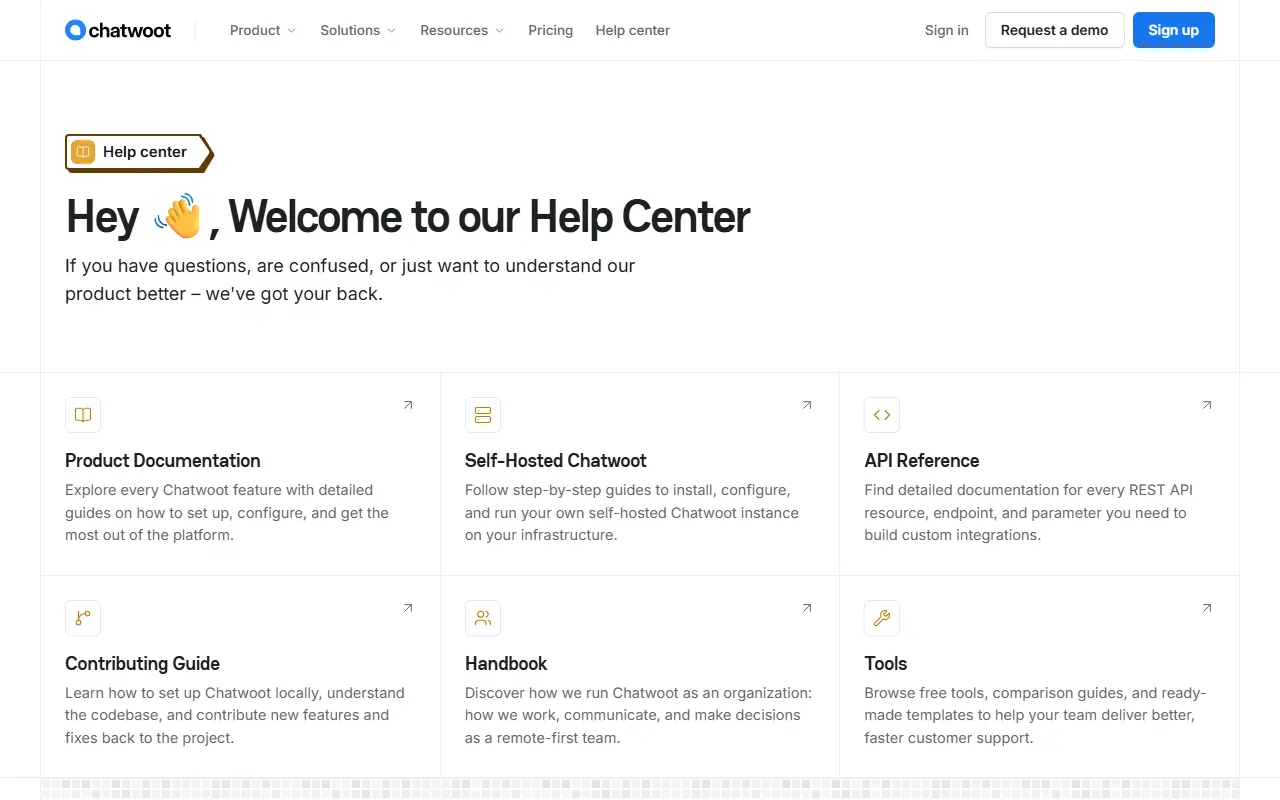
Chatwoot is an open-source, self-hostable customer support platform that gathers all customer conversations into one inbox. It is presented as an alternative to Intercom, Zendesk and Salesforce Service Cloud, and aims to give businesses control over their customer data while managing conversations across channels.
The shared inbox takes in website live chat, email, SMS and messaging channels such as Facebook, Instagram, Twitter, WhatsApp, Telegram and Line. An AI agent called Captain automates replies to common questions to reduce agent workload, and a built-in Help Center portal lets you publish articles and FAQs so customers can find answers themselves. Collaboration tools include private notes with mentions, labels, canned responses, auto-assignment based on availability, custom views and filters, a command bar and multi-language support.
Chatwoot is built with Ruby on Rails and Vue and can be run with Docker, with deployment guides on its help center. The repository license is listed as 'Other', so confirm which parts are open source. A hosted cloud version is also available for teams that prefer not to maintain their own server.
Key features
- Shared inbox across chat, email and social channels
- Captain AI agent for automated replies
- Built-in Help Center portal
- Private notes and @mentions
- Canned responses and auto-assignment
- Custom views and filters
- Support for multiple languages
Pricing: Hacker is free for up to 2 agents. Startups costs $19, Business $39 and Enterprise $99 per agent per month, with a 15-day free trial; extra Captain AI credits are $20 per 1,000.
#2
Crisp is a free, open-source menu bar app for macOS that provides display controls including HiDPI scaling, DDC brightness and volume, presets, and virtual displays.
- GitHub stars
- 2.4k
- Last commit
- yesterday
- Latest release
- v1.7.1
- Licence
- MIT
- Self-hosted
- No
crispmac.app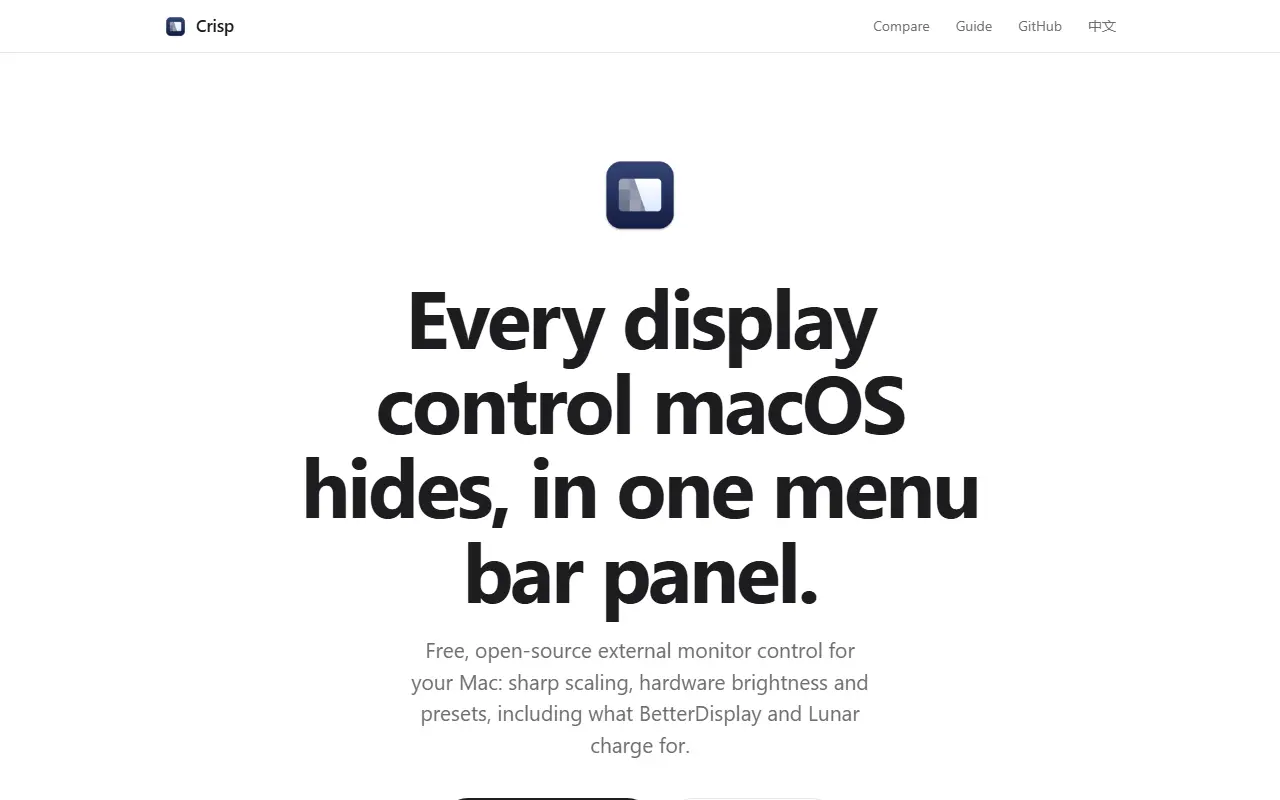
Crisp is a free, open-source menu bar app for macOS that gives users control over external monitors. It provides HiDPI scaling, DDC brightness and volume, presets, and virtual display management, aiming to make any monitor feel as integrated as Apple's own displays.
The app is designed for users who find macOS's handling of third-party monitors lacking, offering features like smooth scaling, extra brightness beyond 100%, and keyboard shortcuts. It also integrates with Shortcuts and includes a command-line tool called crispctl.
Key features
- HiDPI scaling with Retina-style resolutions on external monitors
- DDC hardware brightness control with software fallback
- Extra Brightness to push displays past 100% using HDR reserve
- Monitor volume control over DDC
- Presets for saving and applying display setups
- Shortcuts actions and crispctl command-line tool

A customizable team communications platform with real-time chat and video, aimed at organizations with strict data protection needs and offered self-hosted, cloud or air-gapped.
- GitHub stars
- 46k
- Last commit
- today
- Latest release
- 9.0.0
- Self-hosted
- Yes
- Hosted version
- Available
rocket.chat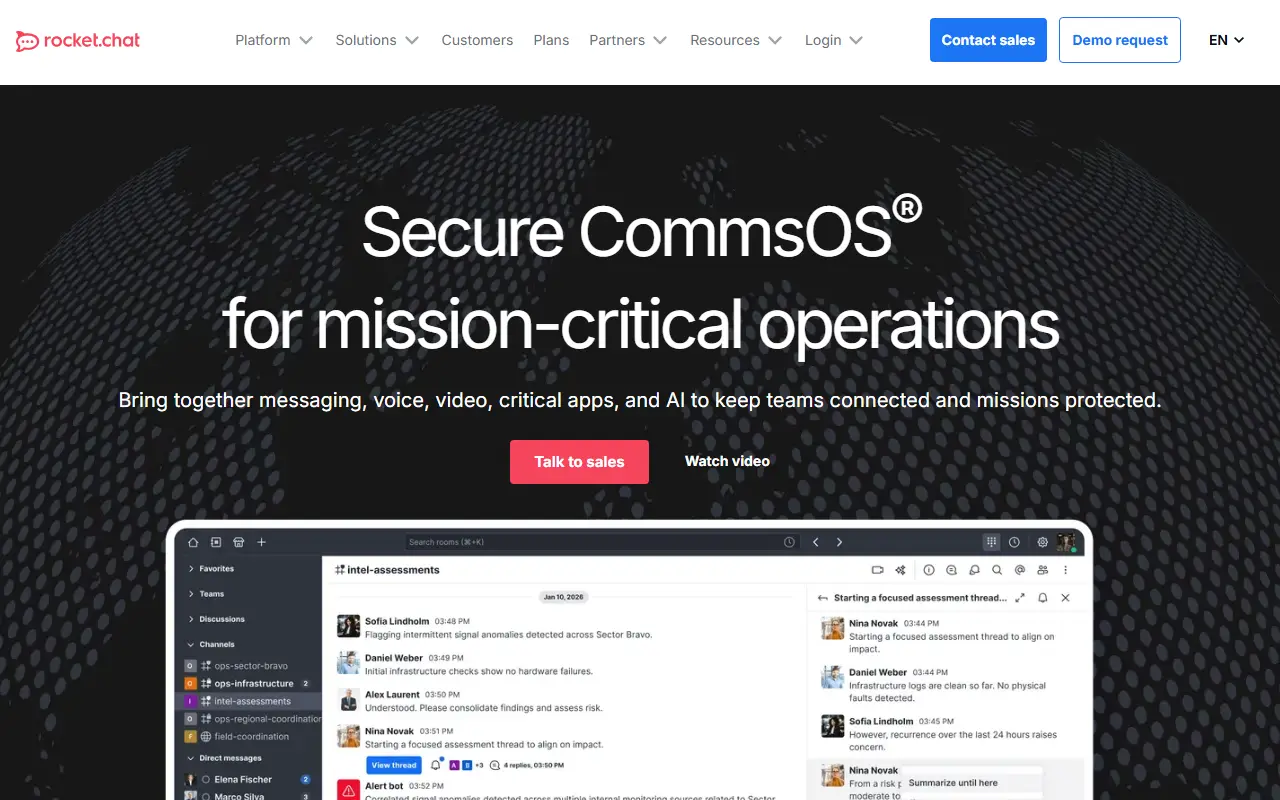
Rocket.Chat is a communications platform written in TypeScript for teams and organizations that care about data protection. It supports real-time conversations between colleagues, with partner companies, and with customers or citizens, and its topics place it in the same space as Slack, with WebRTC for calls and meetings.
The product emphasizes control over where and how it runs. Deployment options include self-hosted servers, a managed cloud and fully air-gapped environments, with a scalable architecture and performance monitoring for workspace administration. Security and sovereignty features, including identity management, are a core part of the pitch, and the platform is built to be highly customizable, so organizations can adapt it to their own workflows and integrations.
The repository's license is listed as 'Other' on GitHub, although the topics reference an MIT-licensed community core, so confirm which components fall under which terms before relying on it commercially. It suits government bodies, enterprises and regulated industries that want a Slack-style tool they can host themselves.
Key features
- Real-time team messaging and channels
- Video conferencing built on WebRTC
- Self-hosted, cloud and air-gapped deployment
- Scalable architecture with performance monitoring
- Identity and security controls for data sovereignty
- Highly customizable platform
Pricing: Rocket.Chat does not publish prices. Commercial, Government and Defense plans are quoted through its sales team, with on-premise and air-gapped deployment options.
#4
A self-hosted, open-core collaboration platform combining team chat, automated workflows, voice calls, screen sharing and AI integrations.
- GitHub stars
- 40k
- Last commit
- yesterday
- Latest release
- v12.0.2
- Self-hosted
- Yes
- Hosted version
- Available
mattermost.com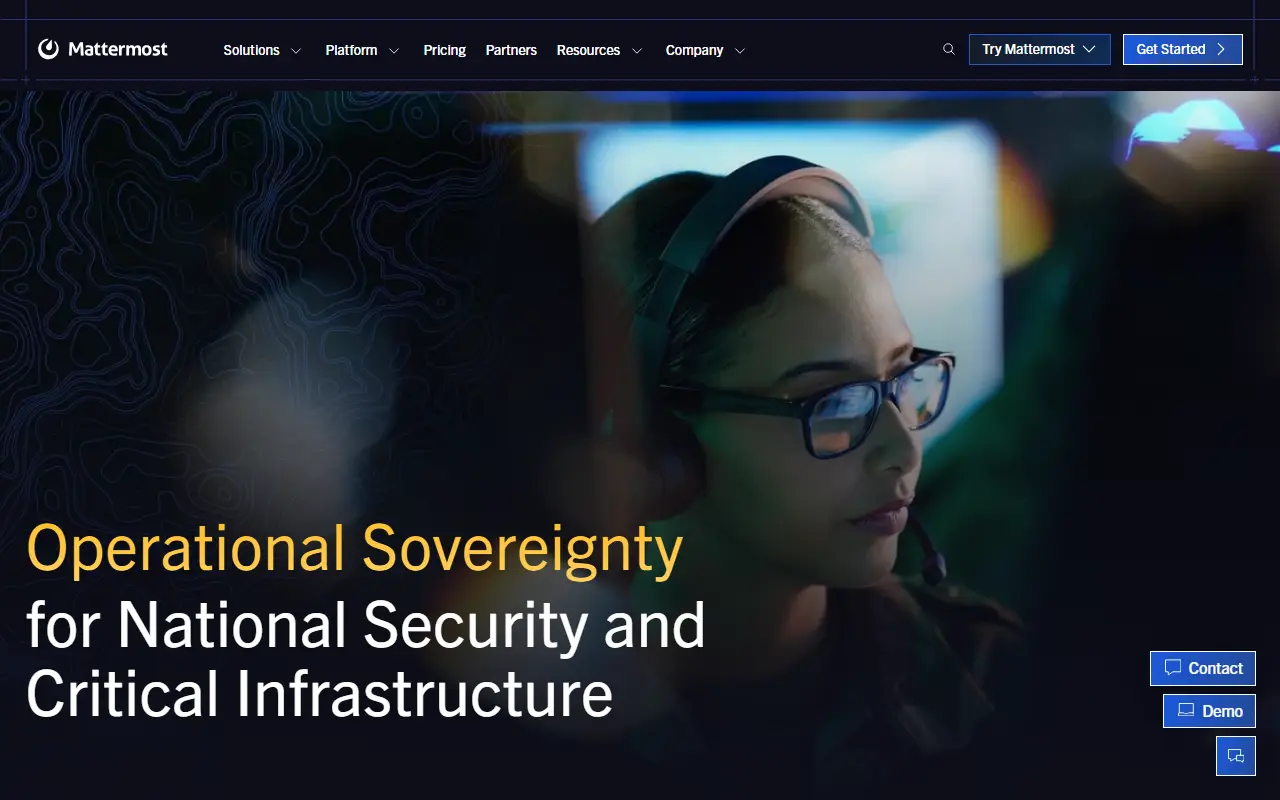
Mattermost is an open-core collaboration platform you host yourself, covering team chat, workflow automation, voice calls, screen sharing and AI integrations. This repository is the primary source for core development of the platform. The server is built with Go and React, ships as one Linux binary and depends on PostgreSQL. GitHub lists the license as 'Other'.
Each month, on the 16th, a newly compiled release is published under the MIT license. You can deploy Mattermost on-premises or try it in the cloud. The project highlights use cases such as DevSecOps, incident resolution and IT service desk, and it offers native clients for Android, iOS, Windows, macOS and Linux in addition to the web interface.
Installation options include Docker, Ubuntu, a tar archive, Kubernetes, Helm and an Omnibus package. Developers can build integrations through APIs, webhooks, slash commands, Apps and plugins, and the repository links product and developer documentation, security bulletins and contribution guides. It suits engineering, security and operations teams that want controlled, self-managed team messaging.
Key features
- Team chat with channels and threads
- Built-in workflow automation
- Voice calling and screen sharing
- Integration with AI tools
- Single Linux binary with PostgreSQL
- Native mobile and desktop apps
- APIs, webhooks, slash commands and plugins
Pricing: Mattermost does not publish prices. Professional, Enterprise and Enterprise Advanced are quoted through sales; a limited-use edition and a 1-hour trial environment are offered for evaluation.
#5
An open-source team chat app that organizes conversations into topic-based threads, designed for both live and asynchronous discussion, available hosted or self-hosted.
- GitHub stars
- 26k
- Last commit
- today
- Latest release
- 13.0
- Licence
- Apache-2.0
- Self-hosted
- Yes
- Hosted version
- Available
zulip.com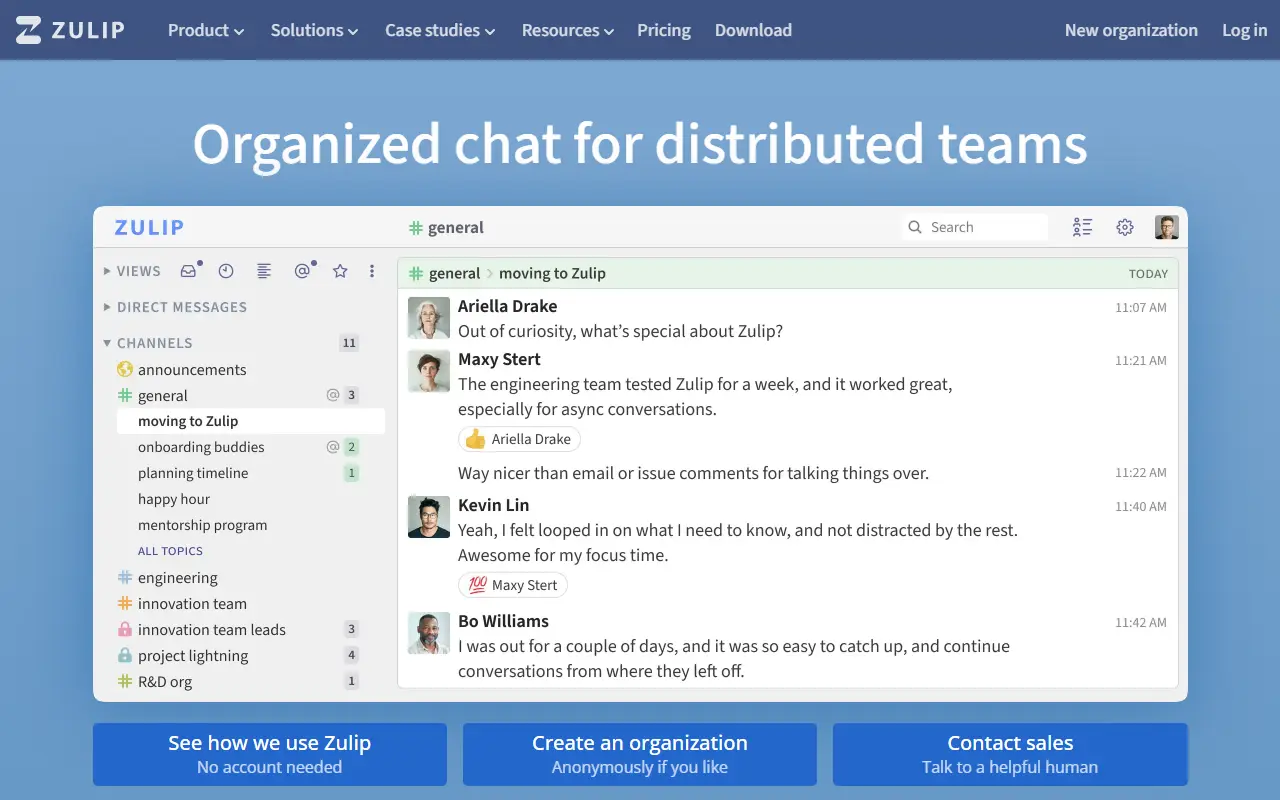
Zulip is an open-source team chat application whose defining feature is topic-based threading within channels. The idea is to blend the strengths of email and chat, so that remote and distributed teams can follow several conversations at once and catch up later without losing context. Its topics tag it as a Slack alternative.
The project is developed by a distributed community, with more than a thousand contributors and a steady flow of commits each month, and it says it has put effort into readable, tested code and extensive contributor documentation. The server is a Python web application, and there are web, desktop, built on Electron, and mobile clients, built with React Native. Zulip is used by companies and open-source projects alike, and the README says it is designed for both live and asynchronous communication.
Zulip is licensed under Apache-2.0. You can run the server on your own infrastructure, which gives full control over data, or use the hosted service operated by the project's company. It suits teams that find flat channel-based chat chaotic and want a more structured way to keep discussions organized.
Key features
- Topic-based threading in channels
- Live and asynchronous conversations
- Web, desktop and mobile clients
- Self-hosted server or hosted service
- Extensive contributor documentation
- Python and JavaScript codebase
Pricing: Cloud has a free plan, with Standard at $8 and Plus at $12 per user per month ($6.67 and $10 billed annually). Self-hosted is free, with Basic at $3.50 and Business at $8 per user per month; Enterprise is by contact.
#6
Self-hosted customer support desk shipped as a single binary, combining email, live chat, and WhatsApp in one shared inbox with a help center and AI features.
- GitHub stars
- 3.1k
- Last commit
- yesterday
- Latest release
- v2.9.2
- Licence
- AGPL-3.0
- Self-hosted
- Yes
libredesk.io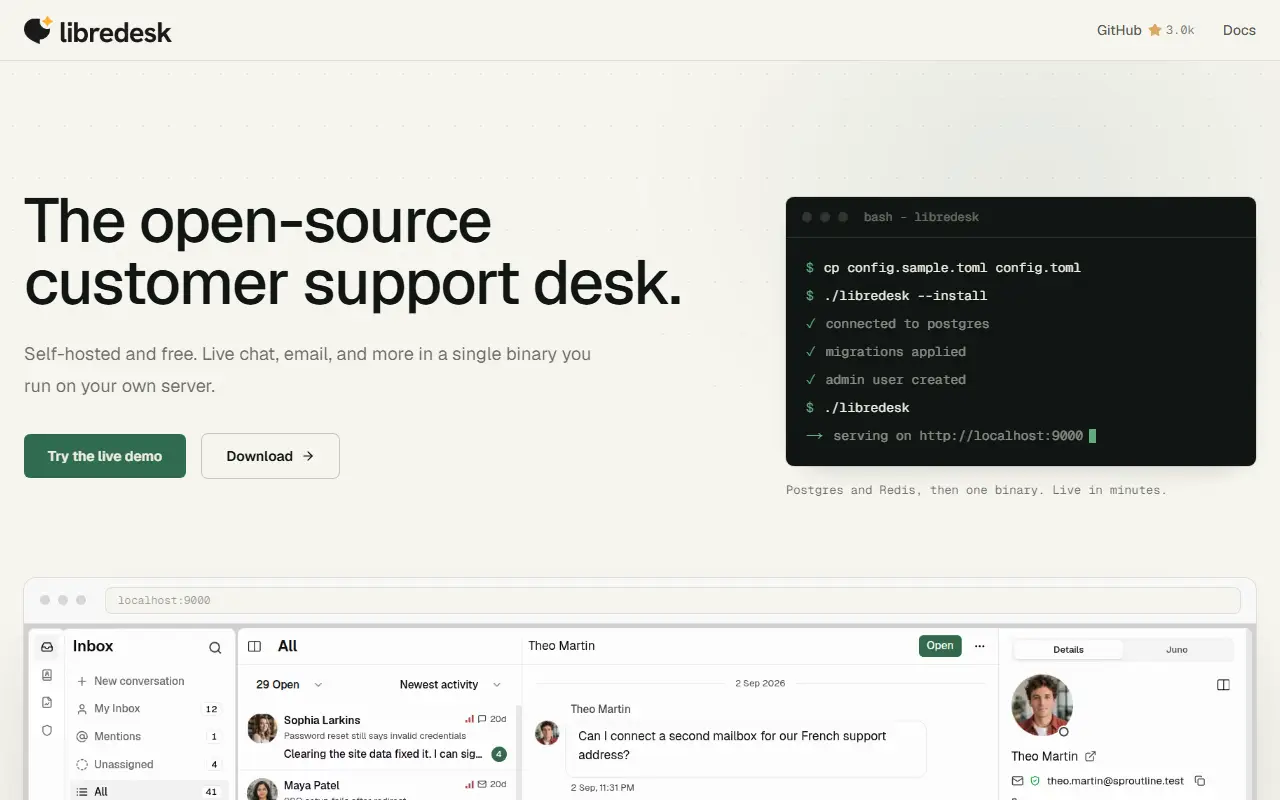
Libredesk is an open-source customer support platform that you host yourself and run as one binary. It brings email, a live chat widget for your website, and WhatsApp conversations (connected through the Meta Cloud API) into a shared inbox, and positions itself as a lightweight alternative to Zendesk, Intercom, and Chatwoot. It is released under the AGPL-3.0 license.
Teams can organize conversations with tags, custom statuses and attributes, snoozing, and search. Automations tag, assign, and route conversations by rules, macros apply saved replies and actions in a single step, and auto-assignment distributes work by agent capacity. SLA management warns about conversations at risk of missing targets, and CSAT ratings and analytics track response times and resolution rates.
A multilingual help center publishes a searchable knowledge base, an AI assistant can answer chat questions from it and hand off to an agent, and an agent copilot drafts replies and summarizes threads. Roles with per-action permissions, OIDC single sign-on, activity logs, an API, and webhooks cover administration. It is written in Go and Vue and suits small and mid-sized support teams.
Key features
- Shared inbox for email, live chat, and WhatsApp
- Searchable multilingual help center
- AI assistant and agent copilot
- Automations, macros, and auto-assignment
- SLA tracking and CSAT ratings
- Role-based permissions and OIDC single sign-on
- API and webhooks
Pricing: Free and open source under the AGPL-3.0 license; run it yourself as a single binary.
#7
OpenCart is a free, open-source PHP e-commerce platform that online merchants install on their own hosting to run a web store.
- GitHub stars
- 8.2k
- Last commit
- 2 days ago
- Latest release
- 4.1.0.4
- Self-hosted
- Yes
opencart.com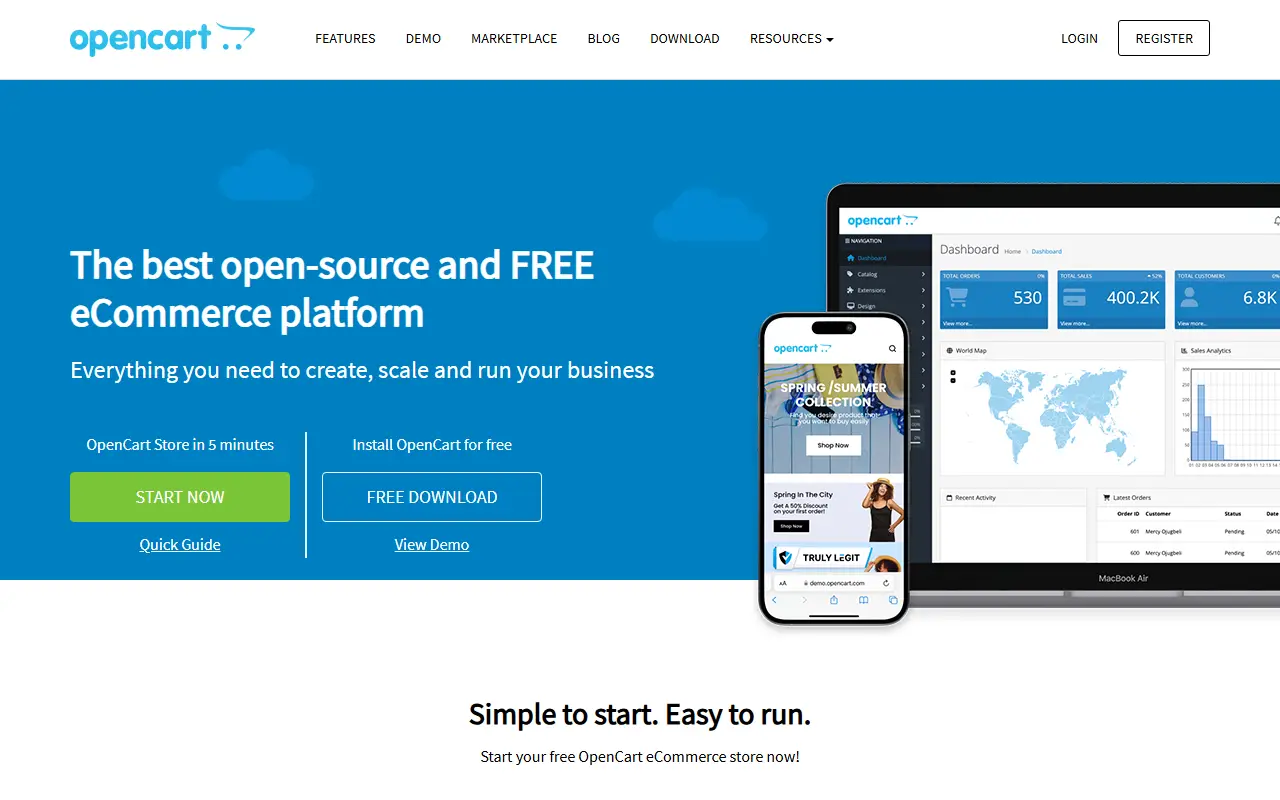
OpenCart is a free and open-source e-commerce platform for online merchants. It is a PHP-based shopping cart system that you install on your own web hosting and use as the foundation of an online store, with JavaScript and HTML on the storefront side.
The repository includes installation and upgrade instructions that ship with the download, and the project directs users to a community forum, a GitHub bug tracker and a changelog for the master branch. Bug reports must relate to the core code, since problems with third-party modules or server configuration are referred back to the extension developer, the forum or commercial partners. Security issues are handled through private messages to moderators instead of public posts.
Contributions follow a documented guide covering environment setup, coding standards and pull request expectations. The repository lists a licence of other, so check the project for its exact terms before redistributing. A hosted version of the store software is not described in the repository.
Key features
- PHP-based shopping cart system
- Self-installed on your own hosting
- Documented upgrade path between versions
- Community forum and bug tracker
- Extension ecosystem from third-party developers
Pricing: Free and open source; installed on your own hosting.
#8
Open-source live support system for websites with web and mobile apps, voice, video, and screen sharing, plus Telegram, WhatsApp, and Messenger integrations.
- GitHub stars
- 2.3k
- Last commit
- yesterday
- Latest release
- 5.00v
- Licence
- Apache-2.0
- Self-hosted
- Yes
livehelperchat.com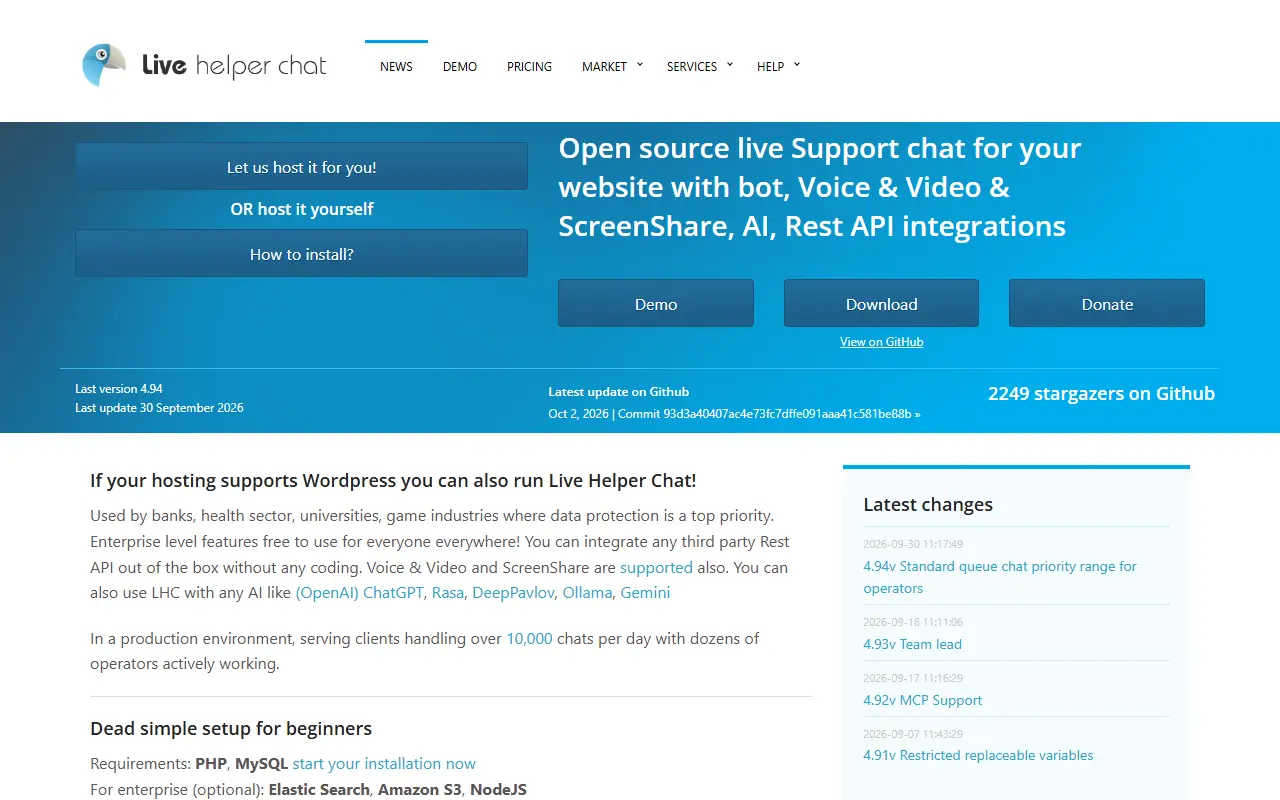
Live Helper Chat is an open-source application that brings live customer support to your website. It is written in PHP and released under the Apache-2.0 license. The project says it is used in production serving over 10,000 chats a day with dozens of operators working at once.
Beyond text chat, it offers voice and video calls and screen sharing, web and mobile operator apps, and channels including Telegram, WhatsApp through Twilio, and Facebook Messenger. A bot builder lets you automate parts of the conversation, and topics point to AI chatbots, with a demo that features ChatGPT and streaming support.
Installation is by cloning the repository and installing Composer dependencies on PHP 8.2 or later, or by downloading a release package that already includes them. Documentation, forum discussions, and a Discord channel provide support. It suits small and large businesses that want a self-hosted chat widget and help desk tool, and developers who want to extend it.
Key features
- Live chat widget for websites
- Voice, video, and screen sharing
- Web and mobile operator apps
- Telegram, WhatsApp via Twilio, and Messenger channels
- Bot builder and AI chatbot support
- Release packages for quick installation
Pricing: Self-hosting is free. Hosted plans run €6 (Basic), €10 (Standard) and €16 (Premium) per 30 days after a 14-day evaluation; paid self-hosted support costs €40 per month.
JivoChat alternatives: questions
- What is the best open-source alternative to JivoChat?
- Chatwoot is the top-ranked open-source alternative to JivoChat on Enlisted: An open-source omnichannel customer support desk with live chat, email and social inbox, an AI agent and a help center, positioned against Intercom and Zendesk. Other strong options are Crisp, Rocket.Chat, Mattermost and Zulip.
- What are the best commercial alternatives to JivoChat?
- Smartsupp, Tidio, Zoho SalesIQ, Olark and Userlike are among the hosted, closed-source alternatives to JivoChat listed on Enlisted, which lists 17 in total. Compare their pricing and features on each tool page.
- Are these JivoChat alternatives free?
- All 8 are open source, so the code is free to use under its licence, and 7 of them can be self-hosted on your own server or computer. 4 also offer a paid or managed cloud version if you'd rather not host it yourself.
- How is this list of JivoChat alternatives ranked?
- By a score built from GitHub stars, star growth over the last 30 days and how recently the code changed. 8 of these projects shipped code in the last 30 days. Data is refreshed daily, and nobody can pay to move up.
 TrackMedia
 TrackRev