7,380 open-source and SaaS tools, with GitHub stats refreshed every day.

42 alternatives ranked by real activity

Open-source ChatGPT alternatives

A curated, ranked list of the 42 best open-source alternatives to ChatGPT.

The best open-source alternative to ChatGPT is OpenClaw. If that doesn't suit you, other good options are Ollama, Open WebUI, LobeHub and AnythingLLM.

ChatGPT alternatives are mainly AI tools, but some are also AI infrastructure tools. 22 of them shipped code in the last 30 days, 42 can be self-hosted, and 25 use a permissive licence.

Last updated October 2, 2026 · ranked by GitHub stars, growth and recent commits

OpenClaw

An open-source personal AI assistant that runs on your own hardware and talks to you through chat apps such as Slack, Telegram and WhatsApp.

GitHub stars
391k
Last commit
today
Latest release
v2026.9.7
Self-hosted
Yes
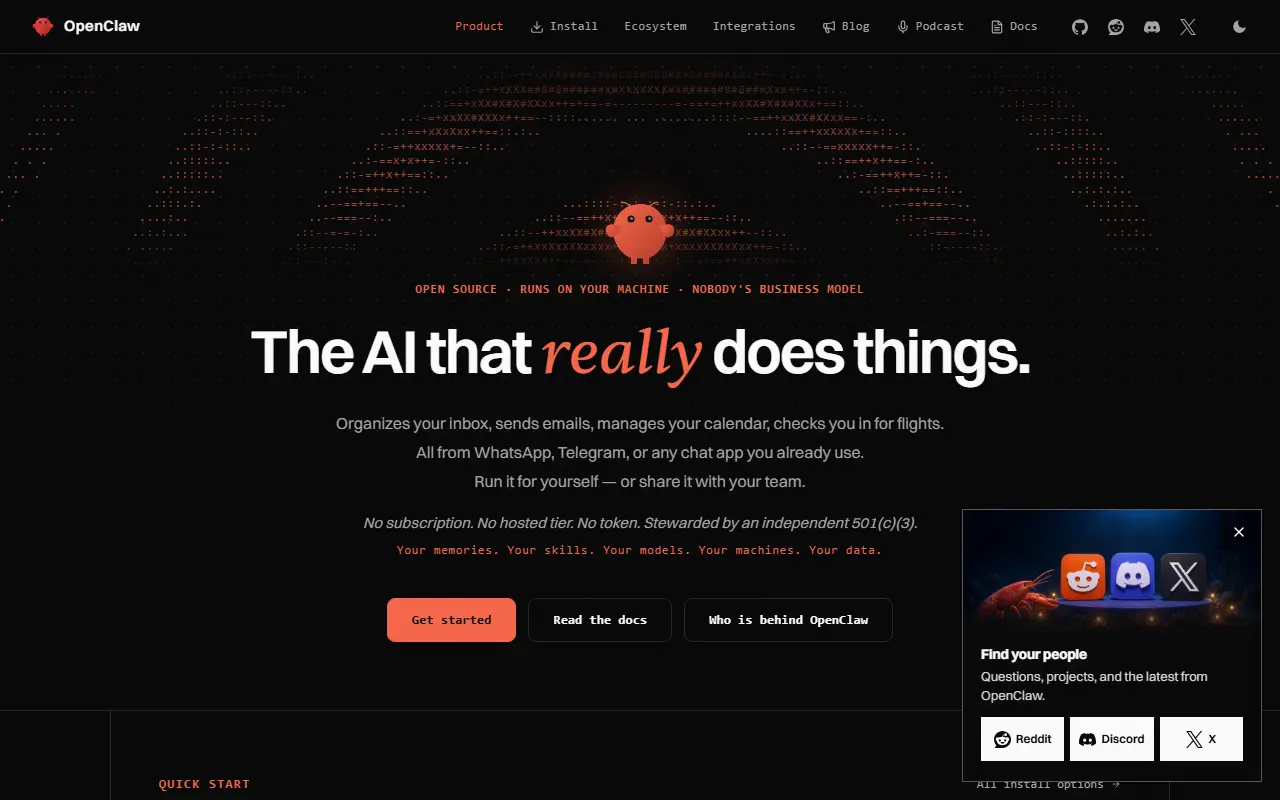
openclaw.aiOpenClaw homepage screenshot

OpenClaw is an AI assistant, open source, that you run on your own computer. Instead of living inside a single website, it connects to the messaging channels you already use, including Discord, iMessage, Slack, Teams, Telegram and WhatsApp, with more than twenty others supported according to the project. Native desktop and mobile apps cover macOS, iOS, Android, Windows and Linux.

A single Gateway process runs the assistant, either as a personal setup on one laptop or as a deployment shared across a team, with configuration being the main difference between the two. State, memory and credentials stay on your hardware, and the model or agent harness is a swappable plugin, so you can use hosted models such as Claude or Codex, or local models, without changing the rest of the setup.

OpenClaw is stewarded by an independent nonprofit foundation, and the project says it offers no paid plan, no hosted service and no token. By default it only contacts its servers for a daily version check, and anonymous statistics are opt-in. GitHub lists the license as 'Other', so check the repository for the exact terms. It suits people who want a private assistant they control themselves.

Key features

  • Connects to Discord, Slack, Telegram, WhatsApp and more
  • Native apps across desktop and mobile platforms
  • Swappable model providers and agent harnesses as plugins
  • Memory and credentials stored on your own hardware
  • Single gateway for personal or shared team use
  • Opt-in anonymous usage statistics

Pricing: Free and open source; the project says it has no paid plan, hosted offering or token.

Ollama

A tool for downloading and running open large language models locally through a command line and REST API, with Docker support and many integrations.

GitHub stars
182k
Last commit
today
Latest release
v0.35.0
Licence
MIT
Self-hosted
Yes
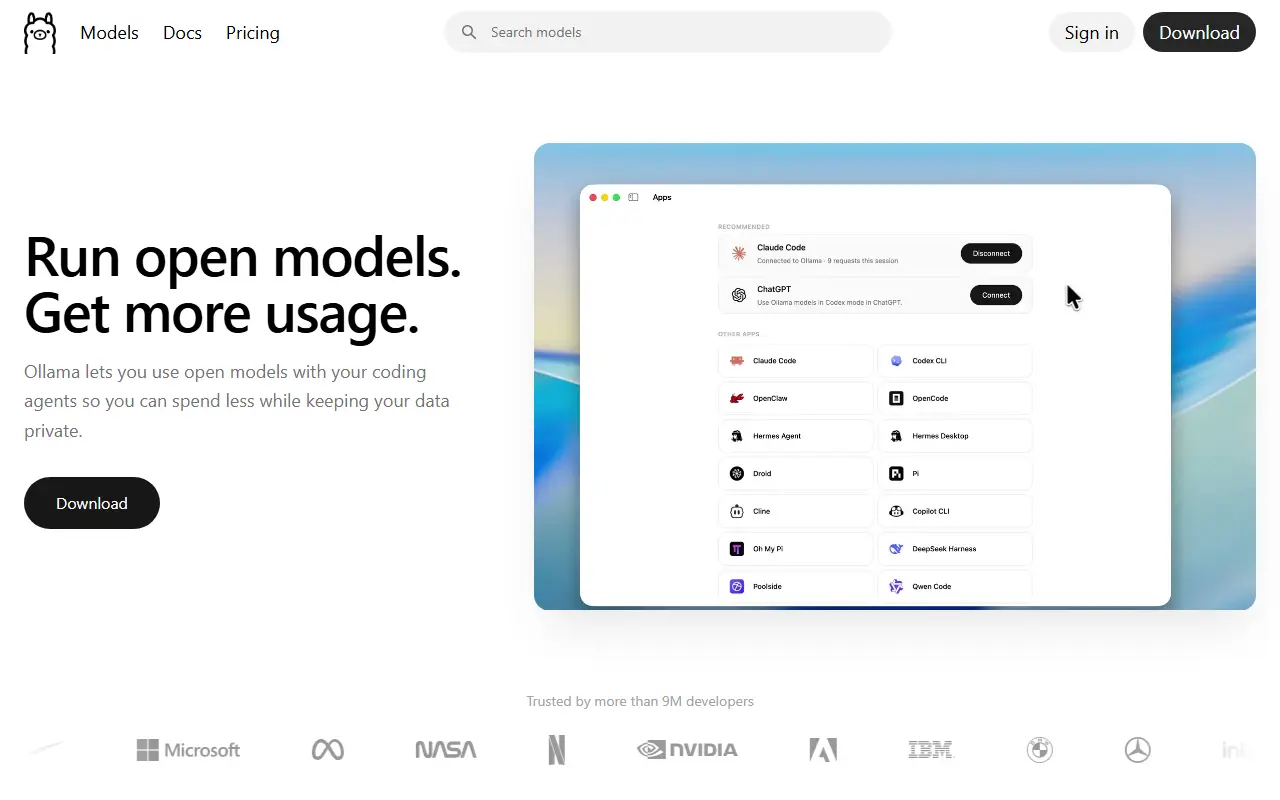
ollama.comOllama homepage screenshot

Ollama makes it straightforward to run open large language models on your own machine. You install it on macOS, Windows or Linux, or use the official Docker image, then pull a model and chat with it from the command line. It is written in Go and released under the MIT license, and it builds on the llama.cpp project for inference.

Besides the CLI, Ollama provides a REST API for managing and running models, with official Python and JavaScript client libraries. Models can be imported and customized through a Modelfile, and an online library lists what is available. It can be connected to coding agents and assistants such as Claude Code, OpenCode, Codex and OpenClaw, and many community chat interfaces, including Open WebUI and LibreChat, work with it.

Because models run on your own hardware, Ollama can serve as a self-hosted alternative to cloud assistants such as ChatGPT and Perplexity when privacy, offline use or cost control matter. It is aimed at developers and hobbyists experimenting with open models, and at teams that want to wire local models into their own applications.

Key features

  • Run open language models locally from the CLI
  • REST API for managing and running models
  • Official Python and JavaScript libraries
  • Modelfile for customizing and importing models
  • Official Docker image
  • Integrations with coding agents and chat interfaces

Pricing: Running models locally is free, and the Free plan includes starter cloud credits. Pro costs $20, Max $100 and Team $500 per month with included usage credits; Enterprise is custom.

Open WebUI

A self-hosted chat interface for local and cloud language models, supporting Ollama and OpenAI-compatible APIs, with RAG, user roles and a plugin system.

GitHub stars
154k
Last commit
today
Latest release
v0.11.4
Self-hosted
Yes
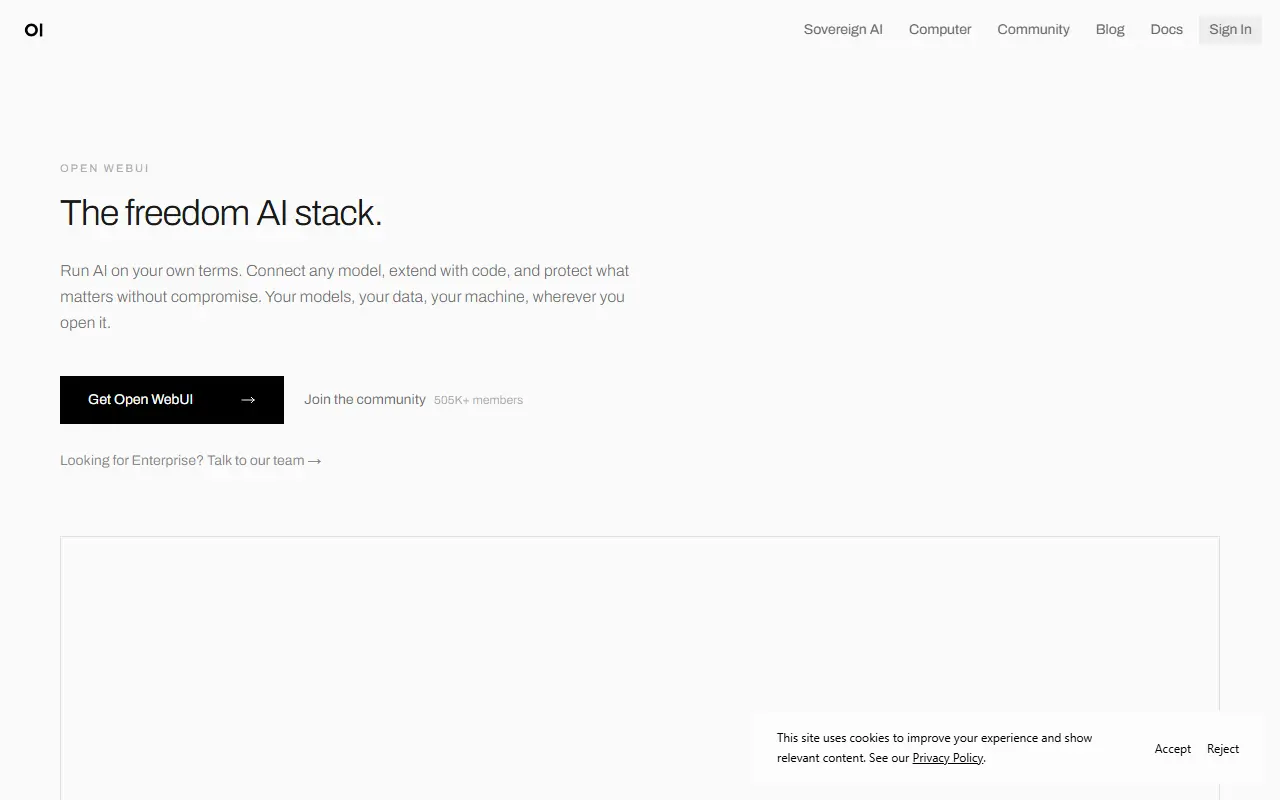
openwebui.comOpen WebUI homepage screenshot

Open WebUI is a self-hosted web interface for working with large language models. It connects to Ollama for local models and to any OpenAI-compatible endpoint, so one deployment can front LM Studio, Groq, Mistral, OpenRouter, vLLM and similar backends side by side. It is designed to keep working fully offline when you rely only on local models.

Administrators get role-based access control with user groups and per-group permissions, which suits shared team or household installs. Beyond chat there is retrieval-augmented generation over your documents, custom models that bundle instructions, tools and knowledge into agents, and an extension system made of filters, actions, pipes, tools and skills. External services attach through MCP, MCPO and OpenAPI tool servers, and an optional Open Terminal feature gives agents a filesystem to work in.

You can install it with pip, uv or Docker, or deploy it to Kubernetes using kubectl, kustomize or Helm, and container images are tagged for bundled Ollama and for CUDA. The project lists an enterprise plan for organizations that want vendor support. Its license is listed as custom rather than a standard one, so review the terms before reselling or rebranding it.

Key features

  • Connects to Ollama and OpenAI-compatible APIs
  • Role-based access control with user groups
  • Retrieval-augmented generation over your own documents
  • Plugin system with filters, tools and pipes
  • MCP and OpenAPI tool server support
  • Custom agents combining models, tools and knowledge
  • Install via pip, Docker or Kubernetes

Pricing: Free to self-host; an enterprise plan is available through the vendor's sales team.

LobeHub

An open-source platform that organizes AI agents into continuous operations, with options to self-host through Docker or major cloud platforms.

GitHub stars
83k
Last commit
today
Latest release
v2.2.18
Self-hosted
Yes
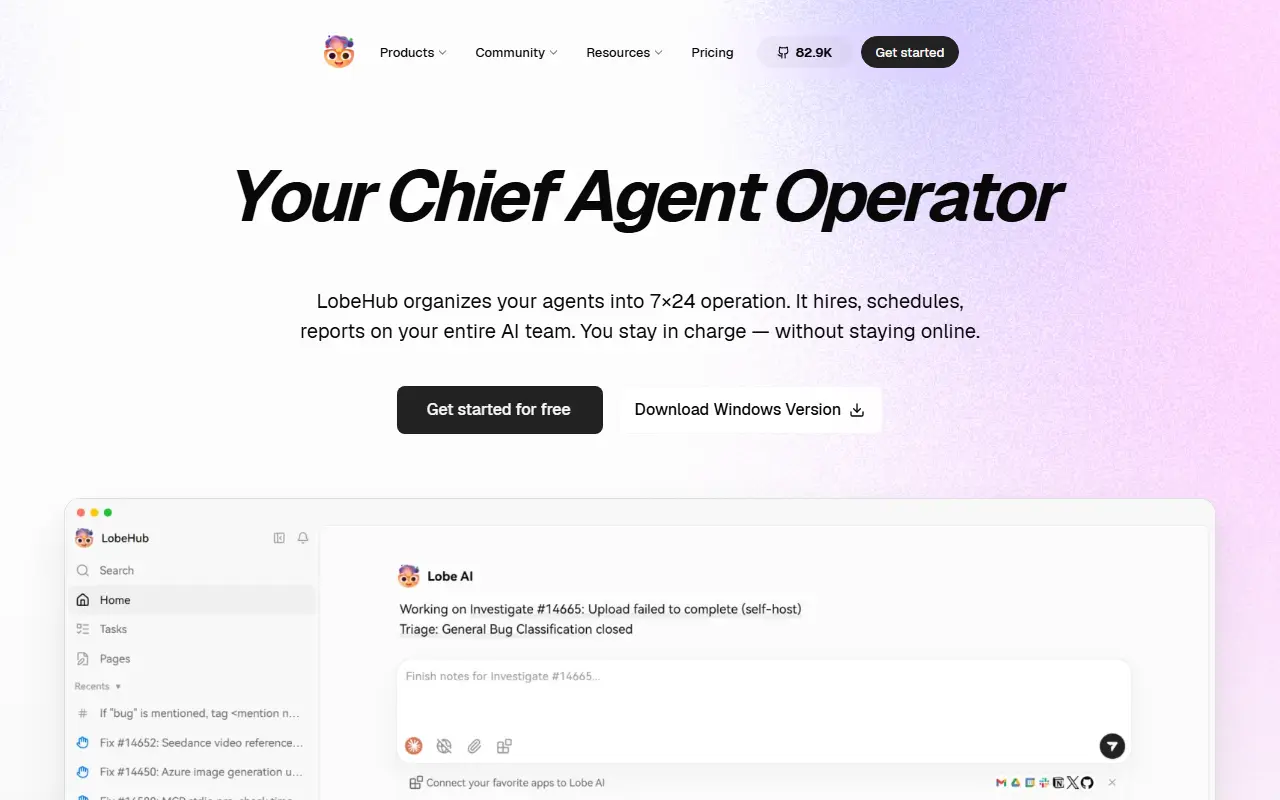
lobehub.comLobeHub homepage screenshot

LobeHub describes itself as a Chief Agent Operator that organizes your AI agents into around-the-clock operation. It is designed to take on the hiring, scheduling and reporting for a whole team of agents so that you stay in charge without having to stay online. The project is written in TypeScript, and its GitHub topics point to chat, agent, knowledge base and MCP functionality.

The README groups its features around four ideas: Operator, Create, Collaborate and Evolve, which cover treating agents as the unit of work, scaling new kinds of collaboration networks, and the co-evolution of humans and agents. A plugin ecosystem extends the platform, and the project's topics reference model providers such as OpenAI, Claude, Gemini and DeepSeek.

LobeHub can be self-hosted: the README documents deployment on Vercel, Zeabur, Sealos and Alibaba Cloud, as well as Docker, and describes the environment variables used for configuration. GitHub lists the license as 'Other', so check the repository for the exact terms. It suits individuals and teams who want to run a shared workspace of AI agents on infrastructure they choose.

Key features

  • Agents organized into continuous operations
  • Scheduling and reporting for agent teams
  • Knowledge base, skills and MCP support
  • Plugin ecosystem for extending agents
  • Docker and cloud platform deployment
  • Support for major model providers

Pricing: Free plan with 500,000 monthly credits. Starter costs $12.90, Premium $24.90 and Ultimate $49.90 per month billed monthly, or about $9.90, $19.90 and $39.90 billed yearly; Enterprise Edition is by contact.

AnythingLLM

An all-in-one AI application for chatting with your documents and running AI agents locally, with multi-user support and desktop and Docker versions.

GitHub stars
67k
Last commit
yesterday
Latest release
v1.17.0
Licence
MIT
Self-hosted
Yes
Hosted version
Available
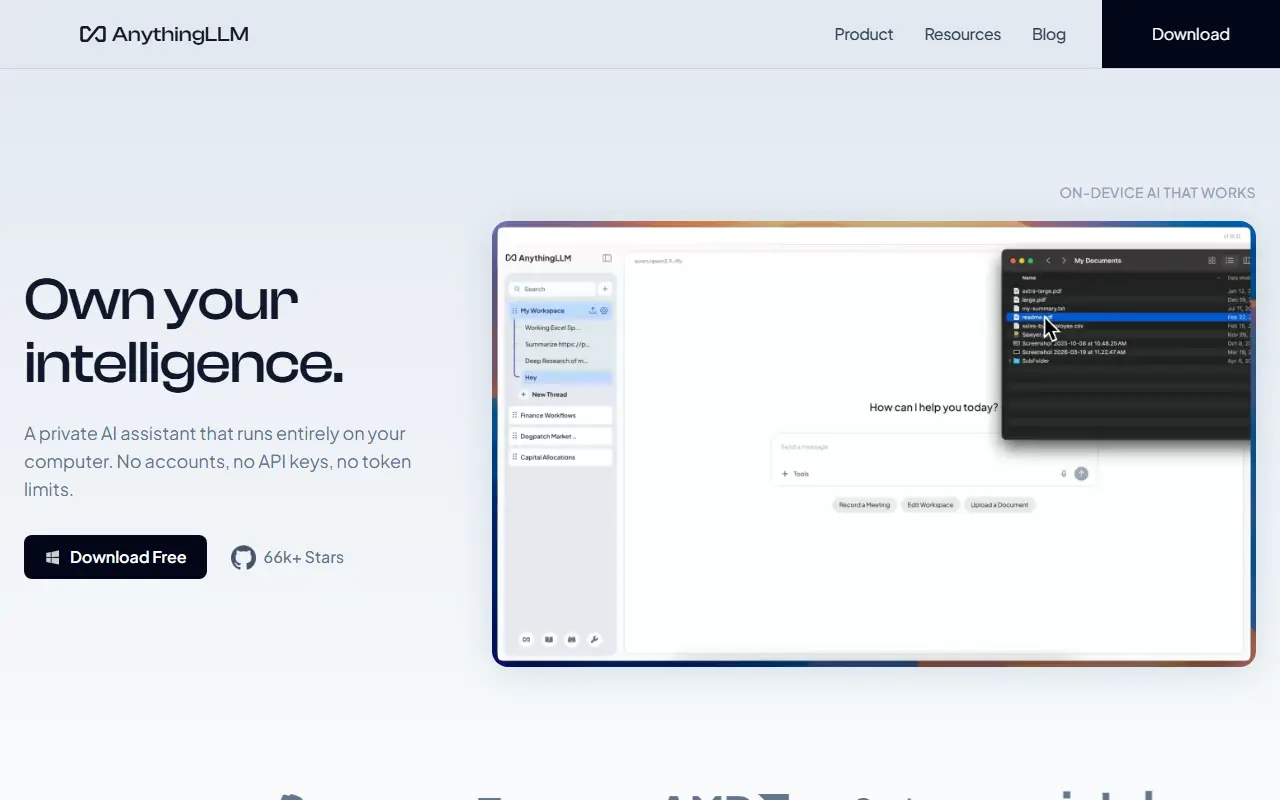
anythingllm.comAnythingLLM homepage screenshot

AnythingLLM is an all-in-one AI application for chatting with your own documents and automating work with AI agents. It runs locally by default, lets you connect local or cloud language models, and is written in JavaScript under the MIT license. The README describes it as a way to build a private, fully featured assistant in the style of ChatGPT.

Vector databases, document processing pipelines, multi-user support and agents all come included. Newer features listed include dynamic model routing based on rules you define, automatic and user-managed memories, scheduled tasks with agent capabilities, skill selection, a no-code agent builder, MCP compatibility and multi-modal support for both closed and open-source models.

It is available as a desktop app for Mac, Windows and Linux, as a Docker version that adds multi-user access control, and as a hosted instance, and there is an open-source Android app. Administrators can control access and experience per user. It suits individuals and teams who want a private document-chat and agent workspace without much setup.

Key features

  • Chat with your documents using RAG
  • Built-in AI agents and no-code agent builder
  • Multi-user access control in Docker version
  • Connects to local or cloud LLMs
  • Vector database and document pipeline support
  • MCP compatibility and scheduled tasks
  • Desktop apps for Mac, Windows and Linux

Pricing: Self-hosting with Docker is free. Hosted Cloud costs $50 per month (Basic) or $99 per month (Pro); Enterprise with on-premise deployment is quoted on request.

PrivateGPT

An open-source API layer that adds RAG, tools, MCP connectors and a built-in test UI to locally hosted models for private AI apps.

GitHub stars
58k
Last commit
today
Latest release
v1.0.1
Licence
Apache-2.0
Self-hosted
Yes
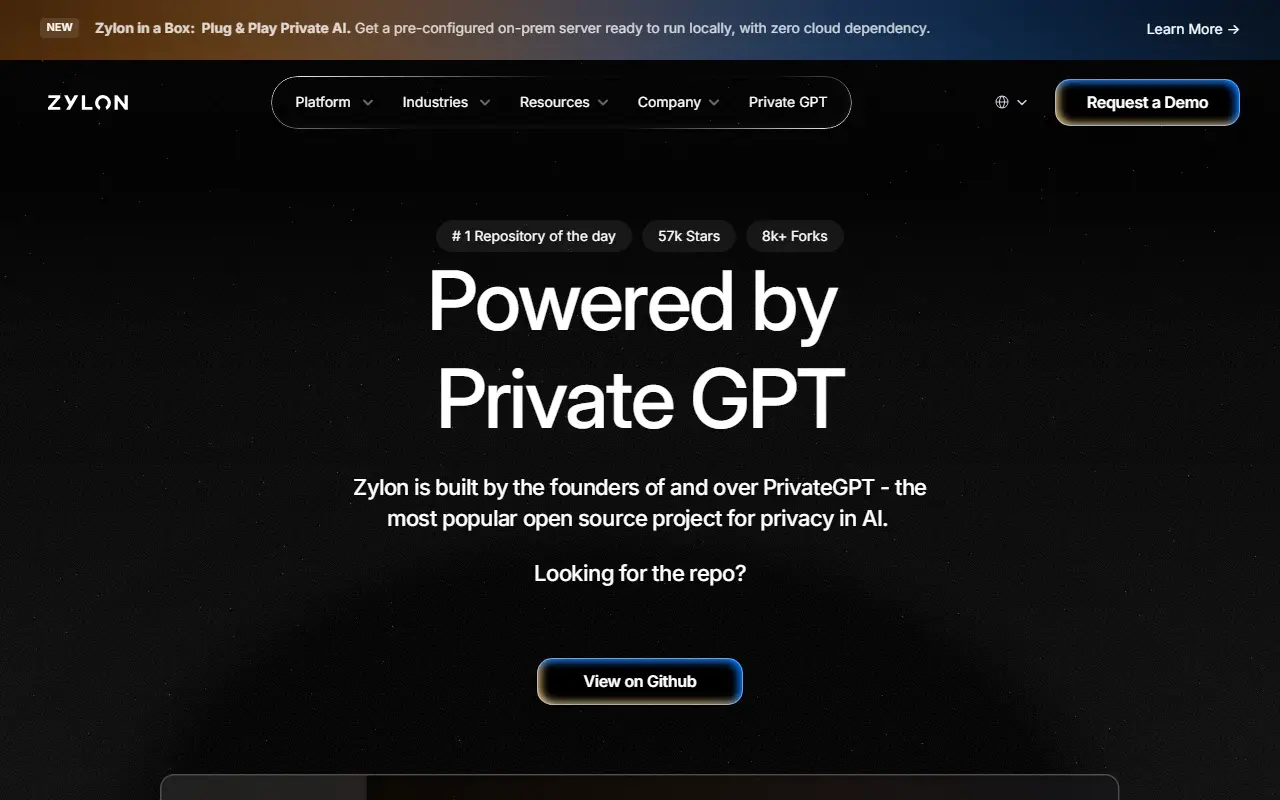
zylon.aiPrivateGPT homepage screenshot

PrivateGPT is an open-source API layer that sits between your applications and a locally hosted language model. Running a model is only the first step, so the project supplies the higher-level building blocks, such as retrieval, tools and file ingestion, that applications usually need. It is written in Python, released under the Apache-2.0 license, and used to power the Zylon on-premise AI platform.

The project leaves model execution to other software: it links to whichever inference server speaks the OpenAI API, such as Ollama, through a configurable base URL. On top of that it offers a messages API (streaming, async and token counting), ingestion of files and artifacts, retrieval that cites its sources, agentic RAG, built-in tools for web search, page fetching and running code, plus user-defined tools, MCP connectors, database and CSV access, and embeddings.

A built-in workbench UI is available for testing and demos, while the API is described as the real product. Quickstart instructions cover Docker and other install options. It suits developers and enterprises that want to build AI products without sending data to cloud APIs, and that already run or plan to run a local inference server.

Key features

  • Messages API with streaming and token counting
  • Retrieval with citations and agentic RAG
  • File and artifact ingestion
  • Built-in web search, web fetch and code execution tools
  • Custom tools and MCP connectors
  • Works with any OpenAI-compatible inference server
  • Built-in workbench UI for testing

Pricing: Free and open source under the Apache-2.0 license.

Cherry Studio

A cross-platform desktop AI client that supports many LLM providers and local models, with prebuilt assistants, document handling and MCP support.

GitHub stars
52k
Last commit
today
Latest release
v2.1.4
Licence
AGPL-3.0
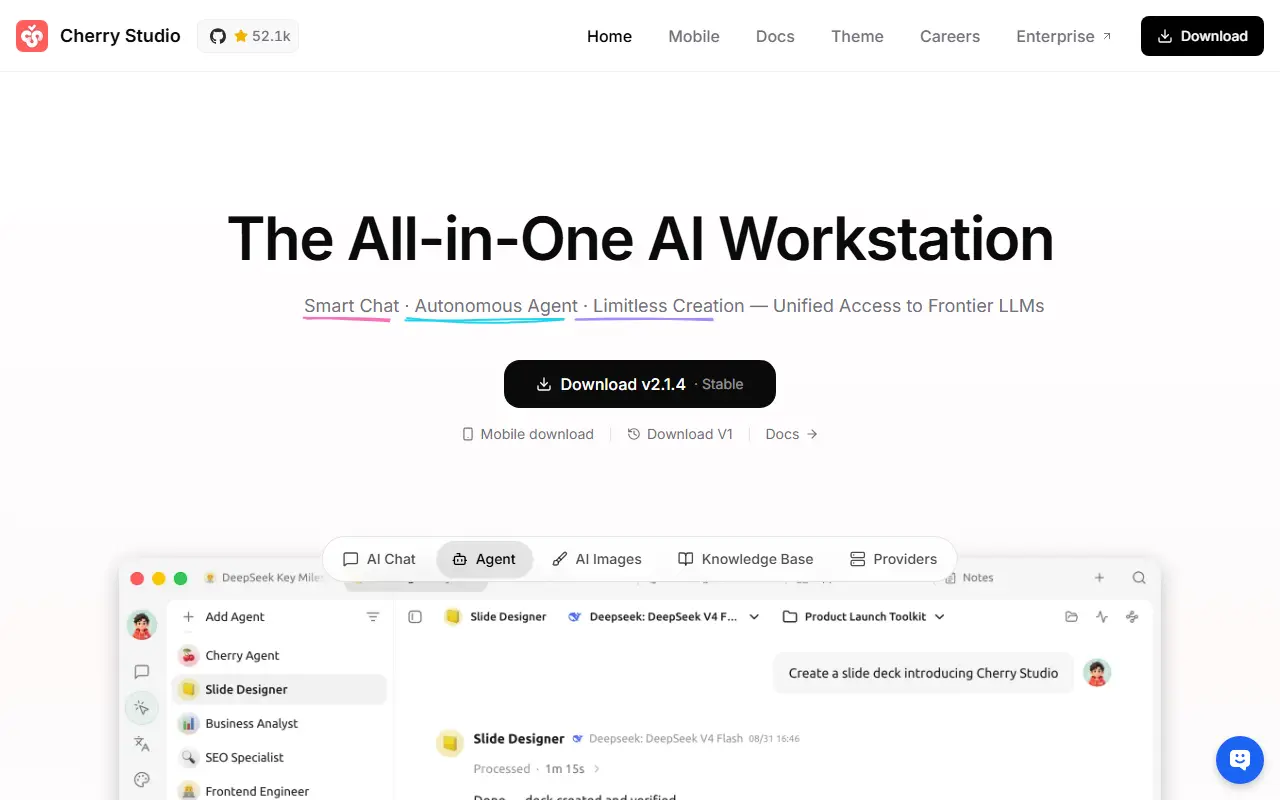
cherryai.comCherry Studio homepage screenshot

Cherry Studio is a desktop client for working with multiple large language model providers, available for Windows, Mac and Linux. It is written in TypeScript and licensed under AGPL-3.0, and it is described as an AI productivity studio offering chat, autonomous agents and a large library of ready-made assistants.

It can connect to major cloud LLM services such as OpenAI, Gemini and Anthropic, to AI web services like Claude, Perplexity and Poe, and to local models through Ollama and LM Studio. Conversations can involve several models at once, and users can pick from more than 300 preconfigured assistants or create their own.

Other tools include handling of text, images, Office files and PDFs, WebDAV backup, Mermaid chart rendering, code highlighting, global search, topic management, AI translation, mini programs and an MCP server. Themes and complete Markdown rendering are included, and no environment setup is needed. It suits individuals who want one desktop app for many models.

Key features

  • Support for many cloud and local LLM providers
  • Over 300 preconfigured AI assistants
  • Multi-model simultaneous conversations
  • Text, image, Office and PDF handling
  • WebDAV backup and Mermaid chart rendering
  • MCP server and mini programs
  • Light and dark themes

Pricing: Free and open source under the AGPL-3.0 license.

LocalAI

An open-source AI engine that runs LLMs, vision, voice, image and video models on your own hardware behind OpenAI-compatible APIs, with no GPU required.

GitHub stars
49k
Last commit
today
Latest release
v4.10.0
Licence
MIT
Self-hosted
Yes
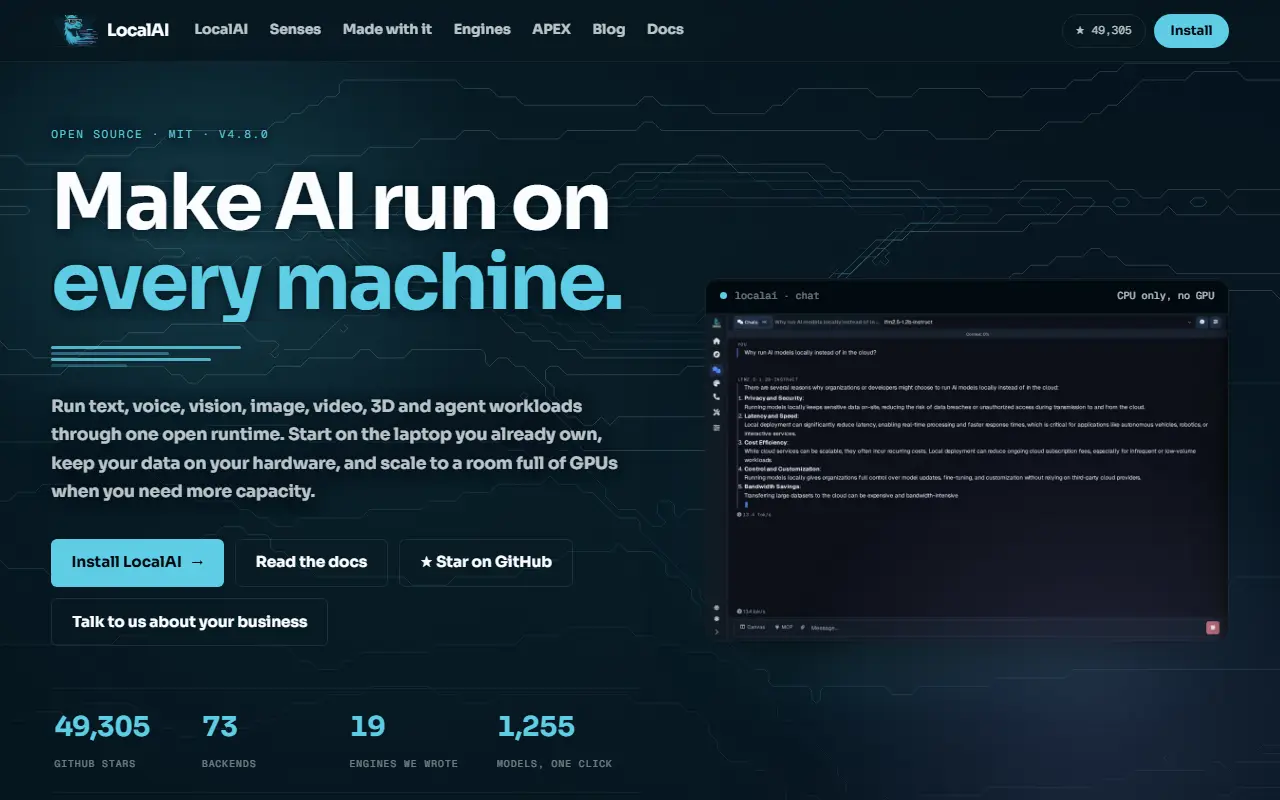
localai.ioLocalAI homepage screenshot

LocalAI is an open-source AI engine for running models of many kinds, including language, vision, voice, image and video models, on your own hardware. A GPU is not required. It is written in Go and released under the MIT license, was started by Ettore Di Giacinto and is looked after by the LocalAI team.

Its design is a small core with separate backends that are pulled on demand, so nothing unused gets installed. Backends wrap engines such as llama.cpp, vLLM, whisper.cpp, stable-diffusion and MLX, and you can write your own in any language against an open interface. It can run on CPU alone, through Vulkan, or on NVIDIA, AMD, Intel and Apple Silicon hardware.

APIs are drop-in compatible with OpenAI, Anthropic and ElevenLabs across every backend. Multi-user features include API key authentication, user quotas and role-based access, and built-in agents support tool use, RAG, MCP and skills. The project stresses that data stays on your infrastructure. It suits developers and teams who want a private, self-hosted replacement for cloud AI APIs.

Key features

  • Runs LLM, vision, voice, image and video models
  • Composable backends pulled on demand
  • OpenAI, Anthropic and ElevenLabs API compatibility
  • Runs on CPU, NVIDIA, AMD, Intel and Apple Silicon
  • API key authentication, quotas and role-based access
  • Built-in agents with tools, RAG and MCP

Pricing: Free and open source under the MIT license.

LibreChat

A self-hostable, open-source ChatGPT-style chat interface that works with many AI providers and includes agents, MCP support, artifacts and multi-user auth.

GitHub stars
45k
Last commit
today
Licence
MIT
Self-hosted
Yes
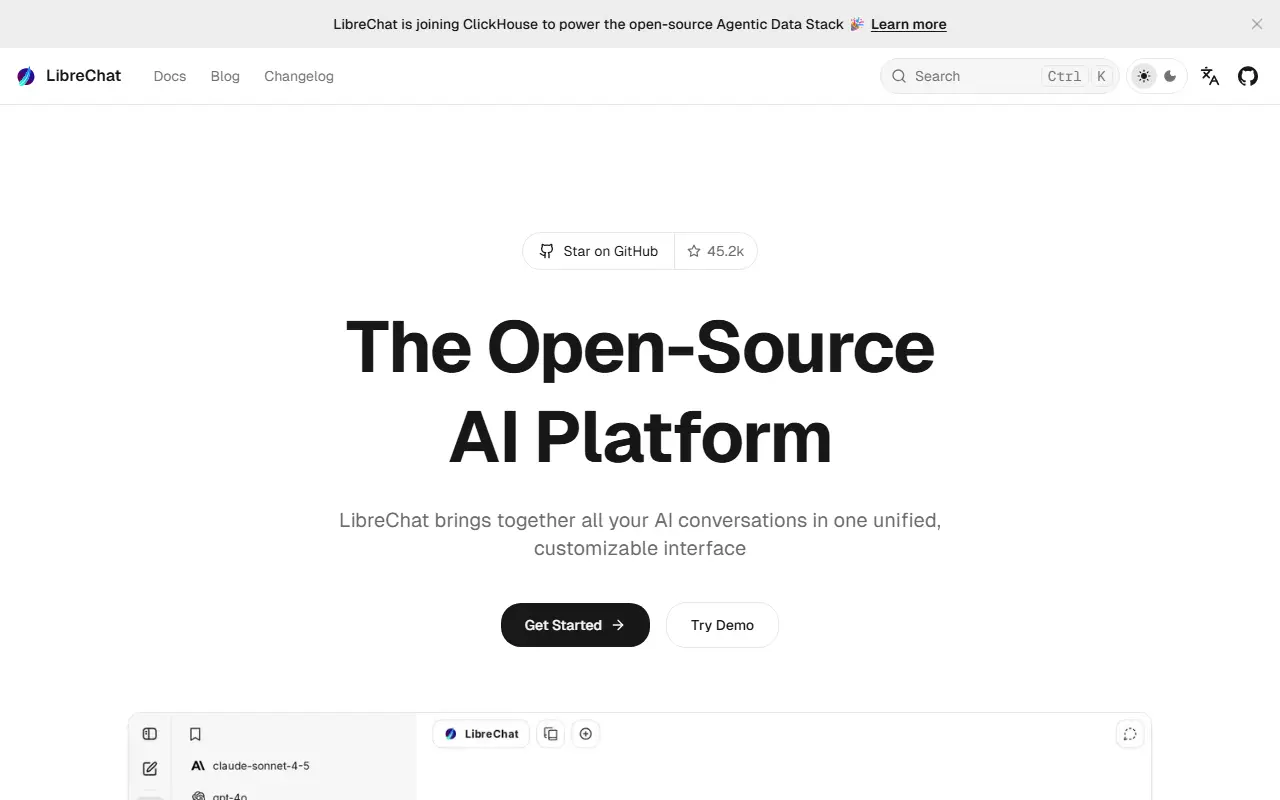
librechat.aiLibreChat homepage screenshot

LibreChat is an open-source chat interface modeled on ChatGPT that you can self-host. It is written in TypeScript and released under the MIT license. Rather than being tied to one vendor, it connects to many providers, including OpenAI, Anthropic, Azure, AWS, Google Vertex AI and Gemini, Mistral, Groq, DeepSeek and OpenRouter, and lets you switch between models within a conversation.

Its feature set includes agents, MCP and skills, artifacts, a code interpreter, image generation, OpenAPI actions and functions, presets, message search and secure multi-user authentication. The recent README highlights an agent management API in beta, optional attached workspaces for code workers that are described as highly experimental, code approval controls, manual context compaction and unified file attachments.

Administrators can set role-based grants and approval modes for sensitive actions such as file writes and command execution. LibreChat suits individuals and organizations that want a private alternative to ChatGPT with a choice of models, and teams that need multi-user access control on infrastructure they manage.

Key features

  • Chat with many AI providers in one interface
  • Switch models within a conversation
  • Agents, skills and MCP support
  • Artifacts and code interpreter
  • Message search and presets
  • Secure multi-user authentication
  • Agent management API in beta

Pricing: Free and open source under the MIT license.

Jan

An open-source desktop app that acts as a ChatGPT replacement, running local language models offline or connecting to cloud providers, with an OpenAI-compatible local server.

GitHub stars
45k
Last commit
today
Latest release
v0.8.4
Self-hosted
Yes
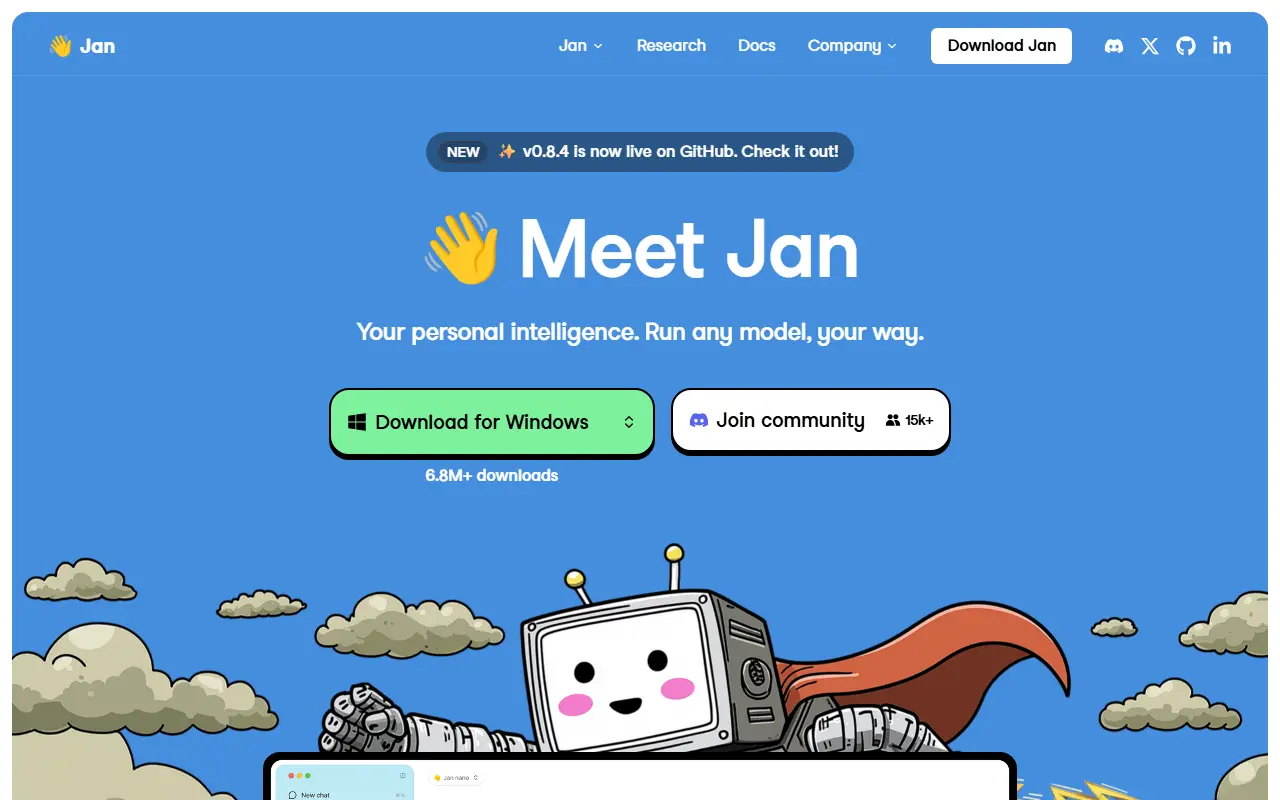
jan.aiJan homepage screenshot

Jan is an open-source desktop application that serves as a ChatGPT alternative you control. It can download and run language models such as Llama, Gemma, Qwen and GPT-oss from Hugging Face entirely on your own computer, so conversations stay private and work without an internet connection.

When you want more capability than local hardware allows, Jan can connect to cloud models from OpenAI, Anthropic, Mistral, Groq, MiniMax and others from the same interface. You can create custom assistants for specific tasks, and Model Context Protocol support adds agentic abilities. A built-in local server on localhost port 1337 exposes an OpenAI-compatible API, so other applications can use your local models as a drop-in backend.

Jan is built with Rust and Tauri and ships installers for Windows, macOS and Linux in deb and AppImage form. Its license is listed as 'Other' on GitHub, so check the repository terms before redistributing it. It is meant for people who want local AI with a polished interface rather than a command line.

Key features

  • Download and run local LLMs from Hugging Face
  • Connect to OpenAI, Anthropic, Mistral and Groq
  • Custom assistants for specific tasks
  • OpenAI-compatible local server
  • Model Context Protocol integration
  • Installers for Windows, macOS and Linux

Pricing: Free and open source; running local models costs nothing beyond your own hardware, and cloud providers bill you separately.

Read more about JanWebsite GitHub

32 more ChatGPT alternatives

ChatGPT alternatives: questions

What is the best open-source alternative to ChatGPT?
OpenClaw is the top-ranked open-source alternative to ChatGPT on Enlisted: An open-source personal AI assistant that runs on your own hardware and talks to you through chat apps such as Slack, Telegram and WhatsApp. Other strong options are Ollama, Open WebUI, LobeHub and AnythingLLM.
Are these ChatGPT alternatives free?
All 42 are open source, so the code is free to use under its licence, and all of them can be self-hosted on your own server or computer. 12 also offer a paid or managed cloud version if you'd rather not host it yourself.
How is this list of ChatGPT alternatives ranked?
By a score built from GitHub stars, star growth over the last 30 days and how recently the code changed. 22 of these projects shipped code in the last 30 days. Data is refreshed daily, and nobody can pay to move up.

People also look for alternatives to…

View all