37 open-source alternatives ranked by real activity

Open-source Notion alternatives

A curated, ranked list of the 37 best open-source alternatives to Notion.

The best open-source alternative to Notion is Macro. If that doesn't suit you, other good options are Alexandrie, EdgeEver, AppFlowy and AFFiNE.

Commercial alternatives to Notion include Nuclino, Coda, Craft and Slite. See all 185.

Notion alternatives are mainly note-taking tools, but some are also documentation & wiki tools and productivity tools. 30 of them shipped code in the last 30 days, 37 can be self-hosted, and 12 use a permissive licence.

Last updated November 13, 2026 · ranked by GitHub stars, growth and recent commits

Macro

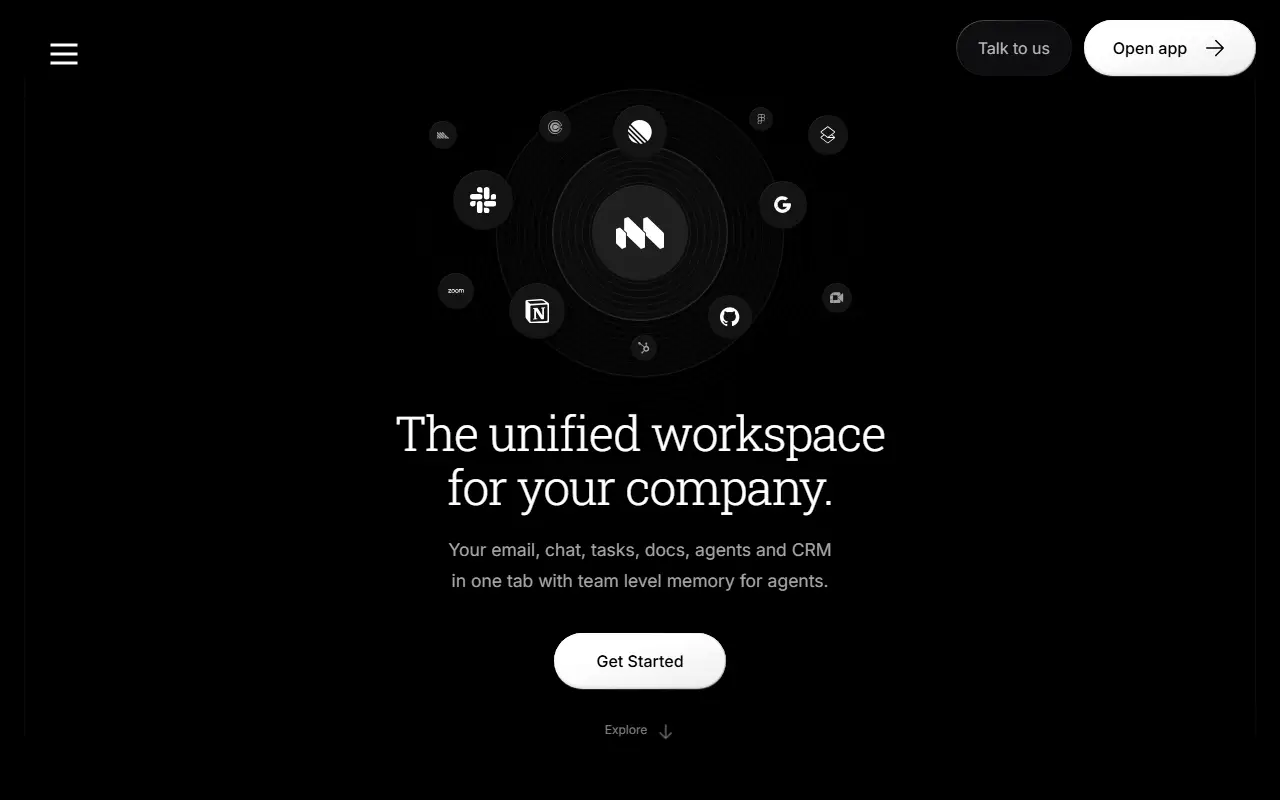
Macro is an open-source team workspace that brings email, chat, documents, tasks, AI agents, calls and CRM together with shared AI memory.

GitHub stars
6.3k
Last commit
today
Latest release
v2026.11.12.0
Licence
AGPL-3.0
Hosted version
Available
macro.comMacro homepage screenshot

Macro is an all-in-one workspace for teams that brings messaging, mail, documents, tasks, AI agents, calls and customer records into a single quick interface. Everything in the workspace can be linked with @ mentions and searched, so people and agents do not have to hop between separate tools to find context.

The project grew from its founders' wish for a single operating system for their startup, after using Slack, Linear, Notion, HubSpot and Superhuman, which do not work together as one system. A shared team-level memory ties the pieces together. Repository topics reference Slack, Notion and Linear as comparison points, plus MCP and agent support. The code base is written in Rust and TypeScript.

Macro is licensed under AGPL-3.0 and offers a hosted sign-up, with documentation, a demo booking and a feature request channel linked in the README. It suits startups and small teams that want to replace a stack of separate collaboration tools.

Key features

  • Unified email, chat and docs
  • Tasks and CRM in the same workspace
  • AI agents with shared team memory
  • @-linking across all content
  • Searchable workspace content
  • Calls and meetings

Pricing: Free plan for personal use. The paid plan costs $40 per seat per month for the first 5 seats and $80 after that. The AGPL-licensed software can also be self-hosted.


Alexandrie

Self-hosted, offline-first knowledge base with an extended Markdown editor, team workspaces, OIDC single sign-on, and one-command Docker deployment.

GitHub stars
3.9k
Last commit
2 days ago
Latest release
v8.14.4
Licence
MIT
Self-hosted
Yes
alexandrie-hub.frAlexandrie homepage screenshot

Alexandrie is an open-source, self-hosted wiki and knowledge management platform for individuals and teams. It combines an extended Markdown editor with offline support, collaboration tools, and fine-grained permissions, and is pitched as an alternative to Notion, Obsidian, and Confluence. It is released under the MIT license.

The Markdown engine supports LaTeX, custom containers, interactive checkboxes, frames, snippets, and integrated diagrams. Content is organized in a multi-tenant structure of teams, workspaces, categories, and nested documents. It works as an offline-first progressive web app that can be installed on devices, and it supports OIDC single sign-on and local S3 backups. The topics also mention kanban boards.

The whole stack comes up with one Docker command. It uses a Go backend and a Nuxt and Vue front end. Alexandrie suits teams and individuals who want a private knowledge base with enterprise-style permissions and who prefer to keep their notes on their own infrastructure.

Key features

  • Extended Markdown editor with LaTeX and diagrams
  • Teams, workspaces, categories, and nested documents
  • Offline-first installable web app
  • OIDC single sign-on
  • Local S3 backups
  • One-command Docker deployment

Pricing: Free and open source under the MIT license.

EdgeEver

AI-native, open-source note-taking and knowledge base with an Evernote-style three-pane layout, MCP support, and deployment on Cloudflare or Docker.

GitHub stars
3.2k
Last commit
yesterday
Latest release
v2.26.0
Licence
AGPL-3.0
Self-hosted
Yes
edgeever.orgEdgeEver homepage screenshot

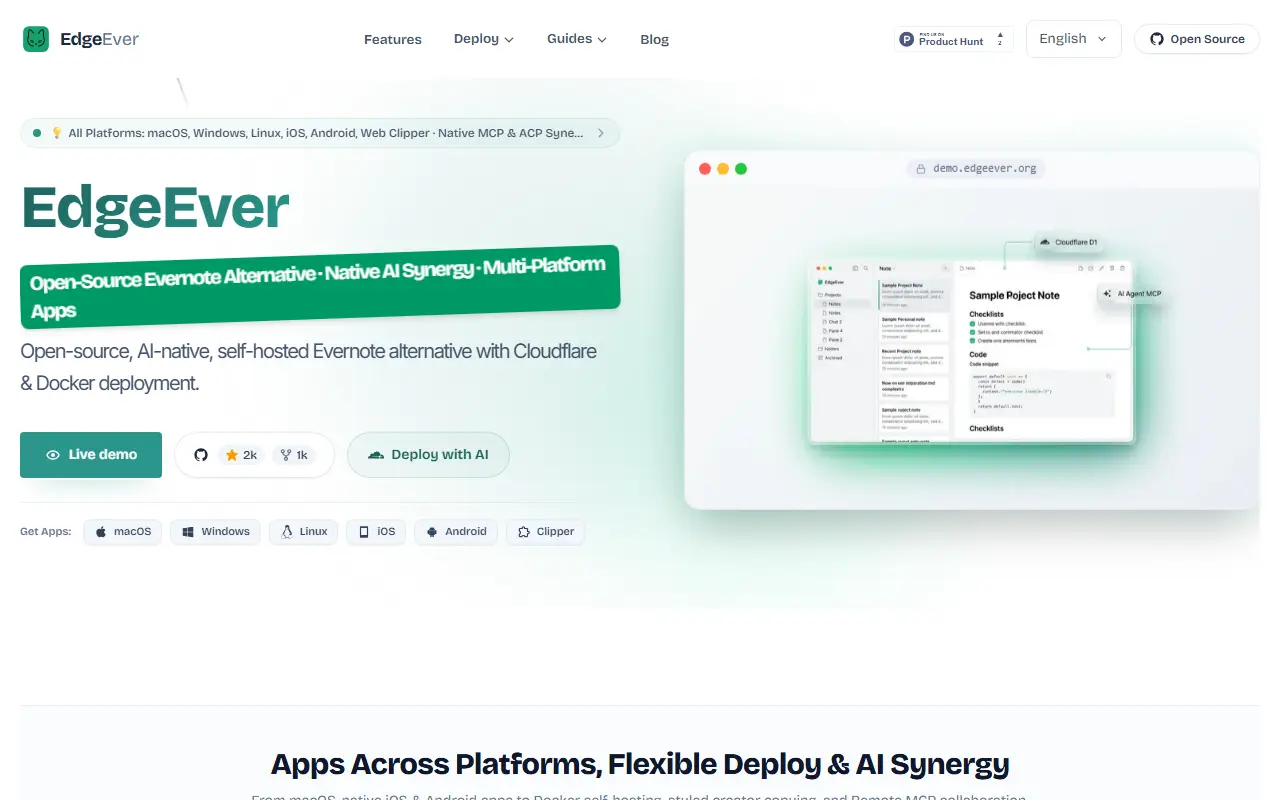
EdgeEver is an open-source notes and knowledge base workspace that revives the three-pane layout familiar from Evernote while adding an open data architecture and integration with AI agents. It is presented as a portable Evernote alternative, is written in TypeScript, and is released under the AGPL-3.0 license.

It can run serverlessly within Cloudflare's free quotas using Workers, D1, and R2, so no server purchase is needed, or you can deploy the same application with Docker on a VPS, NAS, or home server. Native MCP support lets AI agents work with your notes. Other topics include a web clipper, offline-first behavior, PWA and Electron clients, SQLite storage, and the Tiptap editor.

A live demo and client downloads are provided, with the interface available in several languages. EdgeEver was created in 2026, so it is young. It suits people migrating from Evernote and developers who want a knowledge base that agents can read and write.

Key features

  • Evernote-style three-pane notes interface
  • Native MCP support for AI agents
  • Runs on Cloudflare free tier or Docker
  • Web clipper
  • Offline-first PWA and Electron clients
  • Multilingual interface

Pricing: Free and open source under the AGPL-3.0 license; the README says it can run within Cloudflare's free quotas.

AppFlowy

An open-source AI collaborative workspace for notes, wikis, tasks and projects, built as a Notion alternative that keeps you in control of your data.

GitHub stars
79k
Last commit
10 days ago
Latest release
0.15.0
Licence
AGPL-3.0
Self-hosted
Yes
Hosted version
Available
appflowy.comAppFlowy homepage screenshot

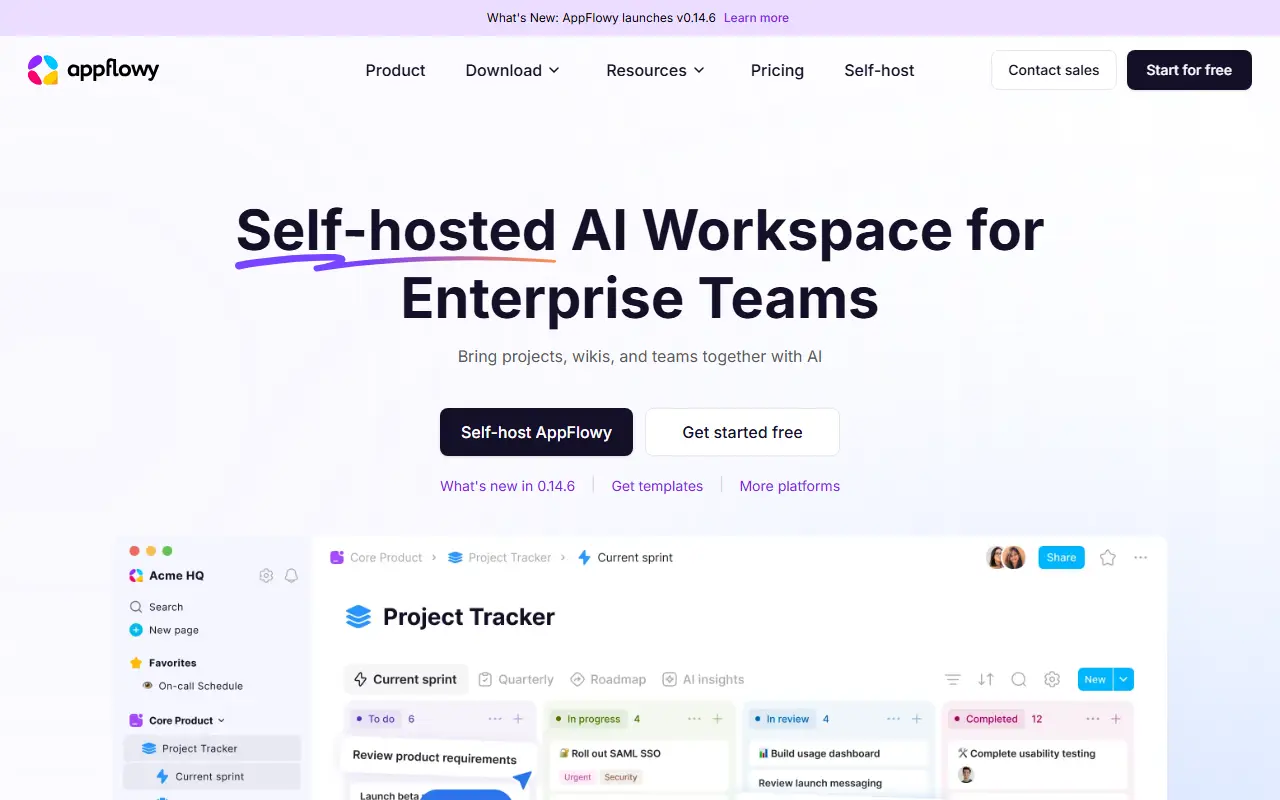
AppFlowy is an open-source workspace that brings documents, wikis, project and task management and team collaboration into one app. It is presented as an alternative to Notion, and its topics also tag it as a Confluence alternative, with the emphasis on keeping control of your own data.

The client is built with Flutter and a Rust core, giving apps for macOS, Windows and Linux plus iOS and Android versions. Desktop builds can be downloaded directly or from channels such as Flathub and Snapcraft. AI features are part of the workspace, and a public roadmap and active forum let users propose features. Translations are contributed through JSON files and tools such as inlang.

The project is AGPL-3.0 licensed and has documentation for self-hosting the server side, so organizations can keep content on their own infrastructure. A hosted version is available through appflowy.com for people who do not want to run servers. It suits teams looking for a Notion-style workspace with a privacy-first stance.

Key features

  • Notes, wikis and documentation in one workspace
  • Project and task management
  • AI features built into the workspace
  • Apps for desktop, iOS and Android
  • Self-hosting option for your own data
  • Public roadmap and community translations

Pricing: Free plan for up to 2 members. Pro costs $12.50 per user per month, or $10 billed annually. Self-hosted plans range from Free to Enterprise but their prices are not listed.

AFFiNE

A privacy-focused, local-first workspace that merges docs, whiteboards and tables on one canvas, positioned as an open-source alternative to Notion and Miro.

GitHub stars
74k
Last commit
yesterday
Latest release
v0.27.4
Self-hosted
Yes
Hosted version
Available
affine.proAFFiNE homepage screenshot

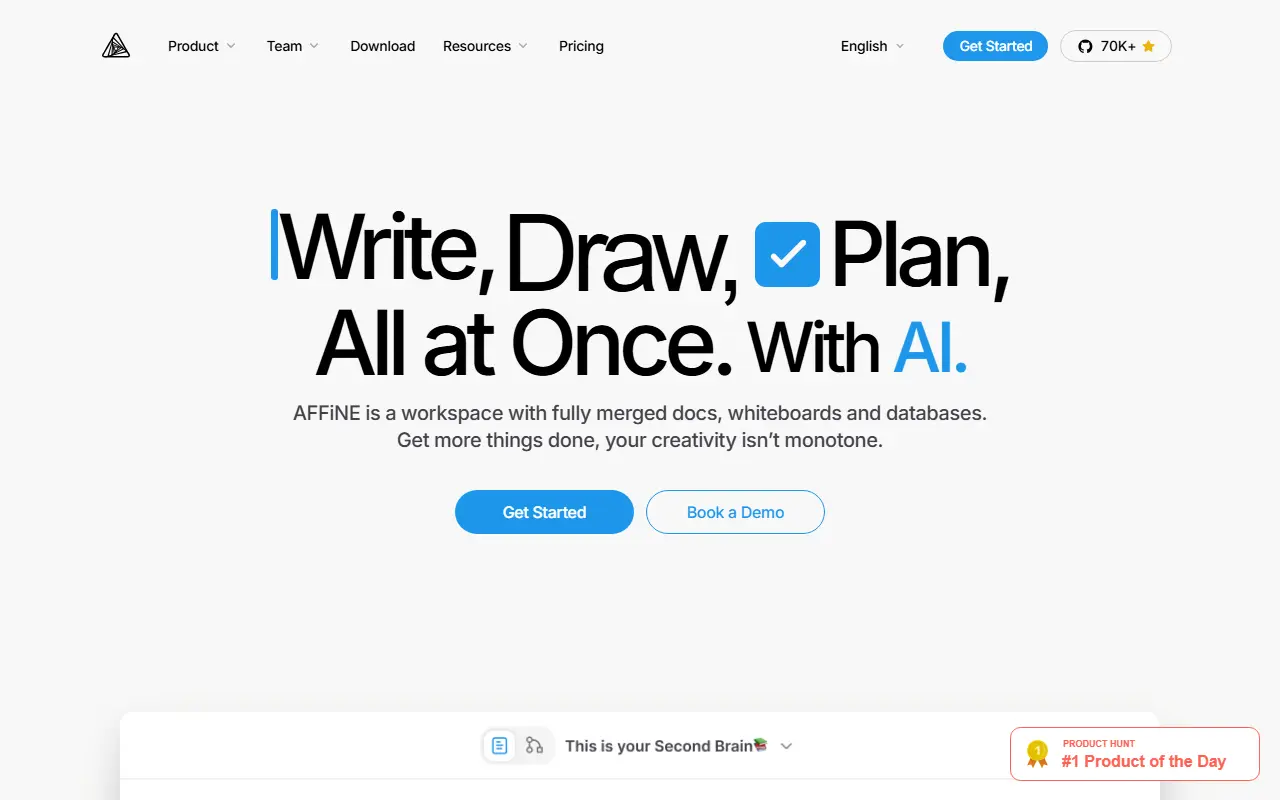
AFFiNE is an open-source workspace that combines writing, drawing and planning in a single app. Documents, an edgeless whiteboard and table views share the same blocks, so you can place rich text, sticky notes, embedded web pages, database views, linked pages, shapes and even slides anywhere on one canvas. It is presented as an alternative to Notion and Miro.

The project stresses local-first storage, meaning your data lives on your own device first, together with real-time collaboration. A multimodal AI assistant helps write reports, turn outlines into slides, summarize articles into mind maps and organize tasks. Under the hood it uses CRDTs for syncing and is built mostly in TypeScript and Rust, with Electron for the desktop app. It also supports Markdown, wiki and knowledge-base use, and presentations.

AFFiNE's license is listed as 'Other' on GitHub, so review it before commercial use. There is a live demo and documentation on the project site, a hosted version is available, and the app can also be self-hosted.

Key features

  • Docs, whiteboard and tables on one canvas
  • Local-first data storage on your device
  • Real-time multi-user collaboration
  • AI assistant for writing, slides and mind maps
  • Markdown editing and linked pages
  • Desktop app built on Electron

Pricing: Free plan with local use and 10 GB of cloud storage. Pro is $6.75 per month and Team $10 per seat per month; a $499.99 one-time Believer plan exists and Enterprise is custom-priced.

Poznote

Self-hosted, open-source note-taking web app run with Docker, offered as an alternative to Notion, Obsidian, Evernote and OneNote.

GitHub stars
1k
Last commit
yesterday
Latest release
6.147.1
Licence
MIT
Self-hosted
Yes
Hosted version
Available
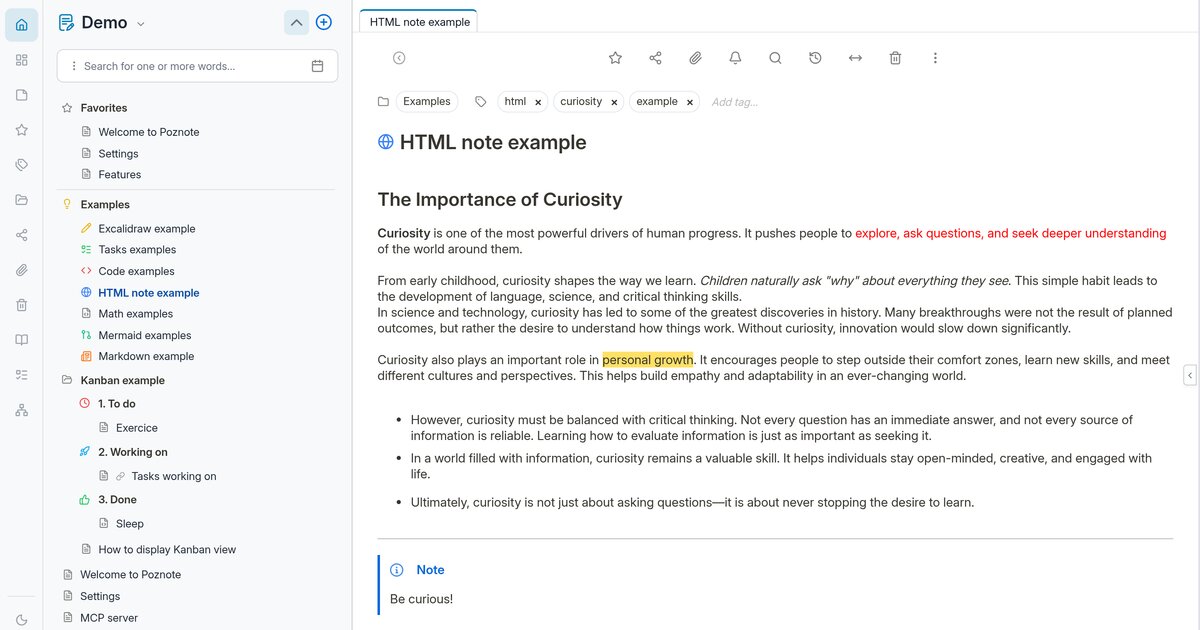
poznote.comPoznote homepage screenshot

Poznote is a note-taking web application that you run on your own server. The README presents it as a free, self-hosted, open-source alternative to Notion, Obsidian, Evernote or OneNote, and the repository topics list notes, tasks, a todo list and wiki use.

The recommended install uses Docker Compose: you download an environment file and a compose file, pull the Poznote web server and MCP images, and start the containers. The official image is multi-arch, so it runs on linux/amd64 and linux/arm64, including Raspberry Pi and NAS devices. A Proxmox VE community script and a community Helm chart for Kubernetes are described as other routes, and a hosting company can run it for people who do not want to manage a server.

Key features

  • Self-hosted alternative to several note-taking apps
  • Multi-user support with sharing and collaboration
  • Different note types, revisions and personalization
  • AI assistant, speech-to-text transcription and an MCP server
  • Chrome extension and an Android share target
  • Backup, export, restore and import options
  • Public demo instance to try before installing

Joplin

A free, open-source, offline-first note-taking and to-do app with Markdown notes, end-to-end encrypted sync, plugins and apps for desktop and mobile.

GitHub stars
57k
Last commit
today
Latest release
v3.7.22
Self-hosted
Yes
Hosted version
Available
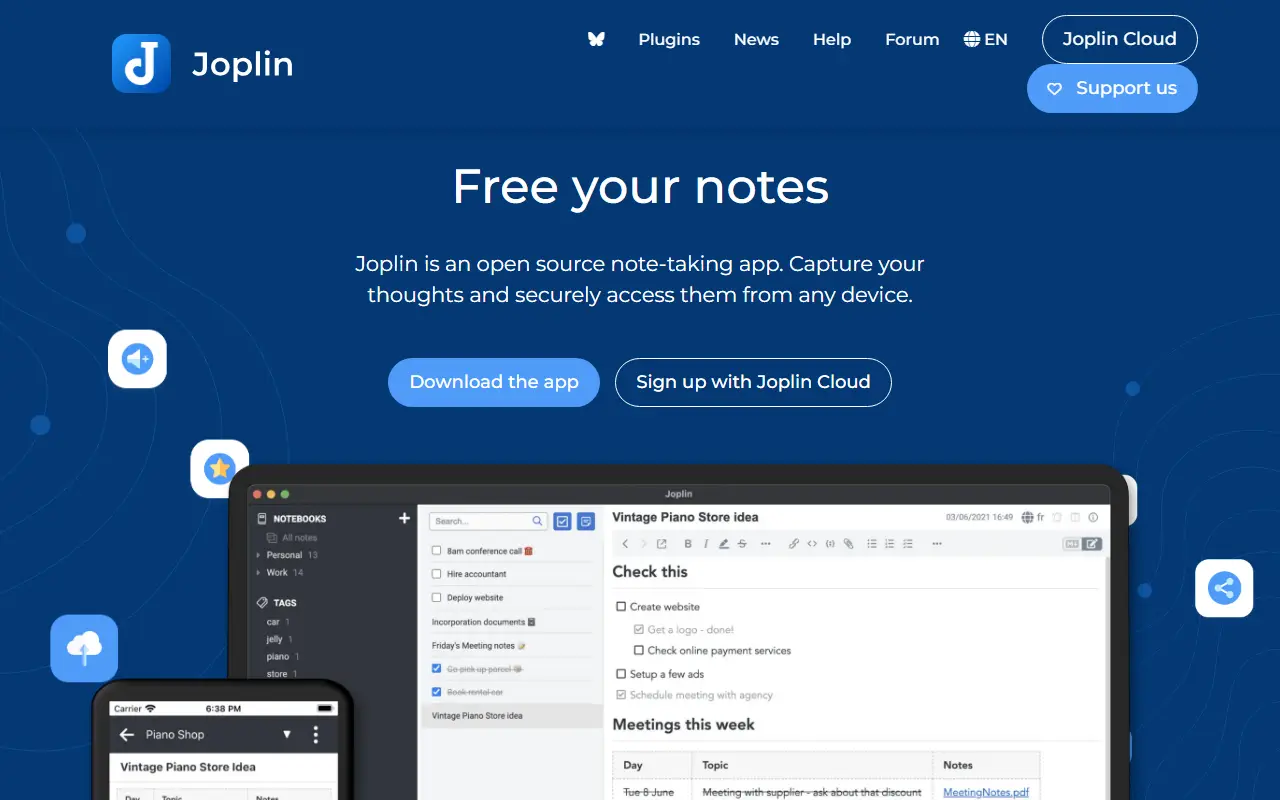
joplinapp.orgJoplin homepage screenshot

Joplin is a note-taking and to-do application, free and open source, that can manage large collections of notes organized into notebooks. Notes are written in Markdown, are searchable, can be tagged, and can be edited either in the app or in your own text editor. Apps are available for Windows, macOS, Linux, Android and iOS.

The app is offline first, so all your data lives on your phone or computer and stays accessible without a connection. Notes can be synchronized with end-to-end encryption through services such as Nextcloud, Dropbox, OneDrive and Joplin Cloud, and topics also mention WebDAV. Full-text search is available on every platform, and plugins and themes let you customize the app. A web clipper saves pages, and notes exported from Evernote can be imported with formatting, attachments and metadata intact; plain Markdown files can be imported as well.

The repository license is listed as 'Other', so check its terms if you plan to redistribute. Joplin is a popular choice for people who want an Evernote replacement that keeps data local or on storage they already control.

Key features

  • Markdown notes organized into notebooks
  • Offline-first storage on your own devices
  • End-to-end encrypted sync via Nextcloud, Dropbox or OneDrive
  • Evernote import with attachments and metadata
  • Plugins and themes
  • Web clipper for saving pages
  • Apps for desktop and mobile

Pricing: Joplin Cloud costs 2.99€ (Basic), 5.99€ (Pro) or 9.99€ (Pro 100 GB) per month, and Teams 7.99€ per user per month. Self-hosted Server Business is 3.33€ per user per month; 14-day trial.

Trilium Notes

A cross-platform hierarchical note-taking app for building large personal knowledge bases, with a rich editor, note cloning, versioning and scripting.

GitHub stars
39k
Last commit
today
Latest release
v0.107.0
Licence
AGPL-3.0
Self-hosted
Yes
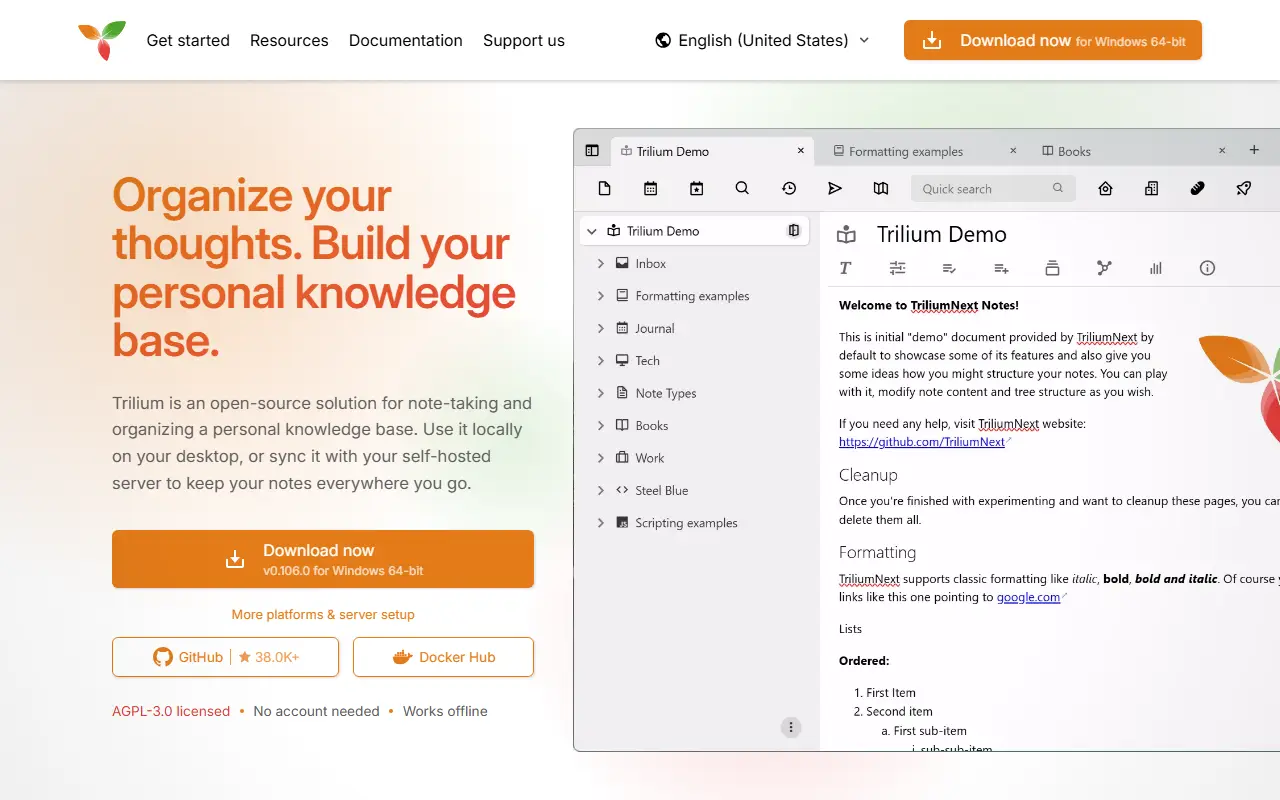
triliumnotes.orgTrilium Notes homepage screenshot

Trilium Notes is a free, open-source, cross-platform note-taking application focused on building large personal knowledge bases. Notes are arranged in a tree of arbitrary depth, and a single note can be cloned into several places in the tree, which lets you organize the same material along different lines without duplicating it.

The editor is a rich WYSIWYG one with tables, images, math and Markdown autoformatting, and there is also support for source code notes with syntax highlighting. Navigation relies on fast jumps between notes, full-text search and note hoisting. Notes are versioned automatically, and attributes can be used to organize, query and script notes. The interface is available in several languages, and built-in documentation opens with F1.

The project, now maintained as TriliumNext, is AGPL-3.0 licensed and built with TypeScript and Electron. It provides desktop builds as well as a server setup with Docker, so you can keep your notes on your own hardware. Stable releases are recommended, with nightly builds available for those who want the newest changes.

Key features

  • Arbitrarily deep note tree with cloning
  • WYSIWYG editor with tables, images and math
  • Code notes with syntax highlighting
  • Full-text search and note hoisting
  • Automatic note versioning
  • Attributes and scripting for advanced use
  • Docker server setup

Pricing: Free and open source under the AGPL-3.0 license.

SiYuan

A privacy-first, self-hostable personal knowledge management system with block-level references, Markdown WYSIWYG editing, flashcards and optional AI chat.

GitHub stars
47k
Last commit
today
Latest release
v3.8.10
Licence
AGPL-3.0
Self-hosted
Yes
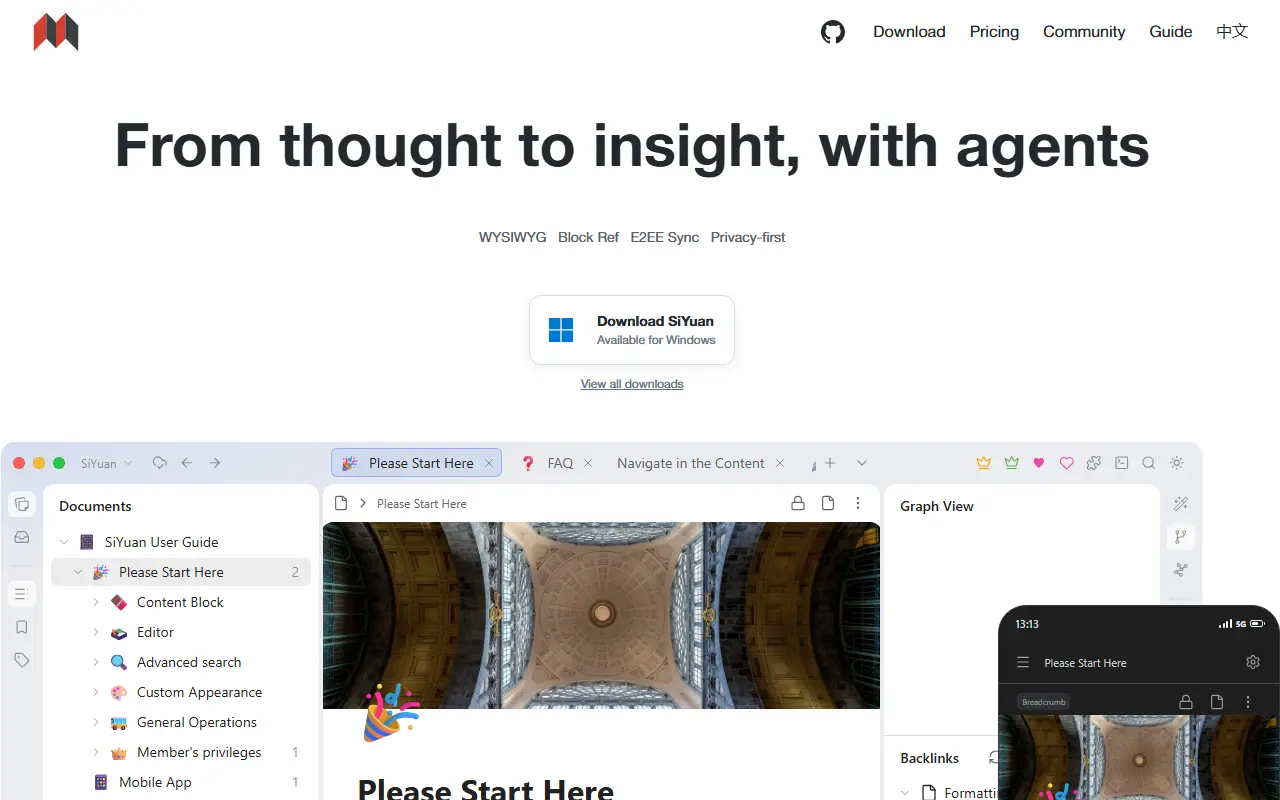
b3log.orgSiYuan homepage screenshot

SiYuan is an open-source, privacy-first personal knowledge management system. Its distinctive feature is fine-grained, block-level referencing: any block can be linked to or embedded elsewhere, with two-way links, custom attributes and SQL query embeds. Editing is Markdown WYSIWYG, and the project describes itself as a workspace where humans and AI agents work together. It is local-first and self-hostable.

The editor supports block-style writing, list outlines, block zoom-in, very large documents, math formulas, charts, flowcharts and Gantt charts. Web clipping, PDF annotation links, flashcards with spaced repetition, a database table view, Tesseract OCR and multi-tab split-screen layouts are included. You can export blocks and embeds, standard Markdown with assets, or PDF, Word and HTML. AI writing and Q and A chat can use the OpenAI API, and template and JavaScript or CSS snippets allow customization.

SiYuan is AGPL-3.0 licensed and available as desktop apps, mobile apps for Android, iOS and HarmonyOS, an installation package, a package manager, and Docker, Kubernetes, Unraid and TrueNAS hosting. A command line interface and an app market for extensions exist. Most features are free, even for commercial use.

Key features

  • Block-level references and two-way links
  • Markdown WYSIWYG editor
  • Flashcards with spaced repetition
  • SQL query embeds and database table views
  • Export to Markdown, PDF, Word and HTML
  • AI writing and Q and A chat
  • Docker, Kubernetes and mobile apps

Pricing: Most features are free, even for commercial use; check the project FAQ for any paid options.

Logseq

A privacy-first, local-first knowledge management app built around linked, outliner-style notes in Markdown or Org-mode, with a graph view and plugin support.

GitHub stars
46k
Last commit
today
Latest release
2.0.2
Licence
AGPL-3.0
Self-hosted
Yes
logseq.comLogseq homepage screenshot

Logseq is an open-source platform for knowledge management and collaboration that puts privacy and local storage first. Notes are organized as linked blocks in an outliner, forming a knowledge graph, and topics show it works with both Markdown and Org-mode files and can be backed by Git.

The project is moving toward a database-backed version that introduces DB graphs. That version is in beta, comes with a new iOS mobile app in alpha and a Real Time Collaboration approach to syncing graphs across devices or working with others, also in alpha. Because data loss is possible while these features mature, the maintainers recommend automated backups. A plugin API, themes and a public roadmap round out the ecosystem.

Logseq is written in Clojure and ClojureScript under the AGPL-3.0 license, and desktop builds are available from the releases page. It appeals to researchers, students and knowledge workers who want a personal wiki with bidirectional links and full ownership of their files.

Key features

  • Outliner-style linked notes
  • Markdown and Org-mode support
  • Knowledge graph of connected pages
  • Local-first storage with Git compatibility
  • Plugin API and themes
  • Real Time Collaboration sync in alpha

Pricing: Free and open source under the AGPL-3.0 license.

27 more Notion alternatives

Commercial Notion alternatives

Hosted, closed-source products that compete with Notion. Showing 12 of 185.

See every Notion alternative on its tool page

Notion alternatives: questions

What is the best open-source alternative to Notion?
Macro is the top-ranked open-source alternative to Notion on Enlisted: Macro is an open-source team workspace that brings email, chat, documents, tasks, AI agents, calls and CRM together with shared AI memory. Other strong options are Alexandrie, EdgeEver, AppFlowy and AFFiNE.
What are the best commercial alternatives to Notion?
Nuclino, Coda, Craft, Slite and Confluence are among the hosted, closed-source alternatives to Notion listed on Enlisted, which lists 185 in total. Compare their pricing and features on each tool page.
Are these Notion alternatives free?
All 37 are open source, so the code is free to use under its licence, and all of them can be self-hosted on your own server or computer. 13 also offer a paid or managed cloud version if you'd rather not host it yourself.
How is this list of Notion alternatives ranked?
By a score built from GitHub stars, star growth over the last 30 days and how recently the code changed. 30 of these projects shipped code in the last 30 days. Data is refreshed daily, and nobody can pay to move up.

People also look for alternatives to…

View all