 TrackMedia
 TrackRev

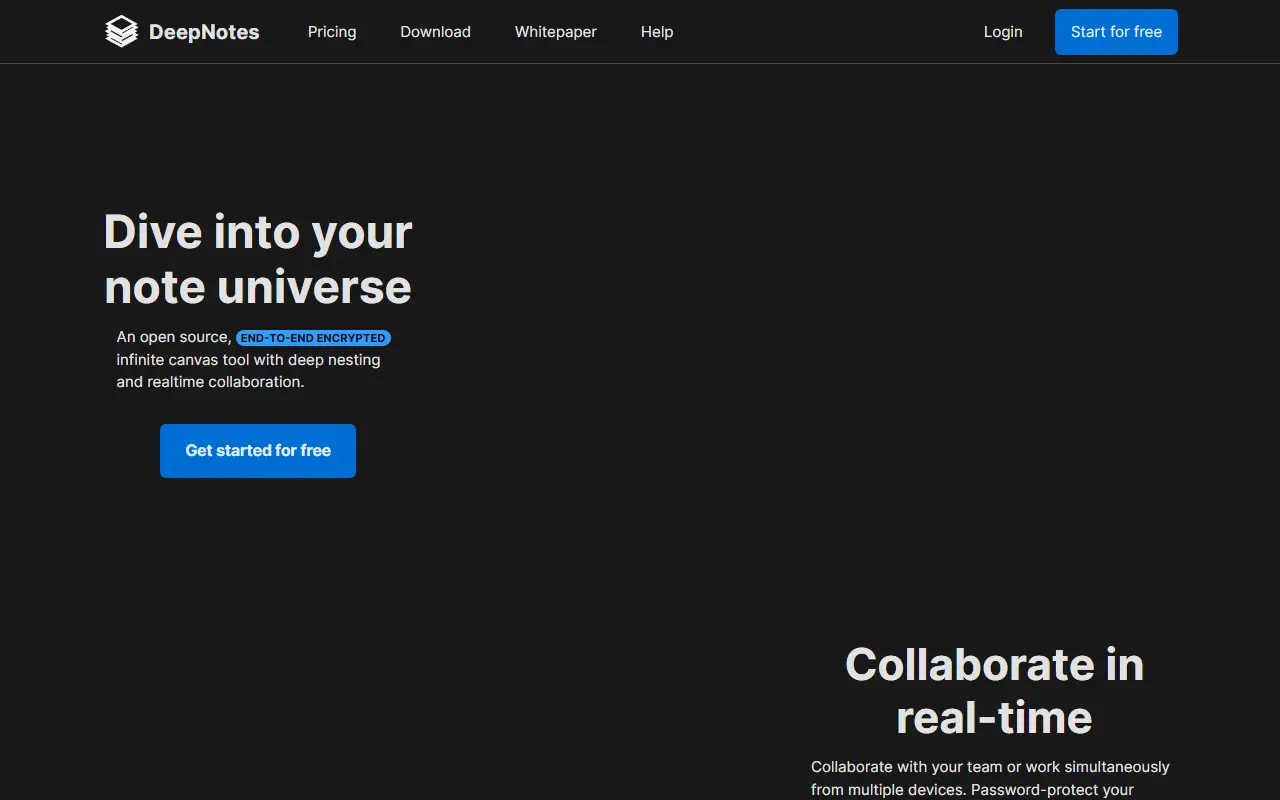
About DeepNotes
DeepNotes is an open-source note-taking tool built around an infinite canvas rather than a linear document. Pages can be nested to any depth, so ideas can be explored in detail without crowding a single surface, and notes are protected with end-to-end encryption.
Users can create groups to collaborate in realtime, organize notes in whatever structure suits them, and rely on what the project calls lifelong storage. The codebase is TypeScript, using Vue and the Quasar framework, Yjs for collaboration, Tiptap for rich text, and KeyDB or Redis for shared memory and communication.
According to its development commands, the same code can be run as a single-page app, a server-side rendered app, an Electron desktop app, or Android and iOS builds. DeepNotes is released under AGPL-3.0, and a hosted version is available at deepnotes.app.
Key features
- Infinite canvas for visual notes
- Deep nesting of pages within pages
- End-to-end encrypted note storage
- Realtime collaboration for groups
- Rich text editing
- Web, desktop and mobile app builds
Good fit for
- Private visual note-taking
- Team brainstorming on a shared canvas
DeepNotes: questions and answers
- What is DeepNotes used for?
- DeepNotes is an AGPL-licensed, end-to-end encrypted infinite-canvas note tool with deeply nested pages and realtime team collaboration. It is a good fit for private visual note-taking and team brainstorming on a shared canvas.
- Is DeepNotes open source?
- Yes. DeepNotes is open source under the AGPL-3.0 licence. Its source code is on GitHub at DeepNotesApp/DeepNotes and is written mainly in TypeScript.
- Is DeepNotes free?
- Yes. DeepNotes is open source, so the software itself is free to use. A managed cloud version is also available, with paid plans from $4.99 per month.
- Can I self-host DeepNotes?
- Yes. DeepNotes can be self-hosted on your own server or infrastructure.
- What is DeepNotes an alternative to?
- DeepNotes is an open-source alternative to Notion, Heptabase, Kinopio and Supernotes. Other open-source alternatives to Notion include AFFiNE, Logseq and Joplin.
- Is DeepNotes actively maintained?
- The most recent commit to DeepNotes was on 2 June 2026, and the latest release is v1.0.25, published on 2 February 2024. The project has 609 stars on GitHub, with 4 added in the last 30 days.
Open-source alternatives to DeepNotes
See all
AFFiNE
Note Taking
There can be more than Notion and Miro. AFFiNE(pronounced [ə‘fain]) is a next-gen knowledg
OSSvs Notion★ 74k
Logseq
Note Taking
A privacy-first, open-source platform for knowledge management and collaboration. Download
AGPL-3.0vs Notion★ 46k
Joplin
Note Taking
Joplin - the privacy-focused note taking app with sync capabilities for Windows, macOS, Li
OSSvs Evernote★ 57k
TiddlyWiki
Note Taking
A self-contained JavaScript wiki for the browser, Node.js, AWS Lambda etc.
OSSvs Notion★ 8.7k
Revezone
Note Taking
A lightweight local-first graphic-centric productivity tool to build your second brain. S
AGPL-3.0vs Heptabase★ 2.7k
Standard Notes
Note Taking
Think fearlessly with end-to-end encrypted notes and files. For issues, visit https://stan
AGPL-3.0vs Evernote★ 6.7k
SaaS alternatives to DeepNotes
See all
Notion
Note Taking
Notion is an AI-enabled workspace for notes, docs, wikis and projects, with agents, meeting notes and search across connected apps.
SaaS
Heptabase
Note Taking
Visual note app that arranges cards on whiteboards for research and learning
SaaS
Kinopio
Note Taking
Spatial canvas for arranging notes, links and ideas
SaaS
Supernotes
Note Taking
Card-based note app with real-time collaboration
SaaS
Melo
Note Taking
Productivity canvas that keeps notes, tasks, AI and tools together on a single board
SaaS
Scrintal
Note Taking
Visual note-taking and knowledge mapping tool using connected cards on a canvas
SaaS