#1
An open-source virtual whiteboard for sketching diagrams and wireframes in a hand-drawn style, with real-time collaboration and end-to-end encryption.
- GitHub stars
- 136k
- Last commit
- today
- Latest release
- v0.18.1
- Licence
- MIT
- Self-hosted
- Yes
- Hosted version
- Available
excalidraw.com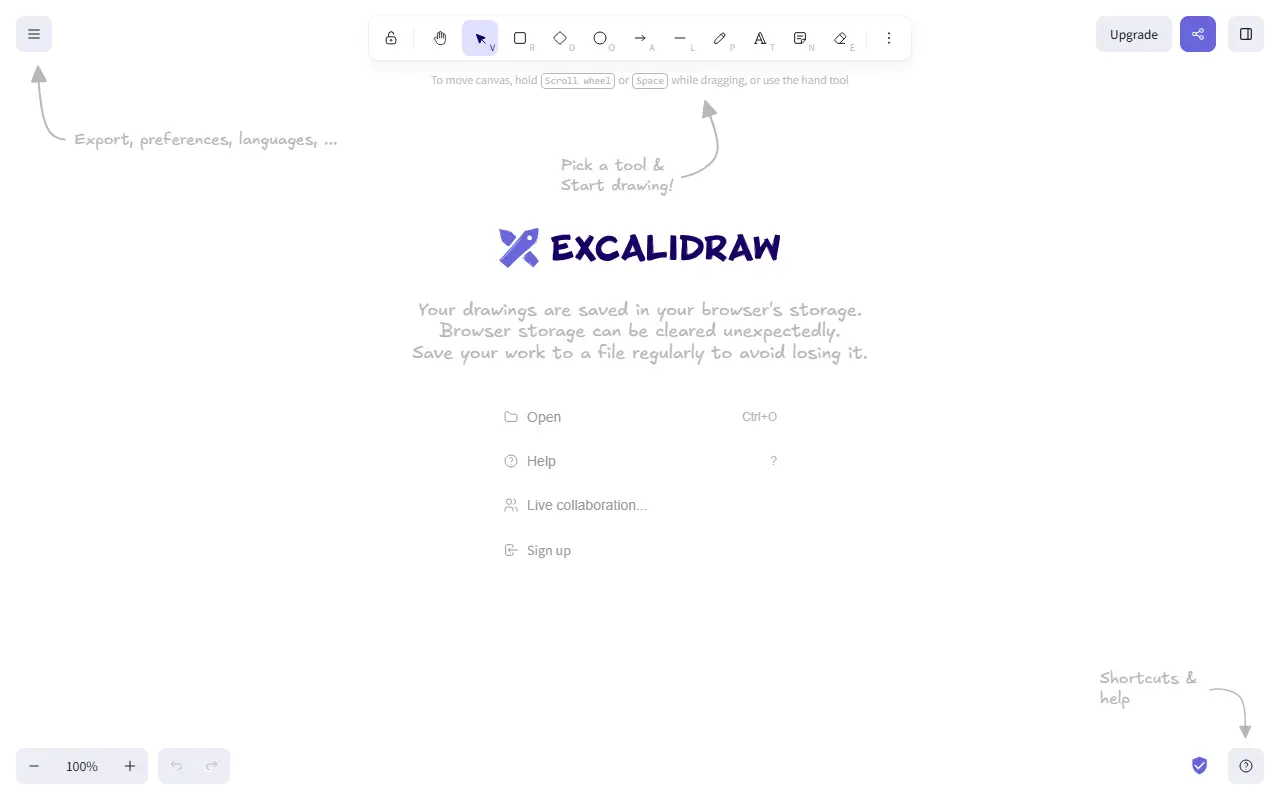
Excalidraw is a browser-based whiteboard that renders shapes, arrows and text in a deliberately hand-drawn style, which makes diagrams feel like quick sketches rather than polished slides. It is used for architecture diagrams, wireframes, brainstorming and teaching, and works on an infinite canvas with zoom and pan.
The editor offers rectangles, circles, diamonds, arrows, lines, free-draw and an eraser, along with labeled arrows that stay bound to shapes, image support, shape libraries, dark mode and undo and redo. Drawings export to PNG, SVG or the clipboard, or to an open JSON-based .excalidraw file. The hosted app adds real-time collaboration with end-to-end encryption, offline use as a progressive web app, autosave in the browser and shareable read-only links.
The editor is also published as an npm package under the MIT license, so developers can embed it in their own products and customize it. A separate paid plan, Excalidraw+, is linked from the project for people who want a hosted workspace.
Key features
- Infinite canvas with hand-drawn style shapes
- Real-time collaboration with end-to-end encryption
- Export to PNG, SVG or open .excalidraw files
- Shape libraries and image support
- Works offline as a progressive web app
- Embeddable editor package on npm
Pricing: Free and open source under the MIT license; excalidraw.com is free to use, and a paid Excalidraw+ plan is also offered.
#2
A privacy-focused, local-first workspace that merges docs, whiteboards and tables on one canvas, positioned as an open-source alternative to Notion and Miro.
- GitHub stars
- 74k
- Last commit
- yesterday
- Latest release
- v0.27.4
- Self-hosted
- Yes
- Hosted version
- Available
affine.pro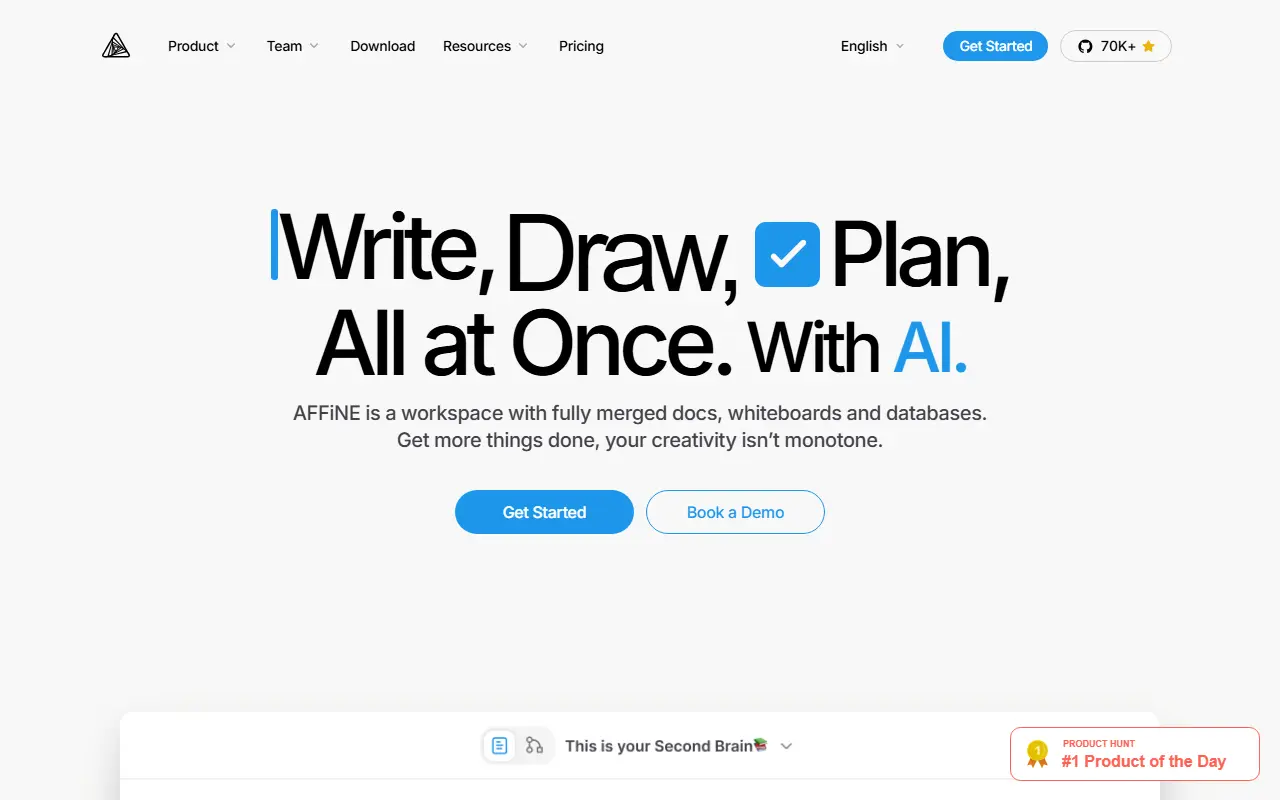
AFFiNE is an open-source workspace that combines writing, drawing and planning in a single app. Documents, an edgeless whiteboard and table views share the same blocks, so you can place rich text, sticky notes, embedded web pages, database views, linked pages, shapes and even slides anywhere on one canvas. It is presented as an alternative to Notion and Miro.
The project stresses local-first storage, meaning your data lives on your own device first, together with real-time collaboration. A multimodal AI assistant helps write reports, turn outlines into slides, summarize articles into mind maps and organize tasks. Under the hood it uses CRDTs for syncing and is built mostly in TypeScript and Rust, with Electron for the desktop app. It also supports Markdown, wiki and knowledge-base use, and presentations.
AFFiNE's license is listed as 'Other' on GitHub, so review it before commercial use. There is a live demo and documentation on the project site, a hosted version is available, and the app can also be self-hosted.
Key features
- Docs, whiteboard and tables on one canvas
- Local-first data storage on your device
- Real-time multi-user collaboration
- AI assistant for writing, slides and mind maps
- Markdown editing and linked pages
- Desktop app built on Electron
Pricing: Free plan with local use and 10 GB of cloud storage. Pro is $6.75 per month and Team $10 per seat per month; a $499.99 one-time Believer plan exists and Enterprise is custom-priced.
#3
A privacy-first, local-first knowledge management app built around linked, outliner-style notes in Markdown or Org-mode, with a graph view and plugin support.
- GitHub stars
- 46k
- Last commit
- today
- Latest release
- 2.0.2
- Licence
- AGPL-3.0
- Self-hosted
- Yes
logseq.com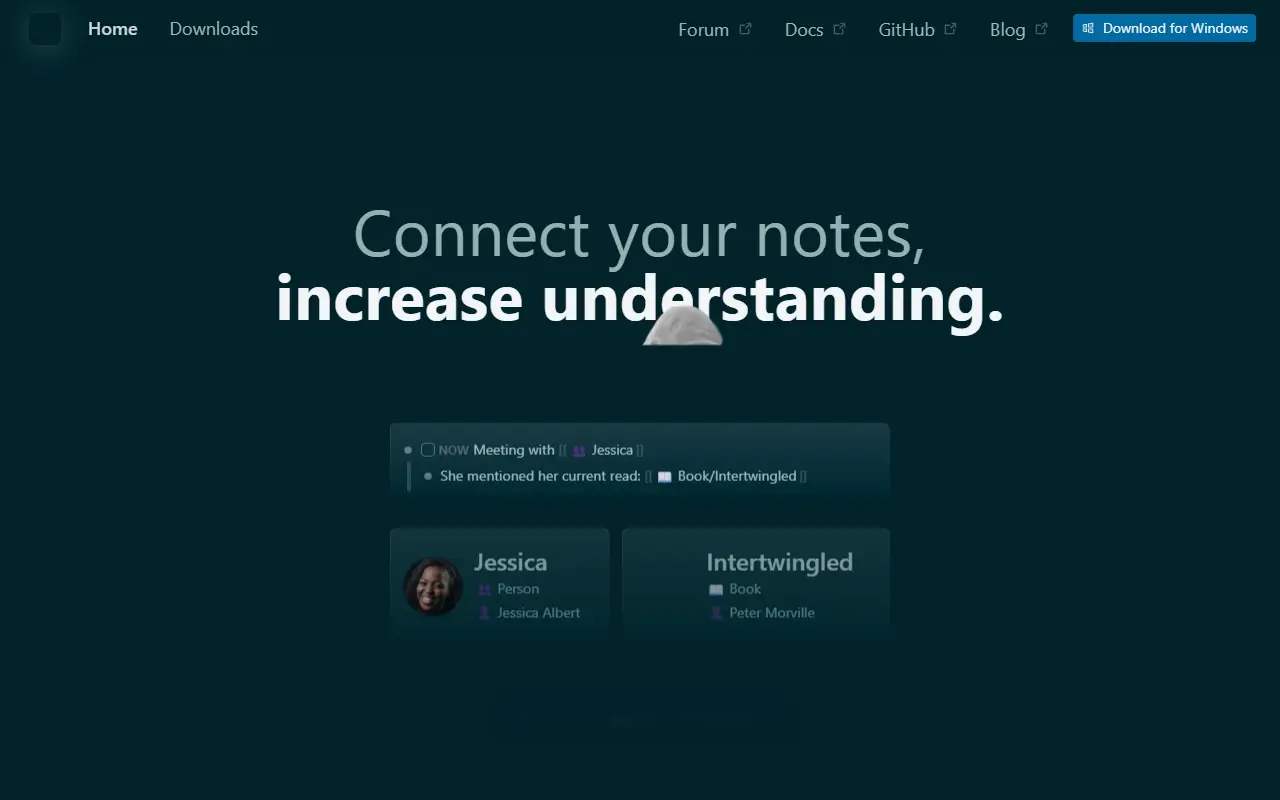
Logseq is an open-source platform for knowledge management and collaboration that puts privacy and local storage first. Notes are organized as linked blocks in an outliner, forming a knowledge graph, and topics show it works with both Markdown and Org-mode files and can be backed by Git.
The project is moving toward a database-backed version that introduces DB graphs. That version is in beta, comes with a new iOS mobile app in alpha and a Real Time Collaboration approach to syncing graphs across devices or working with others, also in alpha. Because data loss is possible while these features mature, the maintainers recommend automated backups. A plugin API, themes and a public roadmap round out the ecosystem.
Logseq is written in Clojure and ClojureScript under the AGPL-3.0 license, and desktop builds are available from the releases page. It appeals to researchers, students and knowledge workers who want a personal wiki with bidirectional links and full ownership of their files.
Key features
- Outliner-style linked notes
- Markdown and Org-mode support
- Knowledge graph of connected pages
- Local-first storage with Git compatibility
- Plugin API and themes
- Real Time Collaboration sync in alpha
Pricing: Free and open source under the AGPL-3.0 license.
#4
Ideon is a self-hosted visual workspace where notes, files, repositories and to-dos live together on a shared infinite canvas.
- GitHub stars
- 680
- Last commit
- 8 days ago
- Latest release
- v1.1.1
- Licence
- AGPL-3.0
- Self-hosted
- Yes
theideon.com
Ideon is a self-hosted visual workspace for projects. Instead of abstract folders and tabs, it uses spatial organization: you place blocks on a shared infinite canvas, and what sits close together is related, so a project's repositories, design notes and tasks can be seen on a single map.
Blocks can hold Markdown notes, images, links, files and to-dos, and live integrations embed repositories and issues from GitHub, GitLab, Gitea and Forgejo directly on the canvas. Teams can collaborate in real time, and a time travel feature shows historical snapshots of the workspace to trace past decisions. A hosted demo is available to try without setup.
Ideon runs with Docker and Docker Compose, using a PostgreSQL database and a persistent storage volume, and there is a one-click template for the Easypanel deployment platform. You set a secret key in an environment file before starting the stack and open the dashboard on port 3000. It is written in TypeScript and licensed under AGPL-3.0.
Key features
- Infinite spatial canvas
- Embedded repositories and issues
- Markdown notes, images and files
- Real-time multiplayer collaboration
- Time travel snapshots
- Docker Compose self-hosting
Pricing: The open source edition is free to self-host with Docker. The managed Cloud and Enterprise plans have no published prices and are handled by contacting sales.
#5
A non-linear personal web notebook and wiki written in JavaScript that runs as a single HTML file in a browser or as a Node.js application.
- GitHub stars
- 8.7k
- Last commit
- 2 days ago
- Latest release
- v5.4.1
- Self-hosted
- Yes
tiddlywiki.com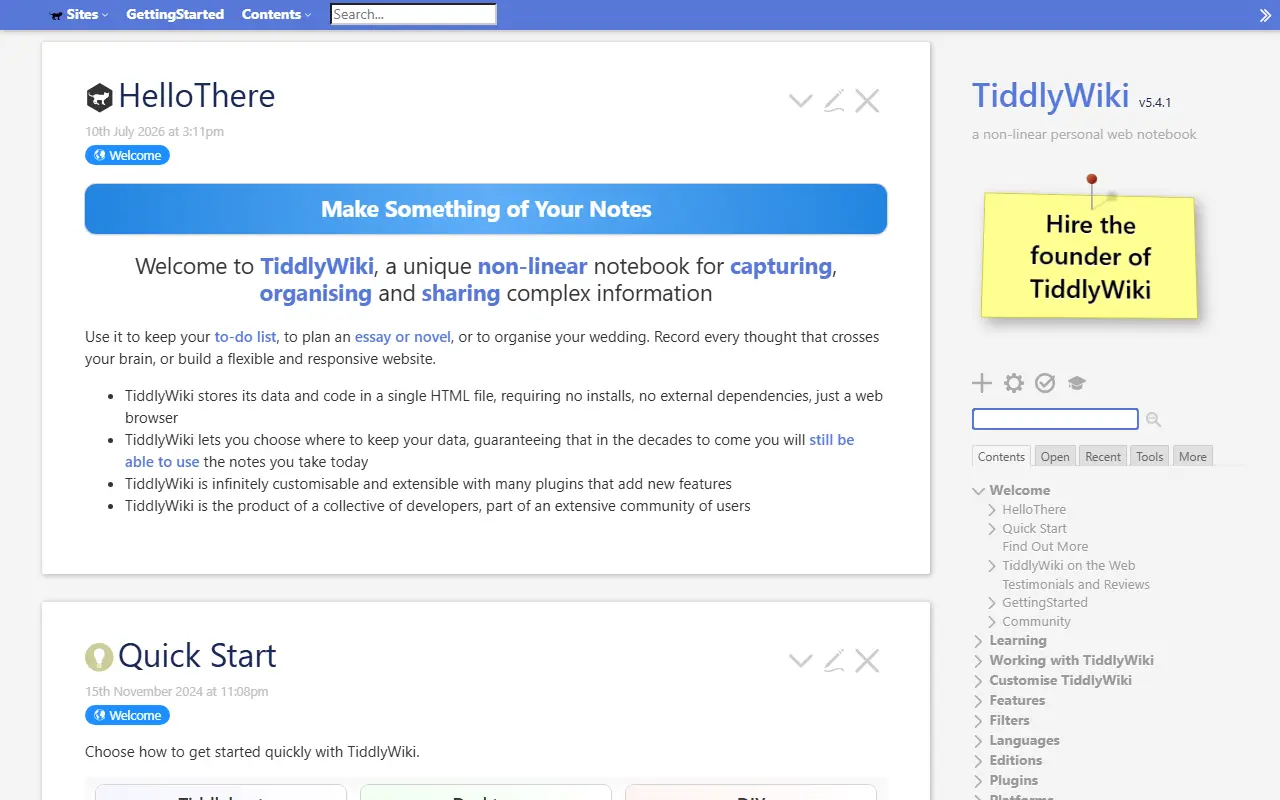
TiddlyWiki is a personal web notebook with a non-linear structure, usable by anyone and kept indefinitely without depending on any company. It is a complete interactive wiki written in JavaScript, in which content is stored as small units called tiddlers that can be linked, tagged and rearranged.
It can be used as one self-contained HTML file in the browser, or run as a Node.js application with a client and server setup for advanced users. The whole interface is implemented in WikiText, which makes it highly customizable, and there is a plugin ecosystem. The project description also mentions that it can run in places such as AWS Lambda.
The community talks on the Talk TiddlyWiki forum, a Google Group that dates back to 2005, GitHub Discussions, Reddit and Discord, and developer documentation is published on the project site. The repository lists the licence as Other. TiddlyWiki is suited to personal knowledge bases, journals, task lists and small documentation sets.
Key features
- Single-file HTML wiki
- Node.js client and server mode
- Non-linear linked notes called tiddlers
- User interface written in WikiText
- Plugins and community extensions
- Runs in browsers and on servers
Pricing: Free and open source; the repository lists the license as Other.
#6
Collaborative infinite-canvas drawing and note-taking app with no zoom limit, available as native desktop apps and in the browser, licensed under GPL-3.0.
- GitHub stars
- 536
- Last commit
- 17 days ago
- Latest release
- v0.6.3
- Licence
- GPL-3.0
- Hosted version
- Available
infinipaint.com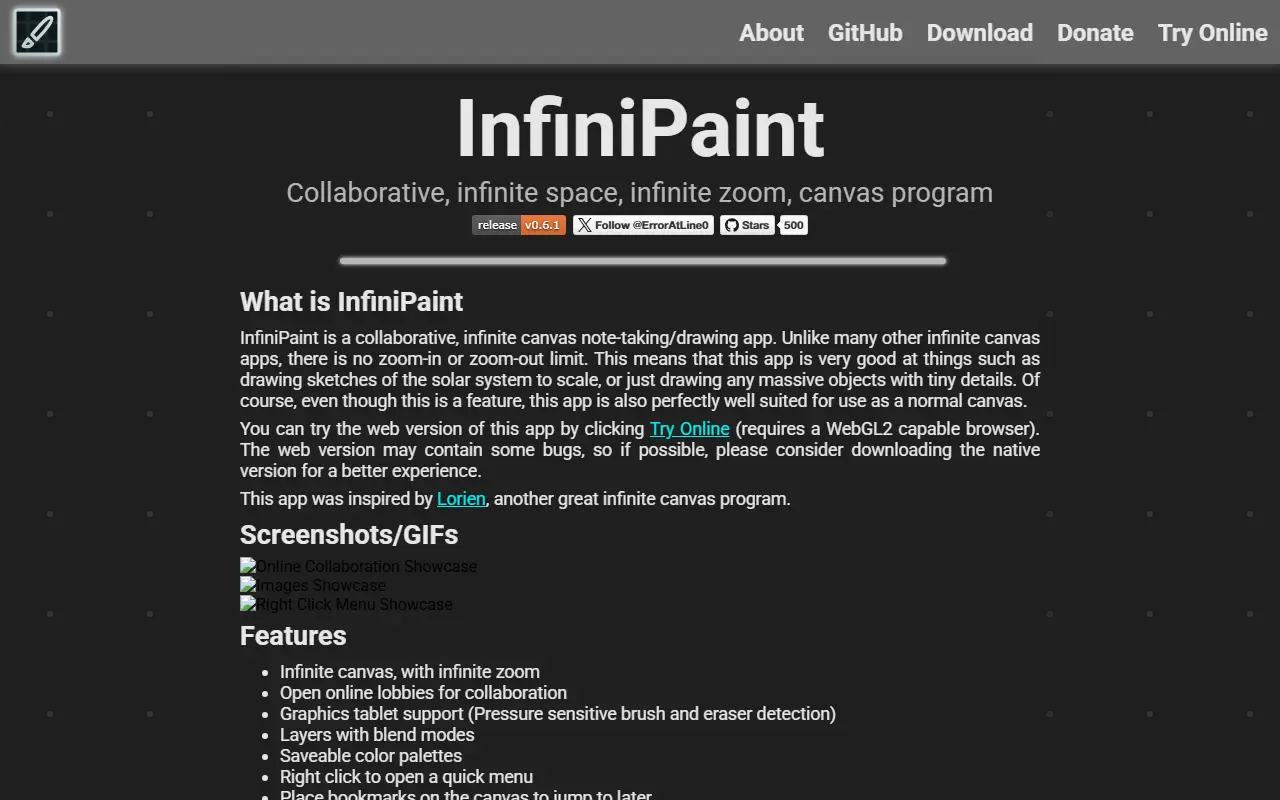
InfiniPaint is an open-source drawing and note-taking app built on an infinite canvas that you can zoom without a fixed limit, until your computer runs out of memory. That makes it handy for sketches that mix huge scale differences, such as a solar system drawn to scale, as well as for ordinary notes and doodles.
Collaboration is built in through online lobbies, which include text chat and the ability to jump to the position of other participants. The project is written in C++ and has a web version compiled with Emscripten that needs a WebGL2-capable browser, though the maintainer recommends the native build for a better experience. Drawing tablets are among the topics the project lists.
Native builds are offered for Windows (installer or portable zip), macOS on Apple Silicon, and Linux through Flathub or flatpak bundles. Files use the .infpnt extension. The author says it was inspired by the Lorien infinite canvas program, and the code is released under the GPL-3.0 licence.
Key features
- Infinite canvas with unlimited zoom
- Online lobbies for real-time collaboration
- Text chat and jump-to-user navigation
- Native apps for Windows, macOS and Linux
- Browser version built with Emscripten
- Tablet-friendly drawing and note-taking
Pricing: Free and open source under the GPL-3.0 licence.
#7
Freeplane is a free, open-source Java mind mapping and knowledge management application, positioned as an alternative to Xmind and MindMeister.
- GitHub stars
- 4.5k
- Last commit
- yesterday
- Latest release
- release-1.13.5
- Licence
- GPL-2.0
- Self-hosted
- Yes
freeplane.org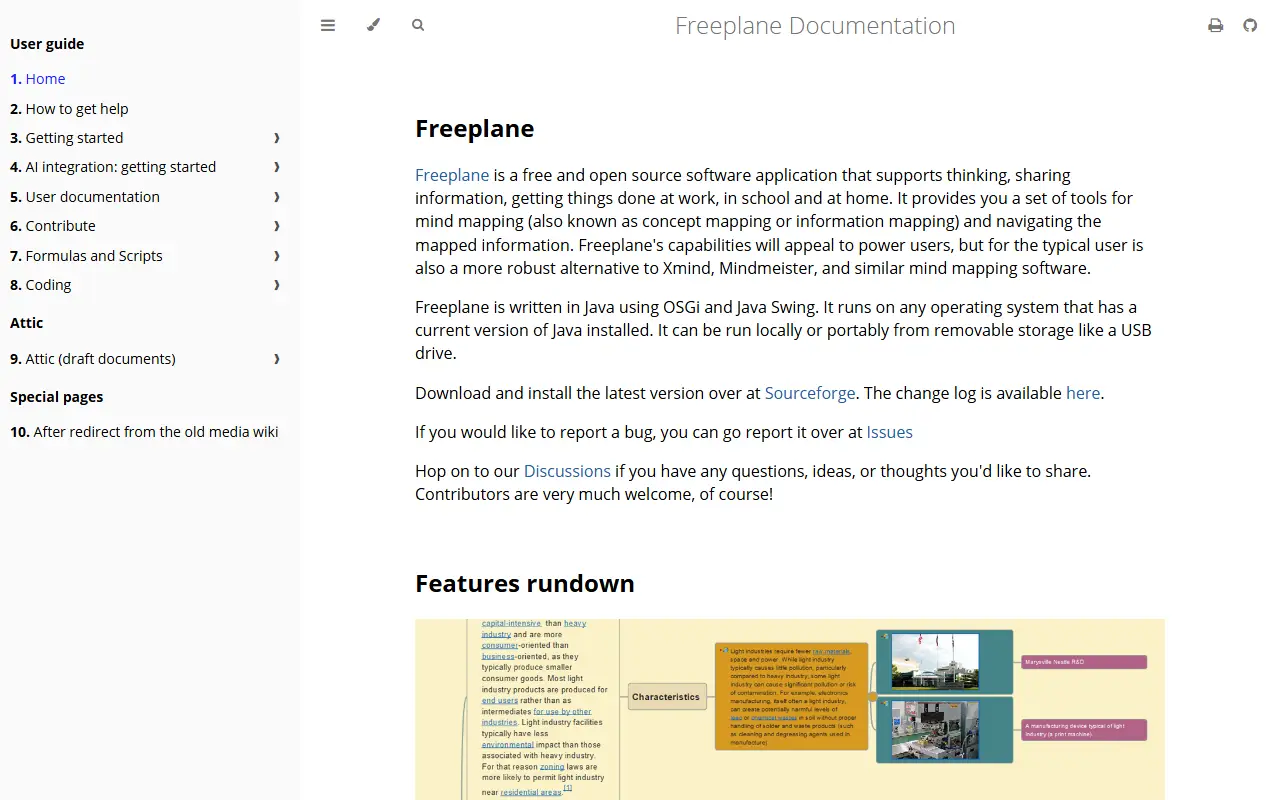
Freeplane is a free and open-source application that supports thinking, sharing information and getting things done, at work, at school and at home. It provides tools for mind mapping, also called concept mapping or information mapping, and for navigating the information you have mapped. It is also used for knowledge management and light project management.
The README presents it as an alternative to commercial mind mapping software such as Xmind and MindMeister, aimed at more demanding users. Capabilities hinted at by the repository topics include Groovy scripting, Markdown and LaTeX support, an outliner view, presentation features and writing aids. It is built in Java on OSGi with a Swing interface, so it runs on any operating system with a current Java installation, and it can run from removable storage such as a USB drive.
Freeplane is licensed under GPL-2.0 and runs locally on your computer, so there is no server or hosted version. It suits students, researchers, writers and teams that want a capable offline mind mapping tool.
Key features
- Mind and concept mapping
- Groovy scripting for automation
- Markdown and LaTeX support
- Outliner and presentation views
- Cross-platform Java application
- Runs from a USB drive
Pricing: Free and open source under GPL-2.0.
#8
Revezone is a free, AGPL-licensed, local-first productivity app combining Excalidraw and Tldraw whiteboards with a Notion-like note editor, for building a personal second brain.
- GitHub stars
- 2.7k
- Last commit
- yesterday
- Latest release
- 1.0.0-alpha.18
- Licence
- AGPL-3.0
- Self-hosted
- Yes
- Hosted version
- Available
revezone.com
Revezone is a lightweight, graphic-centric productivity tool aimed at people building a personal knowledge base, often described as a second brain. It is local-first, meaning notes and boards are stored in the browser or on the local machine rather than requiring a cloud account, and it is currently in public beta.
It combines whiteboard functions based on both Excalidraw and Tldraw with a WYSIWYG, Notion-like note editor that supports slash commands and Markdown syntax. Notes and boards can be organized into folders in a left sidebar, with flexible layout allowing users to sort directories and split the screen by dragging and dropping. The Excalidraw-based board also supports custom fonts and double-link connections to notes within the desktop app.
Revezone can be used online, with data stored in the browser, or as a downloadable desktop app with data stored locally. It is written in TypeScript and released under the AGPL-3.0 license. This repository contains only the basic functionality of the project, according to its README.
Key features
- Excalidraw and Tldraw whiteboard support
- Notion-like WYSIWYG note editor with Markdown
- Local-first data storage
- Folder-based organization of notes and boards
- Custom fonts and note linking on whiteboards
- Desktop app with local data storage
Pricing: Free and open source under the AGPL-3.0 license; an online version and a downloadable desktop app are both available.
Neurite is an open source mind-mapping workspace that combines a real-time fractal canvas with notes, web links and connected AI agents.
- GitHub stars
- 2.2k
- Last commit
- 8 mo ago
- Latest release
- electron-2025.06.18.233853
- Licence
- MIT
Neurite is an open source project that blends fractal visuals with mind-mapping. Nodes on the canvas can represent text, images, video, audio, webpages, PDFs and AI agents, and they are physics-simulated so they fall toward the fractal visualization.
The workspace lets you navigate fractals such as the Mandelbrot set in real time and customize color, quality and speed. On the AI side, multiple AI nodes can be connected for graph-based multi-agent conversation, and a Zettelkasten-style memory responds as a graph of thoughts with non-linear memory access.
Notes sync both ways between the visual workspace and text archives, with custom tags and formatting, and text nodes support code highlighting and execution. Wolfram Alpha and Wikipedia search results can appear as nodes. The README warns that it contains flashing lights and colors, and describes the project as in active development under the MIT licence.
Key features
- Real-time fractal zoom
- Multiple AI nodes in a conversation graph
- Two-way sync between canvas and text notes
- Custom note tags and formatting
- Code highlighting and execution in text nodes
- Nodes for text, images, video, audio, webpages and PDFs
- Wolfram Alpha and Wikipedia results as nodes

DeepNotes is an AGPL-licensed, end-to-end encrypted infinite-canvas note tool with deeply nested pages and realtime team collaboration.
- GitHub stars
- 609
- Last commit
- 5 mo ago
- Latest release
- v1.0.25
- Licence
- AGPL-3.0
- Hosted version
- Available
deepnotes.app
DeepNotes is an open-source note-taking tool built around an infinite canvas rather than a linear document. Pages can be nested to any depth, so ideas can be explored in detail without crowding a single surface, and notes are protected with end-to-end encryption.
Users can create groups to collaborate in realtime, organize notes in whatever structure suits them, and rely on what the project calls lifelong storage. The codebase is TypeScript, using Vue and the Quasar framework, Yjs for collaboration, Tiptap for rich text, and KeyDB or Redis for shared memory and communication.
According to its development commands, the same code can be run as a single-page app, a server-side rendered app, an Electron desktop app, or Android and iOS builds. DeepNotes is released under AGPL-3.0, and a hosted version is available at deepnotes.app.
Key features
- Infinite canvas for visual notes
- Deep nesting of pages within pages
- End-to-end encrypted note storage
- Realtime collaboration for groups
- Rich text editing
- Web, desktop and mobile app builds
Pricing: The Basic plan is free for up to 50 pages. Pro costs $4.99 per month for unlimited pages and collaborative groups, with 20% off on yearly billing.
Kinopio alternatives: questions
- What is the best open-source alternative to Kinopio?
- Excalidraw is the top-ranked open-source alternative to Kinopio on Enlisted: An open-source virtual whiteboard for sketching diagrams and wireframes in a hand-drawn style, with real-time collaboration and end-to-end encryption. Other strong options are AFFiNE, Logseq, Ideon and TiddlyWiki.
- What are the best commercial alternatives to Kinopio?
- Milanote, Muse, Scrintal, Heptabase and Whimsical are among the hosted, closed-source alternatives to Kinopio listed on Enlisted, which lists 16 in total. Compare their pricing and features on each tool page.
- Are these Kinopio alternatives free?
- All 10 are open source, so the code is free to use under its licence, and all of them can be self-hosted on your own server or computer. 5 also offer a paid or managed cloud version if you'd rather not host it yourself.
- How is this list of Kinopio alternatives ranked?
- By a score built from GitHub stars, star growth over the last 30 days and how recently the code changed. 8 of these projects shipped code in the last 30 days. Data is refreshed daily, and nobody can pay to move up.
 TrackMedia
 TrackRev