 TrackMedia
 TrackRev

 Roam Research
 Coggle
 MindMeister
 Xmind
 Whimsical
 Figma
 Trello
 Craft
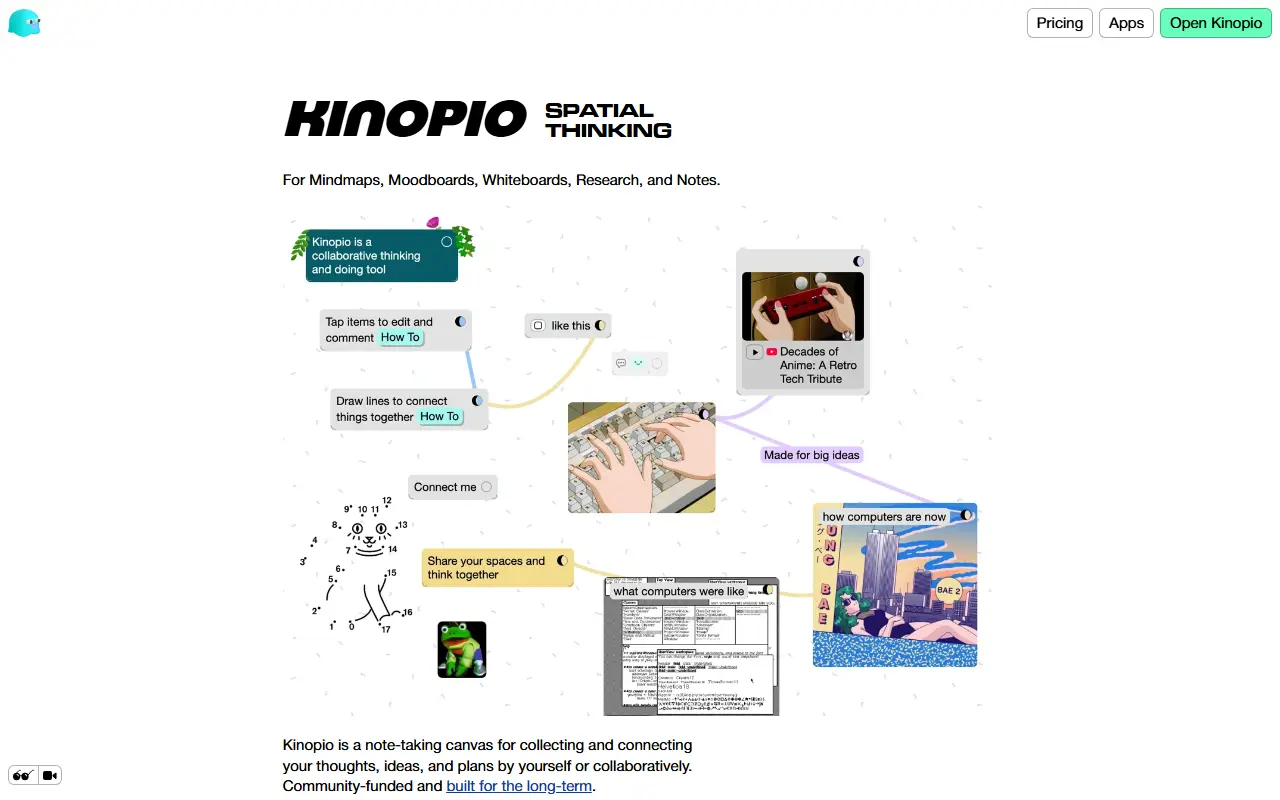
About Kinopio
Kinopio is a commercial spatial thinking tool: a canvas where users collect and connect thoughts, ideas and plans as cards. It can serve as a mind map, moodboard, whiteboard, research space or notebook, and spaces can be used alone or with a team in real time.
Users tap anywhere to type a card, paste links to create previews or play videos, add images and colors, and connect related cards by dragging. Select-to-paint editing lets people change many cards at once, boxes keep related items together, and lists support Kanban-style planning. Other features include comments, backlinked tags, links between spaces, code blocks, offline use, dark mode, import and export, save as PDF, a public API, freehand drawing and group workspaces.
Kinopio describes itself as community-funded and says it is free for 100 cards with no sign-up required. Paid options are listed on its pricing page. It is a hosted service with apps and browser extensions for quick capture.
Key features
- Canvas of connected note cards
- Boxes and lists for organizing cards
- Multi-select painting for bulk edits
- Real-time collaboration on spaces
- Backlinked tags and links between spaces
- Import, export and public API
Good fit for
- Mind mapping and moodboards
- Visual research notes
- Kanban-style team planning
Kinopio: questions and answers
- What is Kinopio used for?
- Kinopio is a spatial note-taking canvas for mind maps, moodboards and research, where cards are connected on a board, alone or with others. It is a good fit for mind mapping and moodboards, visual research notes, and kanban-style team planning.
- Is Kinopio free?
- Yes. Kinopio has a free plan, and paid plans start at $8 per month.
- Is Kinopio open source?
- No. Kinopio is proprietary (closed-source) software and can't be self-hosted. Open-source alternatives to Kinopio include AFFiNE, Revezone and DeepNotes.
- What are some alternatives to Kinopio?
- Kinopio competes with Heptabase, Milanote and Muse. For open-source options, see Enlisted's ranked list of open-source Kinopio alternatives.
Open-source alternatives to Kinopio
See all
AFFiNE
Note Taking
There can be more than Notion and Miro. AFFiNE(pronounced [ə‘fain]) is a next-gen knowledg
OSSvs Notion★ 74k
Revezone
Note Taking
A lightweight local-first graphic-centric productivity tool to build your second brain. S
AGPL-3.0vs Heptabase★ 2.7k
DeepNotes
Note Taking
End-to-end encrypted visual note-taking tool with deep page navigation.
AGPL-3.0vs Notion★ 609
Logseq
Note Taking
A privacy-first, open-source platform for knowledge management and collaboration. Download
AGPL-3.0vs Notion★ 46k
TiddlyWiki
Note Taking
A self-contained JavaScript wiki for the browser, Node.js, AWS Lambda etc.
OSSvs Notion★ 8.7kNeurite
Note Taking
Fractal Graph-of-Thought. Rhizomatic Mind-Mapping for Ai-Agents, Web-Links, Notes, and Cod
MITvs Heptabase★ 2.2k
SaaS alternatives to Kinopio
See all
Heptabase
Note Taking
Visual note app that arranges cards on whiteboards for research and learning
SaaS
Milanote
Whiteboards
Visual board for organising creative projects and mood boards
SaaS
Muse
Whiteboards
Infinite canvas app for visual thinking and research on Apple devices
SaaS
Miro
Whiteboards
Miro is an online collaborative whiteboard where distributed teams brainstorm, map ideas, run workshops and plan projects on an infinite canvas.
SaaS
Notion
Note Taking
Notion is an AI-enabled workspace for notes, docs, wikis and projects, with agents, meeting notes and search across connected apps.
SaaS
Obsidian
Note Taking
Obsidian is a free, flexible note-taking app for private notes, with plugins, linked notes and optional paid Sync and Publish services.
SaaS