7,363 open-source and SaaS tools, with GitHub stats refreshed every day.

5 alternatives ranked by real activity

Open-source Heptabase alternatives

A curated, ranked list of the 5 best open-source alternatives to Heptabase.

The best open-source alternative to Heptabase is AFFiNE. If that doesn't suit you, other good options are Ideon, Neurite, DeepNotes and Revezone.

Heptabase alternatives are mainly note-taking tools, but some are also whiteboard tools. 2 of them shipped code in the last 30 days, 5 can be self-hosted, and 1 uses a permissive licence.

Last updated October 2, 2026 · ranked by GitHub stars, growth and recent commits

AFFiNE

A privacy-focused, local-first workspace that merges docs, whiteboards and tables on one canvas, positioned as an open-source alternative to Notion and Miro.

GitHub stars
73k
Last commit
3 days ago
Latest release
v0.27.4
Self-hosted
Yes
Hosted version
Available
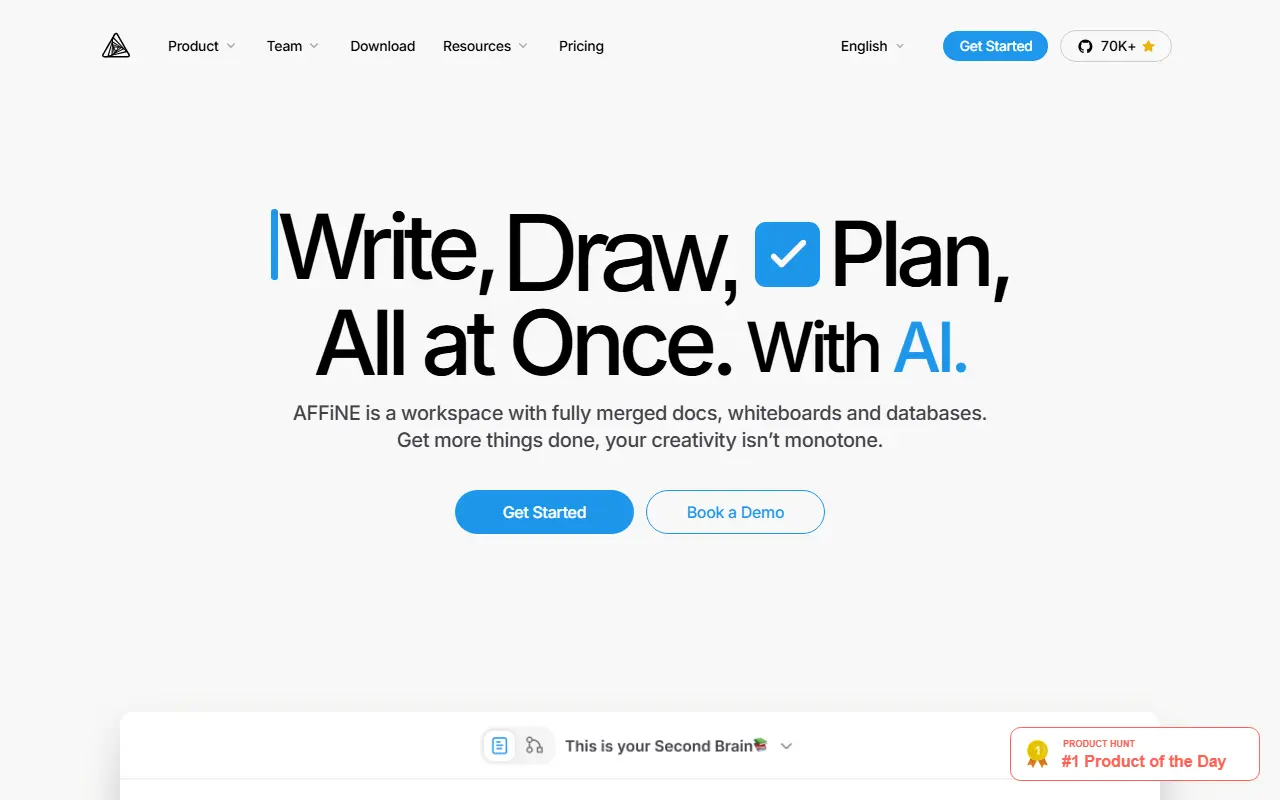
affine.proAFFiNE homepage screenshot

AFFiNE is an open-source workspace that combines writing, drawing and planning in a single app. Documents, an edgeless whiteboard and table views share the same blocks, so you can place rich text, sticky notes, embedded web pages, database views, linked pages, shapes and even slides anywhere on one canvas. It is presented as an alternative to Notion and Miro.

The project stresses local-first storage, meaning your data lives on your own device first, together with real-time collaboration. A multimodal AI assistant helps write reports, turn outlines into slides, summarize articles into mind maps and organize tasks. Under the hood it uses CRDTs for syncing and is built mostly in TypeScript and Rust, with Electron for the desktop app. It also supports Markdown, wiki and knowledge-base use, and presentations.

AFFiNE's license is listed as 'Other' on GitHub, so review it before commercial use. There is a live demo and documentation on the project site, a hosted version is available, and the app can also be self-hosted.

Key features

  • Docs, whiteboard and tables on one canvas
  • Local-first data storage on your device
  • Real-time multi-user collaboration
  • AI assistant for writing, slides and mind maps
  • Markdown editing and linked pages
  • Desktop app built on Electron

Pricing: Free plan with local use and 10 GB of cloud storage. Pro is $6.75 per month and Team $10 per seat per month; a $499.99 one-time Believer plan exists and Enterprise is custom-priced.

Ideon

Ideon is a self-hosted visual workspace where notes, files, repositories and to-dos live together on a shared infinite canvas.

GitHub stars
616
Last commit
2 days ago
Latest release
v0.9.8
Licence
AGPL-3.0
Self-hosted
Yes
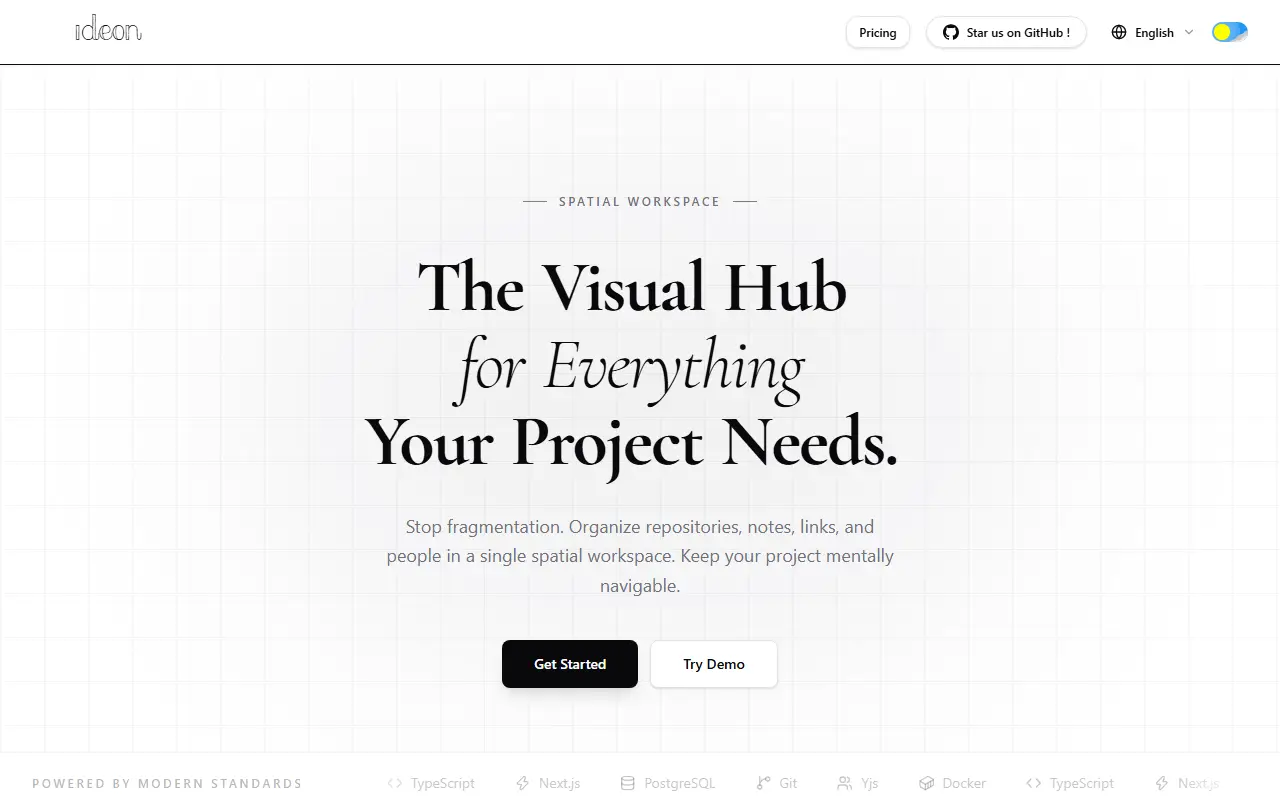
theideon.comIdeon homepage screenshot

Ideon is a self-hosted visual workspace for projects. Instead of abstract folders and tabs, it uses spatial organization: you place blocks on a shared infinite canvas, and what sits close together is related, so a project's repositories, design notes and tasks can be seen on a single map.

Blocks can hold Markdown notes, images, links, files and to-dos, and live integrations embed repositories and issues from GitHub, GitLab, Gitea and Forgejo directly on the canvas. Teams can collaborate in real time, and a time travel feature shows historical snapshots of the workspace to trace past decisions. A hosted demo is available to try without setup.

Ideon runs with Docker and Docker Compose, using a PostgreSQL database and a persistent storage volume, and there is a one-click template for the Easypanel deployment platform. You set a secret key in an environment file before starting the stack and open the dashboard on port 3000. It is written in TypeScript and licensed under AGPL-3.0.

Key features

  • Infinite spatial canvas
  • Embedded repositories and issues
  • Markdown notes, images and files
  • Real-time multiplayer collaboration
  • Time travel snapshots
  • Docker Compose self-hosting

Pricing: The open source edition is free to self-host with Docker. The managed Cloud and Enterprise plans have no published prices and are handled by contacting sales.

Read more about IdeonWebsite GitHub

Neurite

Open-source visual workspace that maps notes, web links, code and AI agents as nodes in a zoomable fractal graph.

GitHub stars
2.1k
Last commit
6 mo ago
Latest release
electron-2025.06.18.233853
Licence
MIT
Hosted version
Available

Neurite is an open-source mind-mapping and note-taking workspace that arranges ideas as nodes in a fractal, zoomable graph. Nodes can hold text, images, videos, code and AI agents, and the interface combines a physics simulation of the graph with an underlying fractal structure. It is aimed at people who want a spatial, exploratory way to organize notes, web links and AI-assisted thinking rather than a linear document tree.

The README covers synchronized knowledge management, a multi-agent chat interface called FractalGPT, a desktop edition and a neural API. The project also describes using the workspace for browsing the web and building graphs of AI agents. A desktop version is available as an Electron build, and the README warns that the interface contains flashing lights and colors that may affect people with photosensitive epilepsy.

Neurite is written in JavaScript, licensed under MIT, and described as in active development. It can be used through its website, and the repository publishes demo videos and a gallery for getting started. Because it is experimental, expect a visually distinctive tool rather than a conventional notes app.

Key features

  • Zoomable fractal node-graph workspace
  • Nodes for text, images, video and code
  • AI agent nodes in the graph
  • Multi-agent chat interface called FractalGPT
  • Desktop edition built with Electron
  • Web links embedded in the workspace

DeepNotes

DeepNotes is an AGPL-licensed, end-to-end encrypted infinite-canvas note tool with deeply nested pages and realtime team collaboration.

GitHub stars
604
Last commit
4 mo ago
Latest release
v1.0.25
Licence
AGPL-3.0
Hosted version
Available
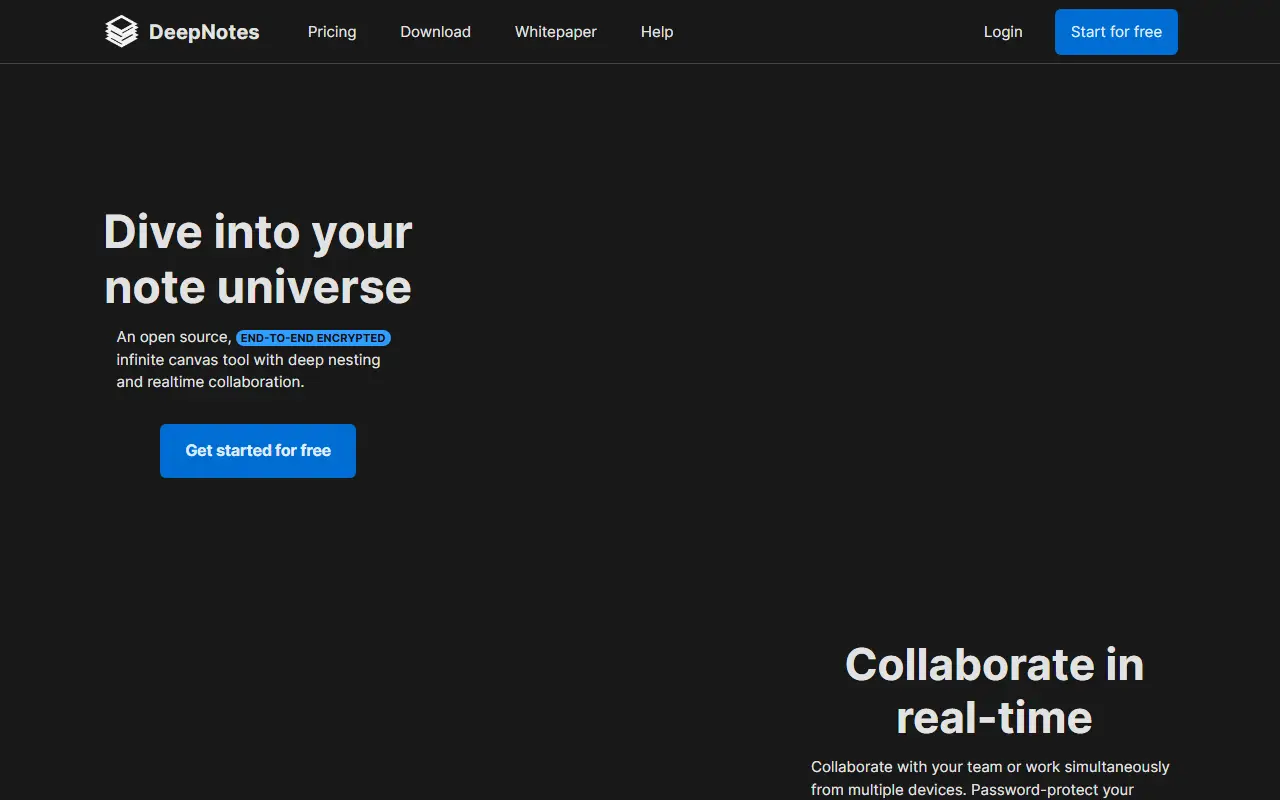
deepnotes.appDeepNotes homepage screenshot

DeepNotes is an open-source note-taking tool built around an infinite canvas rather than a linear document. Pages can be nested to any depth, so ideas can be explored in detail without crowding a single surface, and notes are protected with end-to-end encryption.

Users can create groups to collaborate in realtime, organize notes in whatever structure suits them, and rely on what the project calls lifelong storage. The codebase is TypeScript, using Vue and the Quasar framework, Yjs for collaboration, Tiptap for rich text, and KeyDB or Redis for shared memory and communication.

According to its development commands, the same code can be run as a single-page app, a server-side rendered app, an Electron desktop app, or Android and iOS builds. DeepNotes is released under AGPL-3.0, and a hosted version is available at deepnotes.app.

Key features

  • Infinite canvas for visual notes
  • Deep nesting of pages within pages
  • End-to-end encrypted note storage
  • Realtime collaboration for groups
  • Rich text editing
  • Web, desktop and mobile app builds

Pricing: The Basic plan is free for up to 50 pages. Pro costs $4.99 per month for unlimited pages and collaborative groups, with 20% off on yearly billing.

Revezone

Revezone is a free, AGPL-licensed, local-first productivity app combining Excalidraw and Tldraw whiteboards with a Notion-like note editor, for building a personal second brain.

GitHub stars
2.7k
Last commit
2 yr ago
Latest release
1.0.0-alpha.18
Licence
AGPL-3.0
Self-hosted
Yes
Hosted version
Available

Revezone is a lightweight, graphic-centric productivity tool aimed at people building a personal knowledge base, often described as a second brain. It is local-first, meaning notes and boards are stored in the browser or on the local machine rather than requiring a cloud account, and it is currently in public beta.

It combines whiteboard functions based on both Excalidraw and Tldraw with a WYSIWYG, Notion-like note editor that supports slash commands and Markdown syntax. Notes and boards can be organized into folders in a left sidebar, with flexible layout allowing users to sort directories and split the screen by dragging and dropping. The Excalidraw-based board also supports custom fonts and double-link connections to notes within the desktop app.

Revezone can be used online, with data stored in the browser, or as a downloadable desktop app with data stored locally. It is written in TypeScript and released under the AGPL-3.0 license. This repository contains only the basic functionality of the project, according to its README.

Key features

  • Excalidraw and Tldraw whiteboard support
  • Notion-like WYSIWYG note editor with Markdown
  • Local-first data storage
  • Folder-based organization of notes and boards
  • Custom fonts and note linking on whiteboards
  • Desktop app with local data storage

Pricing: Free and open source under the AGPL-3.0 license; an online version and a downloadable desktop app are both available.

Heptabase alternatives: questions

What is the best open-source alternative to Heptabase?
AFFiNE is the top-ranked open-source alternative to Heptabase on Enlisted: A privacy-focused, local-first workspace that merges docs, whiteboards and tables on one canvas, positioned as an open-source alternative to Notion and Miro. Other strong options are Ideon, Neurite, DeepNotes and Revezone.
Are these Heptabase alternatives free?
All 5 are open source, so the code is free to use under its licence, and all of them can be self-hosted on your own server or computer. 4 also offer a paid or managed cloud version if you'd rather not host it yourself.
How is this list of Heptabase alternatives ranked?
By a score built from GitHub stars, star growth over the last 30 days and how recently the code changed. 2 of these projects shipped code in the last 30 days. Data is refreshed daily, and nobody can pay to move up.

People also look for alternatives to…

View all