7,363 open-source and SaaS tools, with GitHub stats refreshed every day.

9 alternatives ranked by real activity

Open-source Supernotes alternatives

A curated, ranked list of the 9 best open-source alternatives to Supernotes.

The best open-source alternative to Supernotes is AppFlowy. If that doesn't suit you, other good options are AFFiNE, SiYuan, Logseq and Trilium Notes.

Supernotes alternatives are mainly note-taking tools. 6 of them shipped code in the last 30 days, 9 can be self-hosted, and none uses a permissive licence.

Last updated October 2, 2026 · ranked by GitHub stars, growth and recent commits

AppFlowy

An open-source AI collaborative workspace for notes, wikis, tasks and projects, built as a Notion alternative that keeps you in control of your data.

GitHub stars
77k
Last commit
2 days ago
Latest release
0.14.6
Licence
AGPL-3.0
Self-hosted
Yes
Hosted version
Available
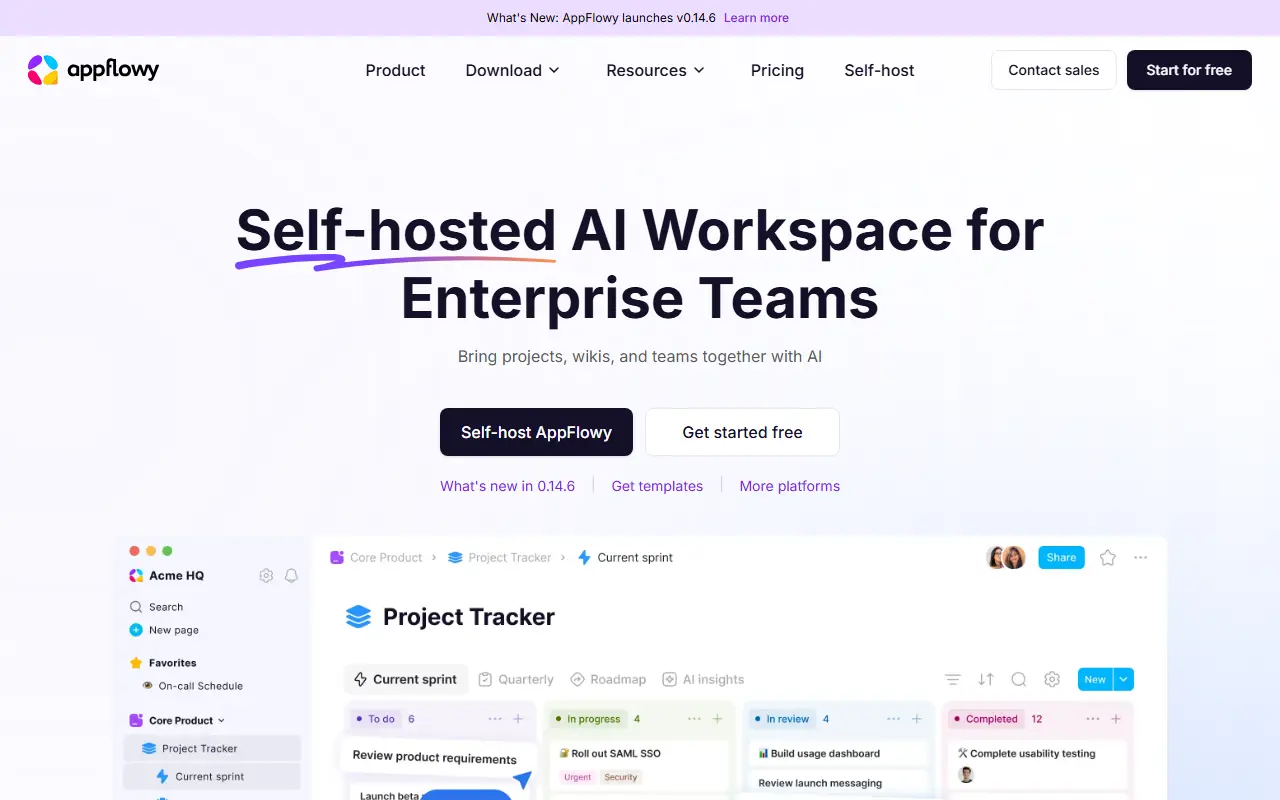
appflowy.comAppFlowy homepage screenshot

AppFlowy is an open-source workspace that brings documents, wikis, project and task management and team collaboration into one app. It is presented as an alternative to Notion, and its topics also tag it as a Confluence alternative, with the emphasis on keeping control of your own data.

The client is built with Flutter and a Rust core, giving apps for macOS, Windows and Linux plus iOS and Android versions. Desktop builds can be downloaded directly or from channels such as Flathub and Snapcraft. AI features are part of the workspace, and a public roadmap and active forum let users propose features. Translations are contributed through JSON files and tools such as inlang.

The project is AGPL-3.0 licensed and has documentation for self-hosting the server side, so organizations can keep content on their own infrastructure. A hosted version is available through appflowy.com for people who do not want to run servers. It suits teams looking for a Notion-style workspace with a privacy-first stance.

Key features

  • Notes, wikis and documentation in one workspace
  • Project and task management
  • AI features built into the workspace
  • Apps for desktop, iOS and Android
  • Self-hosting option for your own data
  • Public roadmap and community translations

Pricing: Free plan for up to 2 members. Pro costs $12.50 per user per month, or $10 billed annually. Self-hosted plans range from Free to Enterprise but their prices are not listed.

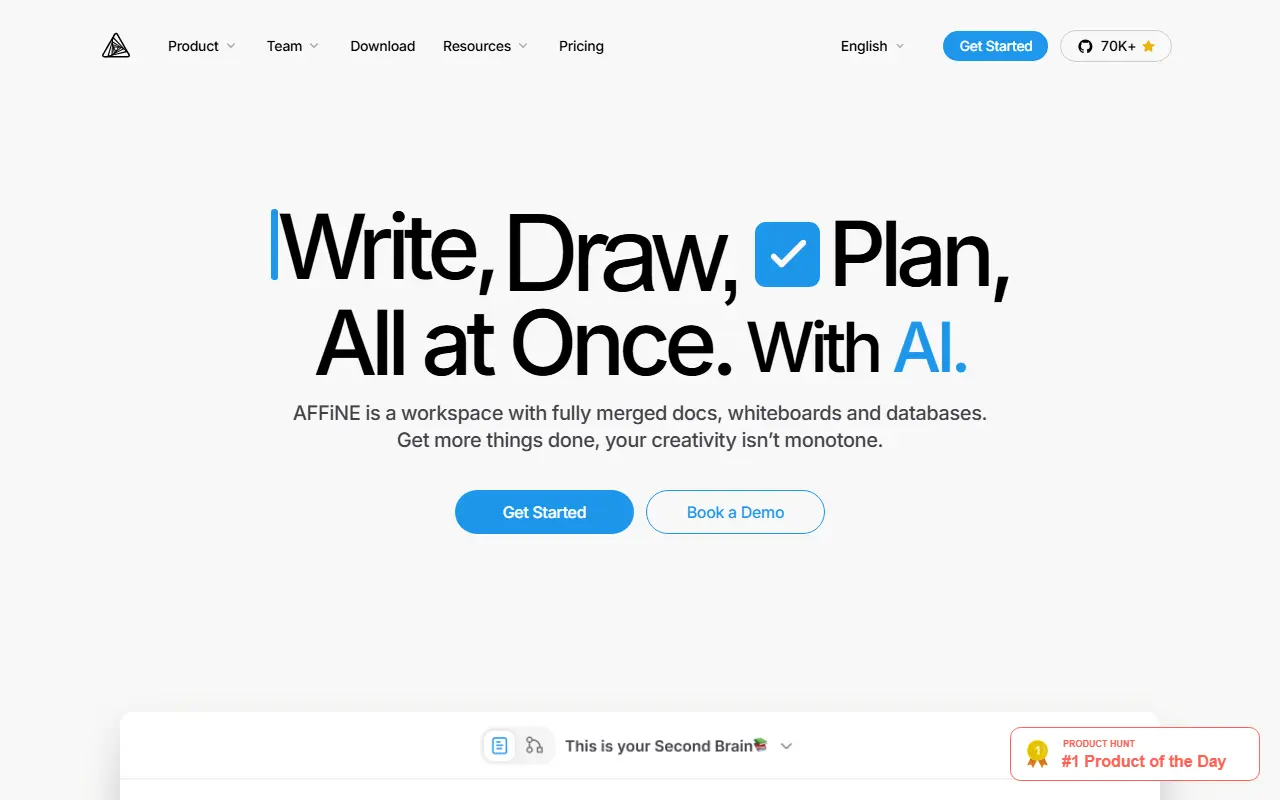
AFFiNE

A privacy-focused, local-first workspace that merges docs, whiteboards and tables on one canvas, positioned as an open-source alternative to Notion and Miro.

GitHub stars
73k
Last commit
2 days ago
Latest release
v0.27.4
Self-hosted
Yes
Hosted version
Available
affine.proAFFiNE homepage screenshot

AFFiNE is an open-source workspace that combines writing, drawing and planning in a single app. Documents, an edgeless whiteboard and table views share the same blocks, so you can place rich text, sticky notes, embedded web pages, database views, linked pages, shapes and even slides anywhere on one canvas. It is presented as an alternative to Notion and Miro.

The project stresses local-first storage, meaning your data lives on your own device first, together with real-time collaboration. A multimodal AI assistant helps write reports, turn outlines into slides, summarize articles into mind maps and organize tasks. Under the hood it uses CRDTs for syncing and is built mostly in TypeScript and Rust, with Electron for the desktop app. It also supports Markdown, wiki and knowledge-base use, and presentations.

AFFiNE's license is listed as 'Other' on GitHub, so review it before commercial use. There is a live demo and documentation on the project site, a hosted version is available, and the app can also be self-hosted.

Key features

  • Docs, whiteboard and tables on one canvas
  • Local-first data storage on your device
  • Real-time multi-user collaboration
  • AI assistant for writing, slides and mind maps
  • Markdown editing and linked pages
  • Desktop app built on Electron

Pricing: Free plan with local use and 10 GB of cloud storage. Pro is $6.75 per month and Team $10 per seat per month; a $499.99 one-time Believer plan exists and Enterprise is custom-priced.

Read more about AFFiNEWebsite GitHub

SiYuan

A privacy-first, self-hostable personal knowledge management system with block-level references, Markdown WYSIWYG editing, flashcards and optional AI chat.

GitHub stars
47k
Last commit
yesterday
Latest release
v3.8.6
Licence
AGPL-3.0
Self-hosted
Yes
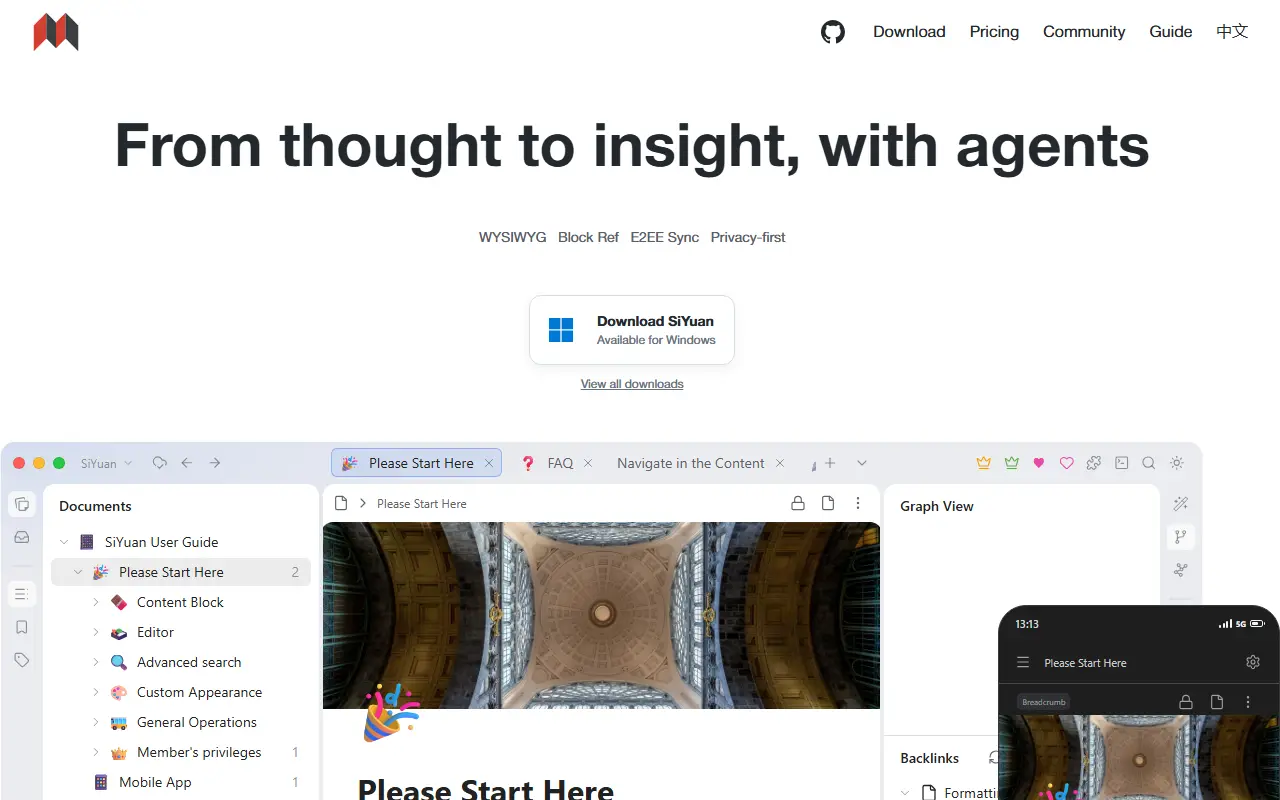
b3log.orgSiYuan homepage screenshot

SiYuan is an open-source, privacy-first personal knowledge management system. Its distinctive feature is fine-grained, block-level referencing: any block can be linked to or embedded elsewhere, with two-way links, custom attributes and SQL query embeds. Editing is Markdown WYSIWYG, and the project describes itself as a workspace where humans and AI agents work together. It is local-first and self-hostable.

The editor supports block-style writing, list outlines, block zoom-in, very large documents, math formulas, charts, flowcharts and Gantt charts. Web clipping, PDF annotation links, flashcards with spaced repetition, a database table view, Tesseract OCR and multi-tab split-screen layouts are included. You can export blocks and embeds, standard Markdown with assets, or PDF, Word and HTML. AI writing and Q and A chat can use the OpenAI API, and template and JavaScript or CSS snippets allow customization.

SiYuan is AGPL-3.0 licensed and available as desktop apps, mobile apps for Android, iOS and HarmonyOS, an installation package, a package manager, and Docker, Kubernetes, Unraid and TrueNAS hosting. A command line interface and an app market for extensions exist. Most features are free, even for commercial use.

Key features

  • Block-level references and two-way links
  • Markdown WYSIWYG editor
  • Flashcards with spaced repetition
  • SQL query embeds and database table views
  • Export to Markdown, PDF, Word and HTML
  • AI writing and Q and A chat
  • Docker, Kubernetes and mobile apps

Pricing: Most features are free, even for commercial use; check the project FAQ for any paid options.

Read more about SiYuanWebsite GitHub

Logseq

A privacy-first, local-first knowledge management app built around linked, outliner-style notes in Markdown or Org-mode, with a graph view and plugin support.

GitHub stars
45k
Last commit
today
Latest release
2.0.1
Licence
AGPL-3.0
Self-hosted
Yes
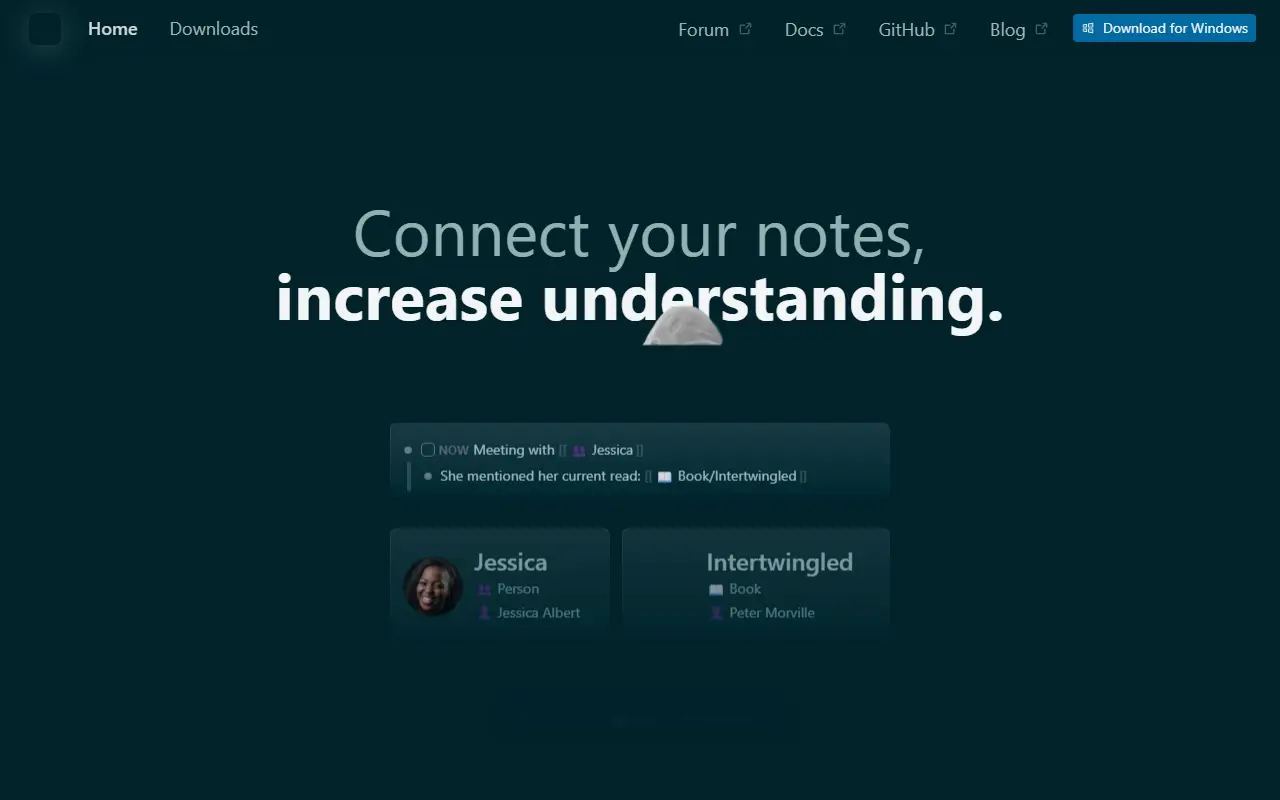
logseq.comLogseq homepage screenshot

Logseq is an open-source platform for knowledge management and collaboration that puts privacy and local storage first. Notes are organized as linked blocks in an outliner, forming a knowledge graph, and topics show it works with both Markdown and Org-mode files and can be backed by Git.

The project is moving toward a database-backed version that introduces DB graphs. That version is in beta, comes with a new iOS mobile app in alpha and a Real Time Collaboration approach to syncing graphs across devices or working with others, also in alpha. Because data loss is possible while these features mature, the maintainers recommend automated backups. A plugin API, themes and a public roadmap round out the ecosystem.

Logseq is written in Clojure and ClojureScript under the AGPL-3.0 license, and desktop builds are available from the releases page. It appeals to researchers, students and knowledge workers who want a personal wiki with bidirectional links and full ownership of their files.

Key features

  • Outliner-style linked notes
  • Markdown and Org-mode support
  • Knowledge graph of connected pages
  • Local-first storage with Git compatibility
  • Plugin API and themes
  • Real Time Collaboration sync in alpha

Pricing: Free and open source under the AGPL-3.0 license.

Read more about LogseqWebsite GitHub

Trilium Notes

A cross-platform hierarchical note-taking app for building large personal knowledge bases, with a rich editor, note cloning, versioning and scripting.

GitHub stars
38k
Last commit
today
Latest release
v0.106.0
Licence
AGPL-3.0
Self-hosted
Yes
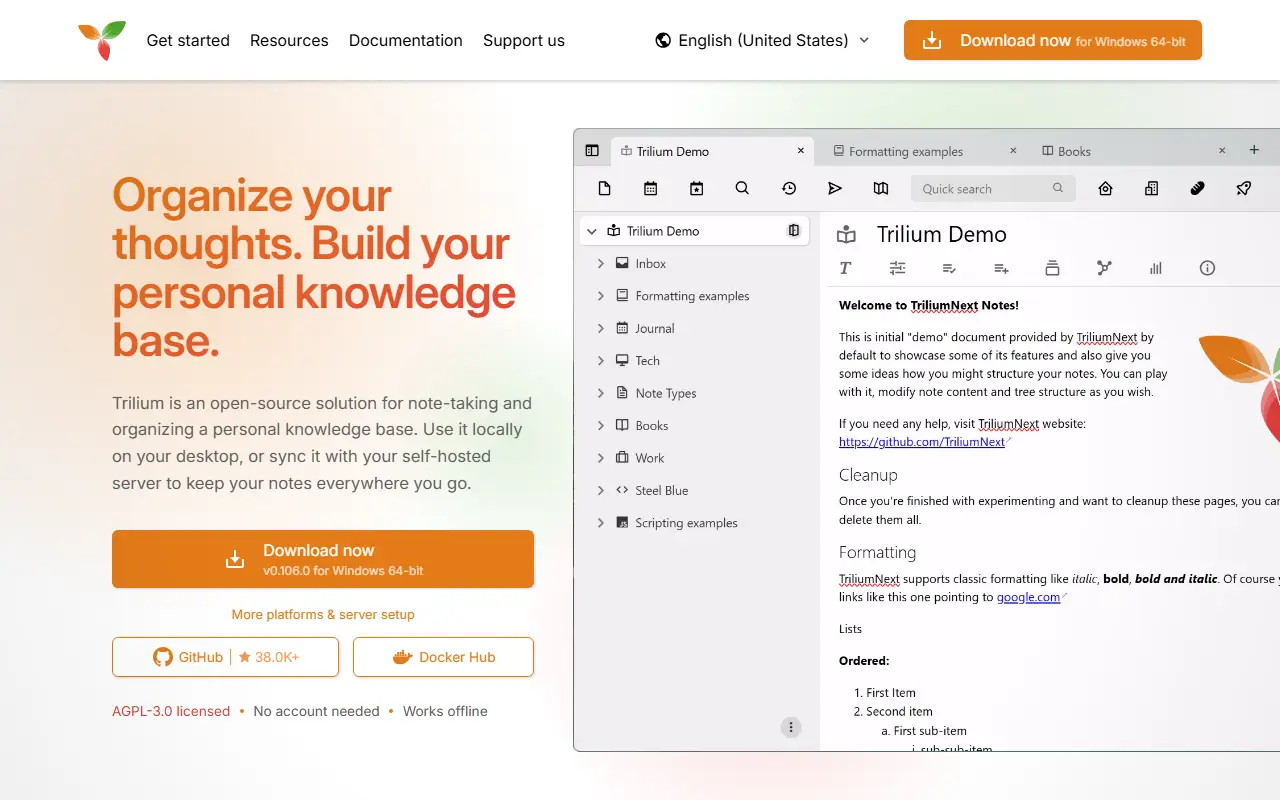
triliumnotes.orgTrilium Notes homepage screenshot

Trilium Notes is a free, open-source, cross-platform note-taking application focused on building large personal knowledge bases. Notes are arranged in a tree of arbitrary depth, and a single note can be cloned into several places in the tree, which lets you organize the same material along different lines without duplicating it.

The editor is a rich WYSIWYG one with tables, images, math and Markdown autoformatting, and there is also support for source code notes with syntax highlighting. Navigation relies on fast jumps between notes, full-text search and note hoisting. Notes are versioned automatically, and attributes can be used to organize, query and script notes. The interface is available in several languages, and built-in documentation opens with F1.

The project, now maintained as TriliumNext, is AGPL-3.0 licensed and built with TypeScript and Electron. It provides desktop builds as well as a server setup with Docker, so you can keep your notes on your own hardware. Stable releases are recommended, with nightly builds available for those who want the newest changes.

Key features

  • Arbitrarily deep note tree with cloning
  • WYSIWYG editor with tables, images and math
  • Code notes with syntax highlighting
  • Full-text search and note hoisting
  • Automatic note versioning
  • Attributes and scripting for advanced use
  • Docker server setup

Pricing: Free and open source under the AGPL-3.0 license.

Anytype

Anytype Desktop is the official client for Anytype, a local-first, end-to-end encrypted knowledge base for notes, tasks, wikis and custom data types.

GitHub stars
8.9k
Last commit
today
Latest release
v0.57.3
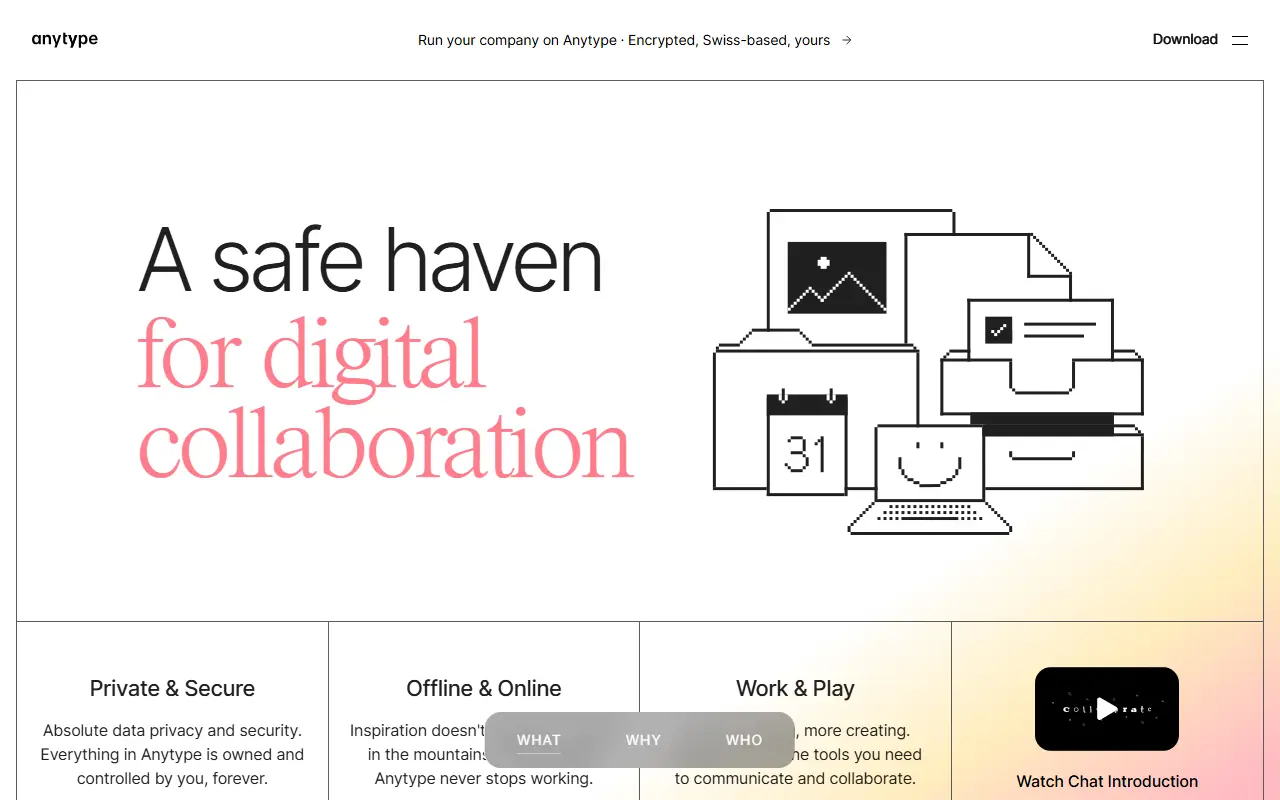
anytype.ioAnytype homepage screenshot

Anytype Desktop is the official desktop client for Anytype, a personal knowledge base for macOS, Windows and Linux. It lets you collect pages, tasks, wikis and journals and link them together, while keeping data stored locally and encrypted across your devices.

The client is built around composable blocks such as text, databases, kanban boards and calendars, and you can define your own Types to shape the data model. Storage is offline-first with optional peer-to-peer sync, and encryption relies on the any-sync protocol. It is an Electron application written in TypeScript, and it can be extended through a gRPC API and AI agents described in the repository.

Sign-in uses an Any-ID, and installers are published on the releases page and the download site. The code is published under the Any Source Available License 1.0 rather than a standard open-source licence, and the README includes instructions for building from source and updating the middleware.

Key features

  • Offline-first local storage
  • Optional peer-to-peer sync
  • End-to-end encryption through any-sync
  • Block-based pages, databases, kanban and calendar
  • Custom Types for your own data model
  • gRPC API for extensions

Blinko

Blinko is an open-source, self-hosted personal AI note app that lets you capture quick card notes and search them in natural language.

GitHub stars
11k
Last commit
1 mo ago
Latest release
1.8.8
Licence
GPL-3.0
Self-hosted
Yes
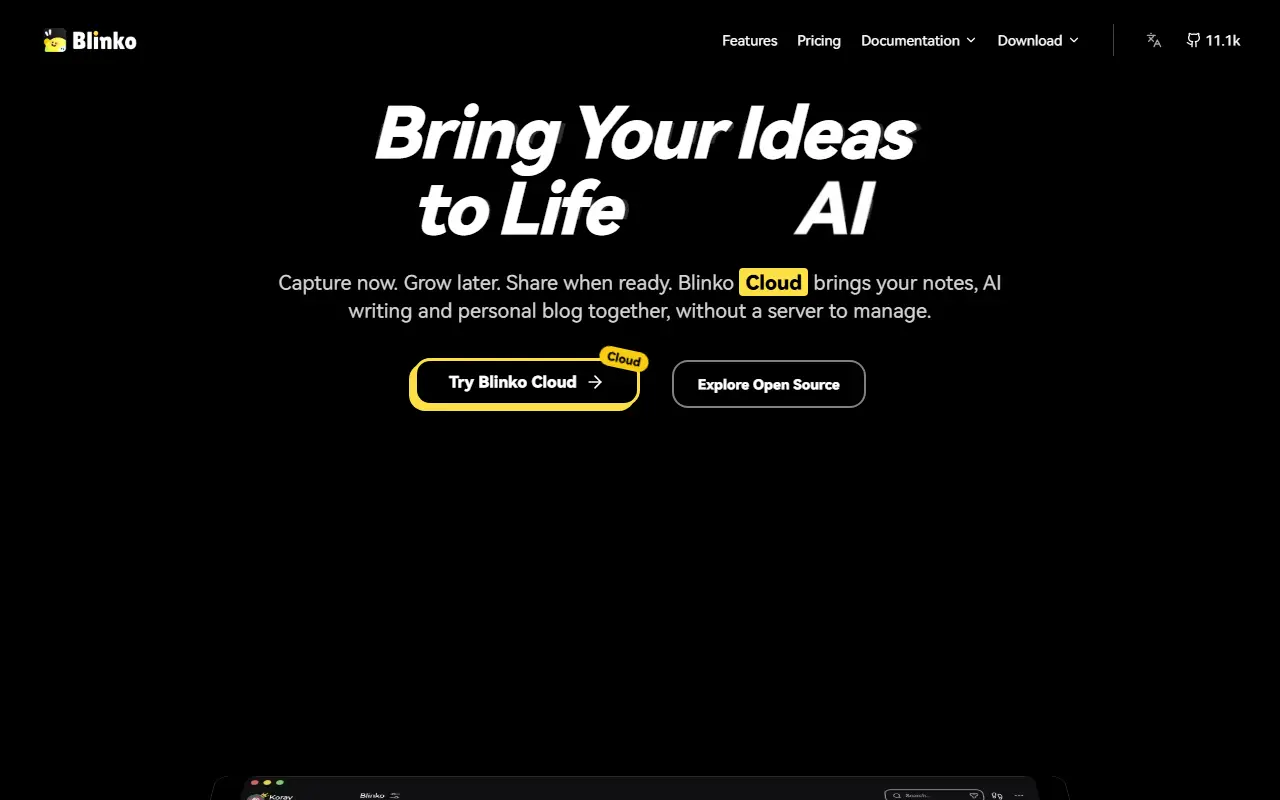
blinko.spaceBlinko homepage screenshot

Blinko is a card-style note-taking app with AI features, designed for people who want to capture fleeting ideas the moment they happen. It is self-hosted and puts privacy first, so your notes stay on a server you control. The interface is built with Next.js and React in TypeScript, backed by PostgreSQL.

Its AI-enhanced retrieval uses retrieval-augmented generation, so you can find notes by asking in natural language rather than remembering keywords. Notes use Markdown and the project is tagged for memos and notebooks. A live demo, official site, documentation and English and Chinese Telegram communities are linked from the README.

Blinko is licensed under GPL-3.0 and installed on your own server, typically with Docker. It suits individuals who want a private alternative to cloud note and memo apps and are comfortable connecting their own AI provider.

Key features

  • Quick card-style note capture
  • AI-powered natural language note search
  • Markdown note support
  • Self-hosted with privacy focus
  • Next.js and PostgreSQL stack
  • Live demo available

Pricing: The open-source edition is free to self-host, and Blinko Cloud has a free plan. Paid cloud plans are Pro at $5.99 and Pro Plus at $10.99 per month.

Read more about BlinkoWebsite GitHub

Notabase

Open-source networked note-taking app with bidirectional links, a graph view and block references, available as a hosted service or self-hosted.

GitHub stars
913
Last commit
2 mo ago
Licence
AGPL-3.0
Self-hosted
Yes
Hosted version
Available
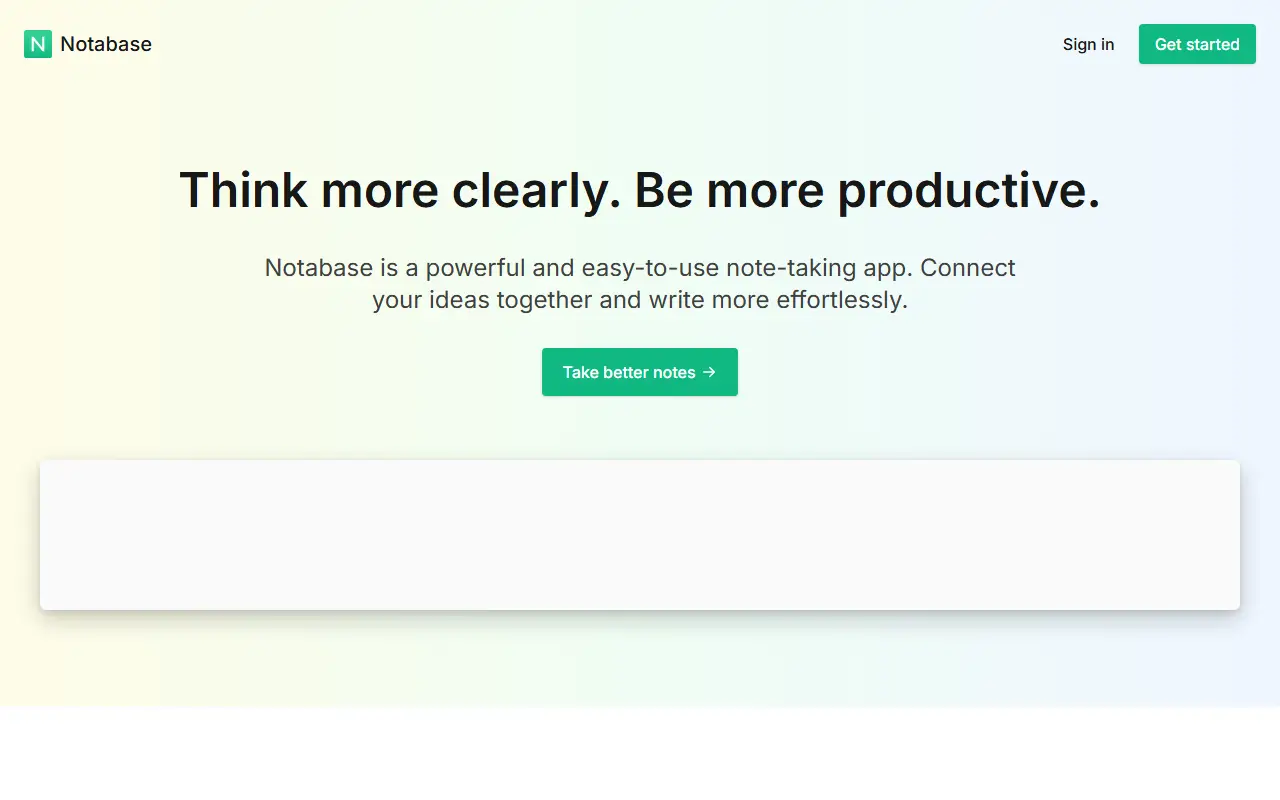
notabase.ioNotabase homepage screenshot

Notabase is a personal knowledge base built for networked thinking. Notes link to one another, so you can move through them like web pages and notice connections you would not have found by filing them in folders. The README describes it as a personal Wikipedia you can edit and browse, and says it draws inspiration from Notion, Obsidian, Typora and Roam Research.

The editor is WYSIWYG with Markdown support. Linked and unlinked references show which other notes mention the one you are viewing, and block references embed a passage from another note that updates when the original changes. Notes can be organized with links, tags and nesting, browsed with page stacking, explored in a graph view and found through full-text search. It installs as a progressive web app for faster loading and offline viewing, and notes sync to the cloud across devices.

You can import or export your notes at any time. Notabase is written in TypeScript and licensed under AGPL-3.0. The project is focused on its hosted experience, but the README says self-hosting or running it locally is possible. It is funded by sponsors and developed in the open.

Key features

  • Linked and unlinked note references
  • Block references that update automatically
  • Graph view of your knowledge network
  • WYSIWYG editor with Markdown support
  • Page stacking for browsing notes
  • Full-text search across notes
  • Installable PWA with offline viewing
  • Import and export of notes

Pricing: The Basic plan is free with a 10-note limit. Pro shows $6.67 per month when billed annually at $80 and adds unlimited notes and web publishing.

DeepNotes

DeepNotes is an AGPL-licensed, end-to-end encrypted infinite-canvas note tool with deeply nested pages and realtime team collaboration.

GitHub stars
604
Last commit
4 mo ago
Latest release
v1.0.25
Licence
AGPL-3.0
Hosted version
Available
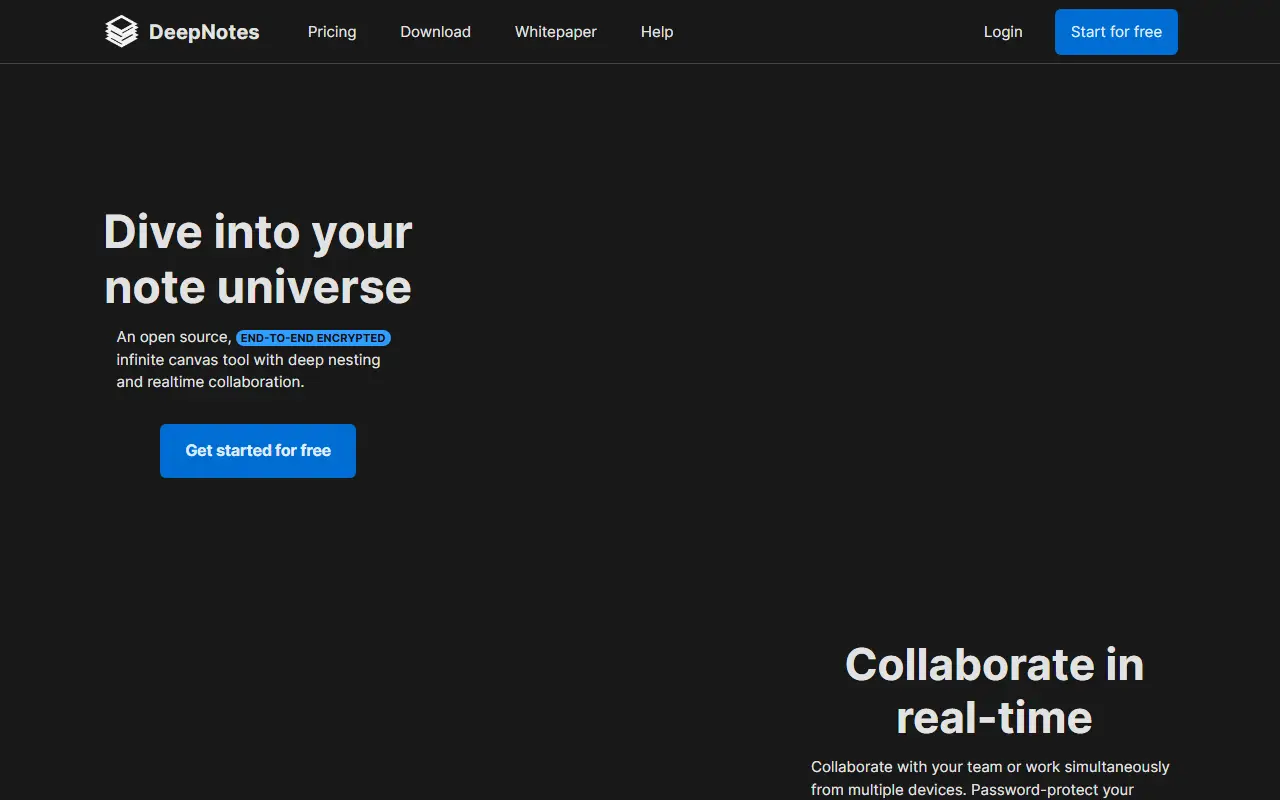
deepnotes.appDeepNotes homepage screenshot

DeepNotes is an open-source note-taking tool built around an infinite canvas rather than a linear document. Pages can be nested to any depth, so ideas can be explored in detail without crowding a single surface, and notes are protected with end-to-end encryption.

Users can create groups to collaborate in realtime, organize notes in whatever structure suits them, and rely on what the project calls lifelong storage. The codebase is TypeScript, using Vue and the Quasar framework, Yjs for collaboration, Tiptap for rich text, and KeyDB or Redis for shared memory and communication.

According to its development commands, the same code can be run as a single-page app, a server-side rendered app, an Electron desktop app, or Android and iOS builds. DeepNotes is released under AGPL-3.0, and a hosted version is available at deepnotes.app.

Key features

  • Infinite canvas for visual notes
  • Deep nesting of pages within pages
  • End-to-end encrypted note storage
  • Realtime collaboration for groups
  • Rich text editing
  • Web, desktop and mobile app builds

Pricing: The Basic plan is free for up to 50 pages. Pro costs $4.99 per month for unlimited pages and collaborative groups, with 20% off on yearly billing.

Supernotes alternatives: questions

What is the best open-source alternative to Supernotes?
AppFlowy is the top-ranked open-source alternative to Supernotes on Enlisted: An open-source AI collaborative workspace for notes, wikis, tasks and projects, built as a Notion alternative that keeps you in control of your data. Other strong options are AFFiNE, SiYuan, Logseq and Trilium Notes.
Are these Supernotes alternatives free?
All 9 are open source, so the code is free to use under its licence, and all of them can be self-hosted on your own server or computer. 4 also offer a paid or managed cloud version if you'd rather not host it yourself.
How is this list of Supernotes alternatives ranked?
By a score built from GitHub stars, star growth over the last 30 days and how recently the code changed. 6 of these projects shipped code in the last 30 days. Data is refreshed daily, and nobody can pay to move up.

People also look for alternatives to…

View all