 TrackMedia
 TrackRev

 Swimm
 Coda
 Notion
 Confluence
 GitHub
 GitLab
 Azure DevOps
 AWS Device Farm
 Google Memorystore
 PagerDuty
 Splunk
 New Relic
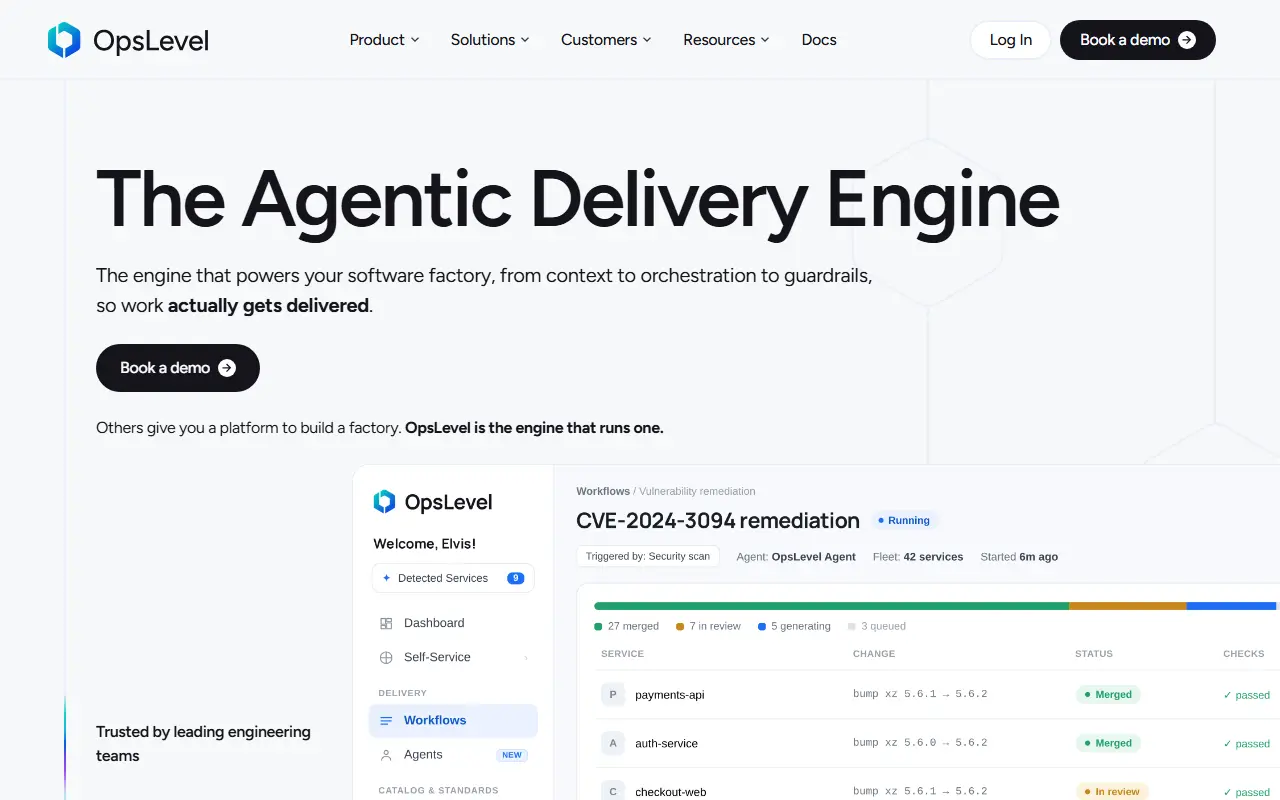
About OpsLevel
OpsLevel is a commercial internal developer portal that gives engineering organizations a single place to see their services, owners, documentation and health. Its catalog is kept up to date automatically from connected tools, so teams have a reliable record of what exists and who is responsible for it.
Beyond the catalog, the product centers on standards: scorecards measure software health, checks give actionable findings, and campaigns drive cross-cutting initiatives across many services. A Knowledge Center brings API and technical documentation together, self-service workflows let developers act without filing tickets, and an extensibility layer allows customization. A context layer exposed over MCP lets AI agents query the catalog, and an agent can open pull requests across many repositories.
OpsLevel is a hosted proprietary product aimed at platform engineering and site reliability teams, with a published pricing page and customer examples on its site. It is sold commercially rather than distributed as open source.
Key features
- Automated service catalog as a record of truth
- Scorecards that measure software health
- Checks and campaigns for cross-service initiatives
- Self-service actions for developers
- Knowledge Center for API and technical docs
- MCP context layer for AI agents
- Integrations across the tech stack
Good fit for
- Cataloging microservices and their owners
- Enforcing engineering standards with scorecards
- Giving platform teams self-service tooling
OpsLevel: questions and answers
- What is OpsLevel used for?
- OpsLevel is an internal developer portal with an automated service catalog, maturity scorecards, self-service actions and tooling for platform and reliability teams. It is a good fit for cataloging microservices and their owners, enforcing engineering standards with scorecards, and giving platform teams self-service tooling.
- How much does OpsLevel cost?
- OpsLevel doesn't publish fixed prices; pricing is quoted on request.
- Is OpsLevel open source?
- No. OpsLevel is proprietary (closed-source) software and can't be self-hosted. Open-source alternatives to OpsLevel include Harness, Backstage and Grafana.
- What are some alternatives to OpsLevel?
- OpsLevel competes with Port, Humanitec and ServiceNow App Engine. For open-source options, see Enlisted's ranked list of open-source OpsLevel alternatives.
Open-source alternatives to OpsLevel
See all
Harness
CI/CD & DevOps
Harness Open Source is an end-to-end developer platform with Source Control Management, CI
Apache-2.0vs GitHub Actions★ 39k
Backstage
CI/CD & DevOps
Backstage is an open framework for building developer portals
Apache-2.0vs Port★ 35k
Grafana
Monitoring & Observability
The open and composable observability and data visualization platform. Visualize metrics,
AGPL-3.0vs Datadog★ 78k
Cortex
Monitoring & Observability
A horizontally scalable, highly available, multi-tenant, long term Prometheus.
Apache-2.0vs Arize AI★ 5.9k
SuperPlane
CI/CD & DevOps
SuperPlane lets AI agents fully automate routine development work, with the rules, verific
Apache-2.0★ 10k
Gitea
CI/CD & DevOps
Gitea - Git with a cup of tea! Painless self-hosted all-in-one software development servic
MITvs Bitbucket★ 59k
SaaS alternatives to OpsLevel
See all
Port
CI/CD & DevOps
Internal developer portal builder with a software catalog and self-service actions
SaaS
Humanitec
CI/CD & DevOps
Platform orchestrator that provisions infrastructure for each deployment on request
SaaS
ServiceNow App Engine
Low-code & Internal Tools
ServiceNow low-code platform for building workflow apps
SaaS
Datadog
Monitoring & Observability
Datadog is a cloud monitoring and observability platform that brings metrics, logs and traces from applications, tools and services into one place.
SaaS
Snyk
Security
Developer security platform that scans code, dependencies, containers and IaC
SaaS
Jellyfish
CI/CD & DevOps
Engineering management platform that links development activity to business priorities
SaaS