 TrackMedia
 TrackRev

About Jellyfish
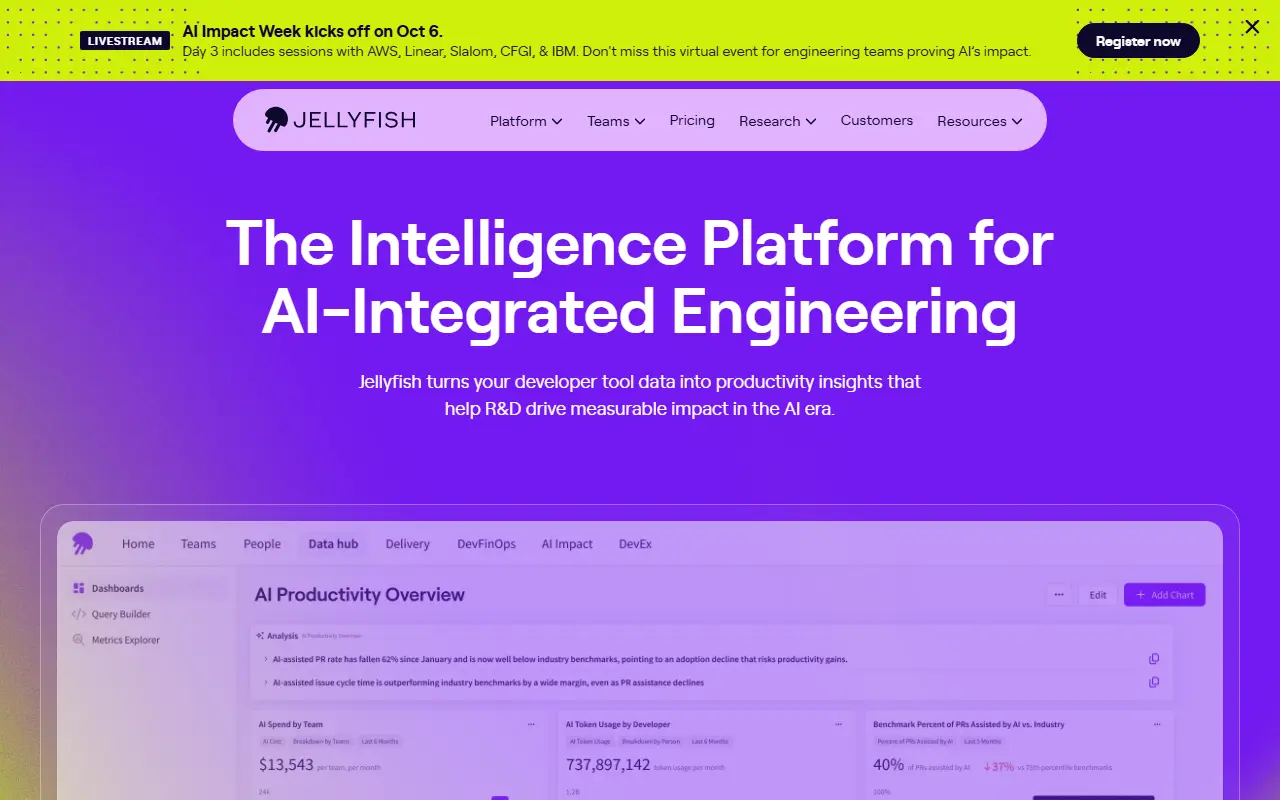
Jellyfish is a commercial engineering management platform for R&D organizations. It connects to the systems where engineering work happens and turns that activity into metrics, so executives, managers and finance teams can see how engineering effort maps to business priorities.
The platform is organized around several areas: AI impact, covering adoption, token cost management and comparisons between AI vendors; operational effectiveness, with life cycle and workflow analysis and team benchmarks; business alignment through resource allocation; developer experience surveys; and DevFinOps, including software capitalization for financial reporting. A report builder and an AI assistant help users explore the data.
Jellyfish is a hosted proprietary product sold to engineering executives, engineering managers, platform teams, product leaders and finance teams. Access is through a demo request, and the vendor publishes a pricing page for plan details.
Key features
- Resource allocation tied to business priorities
- AI adoption and token cost tracking
- Life cycle and workflow analysis
- Team benchmarks and people management views
- Software capitalization for financial reporting
- Developer experience surveys
- Report builder and AI assistant
Good fit for
- Communicating engineering impact to executives
- Automating R&D financial reporting
- Tracking AI tool adoption and spend
Jellyfish: questions and answers
- What is Jellyfish used for?
- Jellyfish is an engineering management platform connecting engineering work with business goals, offering delivery metrics, AI impact analysis and R&D financial reporting. It is a good fit for communicating engineering impact to executives, automating R&D financial reporting, and tracking AI tool adoption and spend.
- How much does Jellyfish cost?
- Jellyfish doesn't publish fixed prices; pricing is quoted on request.
- Is Jellyfish open source?
- No. Jellyfish is proprietary (closed-source) software and can't be self-hosted. In the CI/CD & DevOps category, open-source options include SuperPlane, Kache and Ansible.
- What are some alternatives to Jellyfish?
- Jellyfish competes with LinearB and Swarmia.
Open-source alternatives to Jellyfish
See all
SuperPlane
CI/CD & DevOps
SuperPlane lets AI agents fully automate routine development work, with the rules, verific
Apache-2.0★ 10k
Kache
CI/CD & DevOps
Zero-copy, content-addressed Rust build cache for Rust, C/C++ and more. No copies, no wast
Apache-2.0★ 1.4k
Ansible
CI/CD & DevOps
Ansible is a radically simple IT automation platform that makes your applications and syst
GPL-3.0vs AWS CodeDeploy★ 71k
Gitea
CI/CD & DevOps
Gitea - Git with a cup of tea! Painless self-hosted all-in-one software development servic
MITvs Bitbucket★ 59k
Act
CI/CD & DevOps
Run your GitHub Actions locally 🚀
MITvs Blacksmith★ 73k
Harness
CI/CD & DevOps
Harness Open Source is an end-to-end developer platform with Source Control Management, CI
Apache-2.0vs GitHub Actions★ 39k
SaaS alternatives to Jellyfish
See all
LinearB
CI/CD & DevOps
Engineering metrics and workflow automation built from Git and Jira data
SaaS
Swarmia
CI/CD & DevOps
Engineering productivity analytics covering delivery speed, investment and team agreements
SaaS
DX
CI/CD & DevOps
Developer productivity platform combining surveys and system data to measure engineering teams
SaaS
Faros AI
CI/CD & DevOps
Engineering intelligence platform that analyzes delivery metrics and developer productivity
SaaS
OpsLevel
CI/CD & DevOps
Internal developer portal with a service catalog and maturity scorecards
SaaS
Appcircle
CI/CD & DevOps
Mobile CI/CD platform for building, testing and publishing apps, cloud or self-hosted
SaaS