
About Ansible
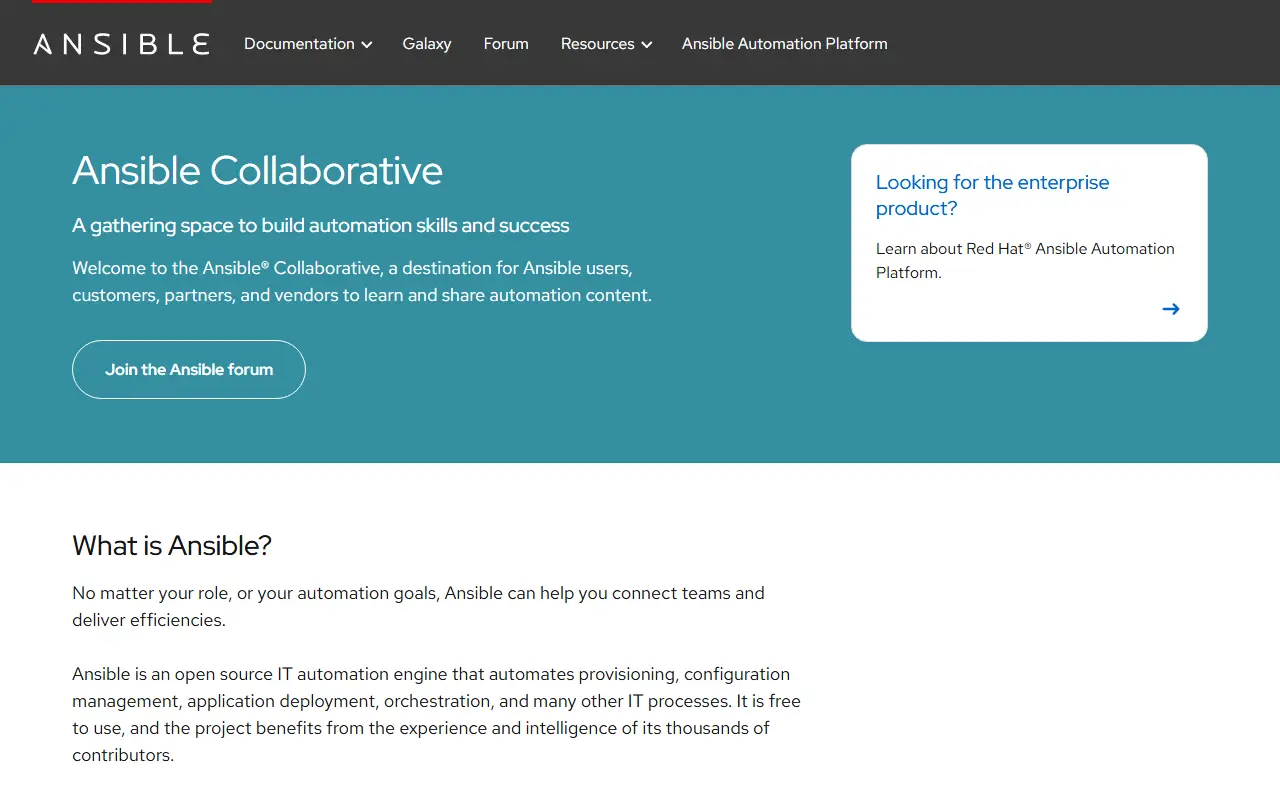
Ansible is an open-source IT automation system written in Python and released under the GPL-3.0 license. It covers configuration management and application deployment, provisioning of cloud resources, one-off ad-hoc commands, network automation and orchestration across many nodes, and it can carry out complex changes such as zero-downtime rolling updates with load balancers.
Its design principles favor a simple setup with a gentle learning curve, managing machines quickly and in parallel, and avoiding custom agents and extra open ports by relying on the existing SSH daemon. Infrastructure is described in a language that is readable by both people and machines, with a focus on security and easy auditing and review. New remote machines can be managed immediately without bootstrapping software, and modules can be written in any dynamic language.
Released versions install with pip or a package manager, while power users can run the development branch for the latest features at the risk of breaking changes. Ansible can be used without root access. It suits system administrators, DevOps and network engineers who want repeatable, version-controlled automation without agents on their servers.
Key features
- Agentless automation over SSH
- Configuration management and application deployment
- Cloud provisioning and network automation
- Parallel management of many machines
- Zero-downtime rolling updates
- Modules in any dynamic language
- Human-readable infrastructure descriptions
Good fit for
- →Server configuration management
- →Rolling application deployments
- →Network device automation
- Built with
- Python
- Tags
- automation
- configuration-management
- devops
- ssh
- python
- infrastructure-as-code
- orchestration
- agentless
Ansible: questions and answers
- What is Ansible used for?
- Ansible is an agentless IT automation platform for configuration management, application deployment, cloud provisioning and network automation over SSH. It is a good fit for server configuration management, rolling application deployments and network device automation.
- Is Ansible open source?
- Yes. Ansible is open source under the GPL-3.0 licence. Its source code is on GitHub at ansible/ansible and is written mainly in Python.
- Is Ansible free?
- Yes. Ansible is open source, so the software itself is free to use.
- What is Ansible an alternative to?
- Ansible is an open-source alternative to AWS CodeDeploy. Other open-source alternatives to AWS CodeDeploy include Kamal, Spug and Argo CD.
- Is Ansible actively maintained?
- Yes. The most recent commit to Ansible was on 30 September 2026, and the latest release is v2.21.4, published on 8 September 2026. The project has 71k stars on GitHub.
Open-source alternatives to Ansible
See all
Kamal
CI/CD & DevOps
Deploy web apps anywhere.
MITvs Heroku★ 15k
Spug
CI/CD & DevOps
Spug is a lightweight agent-free automatic operation and maintenance platform designed for
AGPL-3.0vs AWS CodeDeploy★ 11k
Argo CD
CI/CD & DevOps
Declarative Continuous Deployment for Kubernetes
Apache-2.0vs Octopus Deploy★ 24k
Harness
CI/CD & DevOps
Harness Open Source is an end-to-end developer platform with Source Control Management, CI
Apache-2.0vs GitHub Actions★ 38k
Flux
CI/CD & DevOps
Open and extensible continuous delivery solution for Kubernetes. Powered by GitOps Toolkit
Apache-2.0vs Octopus Deploy★ 8.4k
GoCD
CI/CD & DevOps
GoCD - Continuous Delivery server main repository
Apache-2.0vs TeamCity★ 7.4k
SaaS alternatives to Ansible
See all
AWS CodeDeploy
CI/CD & DevOps
AWS service that automates application deployments to EC2, Lambda and on-premises servers
SaaS
AWS CodeBuild
CI/CD & DevOps
Managed AWS build service that compiles source code and runs tests
SaaS
Buddy
CI/CD & DevOps
Visual CI/CD tool for building, testing and deploying web projects
SaaS
CAST AI
CI/CD & DevOps
Kubernetes automation platform for cost optimization and autoscaling
SaaS
CircleCI
CI/CD & DevOps
Hosted continuous integration and delivery platform for build and test pipelines
SaaS
env0
CI/CD & DevOps
Infrastructure-as-code automation with policy controls and cost tracking
SaaS