
 Laravel Forge
 Laravel Cloud
 Ploi
Ploi AWS App Runner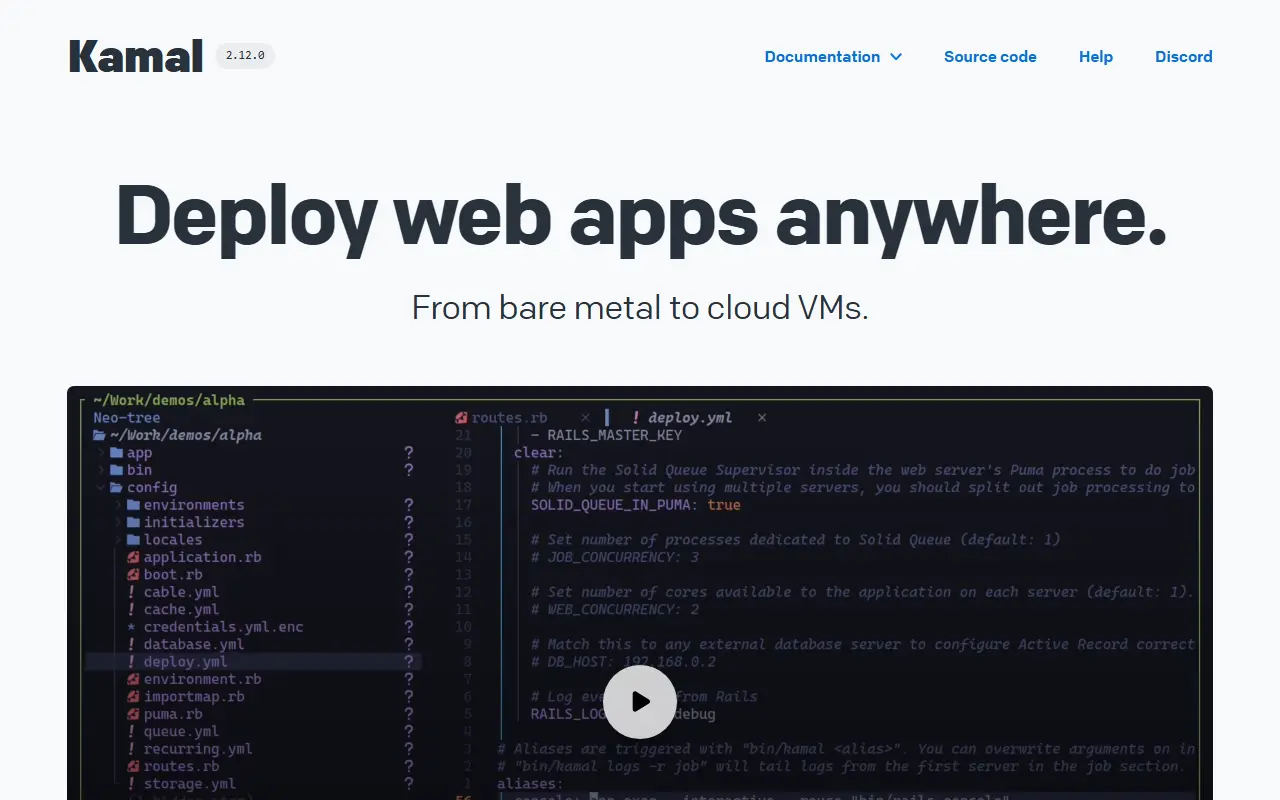
About Kamal
Kamal is a deployment tool for web applications that can run anywhere, from bare metal servers to cloud virtual machines. It uses a proxy component called kamal-proxy to switch requests between containers without downtime, and it works across multiple servers by running commands over SSH using SSHKit.
Originally built for Rails applications, Kamal works with any web app that can be packaged in a Docker container. Documentation on installation, configuration and commands is on kamal-deploy.org, and the documentation itself lives in a separate repository where improvements are welcome.
Kamal is written in Ruby, developed by Basecamp, and released under the MIT license. Because it deploys to servers you control, it suits teams who want a simple alternative to hosted platforms while still getting rolling, zero-downtime releases.
Key features
- Zero-downtime container switching
- Deploys to bare metal or cloud VMs
- Multi-server deployments over SSH
- Works with any Dockerized web app
- kamal-proxy request routing
Good fit for
- →Deploying Rails apps to your own servers
- →Moving off hosted platforms to plain VMs
- Built with
- Ruby
- Tags
- deployment
- docker
- ruby
- rails
- devops
- zero-downtime
- ssh
- self-hosted
Kamal: questions and answers
- What is Kamal used for?
- Kamal deploys containerized web apps to bare metal or cloud servers over SSH with zero-downtime switching between containers. It is a good fit for deploying Rails apps to your own servers and moving off hosted platforms to plain VMs.
- Is Kamal open source?
- Yes. Kamal is open source under the MIT licence. Its source code is on GitHub at basecamp/kamal and is written mainly in Ruby.
- Is Kamal free?
- Yes. Kamal is open source, so the software itself is free to use.
- What is Kamal an alternative to?
- Kamal is an open-source alternative to Heroku, Render, Octopus Deploy and Fly.io. Other open-source alternatives to Heroku include Coolify, Dokploy and Dokku.
- Is Kamal actively maintained?
- Yes. The most recent commit to Kamal was on 30 September 2026, and the latest release is v2.12.0, published on 18 June 2026. The project has 15k stars on GitHub.
Open-source alternatives to Kamal
See all
Coolify
Hosting & PaaS
Self-hosting platform with superpowers. Deploy apps, databases & 280+ services to your
Apache-2.0vs Heroku★ 62k
Dokploy
Hosting & PaaS
Open-source self-hostable Platform as a Service (PaaS) that simplifies the deployment and
OSSvs Heroku★ 38k
Dokku
Hosting & PaaS
A docker-powered PaaS that helps you build and manage the lifecycle of applications
MITvs Heroku★ 32k
CapRover
Hosting & PaaS
Scalable PaaS (automated Docker+nginx) - aka Heroku on Steroids
OSSvs Heroku★ 15k
ZaneOps
Hosting & PaaS
A beautiful and fast self-hosted PaaS for deploying and managing web apps, databases, stat
OSSvs Heroku★ 1.4k
Kubero
Hosting & PaaS
A free and self-hosted PaaS alternative to Heroku / Netlify / Coolify / Vercel / Dokku / P
GPL-3.0vs Heroku★ 4.4k
SaaS alternatives to Kamal
See all
Heroku
Hosting & PaaS
Heroku is a cloud platform as a service where developers deploy, run and scale applications on managed containers, with managed data services and AI add-ons.
SaaS
Render
Hosting & PaaS
Managed hosting for web services, static sites, databases and cron jobs
SaaS
Octopus Deploy
CI/CD & DevOps
Release management and deployment automation across many environments
SaaS
Fly.io
Hosting & PaaS
Runs containers as micro VMs close to users across regional data centers
SaaS
AWS CodeDeploy
CI/CD & DevOps
AWS service that automates application deployments to EC2, Lambda and on-premises servers
SaaS
Qovery
Hosting & PaaS
Platform that deploys and manages applications on a team's own cloud accounts
SaaS