
 DigitalOcean
 Aptible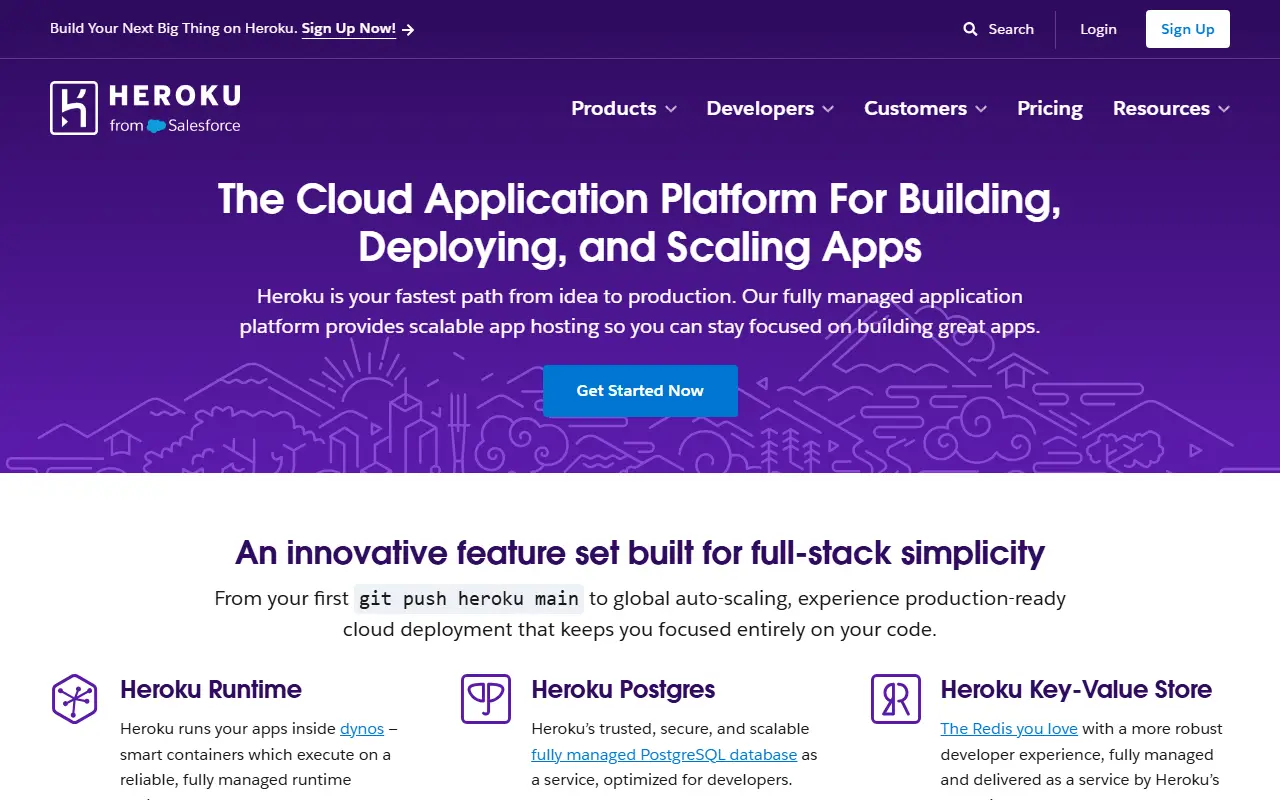
About Heroku
Heroku is a commercial platform as a service for building, deploying and scaling applications without managing servers. The vendor describes its platform as a managed container system, and it has been popular with developers for pushing code straight from a repository to a running app.
The product range includes the core Heroku Platform, Heroku AI for building intelligent applications with managed inference and agents, and managed data services for databases and related needs. The site also lists a dashboard, Dataclips for sharing query results, Elements for add-ons and integrations, and documentation and support. The vendor emphasizes effortless deployment and scaling.
Heroku is hosted, proprietary software, available with a pricing page and a sign-up flow, and it cannot be self-hosted. It suits startups, small teams and developers who prefer to focus on application code and let the platform handle infrastructure, scaling and routine operations.
Key features
- Managed container-based application platform
- Deployment and scaling without server management
- Managed data services
- Heroku AI with managed inference and agents
- Add-ons and integrations marketplace
- Dashboard with shareable Dataclips
Good fit for
- →Startups deploying web apps quickly
- →Developers hosting APIs and background workers
- →Teams adding managed databases to apps
- Tags
- paas
- hosting
- deployment
- cloud-platform
- managed-containers
- developer-tools
Heroku: questions and answers
- What is Heroku used for?
- Heroku is a cloud platform as a service where developers deploy, run and scale applications on managed containers, with managed data services and AI add-ons. It is a good fit for startups deploying web apps quickly, developers hosting APIs and background workers, and teams adding managed databases to apps.
- Is Heroku open source?
- No. Heroku is proprietary (closed-source) software and can't be self-hosted. Open-source alternatives to Heroku include Convox, ZaneOps and Zeabur.
- What are some alternatives to Heroku?
- Heroku competes with Render, Railway and Fly.io. For open-source options, see Enlisted's ranked list of open-source Heroku alternatives.
Open-source alternatives to Heroku
See all
Convox
Hosting & PaaS
Private PaaS built on native AWS services for maximum privacy and minimum upkeep
OSSvs Heroku★ 1.9k
ZaneOps
Hosting & PaaS
A beautiful and fast self-hosted PaaS for deploying and managing web apps, databases, stat
OSSvs Heroku★ 1.4k
Zeabur
Hosting & PaaS
A platform that helps you deploy services with one click.
MPL-2.0vs Vercel★ 683
Coolify
Hosting & PaaS
Self-hosting platform with superpowers. Deploy apps, databases & 280+ services to your
Apache-2.0vs Heroku★ 62k
Dokploy
Hosting & PaaS
Open-source self-hostable Platform as a Service (PaaS) that simplifies the deployment and
OSSvs Heroku★ 38k
Dokku
Hosting & PaaS
A docker-powered PaaS that helps you build and manage the lifecycle of applications
MITvs Heroku★ 32k
SaaS alternatives to Heroku
See all
Render
Hosting & PaaS
Managed hosting for web services, static sites, databases and cron jobs
SaaS
Railway
Hosting & PaaS
Deploys apps and databases from a repo or image with usage-based billing
SaaS
Fly.io
Hosting & PaaS
Runs containers as micro VMs close to users across regional data centers
SaaS
Northflank
Hosting & PaaS
Platform for deploying services, jobs and databases on managed or your own cloud
SaaS
Scalingo
Hosting & PaaS
French PaaS with Heroku-style git deploys on European infrastructure
SaaS
Clever Cloud
Hosting & PaaS
French PaaS that deploys apps and managed databases with usage-based pricing
SaaS