 TrackMedia
 TrackRev

 Azure App Service
 Fly.io
 Render
 Railway
 Vercel
 Netlify
 CockroachDB
 PlanetScale
 DigitalOcean Managed Databases
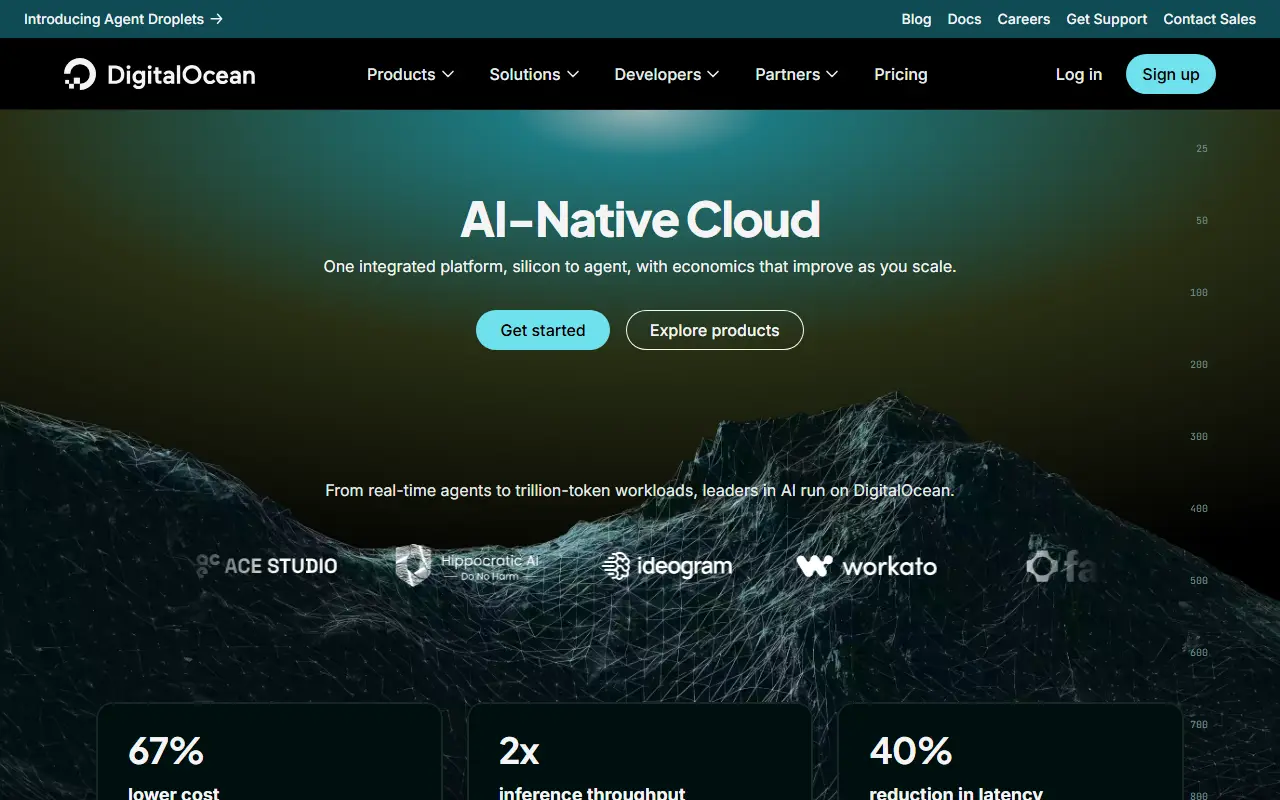
About DigitalOcean
DigitalOcean is a commercial cloud infrastructure provider that targets developers, startups and small and midsize businesses. Its core services include virtual servers, managed databases, storage, networking, security features and a platform-as-a-service called App Platform for deploying applications.
The product catalog is grouped into compute, containers and images, managed databases, management and developer tools, networking, security and storage. Its current homepage emphasizes an AI-native cloud, with serverless inference, model routing and a public-preview Managed Agents service, alongside documentation, a community site and a marketplace of partner offerings.
DigitalOcean is a proprietary hosted service sold on usage, with a public pricing page. It suits teams that want a simpler alternative to larger hyperscale clouds for web hosting, application deployment, databases and increasingly AI inference.
Key features
- Virtual servers for general compute
- App Platform for deploying applications
- Managed database engines
- Object and block storage
- Networking and security services
- Serverless inference and managed agents
Good fit for
- Hosting web applications on virtual servers
- Running managed databases for small teams
- Deploying apps without managing infrastructure
DigitalOcean: questions and answers
- What is DigitalOcean used for?
- DigitalOcean is a cloud provider offering virtual servers, managed databases, storage, networking and the App Platform PaaS, with a growing focus on AI workloads. It is a good fit for hosting web applications on virtual servers, running managed databases for small teams and deploying apps without managing infrastructure.
- Is DigitalOcean free?
- Yes. DigitalOcean has a free plan, and paid plans start at $4 per month.
- Is DigitalOcean open source?
- No. DigitalOcean is proprietary (closed-source) software and can't be self-hosted. Open-source alternatives to DigitalOcean include Ubicloud, Coolify and Dokploy.
- What are some alternatives to DigitalOcean?
- DigitalOcean competes with Linode, Vultr and Amazon Lightsail. For open-source options, see Enlisted's ranked list of open-source DigitalOcean alternatives.
Open-source alternatives to DigitalOcean
See all
Ubicloud
Hosting & PaaS
Ubicloud is an open source cloud that can run anywhere. Our cloud services include elastic
AGPL-3.0vs Amazon Web Services★ 12k
Coolify
Hosting & PaaS
Self-hosting platform with superpowers. Deploy apps, databases & 280+ services to your
Apache-2.0vs Heroku★ 66k
Dokploy
Hosting & PaaS
Open-source self-hostable Platform as a Service (PaaS) that simplifies the deployment and
OSSvs Heroku★ 38k
Apache CloudStack
Infrastructure & Containers
Apache CloudStack is an opensource Infrastructure as a Service (IaaS) cloud computing plat
Apache-2.0vs Amazon Web Services★ 3.1k
Pulumi
Infrastructure & Containers
Pulumi - Infrastructure as Code in any programming language 🚀
Apache-2.0vs DigitalOcean★ 26k
Supabase
Backend as a Service
The Postgres development platform. Supabase gives you a dedicated Postgres database to bui
Apache-2.0vs Firebase★ 115k
SaaS alternatives to DigitalOcean
See all
Linode
Hosting & PaaS
Cloud virtual machines, storage and Kubernetes, now operated as Akamai Cloud
SaaSVultr
Hosting & PaaS
Cloud servers, bare metal and managed Kubernetes across many locations
SaaS
Amazon Lightsail
Hosting & PaaS
Simple virtual private servers with fixed monthly pricing from AWS
SaaS
Hetzner Cloud
Hosting & PaaS
Low-cost European cloud servers with volumes, networks and load balancers
SaaS
AWS Elastic Beanstalk
Hosting & PaaS
PaaS that deploys and scales web apps on AWS from uploaded code
SaaS
Google App Engine
Hosting & PaaS
Managed Google Cloud platform for deploying web apps and APIs without servers
SaaS