 TrackMedia
 TrackRev

About Google App Engine
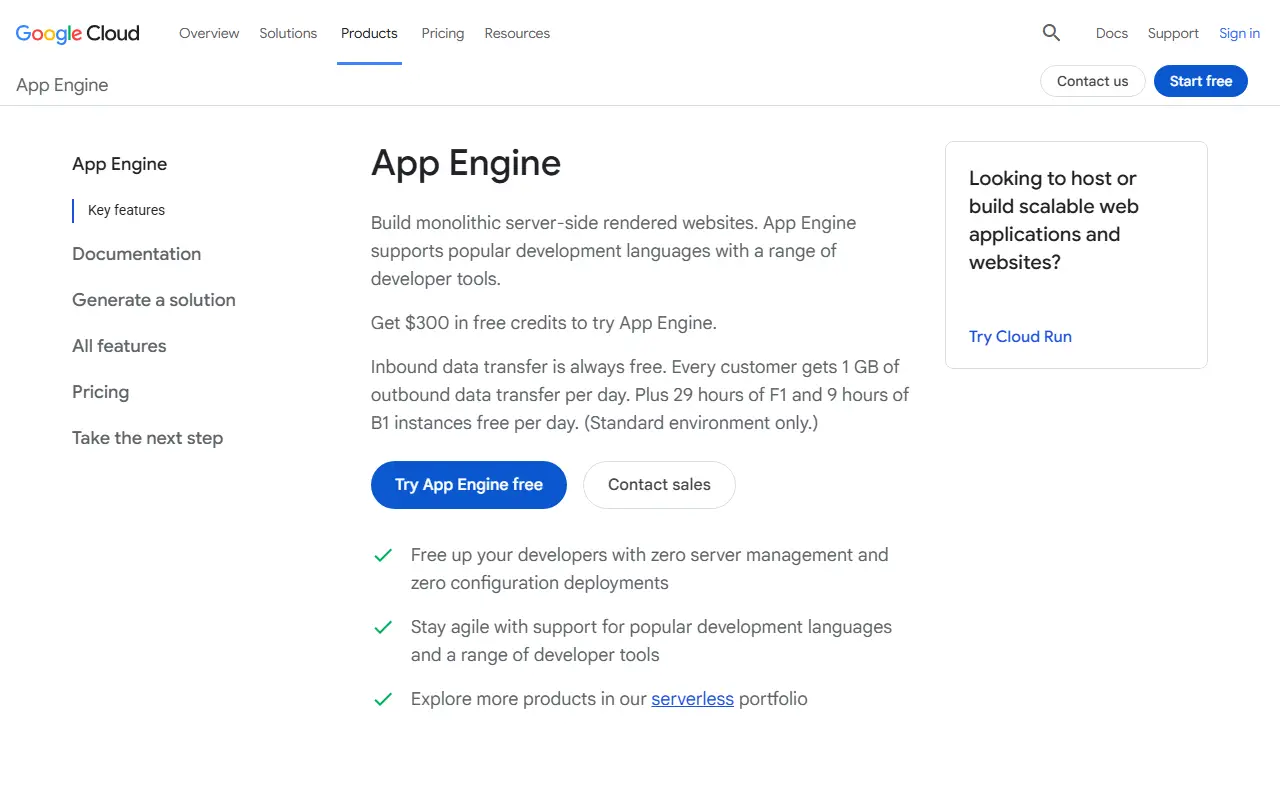
App Engine is Google Cloud's application hosting service, aimed at monolithic server-side rendered websites. Code runs as instances in one of two environments, standard or flexible, and Google handles the infrastructure so developers are not managing servers or configuring deployments by hand.
In the standard environment, instances run in a sandbox using the runtime of a supported language and can scale down to zero instances when there is no traffic. The flexible environment runs Docker containers on Compute Engine virtual machines, which fits custom runtimes and code that depends on native-code frameworks.
Google's own documentation steers new Google Cloud users toward Cloud Run as the preferred alternative and points to it when a needed runtime is not supported. An application can use both App Engine environments at once, which the docs say suits microservice designs.
Key features
- Supports seven programming languages
- Google manages the infrastructure
- Monitoring, logging and error reporting built in
- Host several app versions and staging environments
- Firewall rules and managed TLS certificates
- Instance classes set memory and CPU per instance
- Standard environment can scale to zero instances
Good fit for
- server-side rendered websites
- microservice backends
- apps with sudden traffic spikes
- containerised apps on virtual machines
Google App Engine: questions and answers
- What is Google App Engine used for?
- Google App Engine is a Google Cloud's application hosting service for server-side web apps, run in a standard or flexible environment with the infrastructure managed by Google. It is a good fit for server-side rendered websites, microservice backends and apps with sudden traffic spikes.
- How much does Google App Engine cost?
- Google App Engine is a paid product with no free plan. Billed on usage of standard and flexible environment instances plus App Engine APIs. New accounts get $300 in free credits, free inbound transfer and 1 GB of outbound transfer per day.
- Is Google App Engine open source?
- No. Google App Engine is proprietary (closed-source) software. Open-source alternatives to Google App Engine include Coolify, Dokploy and Dokku.
- What are some alternatives to Google App Engine?
- Google App Engine competes with AWS Elastic Beanstalk, Heroku and Azure App Service. For open-source options, see Enlisted's ranked list of open-source Google App Engine alternatives.
Open-source alternatives to Google App Engine
See all
Coolify
Hosting & PaaS
Self-hosting platform with superpowers. Deploy apps, databases & 280+ services to your
Apache-2.0vs Heroku★ 66k
Dokploy
Hosting & PaaS
Open-source self-hostable Platform as a Service (PaaS) that simplifies the deployment and
OSSvs Heroku★ 38k
Dokku
Hosting & PaaS
A docker-powered PaaS that helps you build and manage the lifecycle of applications
MITvs Heroku★ 32k
CapRover
Hosting & PaaS
Scalable PaaS (automated Docker+nginx) - aka Heroku on Steroids
OSSvs Heroku★ 15k
Tsuru
Hosting & PaaS
Open source and extensible Platform as a Service (PaaS).
BSD-3-Clausevs Heroku★ 5.3k
Rainbond
Hosting & PaaS
Rainbond is an open-source container platform that requires no Kubernetes expertise. Its c
OSSvs Heroku★ 6.3k
SaaS alternatives to Google App Engine
See all
AWS Elastic Beanstalk
Hosting & PaaS
PaaS that deploys and scales web apps on AWS from uploaded code
SaaS
Heroku
Hosting & PaaS
Heroku is a cloud platform as a service where developers deploy, run and scale applications on managed containers, with managed data services and AI add-ons.
SaaS
Azure App Service
Hosting & PaaS
Managed Azure platform for hosting web apps, APIs and mobile backends
SaaS
Google Cloud Run
Hosting & PaaS
Serverless platform for running containers that scale to zero on Google Cloud
SaaS
Render
Hosting & PaaS
Managed hosting for web services, static sites, databases and cron jobs
SaaS
Aptible
Hosting & PaaS
PaaS for deploying apps with built-in compliance controls such as HIPAA
SaaS