 TrackMedia
 TrackRev

 Clever Cloud
 Scalingo
 Aptible
 Laravel Forge
 Laravel Cloud
 Ploi
 PythonAnywhere
 AWS App Runner
 Railway
 Google Cloud Run
 AWS Amplify
 Upsun
 Azure Container Apps
 AWS Fargate
 Amazon ECS
 Qovery
About Dokku
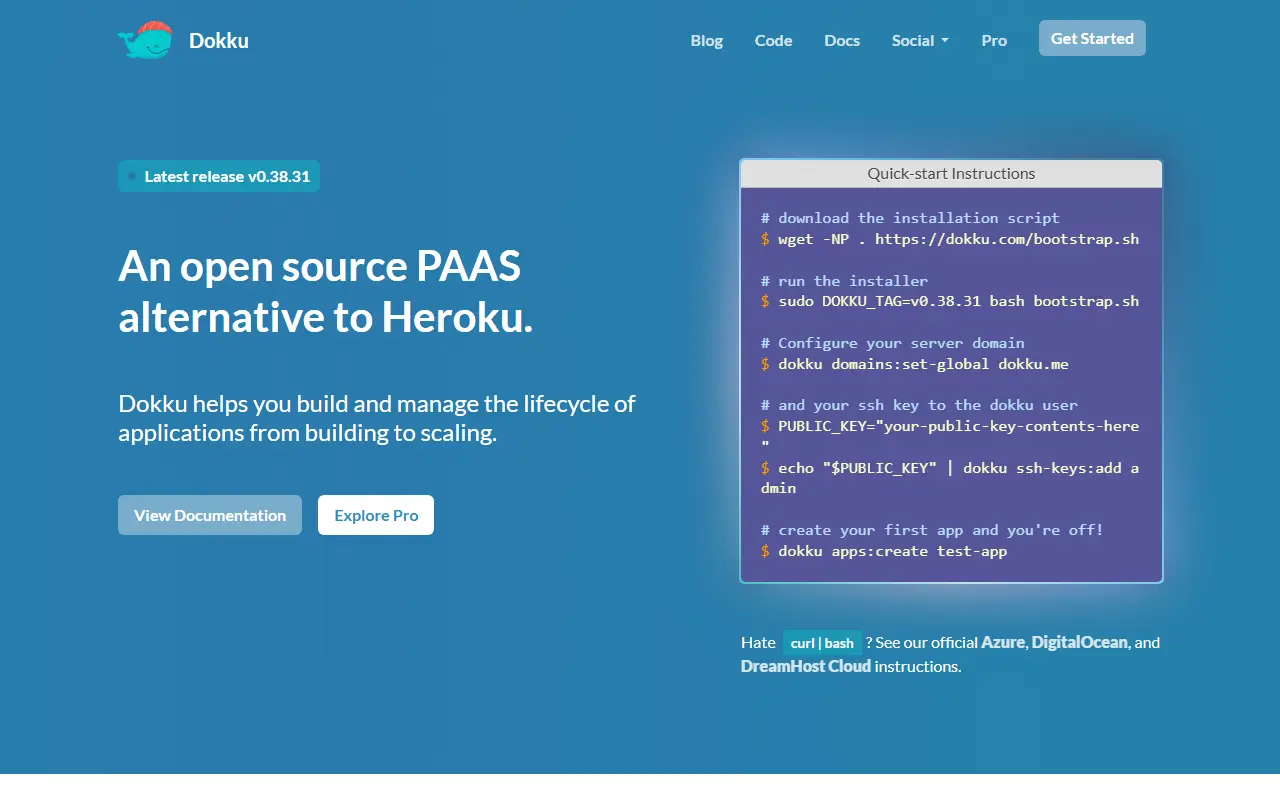
Dokku is a Docker-powered platform as a service that you install on your own server. It is billed as the smallest PaaS implementation around and as an open-source alternative to Heroku, helping you build and manage the full lifecycle of applications, from building them to scaling them.
Installation uses a bootstrap script that you run on a fresh server, after which you set a global domain and add your SSH key to the dokku user, then create apps and deploy to them. Topics refer to buildpack-based builds, containers, and scheduler support for Docker, Kubernetes and Nomad. The project has documentation, a blog, community chat on Discord, Slack and IRC, GitHub Discussions, and a Pro offering listed on the site.
Dokku is MIT licensed and written in Go and shell, with sponsors and backers supporting its development. It suits developers who like the Heroku workflow but want to run it on their own VPS for less cost or more control.
Key features
- Docker-based application deployment
- Heroku-style workflow on your own server
- Bootstrap installer script
- Buildpack and container support
- Scheduler support for Docker, Kubernetes and Nomad
- Active community channels
Good fit for
- Running a personal Heroku on a VPS
- Hosting small production apps cheaply
- Teams needing simple self-hosted deploys
Dokku: questions and answers
- What is Dokku used for?
- Dokku is a Docker-powered, self-hosted mini-Heroku PaaS that builds, deploys and manages applications on a single server, from first build to scaling. It is a good fit for running a personal Heroku on a VPS, hosting small production apps cheaply and teams needing simple self-hosted deploys.
- Is Dokku open source?
- Yes. Dokku is open source under the MIT licence. Its source code is on GitHub at dokku/dokku and is written mainly in Shell.
- Is Dokku free?
- Yes. Dokku is open source, so the software itself is free to use.
- Can I self-host Dokku?
- Yes. Dokku can be self-hosted on your own server or infrastructure; there is no official hosted version.
- What is Dokku an alternative to?
- Dokku is an open-source alternative to Heroku, Fly.io, AWS Elastic Beanstalk and Google App Engine. Other open-source alternatives to Heroku include CapRover, Coolify and Dokploy.
- Is Dokku actively maintained?
- Yes. The most recent commit to Dokku was on 12 November 2026, and the latest release is v0.38.34, published on 30 October 2026. The project has 32k stars on GitHub, with 50 added in the last 30 days.
Open-source alternatives to Dokku
See all
CapRover
Hosting & PaaS
Scalable PaaS (automated Docker+nginx) - aka Heroku on Steroids
OSSvs Heroku★ 15k
Coolify
Hosting & PaaS
Self-hosting platform with superpowers. Deploy apps, databases & 280+ services to your
Apache-2.0vs Heroku★ 66k
Dokploy
Hosting & PaaS
Open-source self-hostable Platform as a Service (PaaS) that simplifies the deployment and
OSSvs Heroku★ 38k
Kubero
Hosting & PaaS
A free and self-hosted PaaS alternative to Heroku / Netlify / Coolify / Vercel / Dokku / P
GPL-3.0vs Heroku★ 4.5k
ZaneOps
Hosting & PaaS
A beautiful and fast self-hosted PaaS for deploying and managing web apps, databases, stat
OSSvs Heroku★ 1.4k
Zeabur
Hosting & PaaS
A platform that helps you deploy services with one click.
MPL-2.0vs Vercel★ 750
SaaS alternatives to Dokku
See all
Heroku
Hosting & PaaS
Heroku is a cloud platform as a service where developers deploy, run and scale applications on managed containers, with managed data services and AI add-ons.
SaaS
Fly.io
Hosting & PaaS
Runs containers as micro VMs close to users across regional data centers
SaaS
AWS Elastic Beanstalk
Hosting & PaaS
PaaS that deploys and scales web apps on AWS from uploaded code
SaaS
Google App Engine
Hosting & PaaS
Managed Google Cloud platform for deploying web apps and APIs without servers
SaaS
Azure App Service
Hosting & PaaS
Managed Azure platform for hosting web apps, APIs and mobile backends
SaaS
Sevalla
Hosting & PaaS
PaaS for apps, databases and static sites from the team behind Kinsta
SaaS