12 open-source alternatives ranked by real activity

Open-source Azure App Service alternatives

A curated, ranked list of the 12 best open-source alternatives to Azure App Service.

The best open-source alternative to Azure App Service is Coolify. If that doesn't suit you, other good options are Kubernetes, Dokploy, Moby and Dokku.

Commercial alternatives to Azure App Service include AWS Elastic Beanstalk, Google App Engine, Aptible and Clever Cloud. See all 16.

Azure App Service alternatives are mainly hosting & PaaS tools, but some are also infrastructure & container tools and password managers. 11 of them shipped code in the last 30 days, 12 can be self-hosted, and 6 use a permissive licence.

Last updated November 13, 2026 · ranked by GitHub stars, growth and recent commits

Coolify

A self-hostable platform for deploying apps, databases and one-click services to your own servers over SSH, an open-source alternative to Heroku, Vercel and Netlify.

GitHub stars
66k
Last commit
today
Latest release
v4.7.5
Licence
Apache-2.0
Self-hosted
Yes
Hosted version
Available
coolify.ioCoolify homepage screenshot

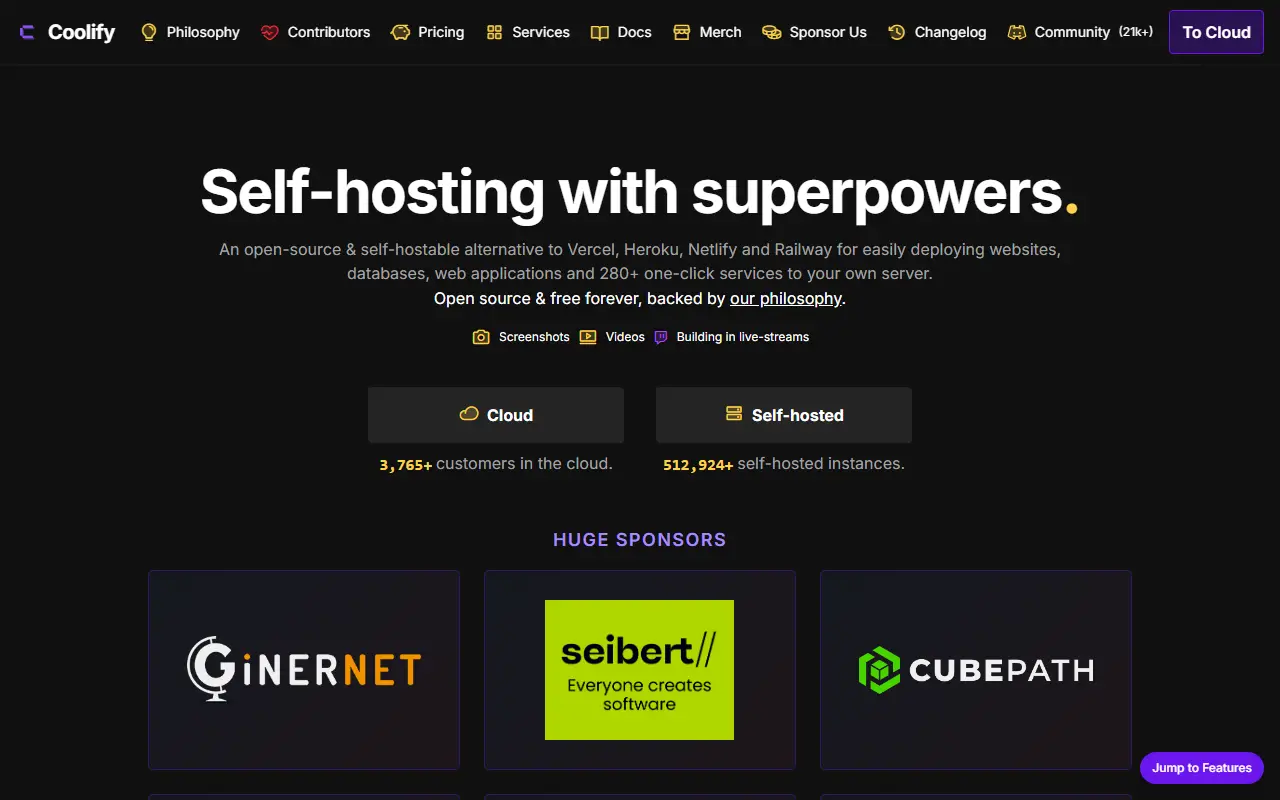
Coolify is an open-source, self-hostable alternative to Heroku, Vercel and Netlify. It manages servers, applications and databases on hardware you control, and the only requirement is SSH access, so a VPS, a bare-metal machine or even a Raspberry Pi can serve as a target. Your configuration stays on your own servers, and if you stop using Coolify the resources it deployed keep running.

Applications can be built from GitHub, GitLab, Bitbucket or Gitea using Nixpacks, Railpack, a Dockerfile, Docker Compose or a prebuilt image. Hundreds of one-click services and managed-style databases come with persistent storage and generated credentials. Deployments can run on every push, create pull-request previews, call webhooks and roll back to retained images. Custom domains, automatic HTTPS, reverse proxies and health checks cover networking, while logs, container terminals and resource monitoring help with operations.

Backups, scheduled tasks, secrets, environment variables and notifications are built in, and resources can be managed through the dashboard, an API, a CLI or MCP, with team-based access controls. Coolify is Apache-2.0 licensed and built mainly with PHP; a hosted Coolify Cloud option exists for people who prefer not to run the control plane themselves.

Key features

  • Deploy from Git with Nixpacks, Dockerfile or Compose
  • Hundreds of one-click services and databases
  • Pull-request previews and rollbacks
  • Automatic HTTPS and custom domains
  • Database and storage backups
  • Multi-server management with team access controls
  • Dashboard, API, CLI and MCP management

Pricing: Self-hosting is free with no feature limits. Coolify Cloud is $5 per month including two connected servers, plus $3 per month for each additional server.

Read more about CoolifyWebsiteGitHub#1 Azure App Service alternative

Kubernetes

An open-source system for deploying, scaling and managing containerized applications across clusters of hosts, hosted by the CNCF.

GitHub stars
129k
Last commit
yesterday
Latest release
v1.37.2
Licence
Apache-2.0
Self-hosted
Yes
Hosted version
Available
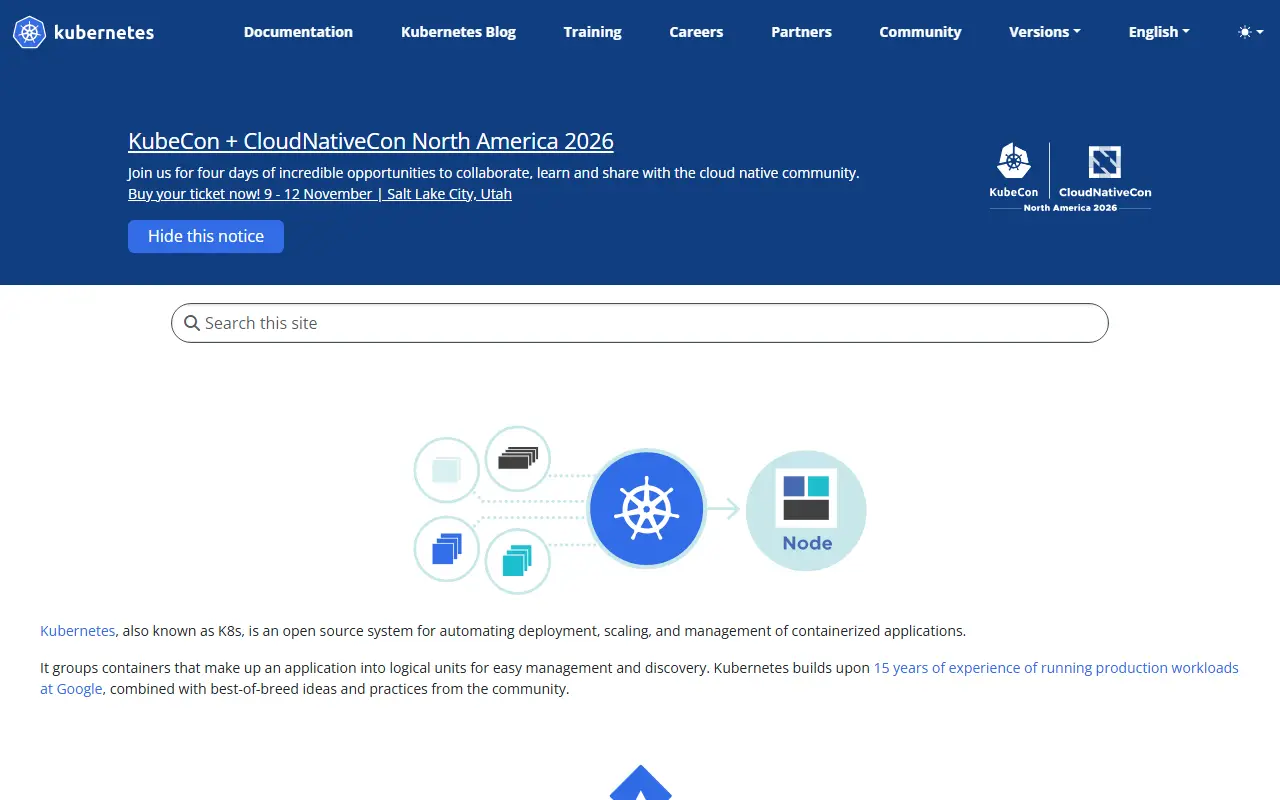
kubernetes.ioKubernetes homepage screenshot

Kubernetes, also written K8s, is an open-source system that manages containerized applications across multiple hosts. It provides the basic mechanisms for deploying, maintaining and scaling applications, so teams can run containers reliably without scheduling each one by hand. It is written in Go and released under the Apache-2.0 license.

The project builds on years of experience running production workloads at Google with an internal system called Borg, combined with practices from the wider community. The Cloud Native Computing Foundation hosts the project. Users interact with it through declarative configuration and the documentation on kubernetes.io, which includes tutorials and a free course on scalable microservices.

Kubernetes can be run on your own infrastructure, and major cloud providers also offer managed Kubernetes services. The README adds that the k8s.io/kubernetes module is not supported for use as a library. It suits platform and DevOps teams running microservices that need scheduling, scaling and automatic recovery.

Key features

  • Container scheduling across multiple hosts
  • Automated application deployment and rollouts
  • Scaling of containerized workloads
  • Maintenance and self-healing of applications
  • Declarative configuration of desired state
  • CNCF-hosted with extensive documentation

Pricing: Free and open source under the Apache-2.0 license; cloud providers sell managed services built on it.

Read more about KubernetesWebsiteGitHub#2 Azure App Service alternative

Dokploy

A free, self-hostable platform as a service for deploying apps, databases and Docker Compose stacks on your own servers, an alternative to Vercel, Netlify and Heroku.

GitHub stars
38k
Last commit
today
Latest release
v0.31.1
Self-hosted
Yes
Hosted version
Available
dokploy.comDokploy homepage screenshot

Dokploy is an open-source, self-hostable platform as a service that simplifies deploying and managing applications and databases. It is positioned as an alternative to Heroku, Vercel and Netlify, and it runs on a VPS you control, installed with a single command.

It can deploy apps in languages such as Node.js, PHP, Python, Go and Ruby, create and manage MySQL, PostgreSQL, MongoDB, MariaDB, libsql and Redis databases, and schedule database backups to external storage. Docker Compose is supported natively, and multiple nodes can be clustered with Docker Swarm or managed as remote servers. One-click templates cover open-source apps such as Plausible, PocketBase and Cal.com, Traefik handles routing and load balancing, and live monitoring shows CPU, memory, storage and network usage per resource.

A CLI and API allow automation, and notifications about deploy success or failure can go to Slack, Discord, Telegram or email. The license is listed as 'Other', so check the repository terms before redistribution. For people who want to skip installation there is a hosted Dokploy Cloud.

Key features

  • Deploy apps in many languages
  • Managed databases with automated backups
  • Native Docker Compose support
  • Multi-node scaling with Docker Swarm
  • One-click open-source templates
  • Traefik routing and load balancing
  • Real-time resource monitoring

Pricing: Hobby costs $4.50 per server per month and Startup starts at $15 per month for up to 3 servers. Enterprise (cloud or self-hosted) and Agency plans are quoted by sales; there is a 7-day free trial.

Read more about DokployWebsiteGitHub#3 Azure App Service alternative

Moby

A modular, open-source toolkit created by Docker for assembling container-based systems, aimed at engineers and integrators rather than end users.

GitHub stars
72k
Last commit
2 days ago
Latest release
docker-v29.9.3
Licence
Apache-2.0
Self-hosted
Yes
mobyproject.orgMoby homepage screenshot

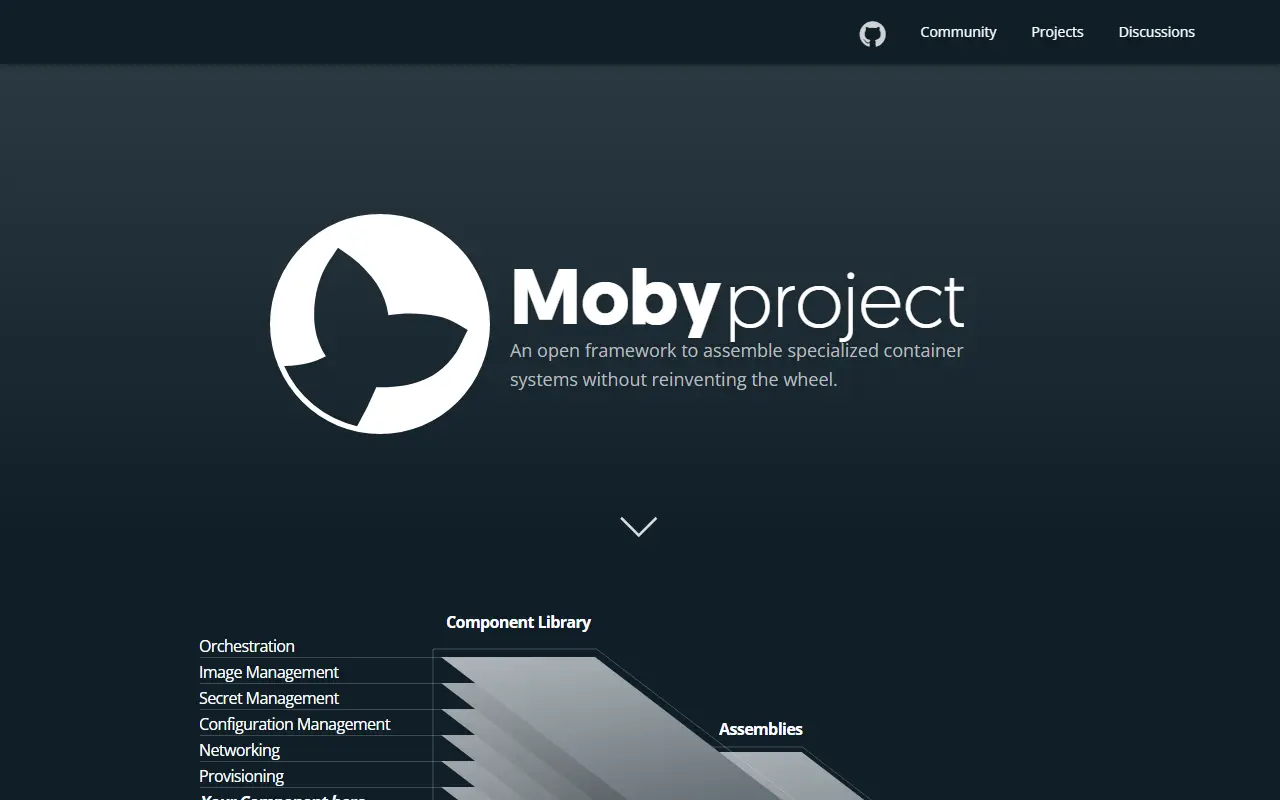
The Moby Project is an open-source effort started by Docker to make software containerization faster and easier. It provides a toolkit of components, a way of combining them into tailored systems built on containers, and a space where container enthusiasts and professionals can try things out and share ideas. It is written in Go under the Apache-2.0 license.

The toolkit's parts include build tooling for containers, a registry, orchestration tools and a runtime, and they can be used as building blocks together with other tools and projects. The project is guided by four principles: modular components with well-defined APIs, batteries included but swappable, secure defaults that preserve usability, and a developer focus, with documentation aimed at developers rather than end users.

The audience is engineers, integrators and enthusiasts who want to modify, experiment with and build container-based systems. The README states it is not meant for people seeking a commercially supported system. Those who want a ready-to-use container product will generally choose a packaged distribution built on top of Moby.

Key features

  • Modular container components with defined APIs
  • Container build tools
  • Container registry and orchestration components
  • Swappable runtime and building blocks
  • Secure defaults without sacrificing usability
  • Framework for assembling custom container systems

Pricing: Free and open source under the Apache-2.0 license.

Read more about MobyWebsiteGitHub#4 Azure App Service alternative

Dokku

A Docker-powered, self-hosted mini-Heroku PaaS that builds, deploys and manages applications on a single server, from first build to scaling.

GitHub stars
32k
Last commit
yesterday
Latest release
v0.38.34
Licence
MIT
Self-hosted
Yes
dokku.comDokku homepage screenshot

Dokku is a Docker-powered platform as a service that you install on your own server. It is billed as the smallest PaaS implementation around and as an open-source alternative to Heroku, helping you build and manage the full lifecycle of applications, from building them to scaling them.

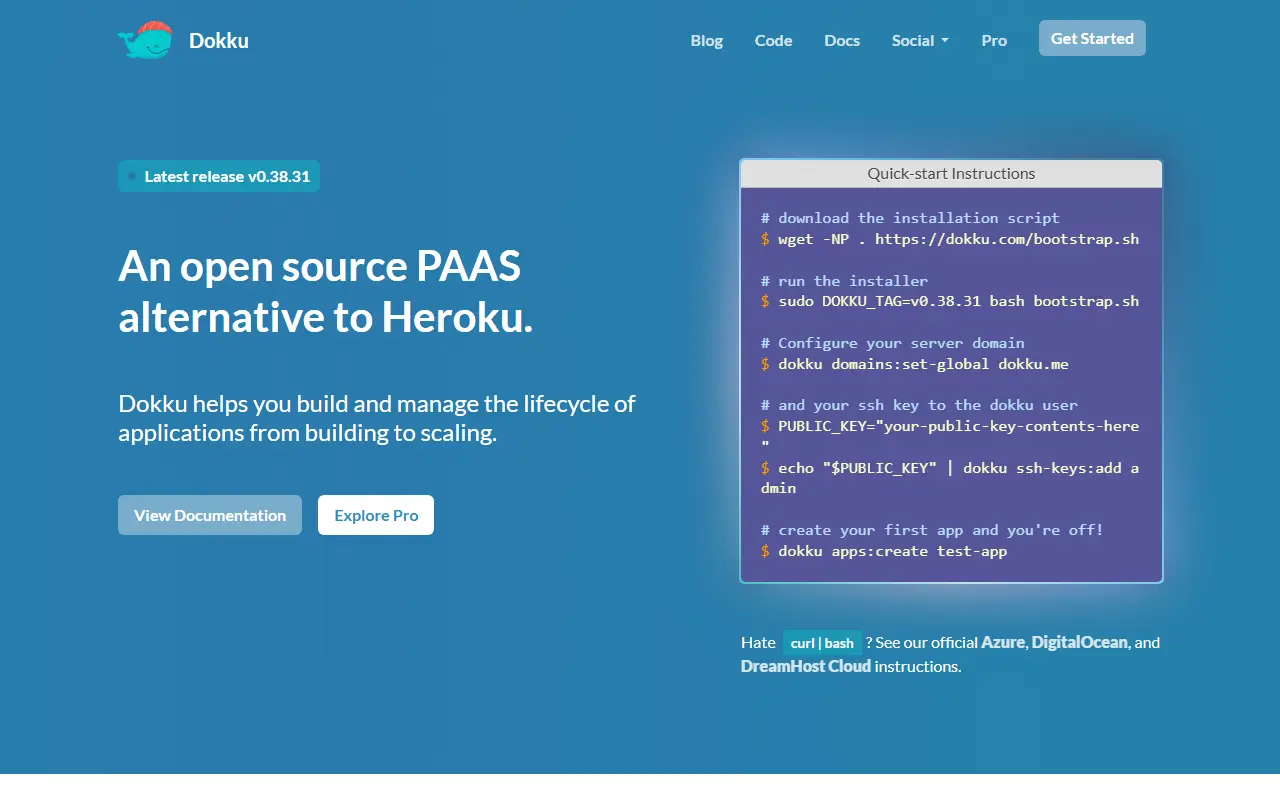
Installation uses a bootstrap script that you run on a fresh server, after which you set a global domain and add your SSH key to the dokku user, then create apps and deploy to them. Topics refer to buildpack-based builds, containers, and scheduler support for Docker, Kubernetes and Nomad. The project has documentation, a blog, community chat on Discord, Slack and IRC, GitHub Discussions, and a Pro offering listed on the site.

Dokku is MIT licensed and written in Go and shell, with sponsors and backers supporting its development. It suits developers who like the Heroku workflow but want to run it on their own VPS for less cost or more control.

Key features

  • Docker-based application deployment
  • Heroku-style workflow on your own server
  • Bootstrap installer script
  • Buildpack and container support
  • Scheduler support for Docker, Kubernetes and Nomad
  • Active community channels

Pricing: Free and open source under the MIT license.

Read more about DokkuWebsiteGitHub#5 Azure App Service alternative

Nomad

Nomad is HashiCorp's workload scheduler and orchestrator for containers, binaries and batch jobs, in the cloud or on-prem.

GitHub stars
17k
Last commit
8 days ago
Latest release
v2.1.1
Self-hosted
Yes
nomadproject.ioNomad homepage screenshot

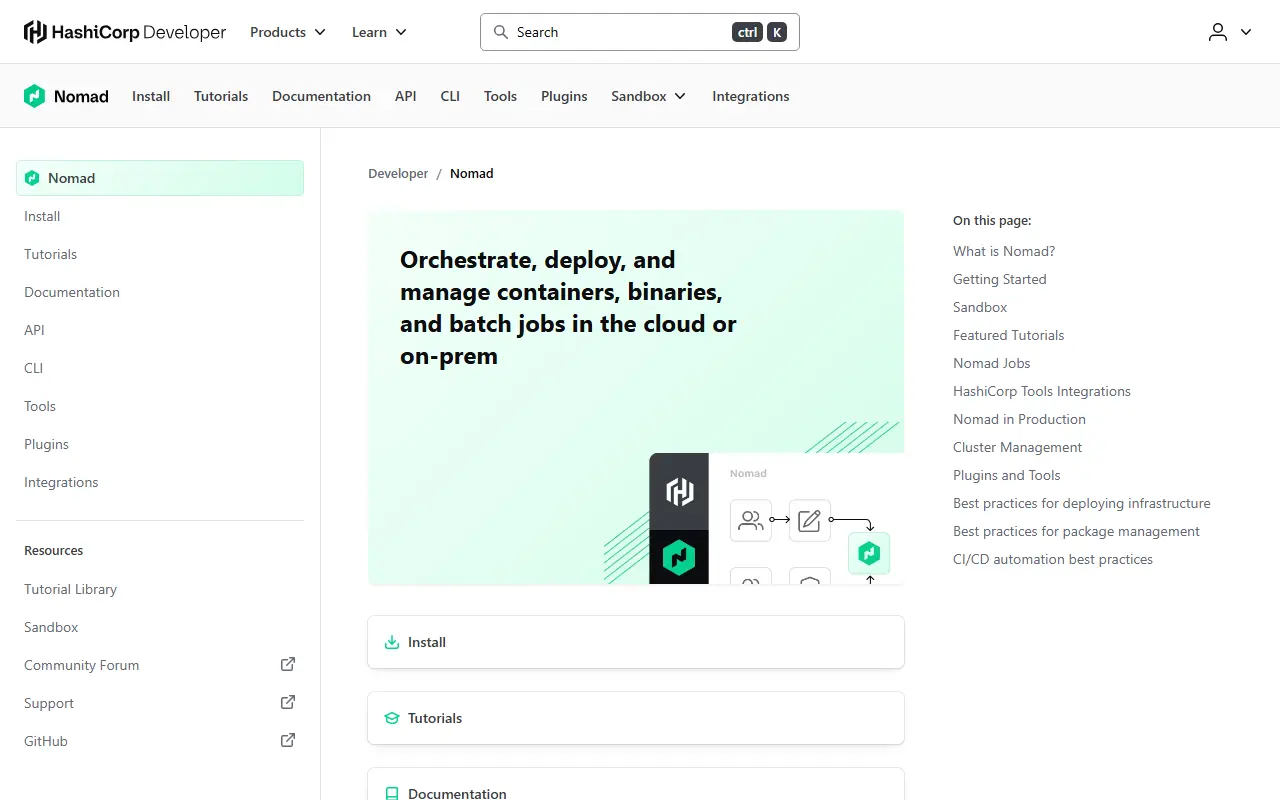
Nomad is a scheduler and orchestrator from HashiCorp. It deploys and manages containers and non-containerized applications, including binaries and batch jobs, across on-prem environments and clouds.

Workloads are described as Nomad jobs. Parameterized jobs allow dynamic runtime behavior from a single job specification, and Nomad Pack provides reusable job templates. The tutorials show it working alongside Consul for service discovery and health checking, Vault for secrets and Terraform for creating clusters.

HashiCorp offers a sandbox with preinstalled tools for experimenting, and the site documents a separate Nomad Enterprise edition. The listed licence is Other, so check the project's terms before using it.

Key features

  • Containers, binaries and batch jobs
  • Containerized and non-containerized apps at scale
  • Parameterized jobs
  • Reusable job templates with Nomad Pack
  • Consul integration for service discovery and mesh
  • Vault integration for workload secrets
Read more about NomadWebsiteGitHub#6 Azure App Service alternative

CapRover

A self-hosted app and database deployment platform that uses Docker, nginx and Let's Encrypt behind a simple web GUI and CLI, often described as a Heroku alternative.

GitHub stars
15k
Last commit
6 days ago
Latest release
v1.16.0
Self-hosted
Yes
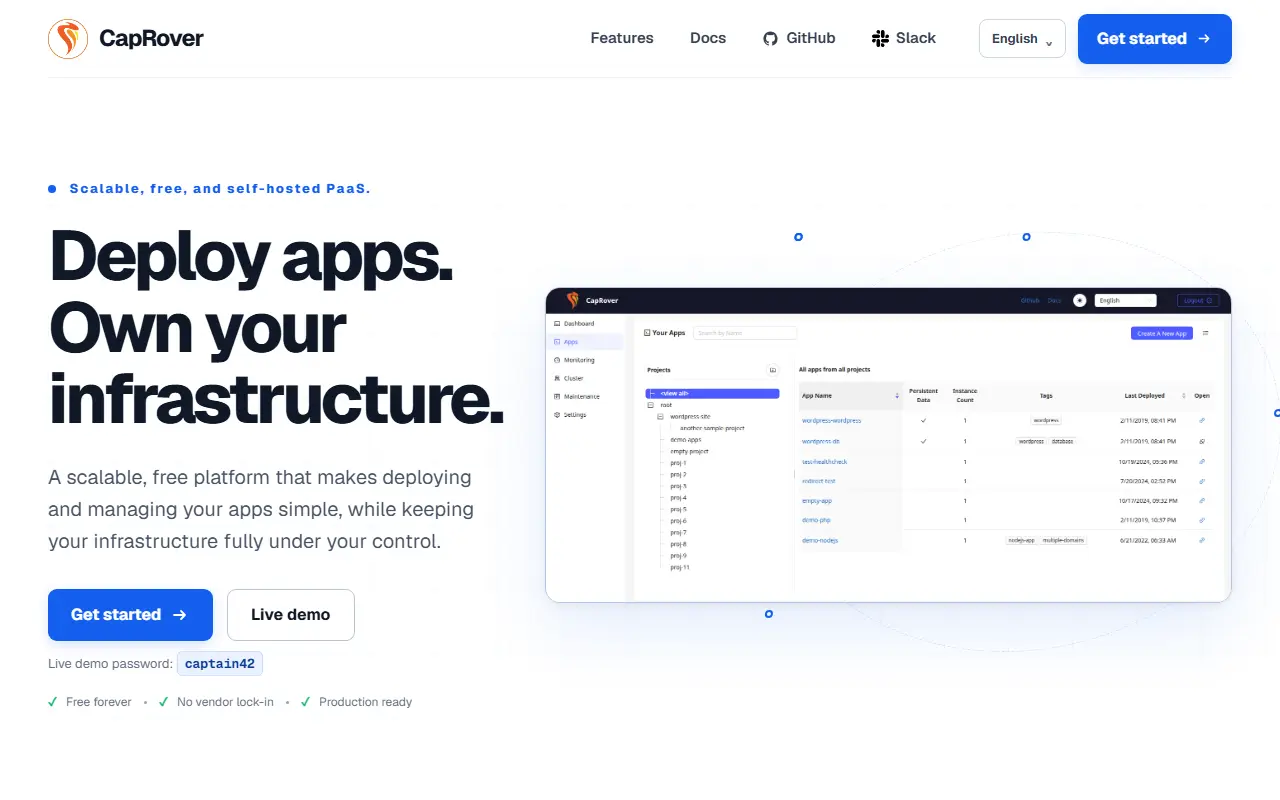
caprover.comCapRover homepage screenshot

CapRover is a deployment platform and web server manager that you install on your own server. It lets you run applications written in NodeJS, Python, PHP, ASP.NET, Ruby and Go, as well as databases like MariaDB, MySQL, MongoDB and Postgres, and apps such as WordPress, without needing deep Docker or nginx knowledge. It is often called a Heroku alternative.

Under the hood it uses Docker Swarm for containerization and clustering, nginx with a customizable template for load balancing, Let's Encrypt for free HTTPS certificates, and NetData for monitoring. You work through a web GUI for convenience or a CLI for automation and scripting. The project emphasizes that there is no lock-in: if you remove CapRover, your apps keep working. It targets developers who do not want to spend days setting up servers, builds, certificates and proxy configuration.

CapRover is written in TypeScript on Node.js, and its license is listed as 'Other' on GitHub, so confirm the terms. It is self-hosted software with no vendor service involved, and it suits small teams and solo developers running several apps on their own VPS.

Key features

  • Web GUI and CLI for deployment
  • Docker Swarm clustering
  • Nginx load balancing
  • Free HTTPS via Let's Encrypt
  • One-click databases and apps
  • No lock-in for deployed applications
Read more about CapRoverWebsiteGitHub#7 Azure App Service alternative

Rainbond

Rainbond is an open-source container platform with a graphical interface that deploys and manages applications on Kubernetes without needing K8s expertise.

GitHub stars
6.3k
Last commit
2 days ago
Latest release
v6.10.3-release
Self-hosted
Yes
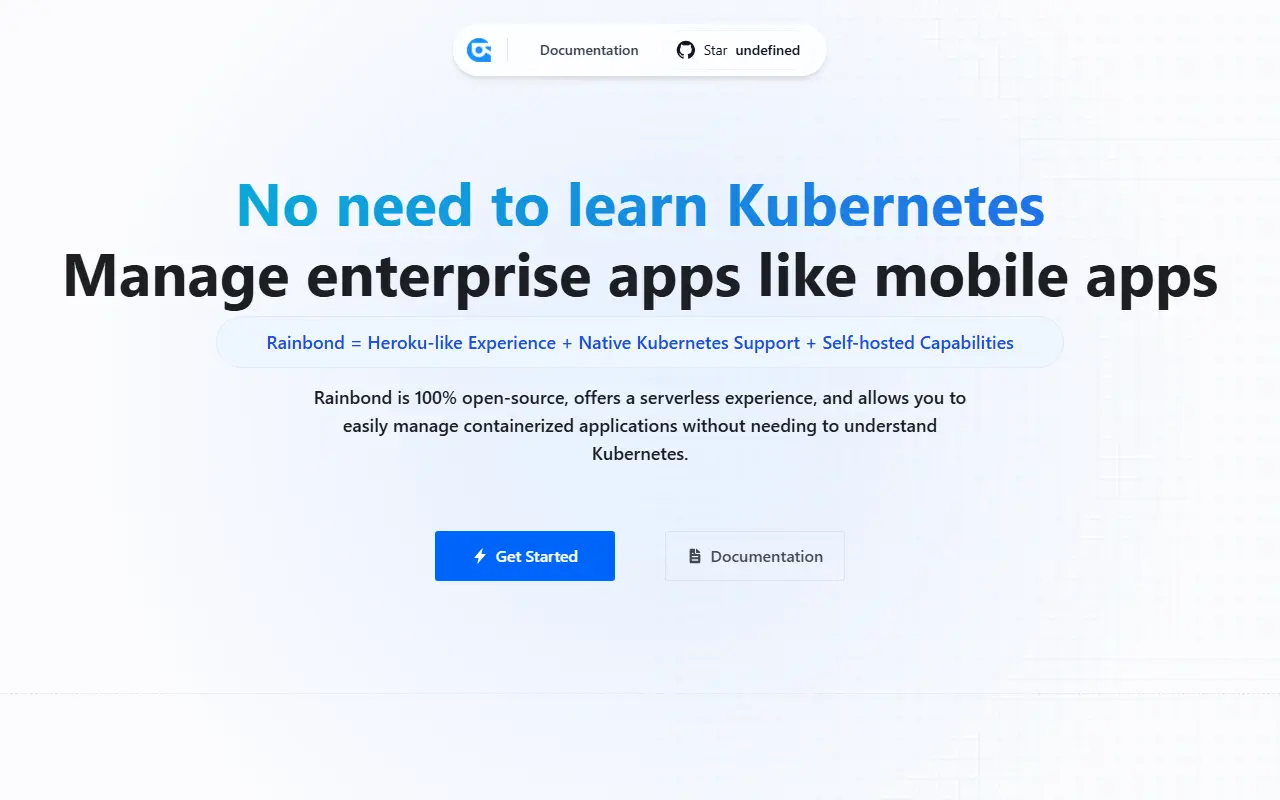
rainbond.ioRainbond homepage screenshot

Rainbond is an open-source application platform that sits on top of Kubernetes and hides most of its complexity. Teams use a graphical interface to build, deploy, assemble and manage applications, so developers and operators without Kubernetes expertise can still run workloads on clusters.

The project describes a unified way to deploy ordinary business applications, projects generated by AI, open-source AI tools and LLM services, with AI assisting in deployment and operation. It targets private, self-hosted deployments on your own servers or Kubernetes clusters, and its README states that the core capabilities are fully open source.

The code is written in Go and published under a license that GitHub lists as 'Other', so review its terms before adopting it. Documentation and a Chinese-language README are provided, and the platform suits teams that want an internal PaaS and application delivery layer over Kubernetes.

Key features

  • Graphical build and deploy workflow
  • Application management on Kubernetes
  • No Kubernetes expertise required
  • Deployment of AI software and LLM services
  • Runs on your own servers or clusters
  • Application assembly from components
Read more about RainbondWebsiteGitHub#8 Azure App Service alternative

Tsuru

Tsuru is an extensible open-source platform as a service that makes deploying apps on Docker and Kubernetes faster without managing servers by hand.

GitHub stars
5.3k
Last commit
today
Latest release
v1.34.0
Licence
BSD-3-Clause
Self-hosted
Yes
tsuru.ioTsuru homepage screenshot

Tsuru is an open-source, extensible platform as a service designed to make application deployment faster and easier. For developers the idea is that servers fade into the background: you write apps in the language of your choice and let Tsuru handle running them on containers.

Apps can attach services like relational and NoSQL databases, memcached or Redis, and are managed through the tsuru command-line tool. The platform is built in Go and uses Docker and Kubernetes under the hood, with documentation, a landing page and contributor instructions based on docker-compose. Its extensibility lets operators plug in their own providers and resources.

Tsuru is licensed under BSD-3-Clause and is run by you on your own infrastructure or cloud accounts. It suits platform and DevOps teams that want to offer their developers an internal, Heroku-style PaaS.

Key features

  • Language-agnostic application deployment
  • Add-on resources like databases and Redis
  • tsuru command-line management
  • Docker and Kubernetes runtime
  • Extensible provider architecture
  • Self-hosted PaaS operation

Pricing: Free and open source under the BSD-3-Clause license.

Read more about TsuruWebsiteGitHub#9 Azure App Service alternative

Kubero

A self-hosted platform-as-a-service that deploys apps on Kubernetes through a web UI, CLI and operator, without needing Kubernetes expertise.

GitHub stars
4.5k
Last commit
1 mo ago
Latest release
v3.1.1
Licence
GPL-3.0
Self-hosted
Yes

Kubero, pronounced Kube Hero, is a self-hosted PaaS that lets a developer deploy an application on Kubernetes without specialized knowledge. It follows the principles of 12-factor apps and can run apps from existing containers or from source code. The repository describes it as an alternative to Heroku, Netlify, Vercel, Dokku and similar tools.

It is Kubernetes native and runs as two containers, kubero-ui and an Operator, on any Kubernetes instance. All its data is stored in the cluster's etcd with no extra database. Setup is done by installing the Kubero CLI and running kubero install, either on an existing cluster or on a new one at providers such as GKE, Scaleway, DigitalOcean, Linode or Kind for local use.

Work is organised into pipelines with phases such as review, test, stage and production, optionally connected to a git repository on GitHub, GitLab, Bitbucket, Gitea or Gogs. The project lists more than 160 app templates, built-in add-ons such as PostgreSQL, Redis and MongoDB, logs, metrics, scheduled tasks, vulnerability scans and notifications. It is GPL-3.0 licensed and has a public demo.

Key features

  • Deploys Docker containers without Helm charts
  • More than 160 ready-made app templates
  • Pipelines with up to four staging environments
  • Review apps built from pull requests
  • Add-ons such as PostgreSQL and Redis deployed with apps
  • Build and deployment notifications via Discord, Slack or webhooks
  • Scheduled or triggered vulnerability scans
  • Single sign-on with GitHub and OAuth2
Read more about KuberoWebsiteGitHub#10 Azure App Service alternative

2 more Azure App Service alternatives

Commercial Azure App Service alternatives

Hosted, closed-source products that compete with Azure App Service. Showing 12 of 16.

See every Azure App Service alternative on its tool page

Azure App Service alternatives: questions

What is the best open-source alternative to Azure App Service?
Coolify is the top-ranked open-source alternative to Azure App Service on Enlisted: A self-hostable platform for deploying apps, databases and one-click services to your own servers over SSH, an open-source alternative to Heroku, Vercel and Netlify. Other strong options are Kubernetes, Dokploy, Moby and Dokku.
What are the best commercial alternatives to Azure App Service?
AWS Elastic Beanstalk, Google App Engine, Aptible, Clever Cloud and DigitalOcean are among the hosted, closed-source alternatives to Azure App Service listed on Enlisted, which lists 16 in total. Compare their pricing and features on each tool page.
Are these Azure App Service alternatives free?
All 12 are open source, so the code is free to use under its licence, and all of them can be self-hosted on your own server or computer. 4 also offer a paid or managed cloud version if you'd rather not host it yourself.
How is this list of Azure App Service alternatives ranked?
By a score built from GitHub stars, star growth over the last 30 days and how recently the code changed. 11 of these projects shipped code in the last 30 days. Data is refreshed daily, and nobody can pay to move up.

People also look for alternatives to…

View all