
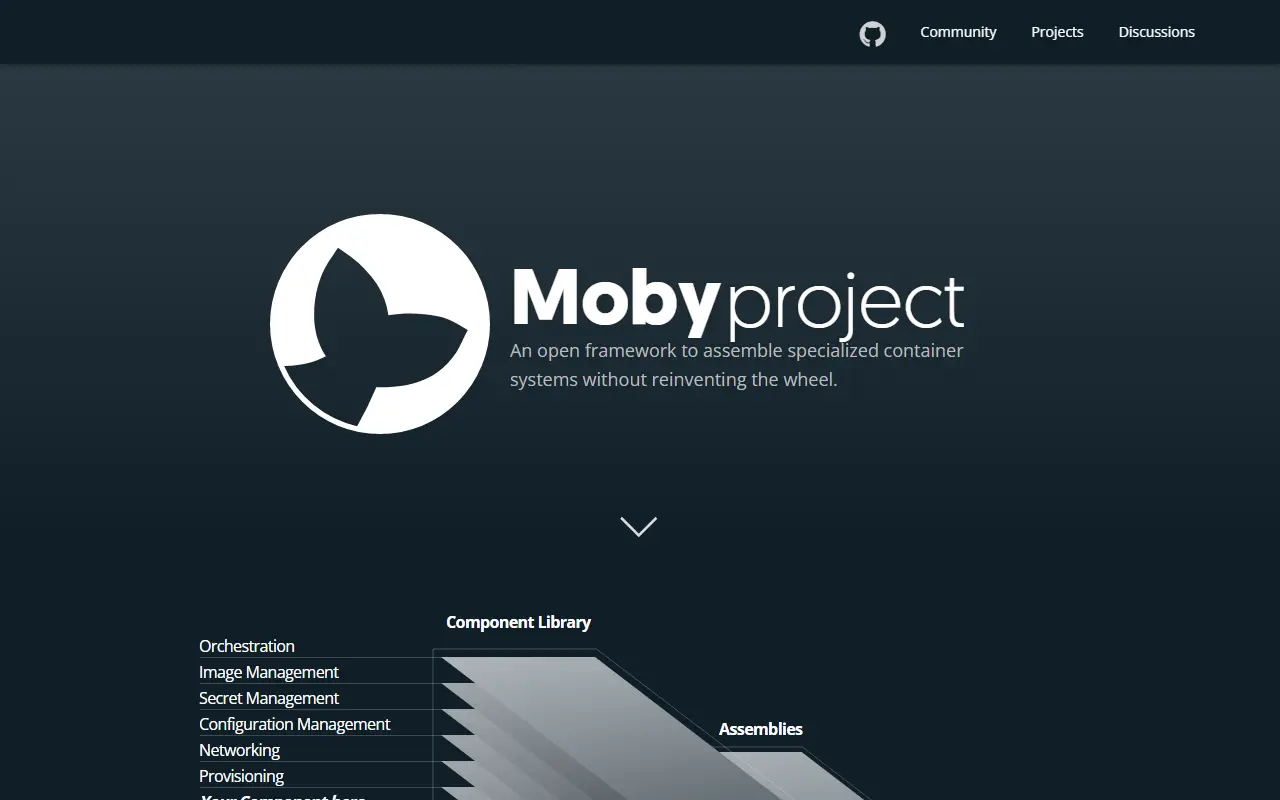
About Moby
The Moby Project is an open-source effort started by Docker to make software containerization faster and easier. It provides a toolkit of components, a way of combining them into tailored systems built on containers, and a space where container enthusiasts and professionals can try things out and share ideas. It is written in Go under the Apache-2.0 license.
The toolkit's parts include build tooling for containers, a registry, orchestration tools and a runtime, and they can be used as building blocks together with other tools and projects. The project is guided by four principles: modular components with well-defined APIs, batteries included but swappable, secure defaults that preserve usability, and a developer focus, with documentation aimed at developers rather than end users.
The audience is engineers, integrators and enthusiasts who want to modify, experiment with and build container-based systems. The README states it is not meant for people seeking a commercially supported system. Those who want a ready-to-use container product will generally choose a packaged distribution built on top of Moby.
Key features
- Modular container components with defined APIs
- Container build tools
- Container registry and orchestration components
- Swappable runtime and building blocks
- Secure defaults without sacrificing usability
- Framework for assembling custom container systems
Good fit for
- →Building custom container platforms
- →Experimenting with container internals
- →Integrating container components into products
- Tags
- containers
- docker
- golang
- container-runtime
- devops
- infrastructure
- moby
- toolkit
Moby: questions and answers
- What is Moby used for?
- Moby is a modular, open-source toolkit created by Docker for assembling container-based systems, aimed at engineers and integrators rather than end users. It is a good fit for building custom container platforms, experimenting with container internals and integrating container components into products.
- Is Moby open source?
- Yes. Moby is open source under the Apache-2.0 licence. Its source code is on GitHub at moby/moby and is written mainly in Go.
- Is Moby free?
- Yes. Moby is open source, so the software itself is free to use.
- Can I self-host Moby?
- Yes. Moby can be self-hosted on your own server or infrastructure; there is no official hosted version.
- What are some alternatives to Moby?
- Similar open-source tools in the Infrastructure & Containers category include Kubernetes, Rancher and Uncloud. SaaS products in the same category include Docker Desktop, Docker Hub and Amazon ECR.
- Is Moby actively maintained?
- Yes. The most recent commit to Moby was on 1 October 2026. The project has 72k stars on GitHub.
Open-source alternatives to Moby
See all
Kubernetes
Infrastructure & Containers
Production-Grade Container Scheduling and Management
Apache-2.0vs Amazon EKS★ 128k
Rancher
Infrastructure & Containers
Complete container management platform
Apache-2.0vs Amazon EKS★ 26k
Uncloud
Infrastructure & Containers
A lightweight tool for deploying and managing containerised applications across a network
Apache-2.0vs Amazon ECS★ 5.5k
Minikube
Infrastructure & Containers
Run Kubernetes locally
Apache-2.0★ 32k
Podman Desktop
Infrastructure & Containers
Podman Desktop is the best free and open source tool to work with Containers and Kubernete
Apache-2.0vs Docker Desktop★ 8kDiun
Infrastructure & Containers
Receive notifications when an image is updated on a Docker registry
MIT★ 5k
SaaS alternatives to Moby
See all
Docker Desktop
Infrastructure & Containers
Desktop app for building and running containers locally, with Kubernetes support
SaaS
Docker Hub
Infrastructure & Containers
Container image registry and library from Docker
SaaS
Amazon ECR
Infrastructure & Containers
Managed container image registry on AWS
SaaS
Amazon ECS
Infrastructure & Containers
Managed container orchestration service on AWS
SaaS
Amazon EKS
Infrastructure & Containers
Managed Kubernetes control plane and worker nodes on AWS
SaaS
Azure Container Registry
Infrastructure & Containers
Managed registry for storing container images and artifacts on Azure
SaaS