 TrackMedia
 TrackRev

About Podman
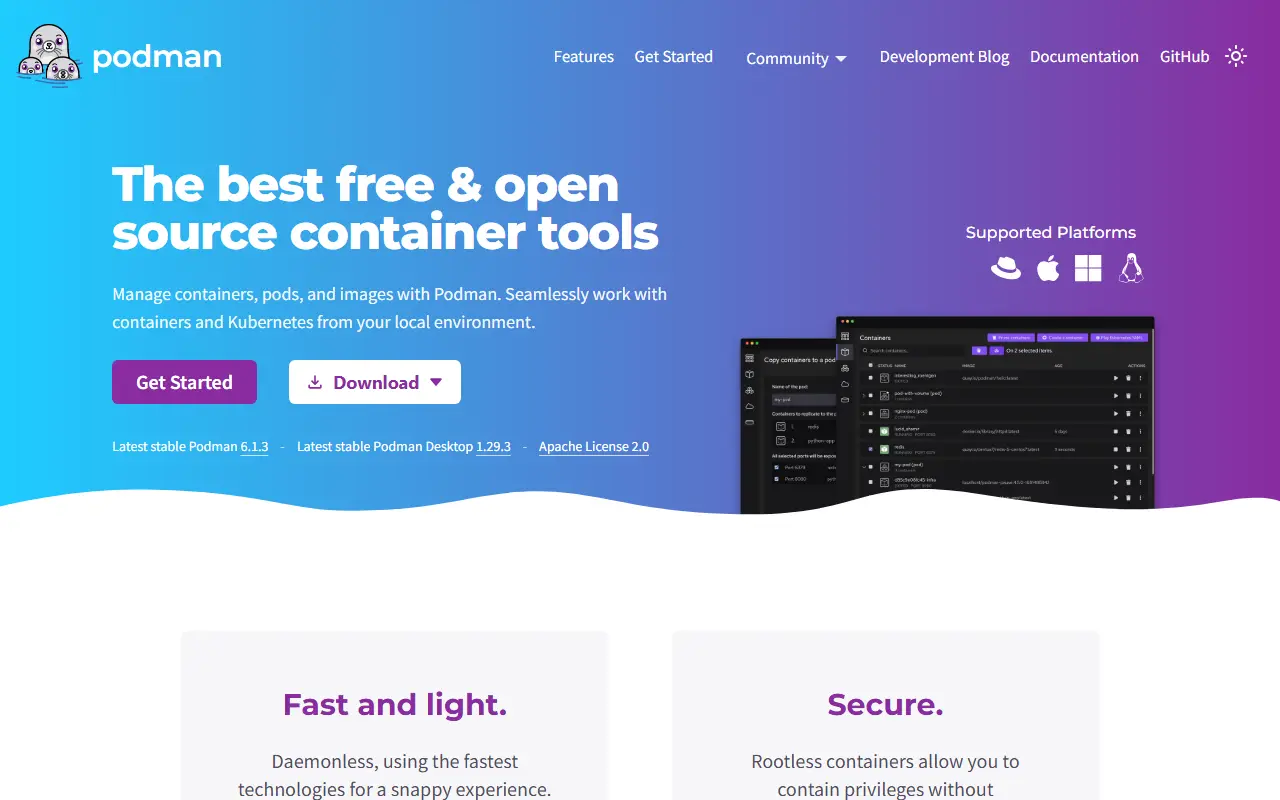
Podman, short for the POD MANager, manages containers and images, along with the volumes attached to them and pods composed of container groups. It runs containers natively on Linux and works on Mac and Windows through a Podman-managed virtual machine. It is written in Go, released under the Apache-2.0 license, and often used as an alternative to Docker.
Podman is built on libpod, a library in the same repository that exposes APIs for container lifecycle, pods, images and volumes. It supports OCI and Docker image formats, pulls and pushes images with trust verification, builds from Containerfiles or Dockerfiles, and handles checkpoint and restore through CRIU. Networking is handled by Netavark. Major and minor releases arrive four times a year and are PGP signed, with only the most recent release supported upstream.
Key features
- Manages containers, images, volumes and pods
- OCI and Docker image format support
- Builds from Containerfile or Dockerfile
- Checkpoint and restore via CRIU
- Networking through Netavark
- Mac and Windows support via a virtual machine
Good fit for
- Running containers without Docker
- Grouping containers into pods that map to Kubernetes
- Local container development on Linux
Podman: questions and answers
- What is Podman used for?
- Podman is a tool for managing OCI containers, images, volumes and pods on Linux, and on Mac and Windows through a managed virtual machine. It is a good fit for running containers without Docker, grouping containers into pods that map to Kubernetes and local container development on Linux.
- Is Podman open source?
- Yes. Podman is open source under the Apache-2.0 licence. Its source code is on GitHub at podman-container-tools/podman and is written mainly in Go.
- Is Podman free?
- Yes. Podman is open source, so the software itself is free to use.
- What is Podman an alternative to?
- Podman is an open-source alternative to Docker Desktop, OrbStack, Depot and Parallels Desktop. Other open-source alternatives to Docker Desktop include Multipass, Vagrant and Minikube.
- Is Podman actively maintained?
- Yes. The most recent commit to Podman was on 12 November 2026, and the latest release is v6.2.0, published on 10 November 2026. The project has 33k stars on GitHub, with 215 added in the last 30 days.
Open-source alternatives to Podman
See all
Multipass
Infrastructure & Containers
Multipass orchestrates virtual Ubuntu instances
GPL-3.0vs OrbStack★ 9.4k
Vagrant
Developer Tools
Vagrant is a tool for building and distributing development environments.
OSSvs OrbStack★ 27k
Minikube
Infrastructure & Containers
Run Kubernetes locally
Apache-2.0vs OrbStack★ 32k
Podman Desktop
Infrastructure & Containers
Podman Desktop is the best free and open source tool to work with Containers and Kubernete
Apache-2.0vs Docker Desktop★ 8.2k
Rancher Desktop
Infrastructure & Containers
Container Management and Kubernetes on the Desktop
Apache-2.0vs Docker Desktop★ 7.4k
QEMU
Infrastructure & Containers
Official QEMU mirror. Please see https://www.qemu.org/contribute/ for how to submit change
OSSvs VMware Workstation★ 14k
SaaS alternatives to Podman
See all
Docker Desktop
Infrastructure & Containers
Desktop app for building and running containers locally, with Kubernetes support
SaaS
OrbStack
Infrastructure & Containers
Lightweight macOS app for running Docker containers and Linux machines
SaaS
Depot
CI/CD & DevOps
Remote container build and CI runner service that speeds up Docker builds
SaaS
Parallels Desktop
Infrastructure & Containers
Virtualization software for running Windows and Linux on Mac
SaaS
Amazon ECS
Infrastructure & Containers
Managed container orchestration service on AWS
SaaS
VMware Workstation
Infrastructure & Containers
Desktop hypervisor for running virtual machines on Windows and Linux
SaaS