
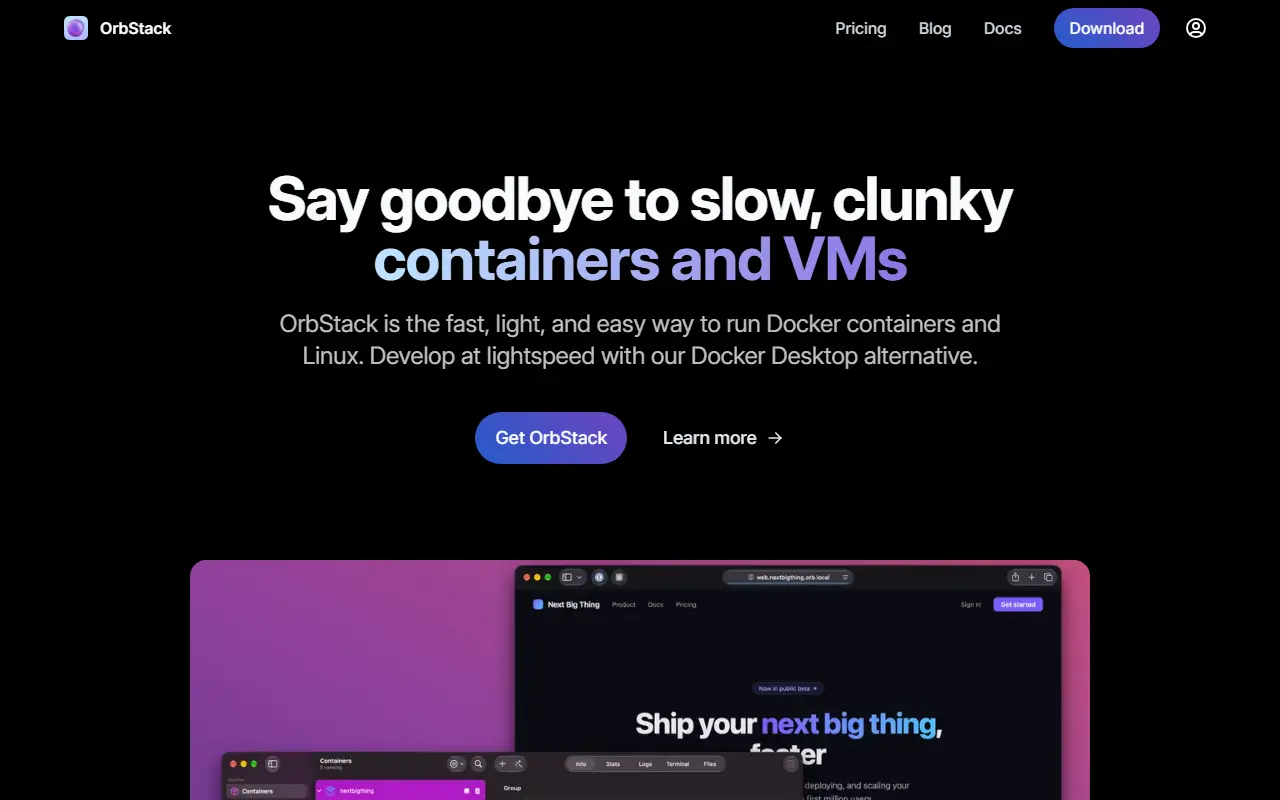
About OrbStack
OrbStack is a macOS application for running Docker containers and Linux machines on a Mac. It is designed as a drop-in replacement for Docker Desktop, with an emphasis on quick startup and low CPU, disk and memory use. The app is built as a native Swift application and is managed from the menu bar.
Containers get fast networking and file sharing, with bind mounts and port forwarding that work out of the box, and x86 images can run through Rosetta emulation on Apple silicon. Beyond containers, it can run Kubernetes and a range of Linux distributions as machines, with USB passthrough, command-line integration, remote SSH editing and isolated sandboxes for untrusted code. Docker Compose and related tooling are included.
OrbStack is commercial software with its own pricing page. It is generally understood to be free for personal use, with a paid license for commercial use, so check the vendor's current terms. It suits Mac-based developers who want a lighter local container setup.
Key features
- Runs Docker containers natively on macOS
- Linux machines with command-line integration
- x86 container support via Rosetta emulation
- Built-in Kubernetes cluster
- Fast file sharing and networking
- USB passthrough and isolated sandboxes
- Menu bar management
Good fit for
- →Replacing Docker Desktop on a Mac
- →Running Linux dev machines alongside containers
- →Testing x86 images on Apple silicon
- Tags
- docker
- containers
- macos
- linux
- kubernetes
- desktop-app
- local-development
OrbStack: questions and answers
- What is OrbStack used for?
- OrbStack is a native macOS app for running Docker containers, Kubernetes and Linux machines locally, positioned as a lighter alternative to Docker Desktop. It is a good fit for replacing Docker Desktop on a Mac, running Linux dev machines alongside containers and testing x86 images on Apple silicon.
- Is OrbStack free?
- Yes. OrbStack has a free plan, and paid plans start at $8 per seat per month.
- Is OrbStack open source?
- No. OrbStack is proprietary (closed-source) software. Open-source alternatives to OrbStack include Colima, Podman and Lima.
- Can I self-host OrbStack?
- Yes. Although OrbStack is closed source, it can be self-hosted on your own servers.
- What are some alternatives to OrbStack?
- OrbStack competes with Docker Desktop. For open-source options, see Enlisted's ranked list of open-source OrbStack alternatives.
Open-source alternatives to OrbStack
See all
Colima
Infrastructure & Containers
Container runtimes on macOS (and Linux) with minimal setup
MITvs Docker Desktop★ 31k
Podman
Infrastructure & Containers
Podman: A tool for managing OCI containers and pods.
Apache-2.0vs Docker Desktop★ 33k
Lima
Infrastructure & Containers
Linux virtual machines, with a focus on running containers
Apache-2.0vs Docker Desktop★ 22k
Podman Desktop
Infrastructure & Containers
Podman Desktop is the best free and open source tool to work with Containers and Kubernete
Apache-2.0vs Docker Desktop★ 8k
Rancher Desktop
Infrastructure & Containers
Container Management and Kubernetes on the Desktop
Apache-2.0vs Docker Desktop★ 7.4k
Multipass
Infrastructure & Containers
Multipass orchestrates virtual Ubuntu instances
GPL-3.0vs OrbStack★ 9.3k
SaaS alternatives to OrbStack
See all
Docker Desktop
Infrastructure & Containers
Desktop app for building and running containers locally, with Kubernetes support
SaaS
Lens
Infrastructure & Containers
Desktop Kubernetes IDE for managing clusters and workloads
SaaS
Parallels Desktop
Infrastructure & Containers
Virtualization software for running Windows and Linux on Mac
SaaS
VMware Workstation
Infrastructure & Containers
Desktop hypervisor for running virtual machines on Windows and Linux
SaaS
Amazon EKS
Infrastructure & Containers
Managed Kubernetes control plane and worker nodes on AWS
SaaS
Azure Kubernetes Service
Infrastructure & Containers
Managed Kubernetes service on Microsoft Azure
SaaS