
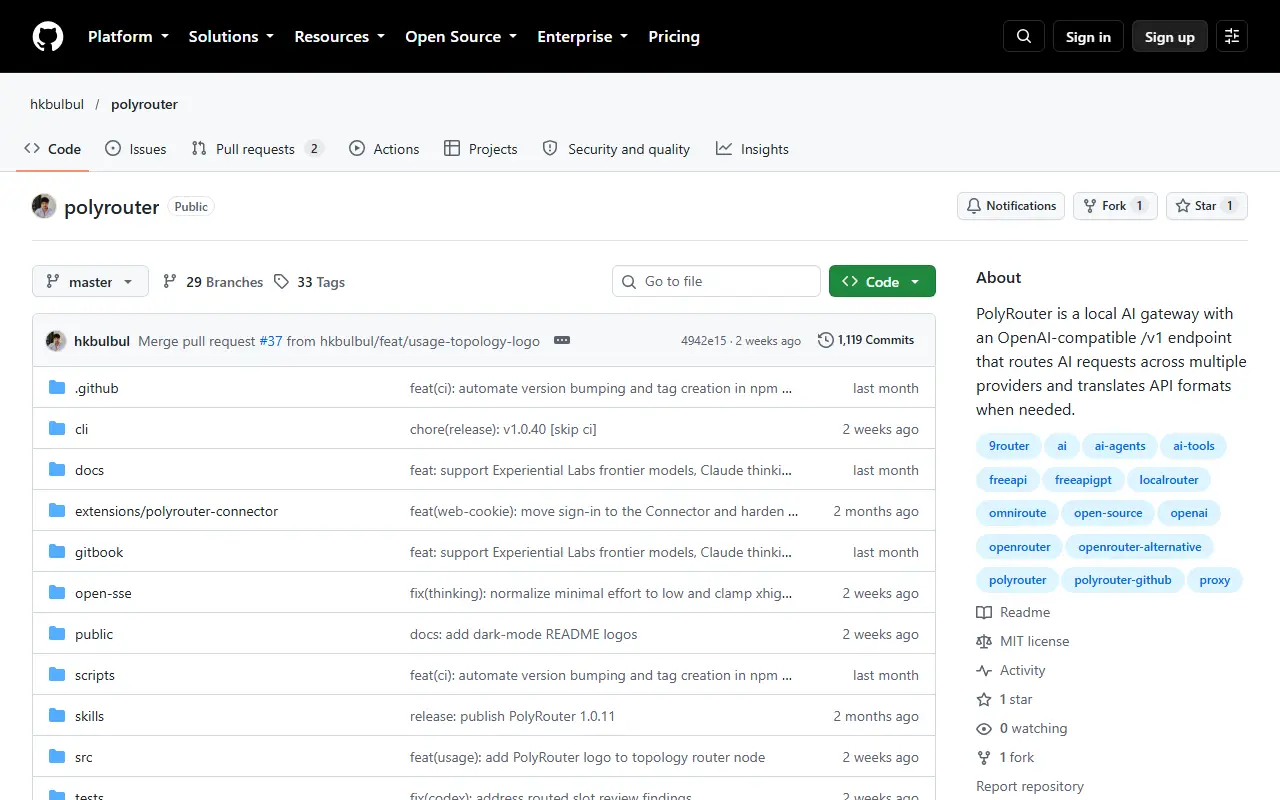
About Polyrouter
PolyRouter runs on your own machine and exposes one OpenAI-compatible /v1 endpoint, so existing clients can talk to many AI providers through a single address. It routes each request to a chosen provider and translates between API formats when the target uses a different one, which saves changing client code when you switch providers. The project is published as a GitHub repository with source code, Docker files, a command-line tool, documentation, a connector extension, tests and a changelog.
Key features
- OpenAI-compatible /v1 endpoint
- Routing across multiple AI providers
- API format translation
- Local gateway running on your machine
- Docker deployment files
Good fit for
- Pointing one client at several AI providers
Polyrouter: questions and answers
- What is Polyrouter used for?
- PolyRouter runs on your machine as an AI gateway: clients call one OpenAI-style /v1 address and it forwards requests to different providers, converting API formats as required. It is a good fit for pointing one client at several AI providers.
- Is Polyrouter open source?
- No. Polyrouter is proprietary (closed-source) software. In the AI Infrastructure category, open-source options include LiteLLM, New API and One API.
- Can I self-host Polyrouter?
- Yes. Although Polyrouter is closed source, it can be self-hosted on your own servers.
- What are some alternatives to Polyrouter?
- Polyrouter competes with OpenRouter, Portkey and AnyRouter.
Open-source alternatives to Polyrouter
See all
LiteLLM
AI Infrastructure
The fastest, litest AI Gateway. Rust core with Python SDK. Call 100+ LLM APIs in OpenAI (o
OSSvs Amazon Bedrock★ 60k
New API
AI Infrastructure
A unified AI model hub for aggregation & distribution. It supports cross-converting variou
AGPL-3.0vs OpenRouter★ 49k
One API
AI Infrastructure
LLM API 管理 & 分发系统,支持 OpenAI、Azure、Anthropic Claude、Google Gemini、DeepSeek、字节豆包、ChatGLM、文心一
MITvs OpenRouter★ 37k
LocalAI
AI Infrastructure
LocalAI is the open-source AI engine. Run any model - LLMs, vision, voice, image, video -
MITvs ChatGPT★ 49k
ODS
AI Infrastructure
Just a chat full of self-hosters running or trying to run ODS. | 1583 members
Apache-2.0★ 7kHarbor
AI Infrastructure
Stop configuring your AI stack. Start using it. One command brings a complete pre-wired LL
Apache-2.0★ 3.2k
SaaS alternatives to Polyrouter
See all
OpenRouter
AI Infrastructure
Unified API gateway for accessing many large language models from one endpoint
SaaS
Portkey
AI Infrastructure
AI gateway and observability platform for managing LLM requests
SaaS
AnyRouter
AI Infrastructure
Unified LLM gateway that routes coding agents and MCP servers through a single endpoint
SaaSAI Stats
AI Infrastructure
Database of AI models plus an OpenAI-compatible gateway with usage, pricing and reliability monitoring
SaaS
AllToken
AI Infrastructure
Unified API gateway to LLMs from OpenAI, Anthropic and Google with usage tracking and routing
SaaS
api-hub.ai
AI Infrastructure
Single API for accessing many AI models behind one endpoint
SaaS