
About Vagrant
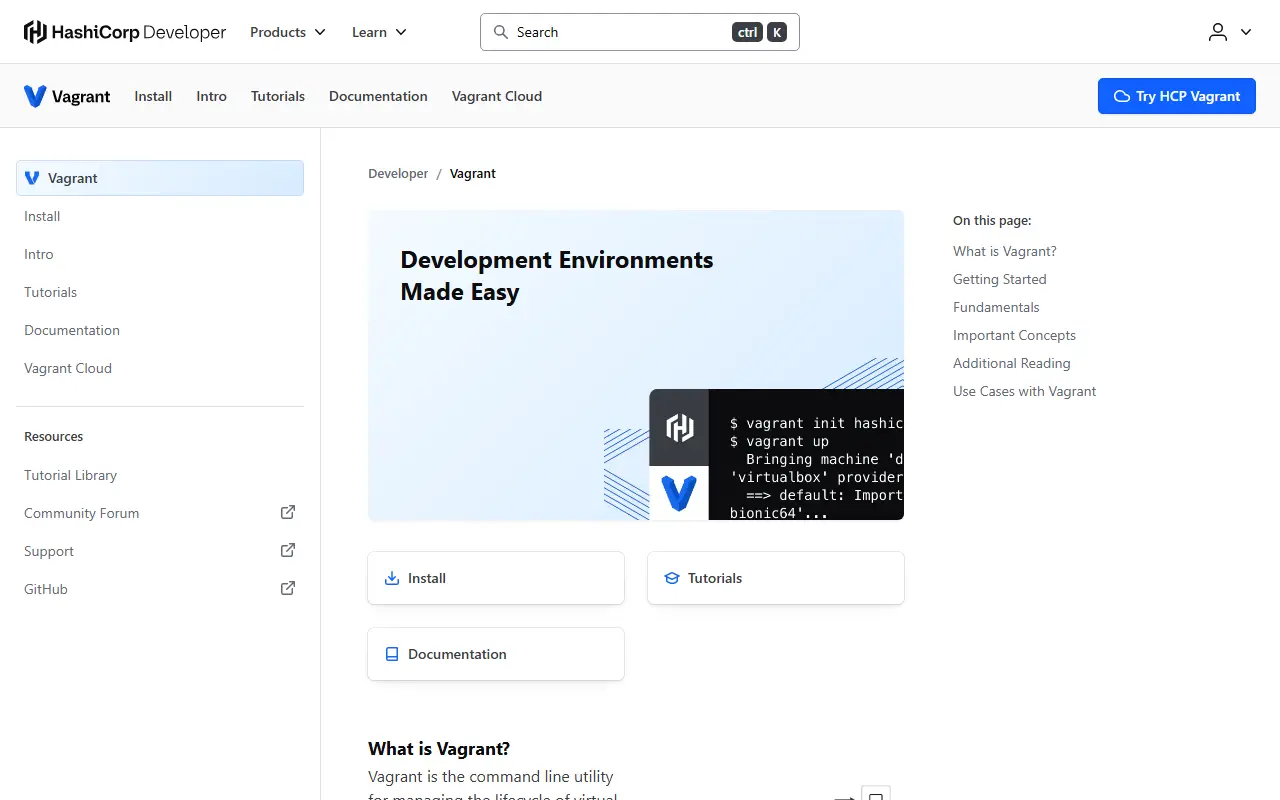
Vagrant helps teams build and share development environments. A single configuration file describes a machine, and Vagrant creates it consistently on any supported provider, so a whole team can work against identical setups regardless of whether they use Windows, macOS or Linux.
Environments can run on local hypervisors like VirtualBox or VMware, on cloud platforms including AWS or OpenStack, or inside containers such as Docker or plain LXC. The framework provides a configuration format and workflow for creating and managing complete portable environments that can live on a laptop or in the cloud. Vagrant is written in Ruby, and it needs bsdtar and curl on the system PATH.
The repository carries a notice that the separate HCP Vagrant service is being deprecated, effective November 2026, with only limited features remaining in the community edition; the notice states this does not affect the Vagrant CLI. The license is listed as 'Other' on GitHub, so confirm the current terms before using it in a commercial setting.
Key features
- Declarative development environment configuration
- Works with VirtualBox and VMware
- Cloud providers such as AWS and OpenStack
- Container providers including Docker and LXC
- Portable across Windows, macOS and Linux
- Ruby-based command line interface
Good fit for
- →Reproducible dev environments for teams
- →Testing software across operating systems
- →Onboarding developers with one command
- Built with
- Ruby
- Tags
- vagrant
- virtualization
- development-environment
- devops
- ruby
- hashicorp
- virtualbox
- automation
Vagrant: questions and answers
- What is Vagrant used for?
- Vagrant is a HashiCorp command line tool that builds and shares portable development environments across VirtualBox, VMware, cloud providers and containers. It is a good fit for reproducible dev environments for teams, testing software across operating systems and onboarding developers with one command.
- Is Vagrant open source?
- Yes. Vagrant is open source under a custom licence. Its source code is on GitHub at hashicorp/vagrant and is written mainly in Ruby.
- Is Vagrant free?
- Yes. Vagrant is open source, so the software itself is free to use under the terms of its own licence.
- What are some alternatives to Vagrant?
- Similar open-source tools in the Developer Tools category include Apprise, assh and LNMP. SaaS products in the same category include Codacy, GoLand and Ona.
- Is Vagrant actively maintained?
- Yes. The most recent commit to Vagrant was on 28 September 2026, and the latest release is v2.4.9, published on 21 August 2025. The project has 27k stars on GitHub.
Open-source alternatives to Vagrant
See allApprise
Developer Tools
Apprise - Push Notifications that work with just about every platform!
BSD-2-Clausevs Courier★ 18k
assh
Developer Tools
:computer: make your ssh client smarter
MIT★ 3.2k
LNMP
Developer Tools
:computer: :whale: :elephant: :dolphin: :penguin: :rocket: Start Docker LNMP(LEMP) In less
Apache-2.0★ 674
Google Workspace CLI
Developer Tools
Google Workspace CLI — one command-line tool for Drive, Gmail, Calendar, Sheets, Docs, Cha
Apache-2.0★ 31k
golangci-lint
Developer Tools
Fast linters runner for Go
GPL-3.0★ 19k
Distrobox
Developer Tools
Use any linux distribution inside your terminal. Enable both backward and forward compatib
GPL-3.0★ 13k
SaaS alternatives to Vagrant
See all
Codacy
Developer Tools
Automated code quality and security analysis for pull requests
SaaS
GoLand
Developer Tools
JetBrains IDE for Go development
SaaS
Ona
Developer Tools
Cloud development environments and software engineering agents, formerly Gitpod
SaaS
RubyMine
Developer Tools
JetBrains IDE for Ruby and Rails development
SaaS
Termius
Developer Tools
SSH client and terminal for desktop and mobile with synced hosts
SaaS
Warp
Developer Tools
Terminal with AI assistance, command blocks and team workflows
SaaS