 TrackMedia
 TrackRev

About QEMU
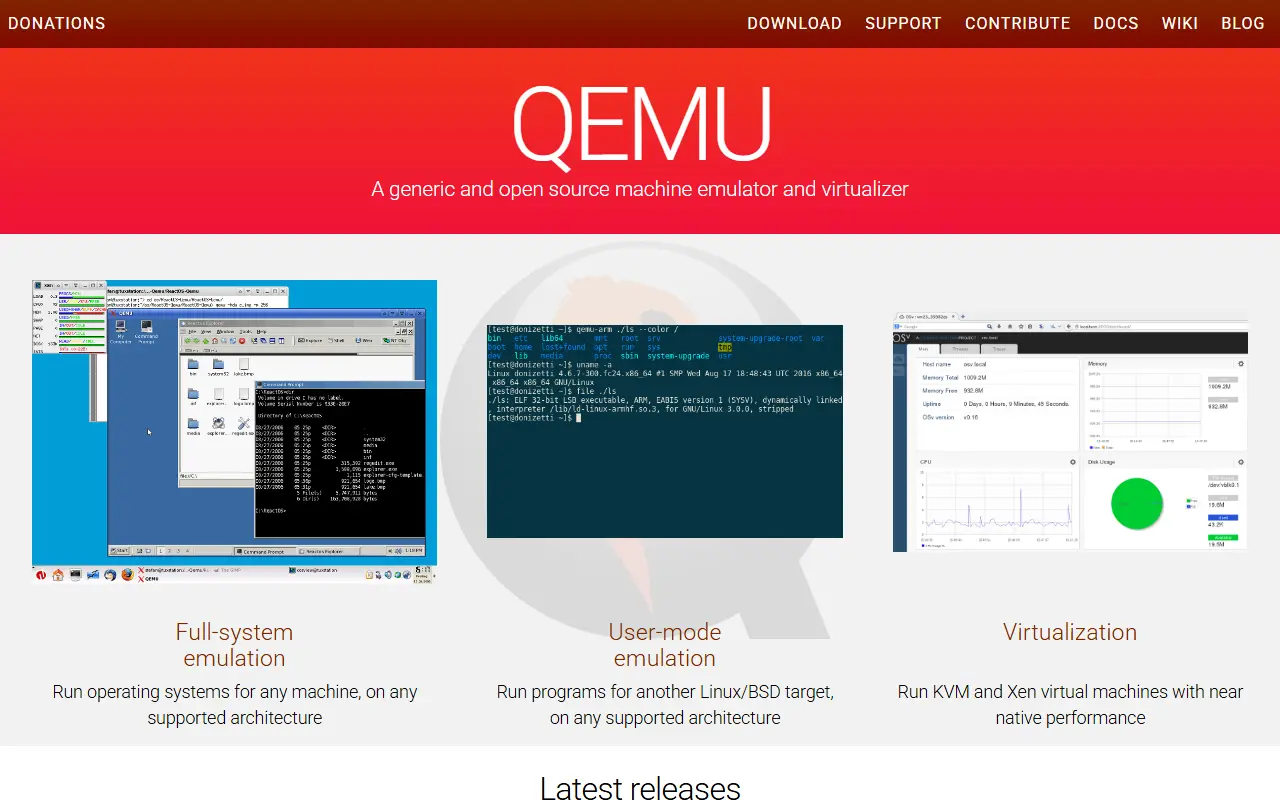
QEMU is a generic, open-source machine emulator and virtualizer. It can emulate a complete computer so that an operating system built for one architecture runs on a host with a different one, and it can also act as the device model behind hardware-assisted virtual machines.
It works in three main modes. Full-system emulation runs operating systems for any supported machine on any supported host architecture. User-mode emulation runs Linux or BSD programs compiled for another architecture. Virtualization mode runs KVM and Xen guests with near-native performance. Projects such as libvirt and libguestfs build on it.
QEMU is written in C and distributed under the GNU GPL, with some components under other licenses. The GitHub repository is an official mirror where pull requests are disabled; changes are submitted through the process described on the project website, and users are asked to rely on release tarballs from qemu.org. The project is a member of Software Freedom Conservancy.
Key features
- Full-system machine emulation across architectures
- User-mode emulation for foreign-architecture programs
- KVM and Xen virtualization
- Works with libvirt and libguestfs
- Signed release tarballs
Good fit for
- Testing software on other CPU architectures
- Running virtual machines with KVM
QEMU: questions and answers
- What is QEMU used for?
- QEMU is an open-source machine emulator and virtualizer that runs guest operating systems and programs across architectures, with KVM and Xen support. It is a good fit for testing software on other CPU architectures and running virtual machines with KVM.
- Is QEMU open source?
- Yes. QEMU is open source under a custom licence. Its source code is on GitHub at qemu/qemu and is written mainly in C.
- Is QEMU free?
- Yes. QEMU is open source, so the software itself is free to use under the terms of its own licence.
- Can I self-host QEMU?
- Yes. QEMU can be self-hosted on your own server or infrastructure; there is no official hosted version.
- What is QEMU an alternative to?
- QEMU is an open-source alternative to VMware Workstation, OrbStack, Parallels Desktop and Google Compute Engine. Other open-source alternatives to VMware Workstation include Vagrant, Multipass and UTM.
- Is QEMU actively maintained?
- Yes. The most recent commit to QEMU was on 10 November 2026. The project has 14k stars on GitHub, with 177 added in the last 30 days.
Open-source alternatives to QEMU
See all
Vagrant
Developer Tools
Vagrant is a tool for building and distributing development environments.
OSSvs OrbStack★ 27k
Multipass
Infrastructure & Containers
Multipass orchestrates virtual Ubuntu instances
GPL-3.0vs OrbStack★ 9.4k
UTM
Infrastructure & Containers
Virtual machines for iOS and macOS
Apache-2.0vs Parallels Desktop★ 37k
Podman
Infrastructure & Containers
Podman: A tool for managing OCI containers and pods.
Apache-2.0vs Docker Desktop★ 33k
VirtualBox
Infrastructure & Containers
Source code for Oracle VirtualBox
GPL-3.0vs VMware Workstation★ 1.5k
Incus
Infrastructure & Containers
Powerful system container and virtual machine manager
Apache-2.0vs Amazon EC2★ 6.6k
SaaS alternatives to QEMU
See all
VMware Workstation
Infrastructure & Containers
Desktop hypervisor for running virtual machines on Windows and Linux
SaaS
OrbStack
Infrastructure & Containers
Lightweight macOS app for running Docker containers and Linux machines
SaaS
Parallels Desktop
Infrastructure & Containers
Virtualization software for running Windows and Linux on Mac
SaaS
Google Compute Engine
Infrastructure & Containers
Virtual machine and compute infrastructure service on Google Cloud
SaaS
Azure Virtual Machines
Infrastructure & Containers
Scalable on-demand virtual machine compute on Microsoft Azure
SaaS
Nutanix
Infrastructure & Containers
Hyperconverged infrastructure and hybrid multicloud platform
SaaS