
 Qovery
 AWS App Runner
 Azure Container Apps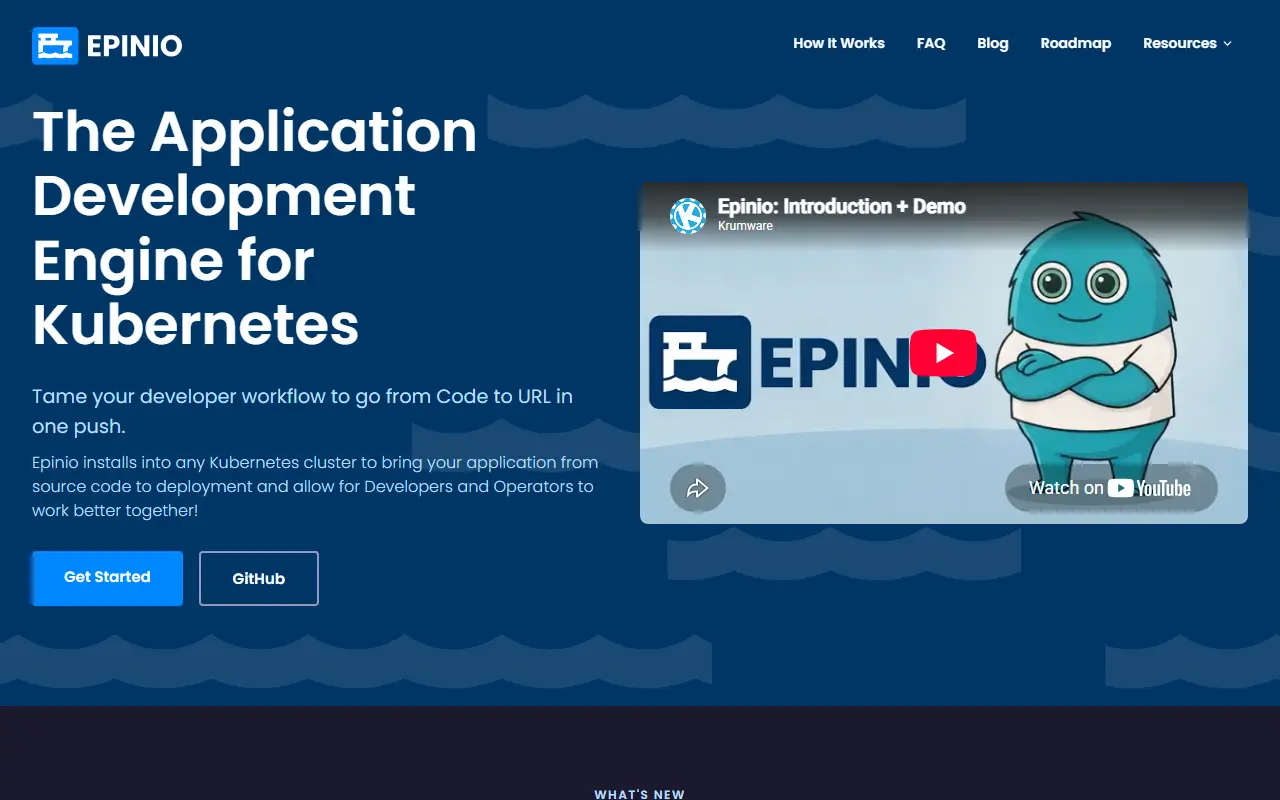
About Epinio
Epinio is an opinionated platform that runs on Kubernetes and takes developers from code to a URL in one step. It exists because Kubernetes has a steep learning curve and operating it well can be a full-time job, while developers would rather spend time on their applications; Epinio adds abstractions and tools so Kubernetes can be used like a PaaS.
The goals are that no Kubernetes experience is needed, there is no steep learning curve, local setup is quick with minimal configuration, and deploying to production works the same as deploying in development. It requires a Kubernetes cluster with an Ingress Controller and cert-manager, after which installation is a short step. The Epinio CLI is installed from a release binary or Homebrew, and a quick-start tutorial walks through creating a namespace and pushing an application. Security features include a TLS-secured API server and basic authentication.
Epinio is written in Go, licensed under Apache-2.0, documented at docs.epinio.io and discussed on the Rancher Users Slack. You run it on your own cluster.
Key features
- Push code to a URL in one step
- PaaS workflow on any Kubernetes cluster
- No Kubernetes expertise required
- Same deployment flow for dev and production
- CLI installable by binary or Homebrew
- TLS-secured API server
Good fit for
- →Developer-friendly PaaS on a company cluster
- →Quick app deployments to Kubernetes for small teams
- Tags
- paas
- kubernetes
- deployment
- golang
- self-hosted
- devops
- developer-experience
Epinio: questions and answers
- What is Epinio used for?
- Epinio is an opinionated PaaS that runs on Kubernetes and takes an application from code to a running URL in one step, without Kubernetes expertise. It is a good fit for developer-friendly PaaS on a company cluster and quick app deployments to Kubernetes for small teams.
- Is Epinio open source?
- Yes. Epinio is open source under the Apache-2.0 licence. Its source code is on GitHub at epinio/epinio and is written mainly in Go.
- Is Epinio free?
- Yes. Epinio is open source, so the software itself is free to use.
- Can I self-host Epinio?
- Yes. Epinio can be self-hosted on your own server or infrastructure.
- What is Epinio an alternative to?
- Epinio is an open-source alternative to Heroku, AWS Elastic Beanstalk, Google App Engine and Azure App Service. Other open-source alternatives to Heroku include Kubero, Coolify and Dokploy.
- Is Epinio actively maintained?
- Yes. The most recent commit to Epinio was on 1 October 2026, and the latest release is v1.14.2, published on 3 September 2026. The project has 611 stars on GitHub.
Open-source alternatives to Epinio
See all
Kubero
Hosting & PaaS
A free and self-hosted PaaS alternative to Heroku / Netlify / Coolify / Vercel / Dokku / P
GPL-3.0vs Heroku★ 4.4k
Coolify
Hosting & PaaS
Self-hosting platform with superpowers. Deploy apps, databases & 280+ services to your
Apache-2.0vs Heroku★ 62k
Dokploy
Hosting & PaaS
Open-source self-hostable Platform as a Service (PaaS) that simplifies the deployment and
OSSvs Heroku★ 38k
CapRover
Hosting & PaaS
Scalable PaaS (automated Docker+nginx) - aka Heroku on Steroids
OSSvs Heroku★ 15k
Tsuru
Hosting & PaaS
Open source and extensible Platform as a Service (PaaS).
BSD-3-Clausevs Heroku★ 5.3k
Dokku
Hosting & PaaS
A docker-powered PaaS that helps you build and manage the lifecycle of applications
MITvs Heroku★ 32k
SaaS alternatives to Epinio
See all
Heroku
Hosting & PaaS
Heroku is a cloud platform as a service where developers deploy, run and scale applications on managed containers, with managed data services and AI add-ons.
SaaS
AWS Elastic Beanstalk
Hosting & PaaS
PaaS that deploys and scales web apps on AWS from uploaded code
SaaS
Google App Engine
Hosting & PaaS
Managed Google Cloud platform for deploying web apps and APIs without servers
SaaS
Azure App Service
Hosting & PaaS
Managed Azure platform for hosting web apps, APIs and mobile backends
SaaS
Clever Cloud
Hosting & PaaS
French PaaS that deploys apps and managed databases with usage-based pricing
SaaS
Aptible
Hosting & PaaS
PaaS for deploying apps with built-in compliance controls such as HIPAA
SaaS