7,363 open-source and SaaS tools, with GitHub stats refreshed every day.

7 alternatives ranked by real activity

Open-source Render alternatives

A curated, ranked list of the 7 best open-source alternatives to Render.

The best open-source alternative to Render is Coolify. If that doesn't suit you, other good options are Dokploy, Kamal, ZaneOps and SwiftWave.

Render alternatives are mainly hosting & PaaS tools, but some are also CI/CD & DevOps tools. 7 of them shipped code in the last 30 days, 6 can be self-hosted, and 5 use a permissive licence.

Last updated October 2, 2026 · ranked by GitHub stars, growth and recent commits

Coolify

A self-hostable platform for deploying apps, databases and one-click services to your own servers over SSH, an open-source alternative to Heroku, Vercel and Netlify.

GitHub stars
62k
Last commit
today
Latest release
v4.3.23
Licence
Apache-2.0
Self-hosted
Yes
Hosted version
Available
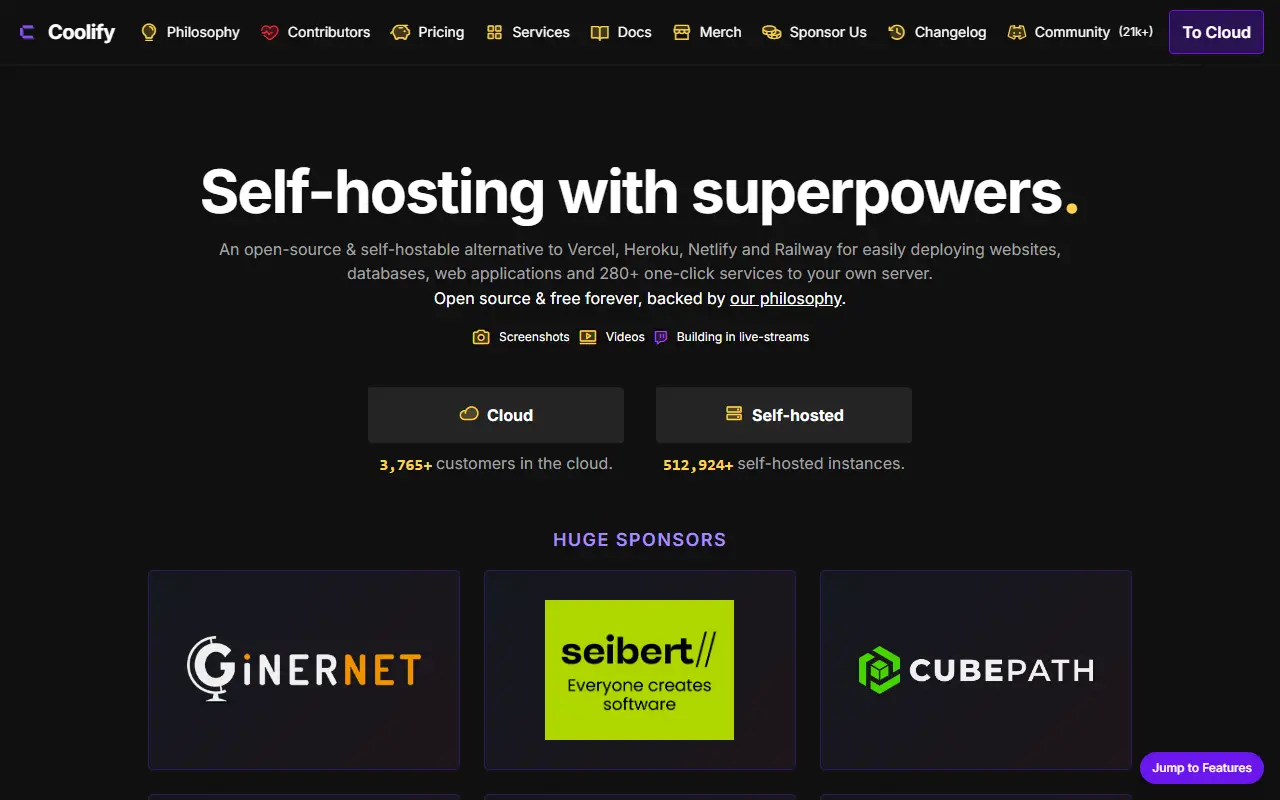
coolify.ioCoolify homepage screenshot

Coolify is an open-source, self-hostable alternative to Heroku, Vercel and Netlify. It manages servers, applications and databases on hardware you control, and the only requirement is SSH access, so a VPS, a bare-metal machine or even a Raspberry Pi can serve as a target. Your configuration stays on your own servers, and if you stop using Coolify the resources it deployed keep running.

Applications can be built from GitHub, GitLab, Bitbucket or Gitea using Nixpacks, Railpack, a Dockerfile, Docker Compose or a prebuilt image. Hundreds of one-click services and managed-style databases come with persistent storage and generated credentials. Deployments can run on every push, create pull-request previews, call webhooks and roll back to retained images. Custom domains, automatic HTTPS, reverse proxies and health checks cover networking, while logs, container terminals and resource monitoring help with operations.

Backups, scheduled tasks, secrets, environment variables and notifications are built in, and resources can be managed through the dashboard, an API, a CLI or MCP, with team-based access controls. Coolify is Apache-2.0 licensed and built mainly with PHP; a hosted Coolify Cloud option exists for people who prefer not to run the control plane themselves.

Key features

  • Deploy from Git with Nixpacks, Dockerfile or Compose
  • Hundreds of one-click services and databases
  • Pull-request previews and rollbacks
  • Automatic HTTPS and custom domains
  • Database and storage backups
  • Multi-server management with team access controls
  • Dashboard, API, CLI and MCP management

Pricing: Self-hosting is free with no feature limits. Coolify Cloud is $5 per month including two connected servers, plus $3 per month for each additional server.


Dokploy

A free, self-hostable platform as a service for deploying apps, databases and Docker Compose stacks on your own servers, an alternative to Vercel, Netlify and Heroku.

GitHub stars
38k
Last commit
yesterday
Latest release
v0.30.8
Self-hosted
Yes
Hosted version
Available
dokploy.comDokploy homepage screenshot

Dokploy is an open-source, self-hostable platform as a service that simplifies deploying and managing applications and databases. It is positioned as an alternative to Heroku, Vercel and Netlify, and it runs on a VPS you control, installed with a single command.

It can deploy apps in languages such as Node.js, PHP, Python, Go and Ruby, create and manage MySQL, PostgreSQL, MongoDB, MariaDB, libsql and Redis databases, and schedule database backups to external storage. Docker Compose is supported natively, and multiple nodes can be clustered with Docker Swarm or managed as remote servers. One-click templates cover open-source apps such as Plausible, PocketBase and Cal.com, Traefik handles routing and load balancing, and live monitoring shows CPU, memory, storage and network usage per resource.

A CLI and API allow automation, and notifications about deploy success or failure can go to Slack, Discord, Telegram or email. The license is listed as 'Other', so check the repository terms before redistribution. For people who want to skip installation there is a hosted Dokploy Cloud.

Key features

  • Deploy apps in many languages
  • Managed databases with automated backups
  • Native Docker Compose support
  • Multi-node scaling with Docker Swarm
  • One-click open-source templates
  • Traefik routing and load balancing
  • Real-time resource monitoring

Pricing: Hobby costs $4.50 per server per month and Startup starts at $15 per month for up to 3 servers. Enterprise (cloud or self-hosted) and Agency plans are quoted by sales; there is a 7-day free trial.

Kamal

Kamal deploys containerized web apps to bare metal or cloud servers over SSH with zero-downtime switching between containers.

GitHub stars
15k
Last commit
2 days ago
Latest release
v2.12.0
Licence
MIT
Self-hosted
Yes
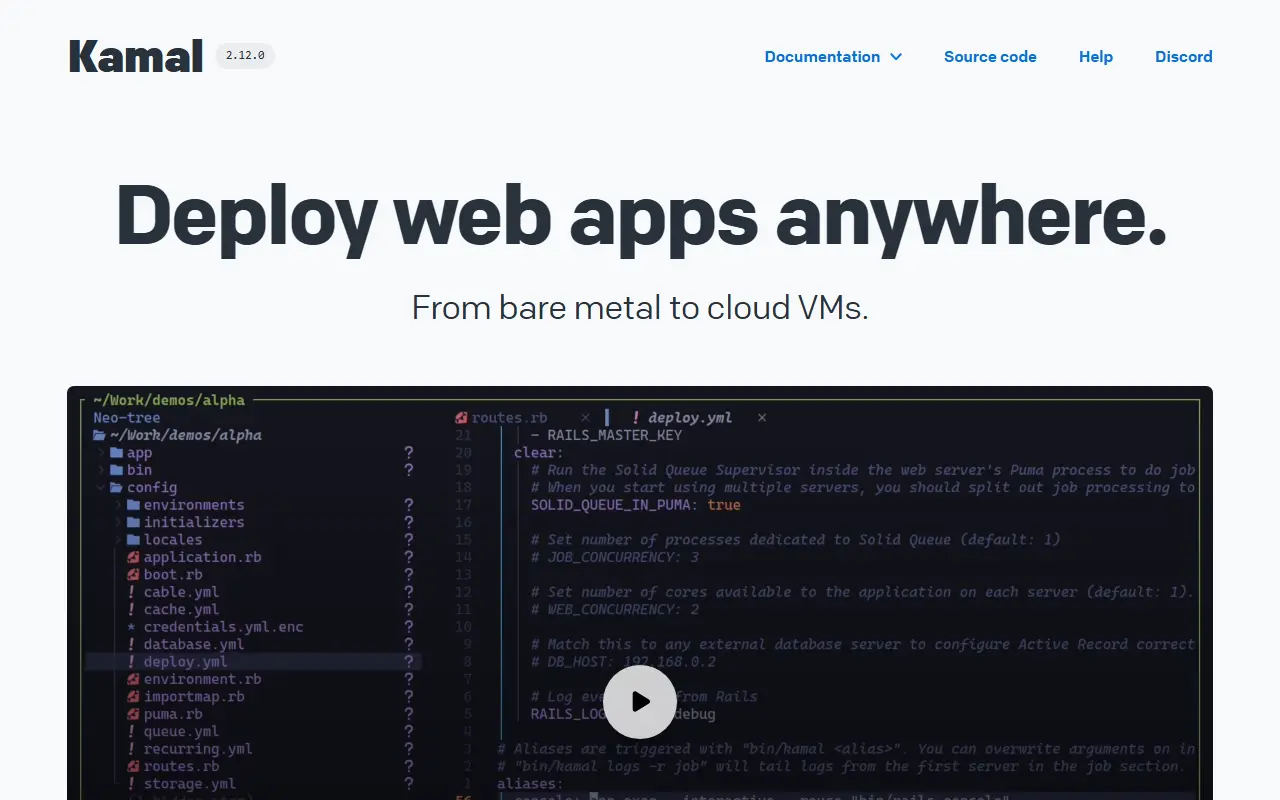
kamal-deploy.orgKamal homepage screenshot

Kamal is a deployment tool for web applications that can run anywhere, from bare metal servers to cloud virtual machines. It uses a proxy component called kamal-proxy to switch requests between containers without downtime, and it works across multiple servers by running commands over SSH using SSHKit.

Originally built for Rails applications, Kamal works with any web app that can be packaged in a Docker container. Documentation on installation, configuration and commands is on kamal-deploy.org, and the documentation itself lives in a separate repository where improvements are welcome.

Kamal is written in Ruby, developed by Basecamp, and released under the MIT license. Because it deploys to servers you control, it suits teams who want a simple alternative to hosted platforms while still getting rolling, zero-downtime releases.

Key features

  • Zero-downtime container switching
  • Deploys to bare metal or cloud VMs
  • Multi-server deployments over SSH
  • Works with any Dockerized web app
  • kamal-proxy request routing

Pricing: Free and open source under the MIT license.

ZaneOps

ZaneOps is a self-hosted platform-as-a-service for deploying web apps, databases and static sites, built on Docker Swarm and Caddy as a Heroku alternative.

GitHub stars
1.4k
Last commit
2 days ago
Latest release
v1.15.1
Self-hosted
Yes
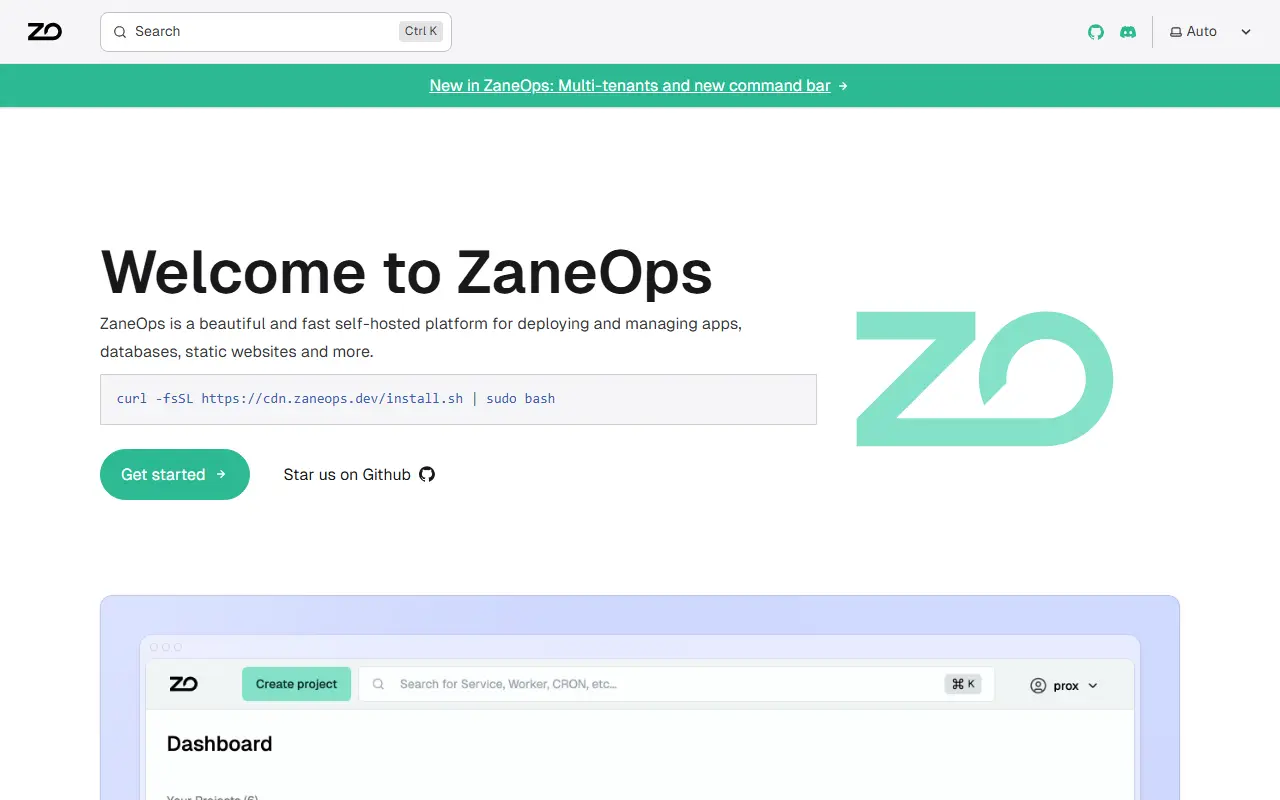
zaneops.devZaneOps homepage screenshot

ZaneOps is an open-source, self-hosted platform for deploying and managing applications on your own servers. It can host static sites, web apps, databases, workers and prepackaged services such as Supabase, WordPress or Ghost, and it is positioned as a free alternative to Heroku, Railway and Render.

Under the hood it uses Docker Swarm for scalability and Caddy for routing, and it presents a dashboard with onboarding, project views, HTTP logs and runtime logs. Projects group related services together, and the documentation covers installation steps and further setup. The project says it was inspired by Plane for its contribution guidelines and by Coolify and Dokploy as other self-hosted deployment tools.

ZaneOps is written in Python, and its licence is listed as other, so review the repository terms before relying on it. It is installed on a server you control, with a milestone-based public roadmap. It suits solo developers, startups and teams that want a Heroku-style workflow without paying for a managed PaaS or giving up control of their infrastructure.

Key features

  • Deploy web apps, databases, and static sites
  • Docker Swarm based scaling
  • Caddy for routing and HTTPS
  • Dashboard with HTTP and runtime logs
  • Projects grouping related services
  • One-command server installation

SwiftWave

SwiftWave is a self-hosted, lightweight PaaS for deploying and managing applications on any server, positioned as an alternative to Heroku, Netlify and Render.

GitHub stars
905
Last commit
7 days ago
Latest release
2.23.1-1
Licence
Apache-2.0
Self-hosted
Yes
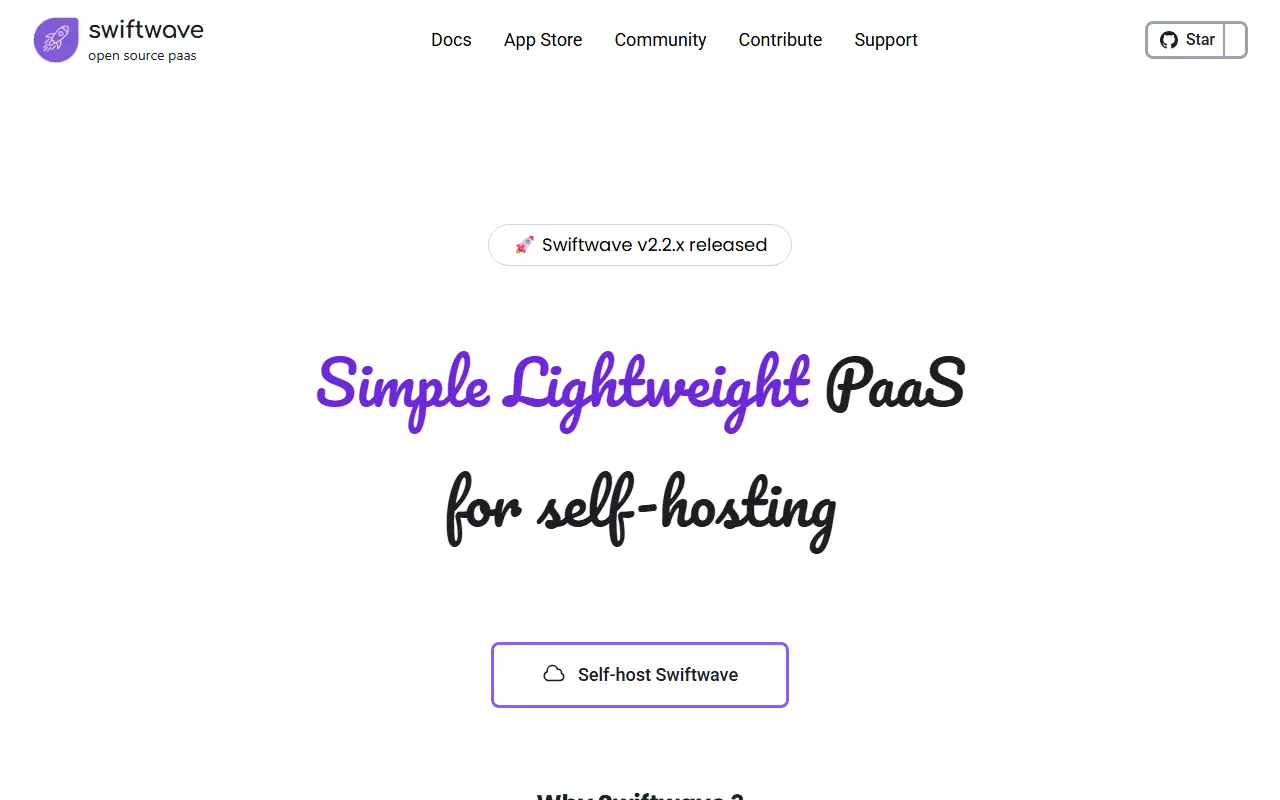
swiftwave.orgSwiftWave homepage screenshot

SwiftWave is an open-source platform as a service that you run on your own server. It lets you deploy and manage applications on a bare-metal machine, a Raspberry Pi or any VPS, giving a Heroku-like workflow without relying on a managed platform.

The project positions itself as an open-source alternative to Heroku, Netlify and Render. It uses Docker, with Swarm mode among its topics, and is described as lightweight. SwiftWave and its dependencies support AMD64, ARM64 and ARMv7 architectures and run on Debian, Ubuntu, Raspbian, Fedora, CentOS, AlmaLinux, Rocky Linux and similar distributions.

It can be installed on providers such as Hetzner, DigitalOcean, Linode, AWS or GCP following the guide on swiftwave.org, and it is released under the Apache-2.0 license. The team runs a community Slack channel and accepts sponsorship through GitHub Sponsors.

Key features

  • Deploy apps on any VPS or bare metal
  • Docker-based application management
  • Runs on AMD64, ARM64 and ARMv7
  • Works on Raspberry Pi
  • Docker Swarm mode support
  • Installs on common Linux distributions

Pricing: Free and open source under the Apache-2.0 license.

Zeabur

Zeabur is a deployment platform that builds and runs services in one click and can be driven from AI tools through a Claude Code plugin and MCP server.

GitHub stars
683
Last commit
8 days ago
Licence
MPL-2.0
Self-hosted
No
Hosted version
Available
zeabur.comZeabur homepage screenshot

Zeabur is a platform for deploying services with one click, presented as an AI DevOps engineer that handles deployment work so developers can focus on code. Through natural language in an AI agent, it can deploy services, rent servers, manage domains, configure databases and troubleshoot issues.

It analyzes your code to detect the language and framework, so no Dockerfile or compose file is required, and builds and redeploys on every push to a connected repository. Deployment options include GitHub integration, Dockerfiles, Docker images, a CLI and a Chrome extension. AI-focused tools include an official Claude Code plugin, an MCP server for assistants such as Claude Desktop and Cursor, and a VS Code and Cursor extension. Infrastructure can be single servers, either bought from Zeabur or brought from providers like AWS, GCP and Hetzner, or clusters.

The repository is under MPL-2.0 and has docs-related topics, but Zeabur itself is a managed commercial platform with its own documentation, templates and community forum. It is relevant to teams that want a hosted PaaS rather than software they run themselves.

Key features

  • One-click deployment with automatic detection
  • Claude Code plugin and MCP server
  • VS Code and Cursor extension
  • GitHub, Docker and CLI deployment
  • Servers you buy or bring yourself
  • Template marketplace

Pricing: A free plan exists. Dev costs $5 and Pro $19 per month with the first 14 days free; Team is $79 per month including 3 seats, plus $24 per extra seat; Enterprise is custom.

Bex

bex is an open-source, AI-native alternative to Render that deploys from Git on your own infrastructure through a Kubernetes operator; it is not yet production-ready.

GitHub stars
566
Last commit
today
Latest release
bex-cli/v0.2.1
Licence
Apache-2.0
Self-hosted
Yes
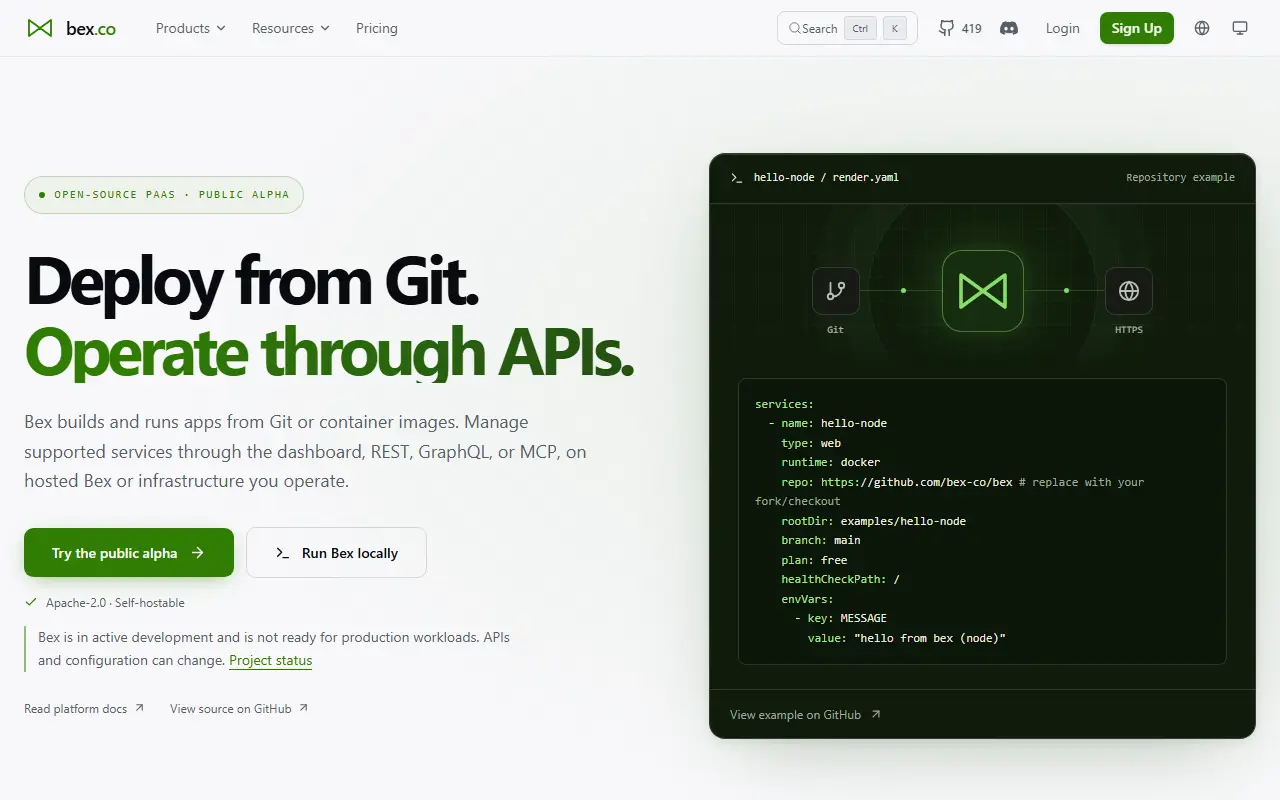
bex.coBex homepage screenshot

bex is an open-source alternative to Render, built so that both developers and coding agents control deployments through the same control plane. You push Git changes and bex builds and deploys to HTTPS on infrastructure you own, aiming for the Render, Heroku and Railway experience without operating Kubernetes by hand.

It deploys Dockerfiles or native Go, Node.js, Python, Ruby, Rust and Elixir projects, understands Render-style render.yaml Blueprints and offers a Render-compatible CLI and API. The dashboard, REST, GraphQL, MCP, CLI and Kubernetes resources all operate the same core, with no dashboard-only actions. Service types include web services, private services, workers, cron jobs, static sites, managed Postgres and managed Key Value, with logs, metrics, deploy history, rollbacks, domains, TLS and SSH. The same Go operator runs against Docker-container machines locally or Hetzner machines in production-style clusters, and compatibility claims are tracked in a Render parity ledger.

The README warns that bex is in active development and not ready for production workloads, and that APIs and configuration may change. It is licensed under Apache-2.0.

Key features

  • Git push to HTTPS deployments
  • Render-style Blueprints and compatible CLI
  • Web services, workers, cron jobs and static sites
  • Managed Postgres and Key Value
  • REST, GraphQL and MCP interfaces
  • Kubernetes operator architecture

Pricing: Self-hosting has no software fee. Hosted pricing (public alpha) combines a workspace fee of $0, $17.50 or $349.30 per month with compute from $4.90 per service per month and metered builds, bandwidth and storage.

Render alternatives: questions

What is the best open-source alternative to Render?
Coolify is the top-ranked open-source alternative to Render on Enlisted: A self-hostable platform for deploying apps, databases and one-click services to your own servers over SSH, an open-source alternative to Heroku, Vercel and Netlify. Other strong options are Dokploy, Kamal, ZaneOps and SwiftWave.
Are these Render alternatives free?
All 7 are open source, so the code is free to use under its licence, and 6 of them can be self-hosted on your own server or computer. 3 also offer a paid or managed cloud version if you'd rather not host it yourself.
How is this list of Render alternatives ranked?
By a score built from GitHub stars, star growth over the last 30 days and how recently the code changed. 7 of these projects shipped code in the last 30 days. Data is refreshed daily, and nobody can pay to move up.

People also look for alternatives to…

View all