#1
An agentless IT automation platform for configuration management, application deployment, cloud provisioning and network automation over SSH.
- GitHub stars
- 71k
- Last commit
- 2 days ago
- Latest release
- v2.22.0
- Licence
- GPL-3.0
- Self-hosted
- Yes
ansible.com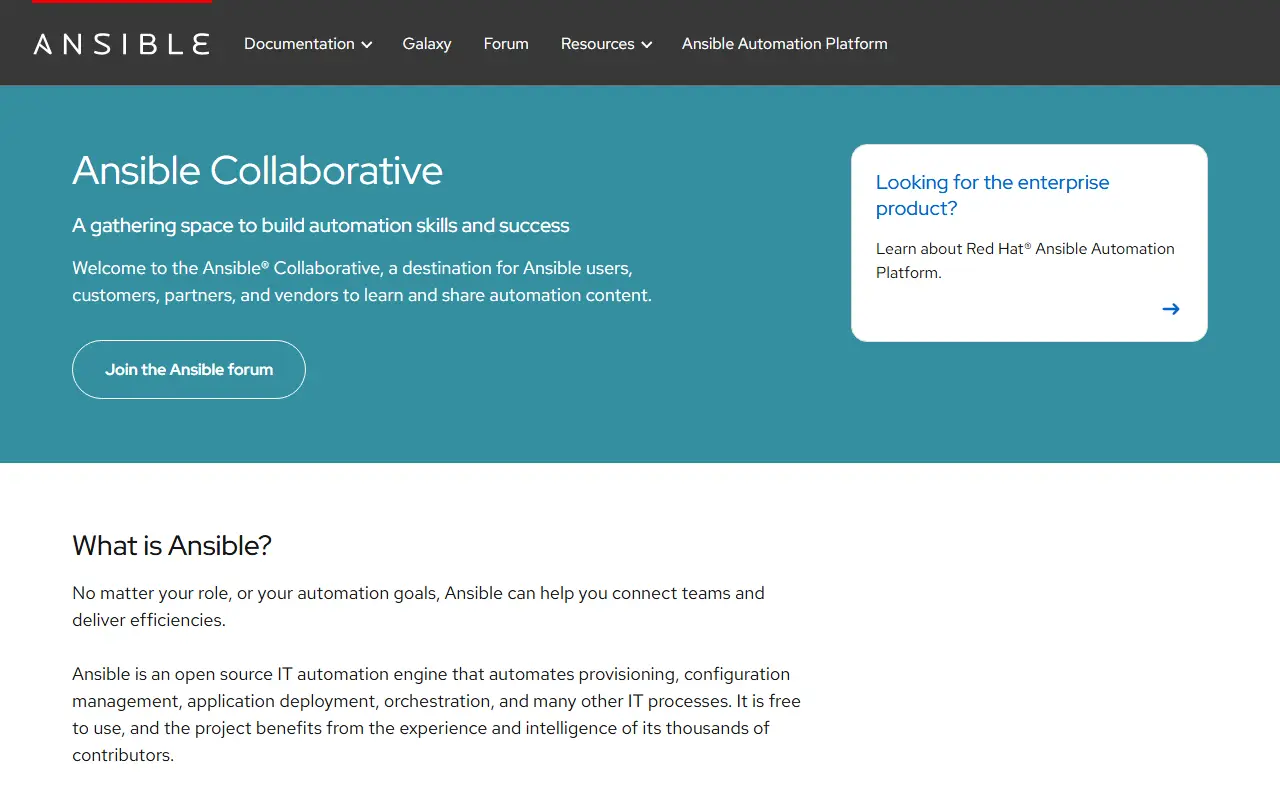
Ansible is an open-source IT automation system written in Python and released under the GPL-3.0 license. It covers configuration management and application deployment, provisioning of cloud resources, one-off ad-hoc commands, network automation and orchestration across many nodes, and it can carry out complex changes such as zero-downtime rolling updates with load balancers.
Its design principles favor a simple setup with a gentle learning curve, managing machines quickly and in parallel, and avoiding custom agents and extra open ports by relying on the existing SSH daemon. Infrastructure is described in a language that is readable by both people and machines, with a focus on security and easy auditing and review. New remote machines can be managed immediately without bootstrapping software, and modules can be written in any dynamic language.
Released versions install with pip or a package manager, while power users can run the development branch for the latest features at the risk of breaking changes. Ansible can be used without root access. It suits system administrators, DevOps and network engineers who want repeatable, version-controlled automation without agents on their servers.
Key features
- Agentless automation over SSH
- Configuration management and application deployment
- Cloud provisioning and network automation
- Parallel management of many machines
- Zero-downtime rolling updates
- Modules in any dynamic language
- Human-readable infrastructure descriptions
Pricing: Free and open source under the GPL-3.0 license.
#2
An open-source developer platform combining Git hosting, CI/CD pipelines, cloud development environments called Gitspaces and artifact registries, the successor to Drone.
- GitHub stars
- 39k
- Last commit
- yesterday
- Latest release
- v2.28.2
- Licence
- Apache-2.0
- Self-hosted
- Yes
harness.io
Harness Open Source is a developer platform written in Go that bundles source code hosting, automated pipelines, hosted development environments and artifact registries in one product. The idea is to give a team a complete, self-run DevOps toolchain rather than separate services for repositories, builds and package storage.
Its hosted development environments are called Gitspaces, and the platform also includes registries for build artifacts. Harness is presented as the next generation of Drone: Drone focused only on continuous integration, whereas Harness adds code hosting and developer environments. The maintainers say the goal is eventual parity with Drone's pipeline capabilities so users can migrate, and a snapshot of Drone lives on a separate branch so it can keep developing.
You can run Harness locally from the published Docker image and open it on port 3000. The image stores its database and repositories in a volume, so a bind mount or named volume is strongly recommended to avoid losing data when the container stops. The project is Apache-2.0 licensed, with documentation at developer.harness.io.
Key features
- Git repository hosting
- CI/CD pipelines for build automation
- Gitspaces hosted development environments
- Artifact registries for build outputs
- Docker image for quick local setup
- Migration path from Drone
Pricing: A free plan covers individual developers and small teams. The Essentials bundle and the modular Enterprise plan have no published prices and are quoted through sales.
#3
Argo CD is a Kubernetes continuous delivery tool built on GitOps, syncing applications from Git to clusters declaratively.
- GitHub stars
- 25k
- Last commit
- yesterday
- Latest release
- v3.6.1
- Licence
- Apache-2.0
- Self-hosted
- Yes
argo-cd.readthedocs.io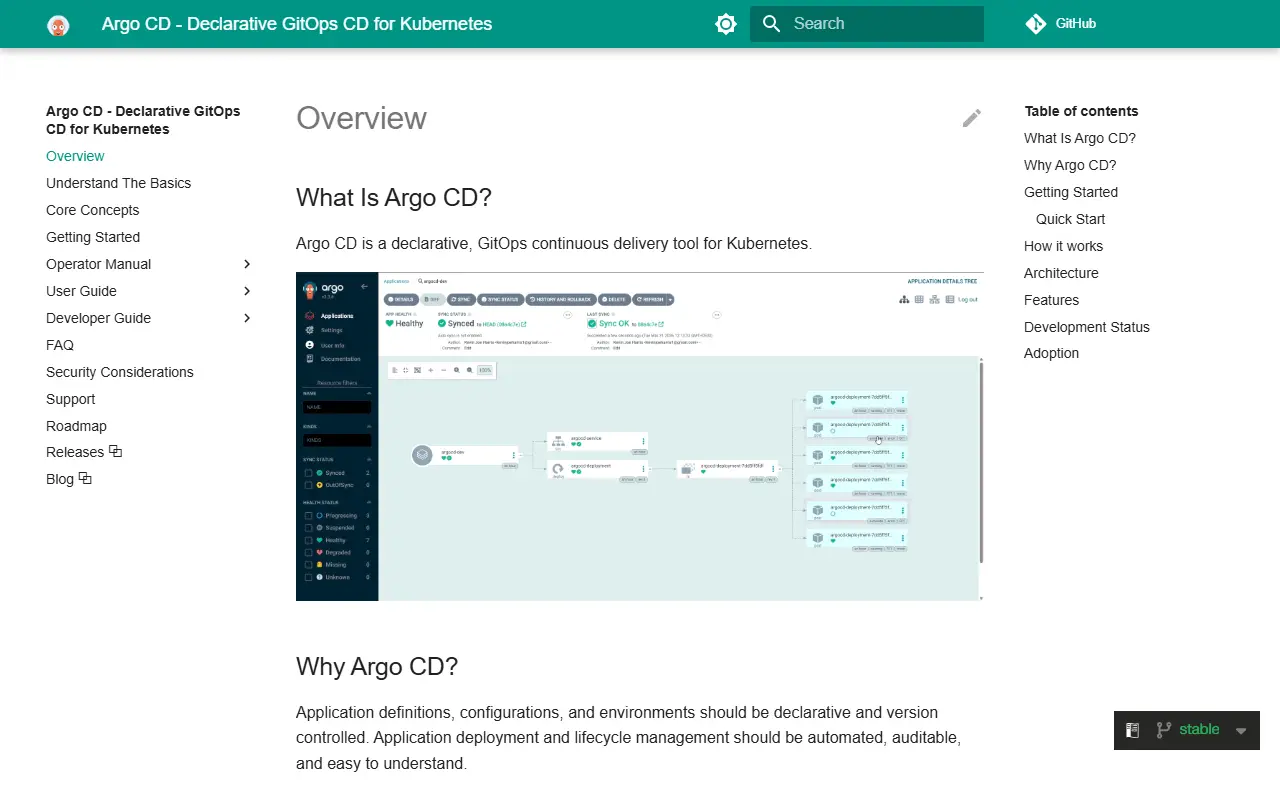
Argo CD applies GitOps principles to continuous delivery on Kubernetes, in a declarative way. Its premise is that application definitions, configuration and environments should be declarative and version controlled, and that rolling out and managing applications should be automated, traceable and straightforward. It is written in Go, is part of the Argo project under the CNCF, and is released under the Apache-2.0 license.
Repository topics show support for Helm, Kustomize and Jsonnet as ways to describe applications, alongside a focus on continuous deployment pipelines. The project offers complete documentation and a live demo, and the community can be reached through GitHub Discussions, a Slack channel, contributor office hours and monthly user community meetings. Its README links to many blog posts and talks on combining Argo CD with tools such as Crossplane, Argo Workflows and preview environments for pull requests.
Key features
- GitOps-based continuous delivery for Kubernetes
- Declarative, version-controlled application definitions
- Helm, Kustomize and Jsonnet support
- Automated and auditable deployments
- Live demo and complete documentation
- CNCF-governed open community
Pricing: Free and open source under the Apache-2.0 license.
#4
Jenkins is an open-source, Java-based automation server for building, testing and deploying software, extended through plugins.
- GitHub stars
- 27k
- Last commit
- yesterday
- Latest release
- jenkins-2.590
- Licence
- MIT
- Self-hosted
- Yes
jenkins.io
Jenkins is an open-source automation server written in Java. Teams use it to automate parts of their development workflow, including building projects, running tests to catch bugs early, performing static code analysis and deploying software. The README states that more than 2,000 plugins extend it to automate nearly any task. It is released under the MIT license, and its topics include continuous integration, delivery and pipelines as code.
The project distributes official downloads as WAR archives, Docker images, and native packages or installers for several Linux distributions and Windows. Two release lines exist: weekly releases carrying all new features and fixes, and Long-Term Support releases that receive periodic backported bug fixes. The repository links to contributing guidelines, good first issues, developer documentation, governance and adopters information. As a self-managed server, you operate and secure your own Jenkins instance.
Key features
- Automation server for build, test and deploy
- Plugin ecosystem with over 2,000 plugins
- Pipelines as code
- WAR, Docker image and native package installs
- Weekly and Long-Term Support release lines
- Static code analysis and deployment automation
Pricing: Free and open source under the MIT license.
#5
Open-source tool for building and deploying software across many servers, with an API for automation and no cap on connected servers.
- GitHub stars
- 13k
- Last commit
- 21 days ago
- Latest release
- v2.3.4
- Licence
- GPL-3.0
- Self-hosted
- Yes
komo.do
Komodo is an open-source tool for building and deploying software across many servers. It is intended for people who run their own infrastructure and want a single place to manage builds and deployments on all of their machines, rather than logging in to each one separately.
The project states that there is no limit on the number of servers that can be connected and no restriction on the API available for automation. Servers are connected through a component called Periphery, which has its own setup guide, and the maintainers publish a roadmap, a public demo and a build server for people who want to look around. Screenshots show both light and dark themes.
Komodo is written in Rust and released under GPL-3.0. The maintainers warn that, although they try to keep releases stable, the software comes with no warranty, so it should be used at your own risk. Documentation is available on the project site and community discussion happens on Discord.
Key features
- Build and deploy software across many servers
- No limit on connected servers
- Unrestricted API for automation
- Periphery setup for connecting servers
- Light and dark interface themes
Pricing: Free and open source under the GPL-3.0 license.
#7
Kamal deploys containerized web apps to bare metal or cloud servers over SSH with zero-downtime switching between containers.
- GitHub stars
- 15k
- Last commit
- 2 days ago
- Latest release
- v2.12.0
- Licence
- MIT
- Self-hosted
- Yes
kamal-deploy.org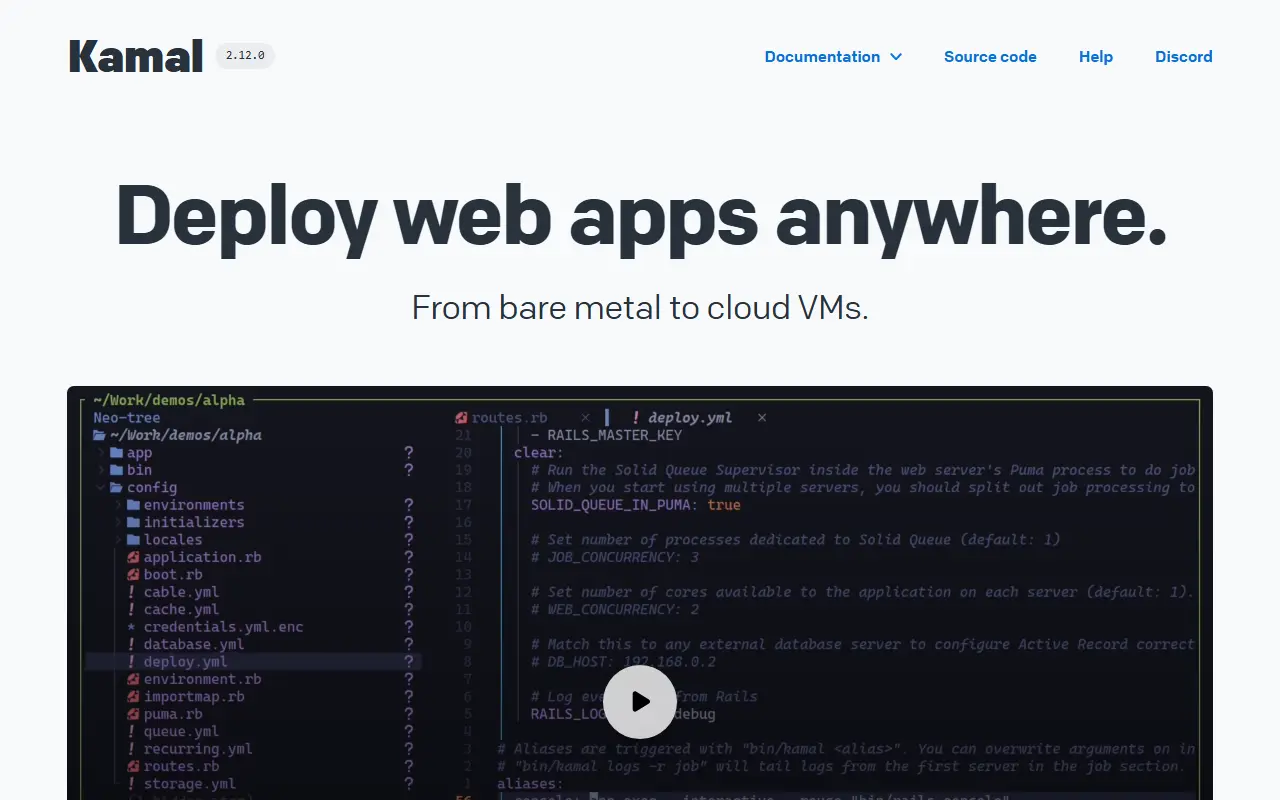
Kamal is a deployment tool for web applications that can run anywhere, from bare metal servers to cloud virtual machines. It uses a proxy component called kamal-proxy to switch requests between containers without downtime, and it works across multiple servers by running commands over SSH using SSHKit.
Originally built for Rails applications, Kamal works with any web app that can be packaged in a Docker container. Documentation on installation, configuration and commands is on kamal-deploy.org, and the documentation itself lives in a separate repository where improvements are welcome.
Kamal is written in Ruby, developed by Basecamp, and released under the MIT license. Because it deploys to servers you control, it suits teams who want a simple alternative to hosted platforms while still getting rolling, zero-downtime releases.
Key features
- Zero-downtime container switching
- Deploys to bare metal or cloud VMs
- Multi-server deployments over SSH
- Works with any Dockerized web app
- kamal-proxy request routing
Pricing: Free and open source under the MIT license.
#8
Salt automates infrastructure management and configuration at scale, with remote execution, event-driven automation and cloud provisioning.
- GitHub stars
- 16k
- Last commit
- yesterday
- Latest release
- v3007.17
- Licence
- Apache-2.0
- Self-hosted
- Yes
docs.saltproject.io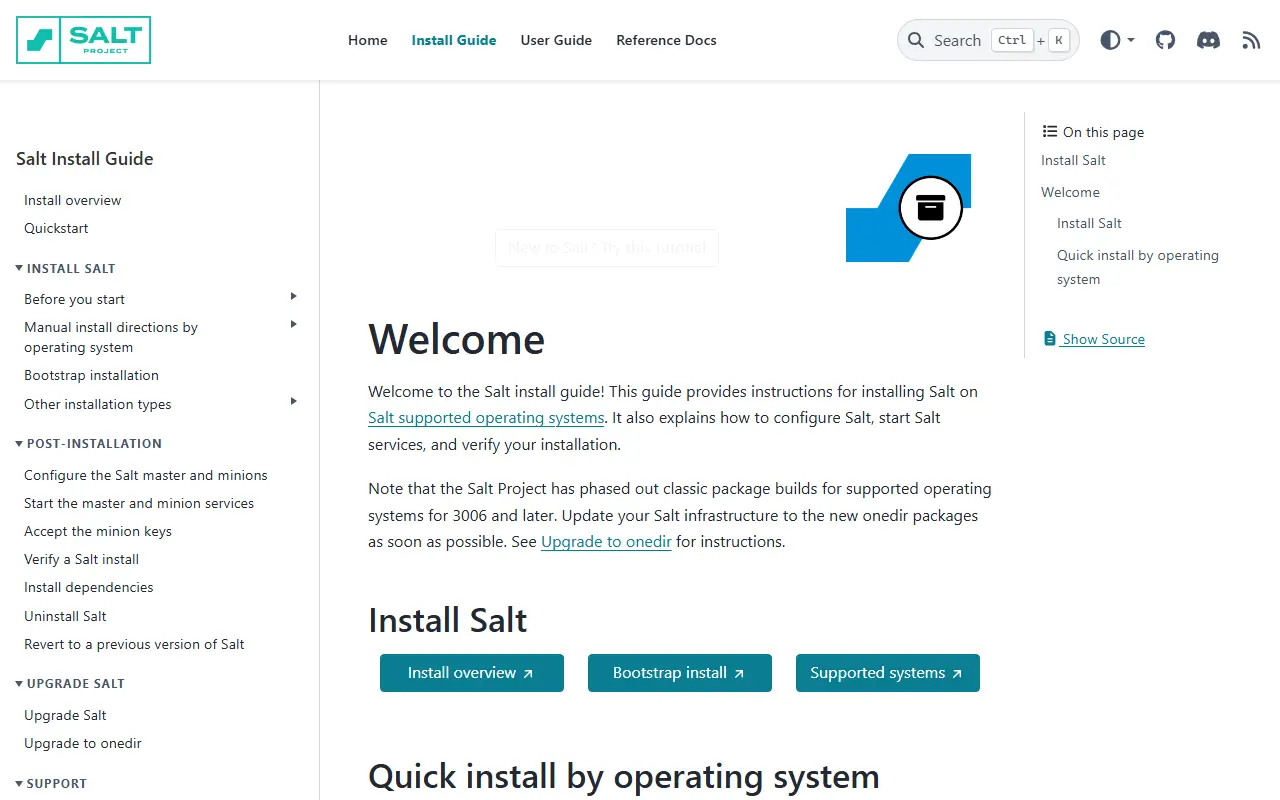
Salt is software for automating the management and configuration of infrastructure and applications at scale. It is written in Python and released under the Apache 2.0 license, and it is used for configuration management, remote execution and infrastructure-as-code across servers, cloud resources and edge or IoT devices.
Salt uses a master and minion model: a Salt master controls agents, called minions, whose keys the administrator accepts. Repository topics point to ZeroMQ messaging, an event stream and event management, along with cloud provider and cloud provisioning support. The install guide covers a quickstart script, bootstrap installation, manual installation by operating system, upgrades and a version support lifecycle.
The install documentation lists supported operating systems and Python versions, and describes a onedir packaging format. Salt is typically self-run on your own infrastructure, with the master and minion services configured and started by the operator, and community support through GitHub and Discord.
Key features
- Configuration management for servers
- Remote execution across many machines
- Event stream and event-driven automation
- Cloud provider provisioning support
- Master and minion architecture
- Quickstart and bootstrap install scripts
Pricing: Free and open source under the Apache 2.0 license.
#9
Capistrano is a remote server automation and deployment tool written in Ruby that can deploy applications in any language.
- GitHub stars
- 13k
- Last commit
- 11 days ago
- Latest release
- v3.20.1
- Licence
- MIT
capistranorb.com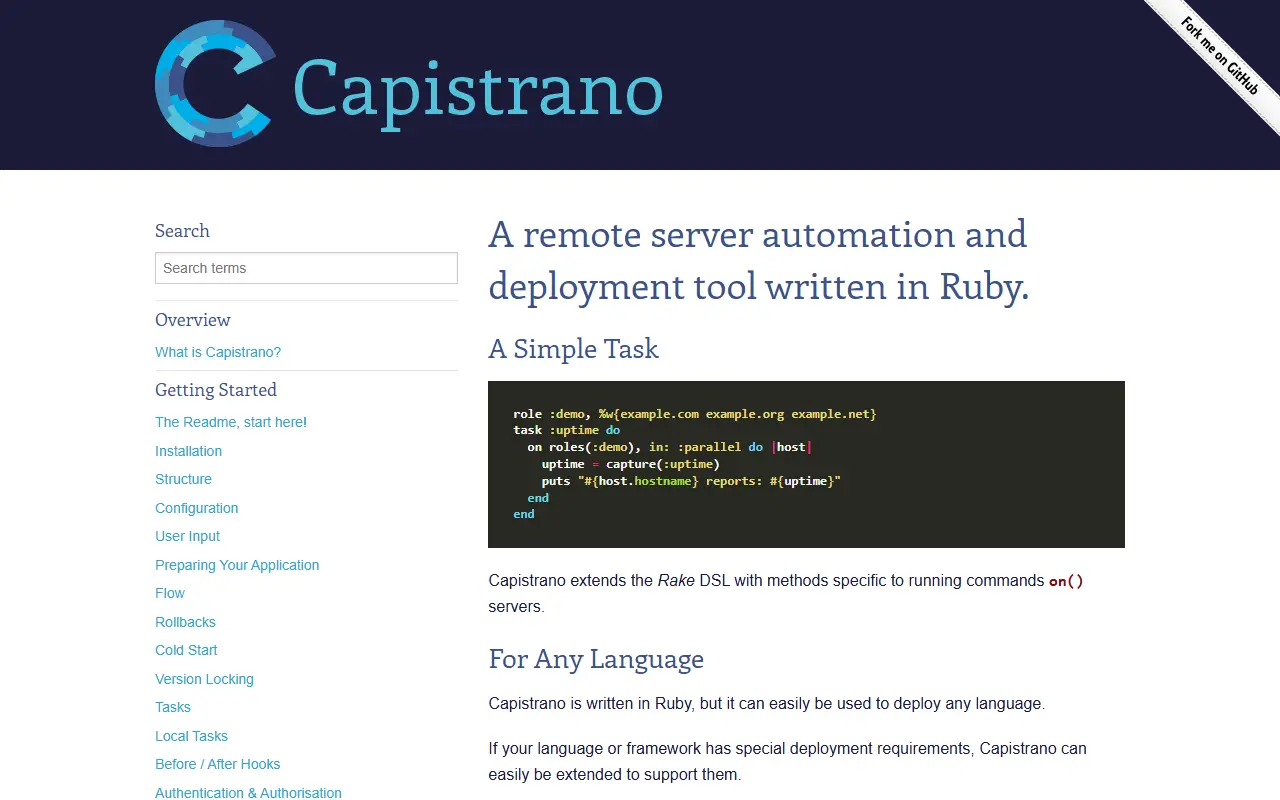
Capistrano is a remote server automation and deployment tool written in Ruby, released under the MIT licence. It extends the Rake DSL with methods for running commands on servers, so deployment steps are written as tasks against named roles and hosts.
Although it is written in Ruby, the project says it can be used to deploy any language, and it can be extended where a language or framework has special deployment requirements. The documentation covers installation, configuration, flow, rollbacks, cold starts, version locking, before and after hooks, host and role filtering, official and third-party plugins, and a cookbook with Rails related tasks.
The site also keeps a Capistrano 2 documentation repository and an upgrade guide from version 2.x to 3, and mentions the version 3 release announcement of June 2013.
Key features
- Remote server automation and deployment
- Rake DSL extended with server command methods
- Extensible for special deployment requirements
- Host and role filtering plus custom filters
- Documented rollbacks and before/after hooks

Flux is a CNCF graduated GitOps tool that keeps Kubernetes clusters in sync with Git repositories and OCI artifacts and automates configuration updates.
- GitHub stars
- 8.5k
- Last commit
- 4 days ago
- Latest release
- v2.10.0
- Licence
- Apache-2.0
- Self-hosted
- Yes
fluxcd.io
Flux version 2 is a continuous delivery tool for Kubernetes. It keeps clusters in sync with sources of configuration, such as Git repositories and OCI artifacts, and automates updates to that configuration when new code is ready to deploy.
Flux v2 is built on Kubernetes' API extension system and the GitOps Toolkit, which bundles composable APIs with specialized controllers. Source controllers handle resources such as GitRepository, OCIRepository, HelmRepository, HelmChart and Bucket, and a Kustomize controller applies the configuration. It supports multi-tenancy, syncing multiple Git repositories, managing Helm releases, automating image updates back to Git and handling secrets with SOPS. It also integrates with Prometheus.
Flux is written in Go, licensed under Apache-2.0 and is a graduated project of the Cloud Native Computing Foundation. The documentation includes a bootstrap guide for installing it on a cluster and deploying a sample app in a GitOps manner, and teams can extend it with the toolkit to build their own delivery systems.
Key features
- GitOps sync from Git and OCI sources
- Helm release management
- Automated image updates written back to Git
- Multi-tenancy support
- Secrets management with SOPS
- Prometheus integration
Pricing: Free and open source under the Apache-2.0 licence.
5 more Octopus Deploy alternatives
Octopus Deploy alternatives: questions
- What is the best open-source alternative to Octopus Deploy?
- Ansible is the top-ranked open-source alternative to Octopus Deploy on Enlisted: An agentless IT automation platform for configuration management, application deployment, cloud provisioning and network automation over SSH. Other strong options are Harness, Argo CD, Jenkins and Komodo.
- What are the best commercial alternatives to Octopus Deploy?
- CloudBees, Buddy, AWS CodePipeline, AWS CodeDeploy and Azure Pipelines are among the hosted, closed-source alternatives to Octopus Deploy listed on Enlisted, which lists 15 in total. Compare their pricing and features on each tool page.
- Are these Octopus Deploy alternatives free?
- All 15 are open source, so the code is free to use under its licence, and all of them can be self-hosted on your own server or computer. 2 also offer a paid or managed cloud version if you'd rather not host it yourself.
- How is this list of Octopus Deploy alternatives ranked?
- By a score built from GitHub stars, star growth over the last 30 days and how recently the code changed. 14 of these projects shipped code in the last 30 days. Data is refreshed daily, and nobody can pay to move up.
 TrackMedia
 TrackRev