 TrackMedia
 TrackRev

 Octopus Deploy
 VMware Workstation
 ProGet
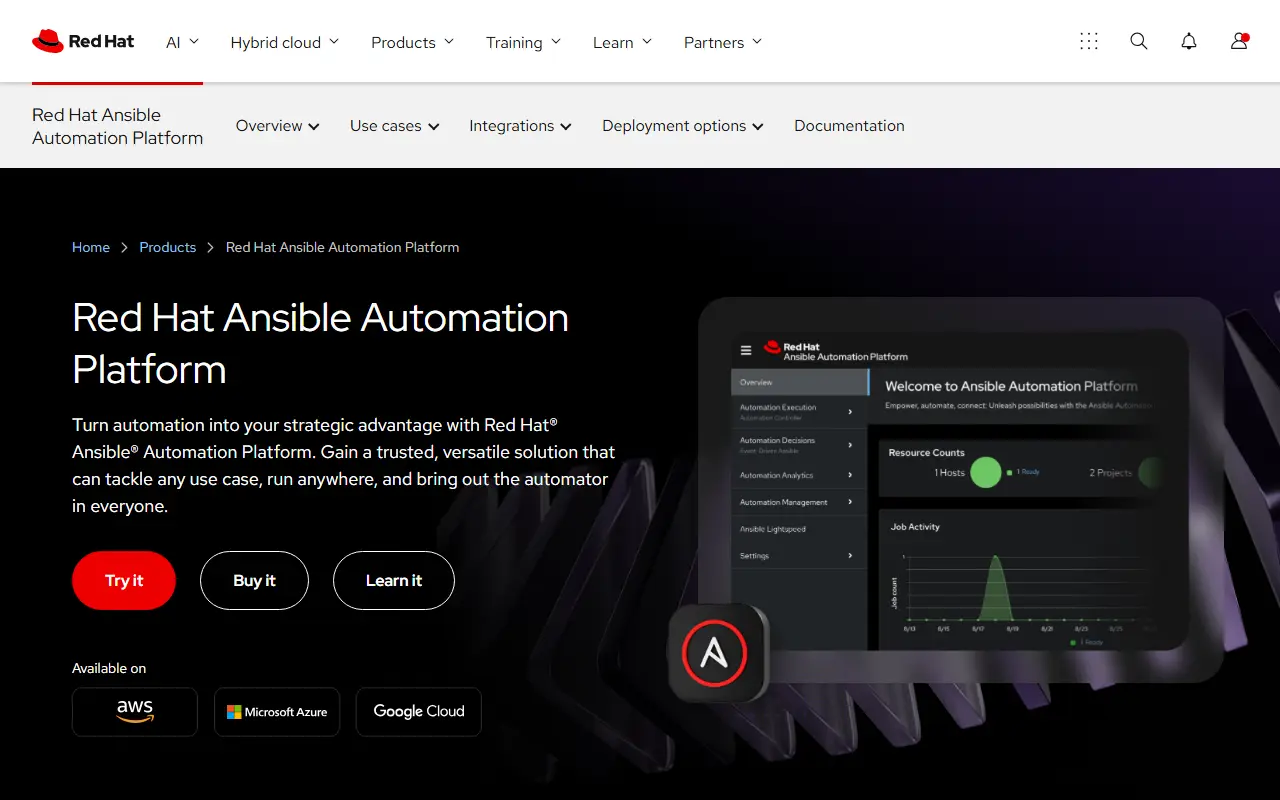
About Red Hat Ansible Automation Platform
Red Hat Ansible Automation Platform is the commercial, supported edition of Ansible automation. Red Hat describes it as a platform for implementing enterprise-wide automation regardless of where an organization is in its automation journey, and it is widely used for infrastructure, network and cloud provisioning.
It extends the open-source Ansible project with enterprise features and support, and it sits within Red Hat's hybrid cloud portfolio next to Red Hat Enterprise Linux and OpenShift. Red Hat frames automation as a way to scale work and unite technology, teams and environments, with use cases that include security, virtualization and edge computing. Automation is generally written as human-readable playbooks.
Ansible Automation Platform is sold by subscription with Red Hat support. The site provides trial options and a dedicated pricing page, though no prices appear in the page text.
Key features
- Enterprise-supported Ansible automation
- Infrastructure and network automation
- Cloud provisioning workflows
- Integration with Red Hat platforms
- Support for hybrid cloud environments
Good fit for
- Automating server and network configuration
- Provisioning cloud resources consistently
- Scaling automation across teams
Red Hat Ansible Automation Platform: questions and answers
- What is Red Hat Ansible Automation Platform used for?
- Red Hat Ansible Automation Platform is an enterprise automation product for provisioning and managing infrastructure, network and cloud resources. It is a good fit for automating server and network configuration, provisioning cloud resources consistently, and scaling automation across teams.
- How much does Red Hat Ansible Automation Platform cost?
- Red Hat Ansible Automation Platform doesn't publish fixed prices; pricing is quoted on request. A free trial is available.
- Is Red Hat Ansible Automation Platform open source?
- No. Red Hat Ansible Automation Platform is proprietary (closed-source) software. Open-source alternatives to Red Hat Ansible Automation Platform include Pulumi, Crossplane and Salt Project.
- Can I self-host Red Hat Ansible Automation Platform?
- Yes. Although Red Hat Ansible Automation Platform is closed source, it can be self-hosted on your own servers.
- What are some alternatives to Red Hat Ansible Automation Platform?
- Red Hat Ansible Automation Platform competes with Puppet Enterprise, HCP Terraform and Spacelift. For open-source options, see Enlisted's ranked list of open-source Red Hat Ansible Automation Platform alternatives.
Open-source alternatives to Red Hat Ansible Automation Platform
See all
Pulumi
Infrastructure & Containers
Pulumi - Infrastructure as Code in any programming language 🚀
Apache-2.0vs DigitalOcean★ 26k
Crossplane
Infrastructure & Containers
The Cloud Native Control Plane
Apache-2.0vs Humanitec★ 12k
Salt Project
CI/CD & DevOps
Software to automate the management and configuration of infrastructure and applications a
Apache-2.0vs Red Hat Ansible Automation Platform★ 16k
CFEngine
Workflow Automation
CFEngine Community
OSSvs Red Hat Ansible Automation Platform★ 540
Chef
CI/CD & DevOps
Chef Infra, a powerful automation platform that transforms infrastructure into code automa
Apache-2.0vs Northflank★ 8.3k
Rundeck
Workflow Automation
Enable Self-Service Operations: Give specific users access to your existing tools, service
Apache-2.0vs CloudBees★ 6.4k
SaaS alternatives to Red Hat Ansible Automation Platform
See all
Puppet Enterprise
Infrastructure & Containers
Configuration management and compliance automation platform for infrastructure
SaaS
HCP Terraform
CI/CD & DevOps
HashiCorp managed service for running Terraform with remote state and policy checks
SaaS
Spacelift
CI/CD & DevOps
Infrastructure-as-code management for Terraform, OpenTofu, Pulumi and Ansible
SaaS
env0
CI/CD & DevOps
Infrastructure-as-code automation with policy controls and cost tracking
SaaS
Scalr
CI/CD & DevOps
Terraform and OpenTofu automation and collaboration platform
SaaS
Terraform Cloud
CI/CD & DevOps
Manage infrastructure as code
SaaS