
About Salt Project
Salt is software for automating the management and configuration of infrastructure and applications at scale. It is written in Python and released under the Apache 2.0 license, and it is used for configuration management, remote execution and infrastructure-as-code across servers, cloud resources and edge or IoT devices.
Salt uses a master and minion model: a Salt master controls agents, called minions, whose keys the administrator accepts. Repository topics point to ZeroMQ messaging, an event stream and event management, along with cloud provider and cloud provisioning support. The install guide covers a quickstart script, bootstrap installation, manual installation by operating system, upgrades and a version support lifecycle.
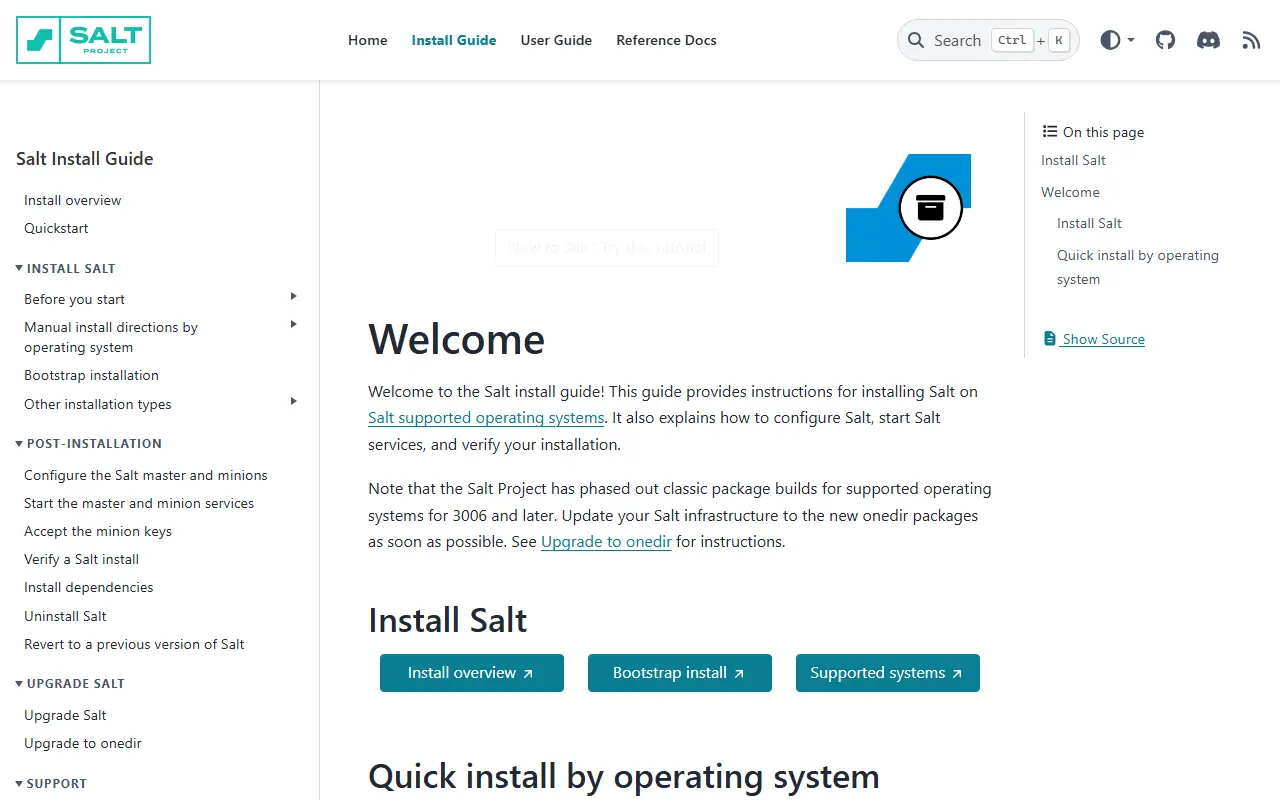
The install documentation lists supported operating systems and Python versions, and describes a onedir packaging format. Salt is typically self-run on your own infrastructure, with the master and minion services configured and started by the operator, and community support through GitHub and Discord.
Key features
- Configuration management for servers
- Remote execution across many machines
- Event stream and event-driven automation
- Cloud provider provisioning support
- Master and minion architecture
- Quickstart and bootstrap install scripts
Good fit for
- →Managing configuration across server fleets
- →Running commands on many hosts at once
- Built with
- Python
- Tags
- configuration-management
- automation
- remote-execution
- infrastructure-as-code
- python
- zeromq
- devops
- cloud-provisioning
Salt Project: questions and answers
- What is Salt Project used for?
- Salt Project automates infrastructure management and configuration at scale, with remote execution, event-driven automation and cloud provisioning. It is a good fit for managing configuration across server fleets and running commands on many hosts at once.
- Is Salt Project open source?
- Yes. Salt Project is open source under the Apache-2.0 licence. Its source code is on GitHub at saltstack/salt and is written mainly in Python.
- Is Salt Project free?
- Yes. Salt Project is open source, so the software itself is free to use.
- Can I self-host Salt Project?
- Yes. Salt Project can be self-hosted on your own server or infrastructure.
- What is Salt Project an alternative to?
- Salt Project is an open-source alternative to Red Hat Ansible Automation Platform and Puppet Enterprise.
- Is Salt Project actively maintained?
- Yes. The most recent commit to Salt Project was on 30 September 2026, and the latest release is v3008.3, published on 30 September 2026. The project has 16k stars on GitHub.
Open-source alternatives to Salt Project
See all
Ansible
CI/CD & DevOps
Ansible is a radically simple IT automation platform that makes your applications and syst
GPL-3.0vs AWS CodeDeploy★ 71k
Chef
CI/CD & DevOps
Chef Infra, a powerful automation platform that transforms infrastructure into code automa
Apache-2.0★ 8.2k
Atlantis
CI/CD & DevOps
Terraform Pull Request Automation
Apache-2.0vs HCP Terraform★ 9.3k
TaskCat
CI/CD & DevOps
Test all the CloudFormation things! (with TaskCat)
Apache-2.0★ 1.2k
pypyr
CI/CD & DevOps
pypyr task-runner cli & api for automation pipelines. Automate anything by combining comma
Apache-2.0★ 645
Jenkins
CI/CD & DevOps
Jenkins automation server
MITvs CircleCI★ 27k
SaaS alternatives to Salt Project
See all
Red Hat Ansible Automation Platform
Infrastructure & Containers
Enterprise automation platform for infrastructure, network and cloud provisioning
SaaS
Puppet Enterprise
Infrastructure & Containers
Configuration management and compliance automation platform for infrastructure
SaaS
Buddy
CI/CD & DevOps
Visual CI/CD tool for building, testing and deploying web projects
SaaS
CAST AI
CI/CD & DevOps
Kubernetes automation platform for cost optimization and autoscaling
SaaS
CircleCI
CI/CD & DevOps
Hosted continuous integration and delivery platform for build and test pipelines
SaaS
env0
CI/CD & DevOps
Infrastructure-as-code automation with policy controls and cost tracking
SaaS