7,363 open-source and SaaS tools, with GitHub stats refreshed every day.

9 alternatives ranked by real activity

Open-source AWS AppConfig alternatives

A curated, ranked list of the 9 best open-source alternatives to AWS AppConfig.

The best open-source alternative to AWS AppConfig is Unleash. If that doesn't suit you, other good options are GrowthBook, Flagsmith, Flipt and Flagr.

AWS AppConfig alternatives are mainly feature flag tools. 8 of them shipped code in the last 30 days, 9 can be self-hosted, and 6 use a permissive licence.

Last updated October 2, 2026 · ranked by GitHub stars, growth and recent commits

Unleash

An open-source feature management platform for rolling out features gradually with flags, strategies and variants, with many SDKs and an Enterprise edition.

GitHub stars
14k
Last commit
yesterday
Latest release
v8.2.0
Licence
AGPL-3.0
Self-hosted
Yes
Hosted version
Available
getunleash.ioUnleash homepage screenshot

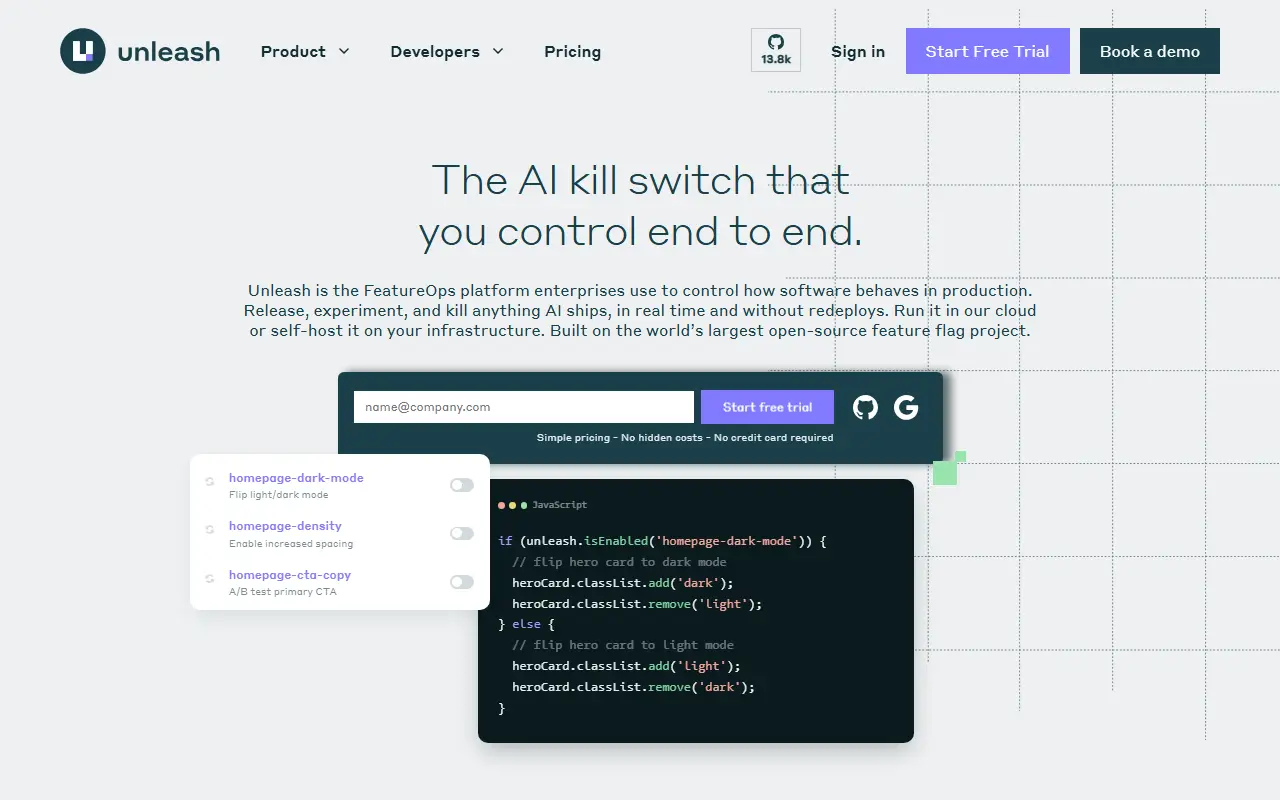
Unleash is an open-source feature management platform. Teams wrap new functionality in feature flags, deploy code to production in smaller releases, and then decide when and for whom each feature is switched on. This lowers the risk of releases and lets several features be developed at once without long-lived feature branches.

Flags can be tested against real production data and controlled using activation strategies and variants, and the project topics also point to experiments and toggles. Unleash provides 15 official client and server SDKs plus community SDKs and works with any language or framework. The Enterprise edition adds single sign-on, SCIM user provisioning, change requests and fine-grained roles, with unlimited projects and environments in a hosted instance.

The open-source edition is licensed under AGPL-3.0 and can be run locally with git and Docker, serving its interface on port 4242, or directly from source with Node.js. A live demo is available, and a free trial gives access to a hosted Enterprise instance.

Key features

  • Feature flags with gradual rollouts
  • Activation strategies and variants
  • 15 official client and server SDKs
  • Role-based access control in Enterprise
  • Change requests for flag updates
  • SSO and SCIM provisioning in Enterprise
  • Multiple projects and environments
  • Run locally with Docker

Pricing: The open-source edition is free to self-host. Pay-as-you-go costs $75 per seat per month with a 14-day trial; annual Enterprise contracts are quoted.

Read more about UnleashWebsite GitHub

GrowthBook

An open-source platform for feature flags, A/B experimentation and product analytics that queries your data warehouse, available in the cloud or self-hosted.

GitHub stars
8.5k
Last commit
yesterday
Latest release
v5.1.0
Self-hosted
Yes
Hosted version
Available
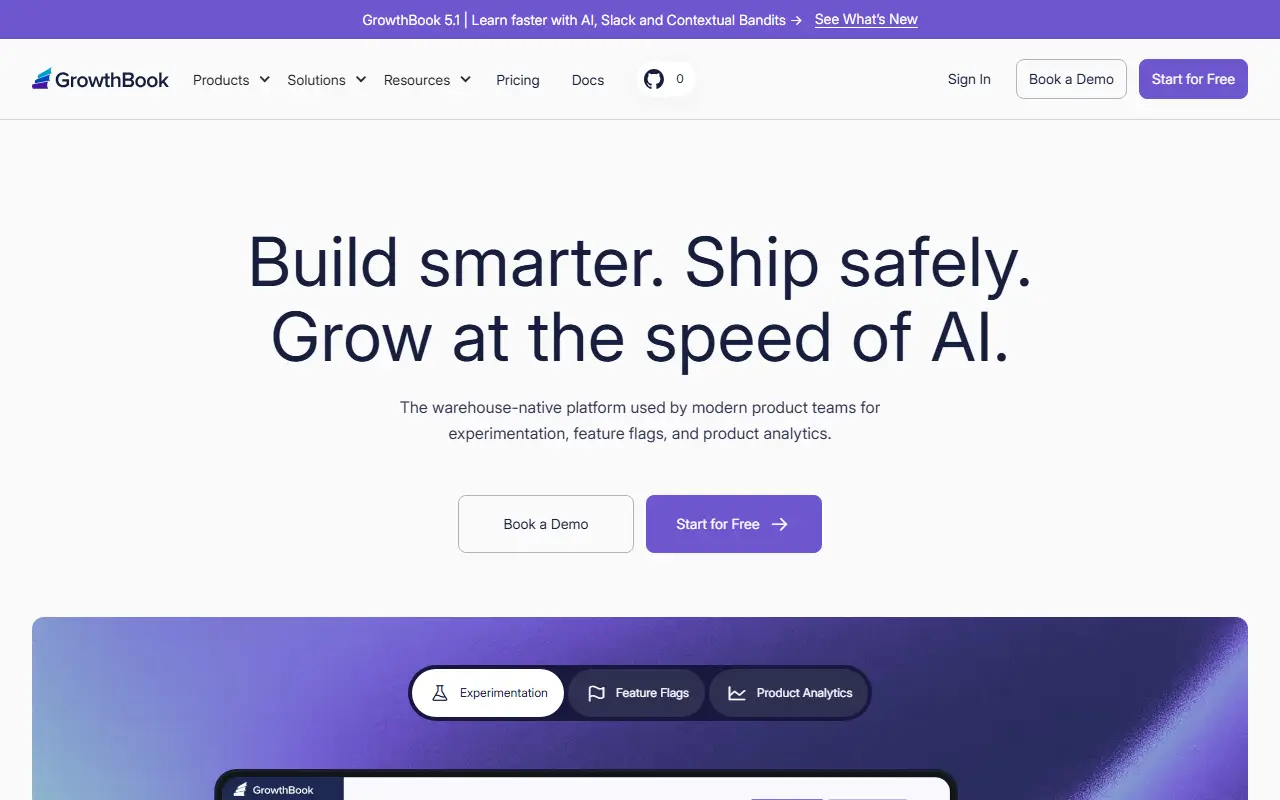
growthbook.ioGrowthBook homepage screenshot

GrowthBook combines feature flagging, experimentation and product analytics in one open-source platform. The project's stated philosophy is that most companies cannot build an in-house platform of this kind, so it aims to give them the flexibility of one without the effort, instead of paying for closed SaaS tools or stitching together unmaintained libraries.

Feature flags support targeting, gradual rollouts and experiments, with 24 SDKs including React, Python, Android and iOS. The statistics engine offers methods such as CUPED, sequential and Bayesian testing, post-stratification, bandits and sample ratio mismatch checks. It is warehouse native, querying data sources such as BigQuery, Snowflake and Databricks, with metrics defined in flexible SQL. A built-in analytics suite supports dashboards, and there are webhooks, a REST API and an MCP server.

You can start with a free GrowthBook Cloud account or run it yourself with Docker and the prebuilt public image. The repository lists the licence as Other, so review the licence terms for the exact conditions on the open-source and enterprise parts. It suits product and data teams that want to run experiments on their own warehouse data.

Key features

  • Feature flags with advanced targeting
  • A/B tests with a Bayesian stats engine
  • Warehouse-native data source queries
  • SQL-based metric definitions
  • Built-in product analytics dashboards
  • 24 SDKs across many languages
  • REST API, webhooks and MCP server

Pricing: Free Starter cloud plan and a free self-hosted Open Source edition. Pro costs $40 per seat per month for up to 30 users; Enterprise is custom.

Read more about GrowthBookWebsite GitHub

Flagsmith

An open-source feature flag and remote config platform with segments, A/B testing and SDKs, deployable self-hosted, in a private cloud or as a managed cloud service.

GitHub stars
6.6k
Last commit
yesterday
Latest release
v2.279.0
Licence
BSD-3-Clause
Self-hosted
Yes
Hosted version
Available
flagsmith.comFlagsmith homepage screenshot

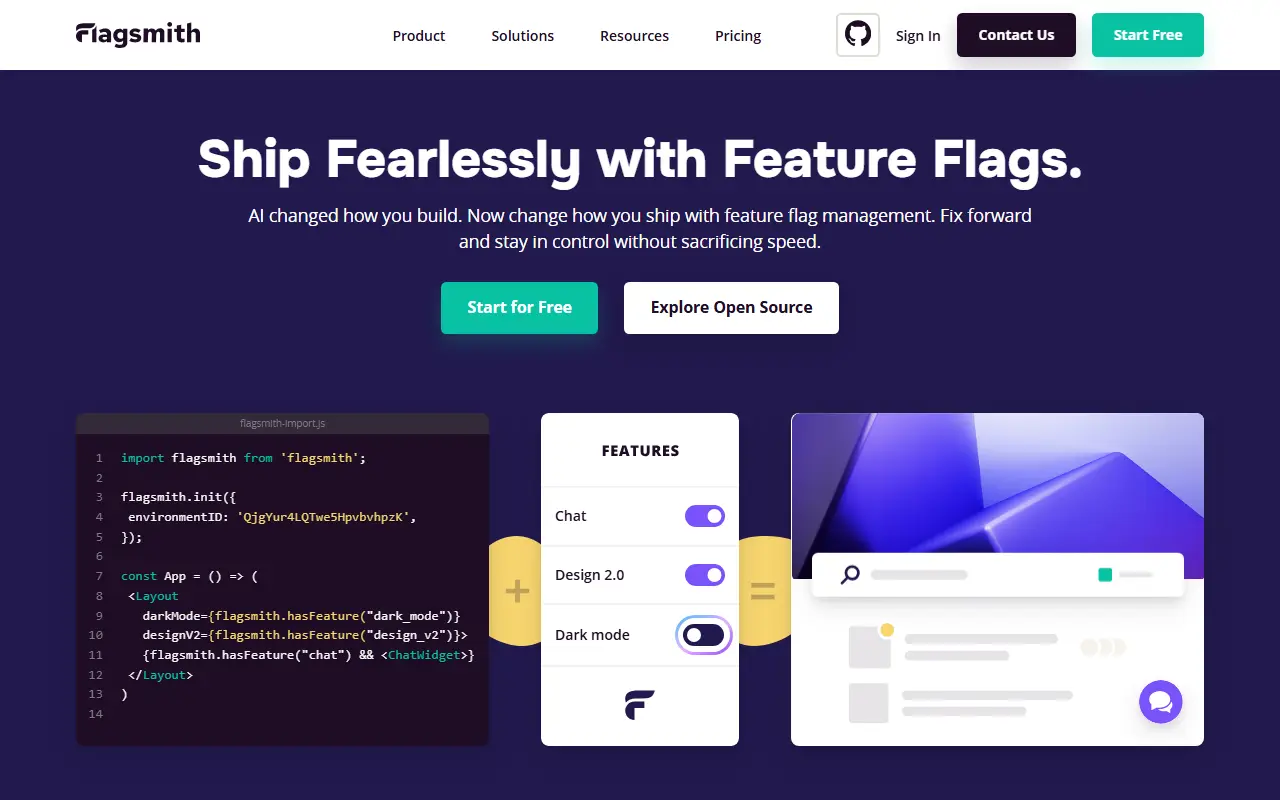
Flagsmith is a feature management platform, released as open source, offering feature flags, remote configuration and experimentation. It provides three deployment options: self-hosted, available as a free open-source build or as a fully supported Enterprise edition, a private cloud and a standard cloud service. Its partnership with OpenFeature is intended to avoid vendor lock-in.

Teams wrap sections of code in flags and toggle features on or off remotely for different environments, users or segments without deploying new code. Segments let you release to beta testers and gather feedback, and A/B and multivariate tests run on top of segments. Organisation management covers orgs, projects and roles for team members, and SDKs cover more than 15 languages with support for frameworks such as React and Next.js, plus integrations and an MCP server.

Flagsmith is written in Python and React, ships as Docker images and is released under the BSD 3-Clause licence for the open-source build. It suits product and engineering teams that want controlled rollouts and remote configuration across web, mobile and server-side applications.

Key features

  • Feature flags with remote toggling
  • Remote configuration values
  • Segments for targeted releases
  • A/B and multivariate testing
  • Organisations, projects and roles
  • SDKs for 15+ languages
  • Integrations and MCP server

Pricing: Free plan with 50,000 requests a month. Start-Up costs $45 and Scale-Up $300 per month ($40 and $250 billed yearly), each with a 14-day trial; Enterprise is quoted.

Read more about FlagsmithWebsite GitHub

Flipt

Flipt is a Git-native feature flag platform that stores flags as code in your own repositories and deploys them with your existing Git workflow.

GitHub stars
4.9k
Last commit
yesterday
Latest release
v2.13.0
Self-hosted
Yes
flipt.ioFlipt homepage screenshot

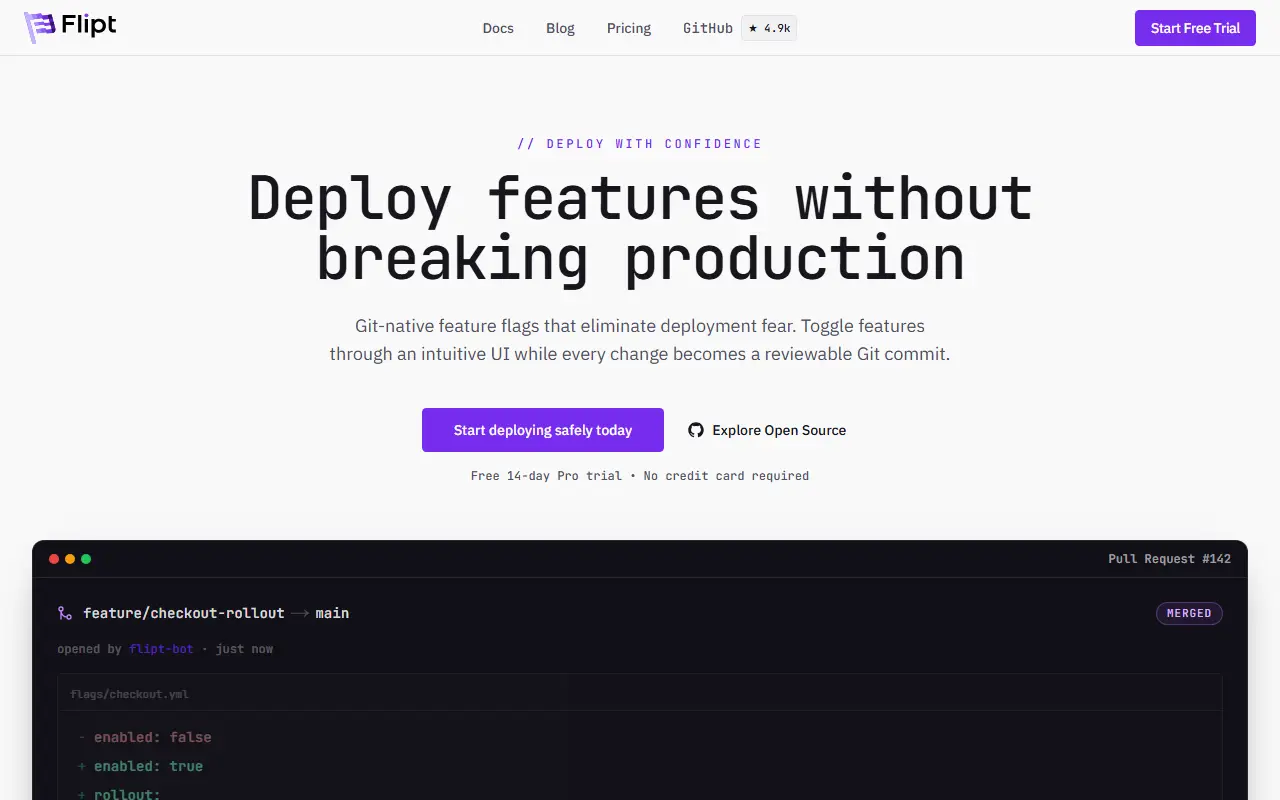
Flipt is a feature management platform that treats feature flags as code. In version 2 the flags live in your own Git repositories, follow your existing branching strategy and deploy alongside application code, rather than sitting in a separate database that only a dashboard can change. It is aimed at developer teams that already rely on GitOps practices.

The README stresses owning your data and working with tools you already trust. The project is written in Go with a React and TypeScript interface, offers gRPC and REST access, and lists OpenTelemetry support among its topics for observability. The v1 code remains available on the main branch with separate documentation.

The repository license is listed as 'Other' on GitHub, so check the terms before use. Flipt is self-hosted, and the website, docs and Discord community are linked for help. It suits engineering teams that want progressive delivery and flag evaluation without sending flag data to a third-party service.

Key features

  • Feature flags stored in Git repositories
  • Works with existing branching workflows
  • gRPC and REST APIs
  • OpenTelemetry observability support
  • React and TypeScript admin interface
  • Self-hosted Go server
Read more about FliptWebsite GitHub

Flagr

Go microservice for feature flags, A/B testing, and dynamic configuration, with an evaluation API, a Vue 3 UI, and several storage backends.

GitHub stars
2.6k
Last commit
6 days ago
Latest release
1.2.4
Licence
Apache-2.0
Self-hosted
Yes
openflagr.github.ioFlagr homepage screenshot

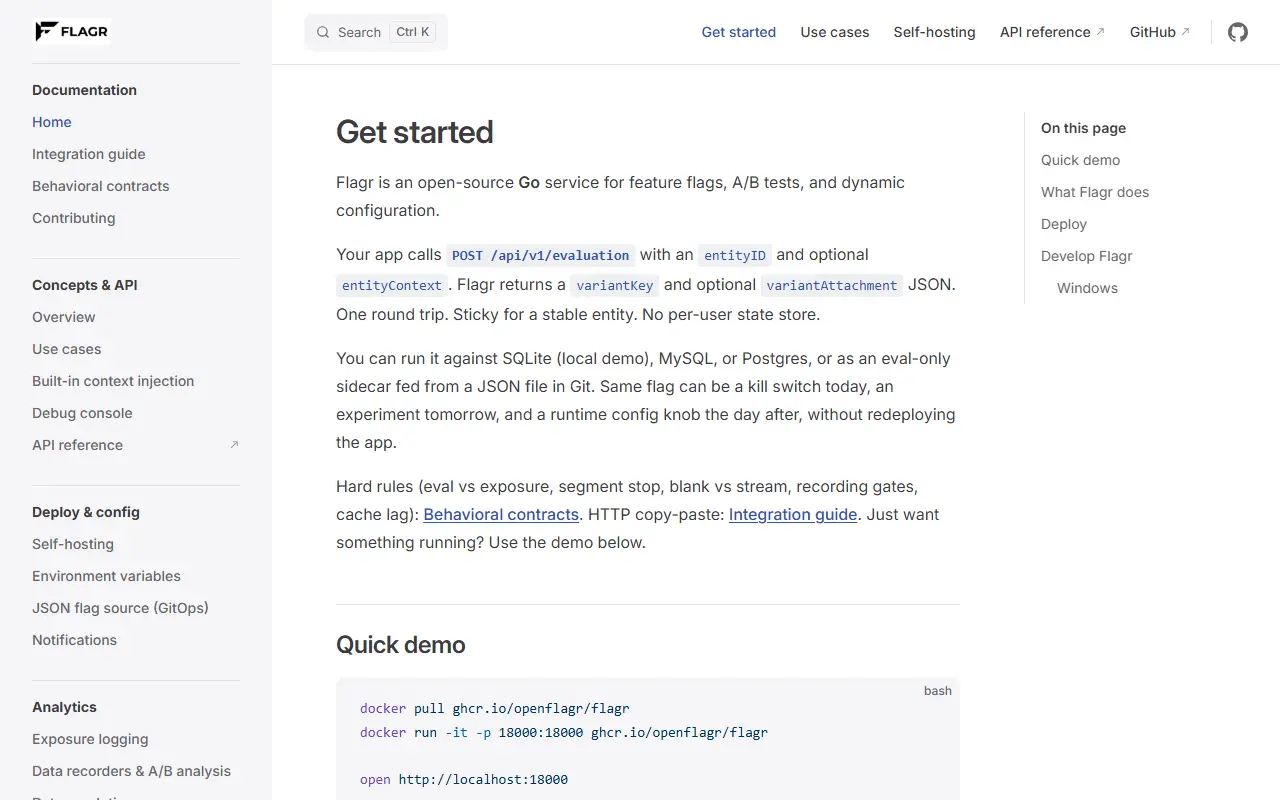
Flagr is an open-source Go service for feature flags, A/B tests, and dynamic configuration. Your application calls an evaluation endpoint with the identity and context of the entity being evaluated, and Flagr returns a variant and an optional JSON attachment. This lets teams ship code turned off, enable it for specific audiences, run experiments with sticky assignment, and change runtime configuration without redeploying.

It is self-hosted and can store data in SQLite, MySQL, PostgreSQL, or JSON files managed through GitOps, and it provides a Vue 3 interface and an official Docker image. The project continues the development of the original checkr/flagr repository and is released under the Apache-2.0 license. Published load tests show it handling thousands of requests per second with sub-millisecond median latency.

A hosted demo is available for trying the UI, and the documentation covers integration, self-hosting, environment variables, and the API reference. Flagr suits engineering teams that want a lightweight, self-run alternative to commercial feature management platforms.

Key features

  • Feature flags with per-audience targeting
  • A/B testing with sticky variant assignment
  • Dynamic configuration via JSON attachments
  • Evaluation API for applications
  • SQLite, MySQL, PostgreSQL, or JSON storage
  • Vue 3 admin UI and Docker image

Pricing: Free and open source under the Apache-2.0 license.

Read more about FlagrWebsite GitHub

GO Feature Flag

Lightweight, self-hosted feature flag solution built on OpenFeature, with a relay proxy, file-based flag configuration, and rollout strategies.

GitHub stars
2.1k
Last commit
yesterday
Latest release
v1.56.0
Licence
MIT
Self-hosted
Yes
gofeatureflag.orgGO Feature Flag homepage screenshot

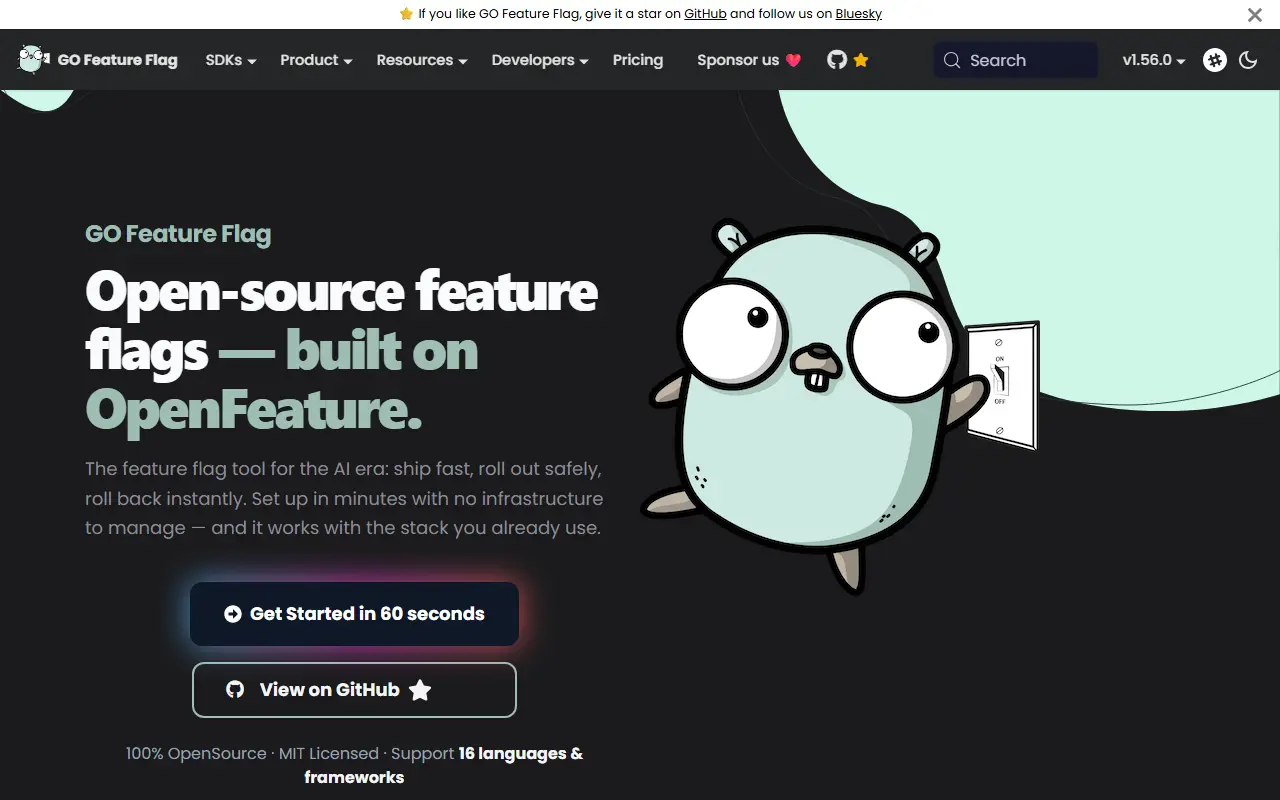
GO Feature Flag is a simple, complete, and lightweight feature flag solution that you host yourself. It is written in Go, 100% open source under the MIT license, and part of the OpenFeature ecosystem, which means it can be used from many languages through OpenFeature SDKs and a relay proxy.

You write flag configuration in files that can live in a storage location of your choice, then evaluate flags in your code with an evaluation context. The documentation covers flag file format, rule format, targeting, custom bucketing, variations, gradual and complex rollout strategies, notifiers for flag changes, data export, and a command-line tool. Topics also reference experimentation and continuous delivery.

The project asks adopters to add themselves to a public list and accepts sponsorship. It suits engineering teams that want to ship code safely behind flags and run progressive rollouts or experiments without paying for a commercial feature management service.

Key features

  • Flags defined in configuration files
  • Relay proxy for any language
  • OpenFeature SDK compatibility
  • Rules, variations, and custom bucketing
  • Progressive and complex rollouts
  • Notifiers and data export
  • Command-line tool

Pricing: The open-source edition is free forever with all features. Enterprise support adds premium help and SLAs and is priced on request.

FeatBit

Self-hostable feature flag platform for progressive rollouts, targeting, remote config, and A/B testing, built on .NET with SDKs for several languages.

GitHub stars
1.9k
Last commit
2 days ago
Latest release
6.0.0
Licence
MIT
Self-hosted
Yes
featbit.coFeatBit homepage screenshot

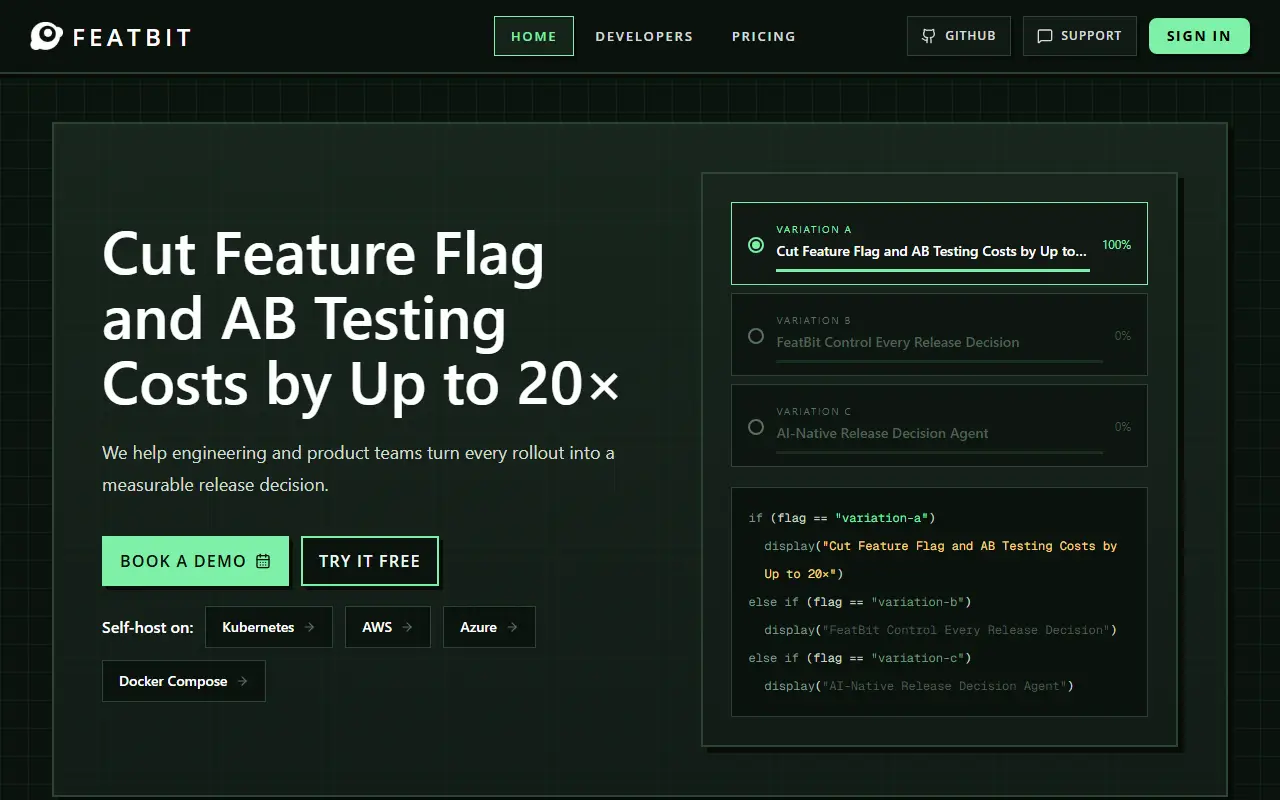
FeatBit is an open-source feature flag management platform that developers can host themselves. It helps teams ship code safely by testing in production, releasing to a small share of users first, expanding gradually, and recovering instantly from errors without redeploying. It is written in C# and .NET and released under the MIT license.

Teams control who sees each feature and when, release to specific target users, and run A/B tests and experiments to measure outcomes. Topics list remote configuration, entitlement, release as code, and progressive delivery. SDKs are available for languages including .NET, Python, and TypeScript, and the project provides documentation, a Discord community, and an online demo.

FeatBit suits engineering teams adopting continuous delivery who want an enterprise-style flag system under their own control, as an alternative to commercial platforms such as LaunchDarkly.

Key features

  • Feature flags with targeted rollouts
  • Progressive percentage-based release
  • A/B testing and experimentation
  • Remote configuration
  • SDKs for .NET, Python, and TypeScript
  • Self-hosted with online demo

Pricing: Self-hosted Foundation is free forever with no usage limits. Enterprise costs $3,999 per year, and Enterprise Premium is custom-priced.

Read more about FeatBitWebsite GitHub

Featurevisor

Featurevisor manages feature flags, experiments and remote configuration declaratively in a Git repository and serves them as static datafiles.

GitHub stars
812
Last commit
24 days ago
Licence
MIT
Self-hosted
Yes
featurevisor.comFeaturevisor homepage screenshot

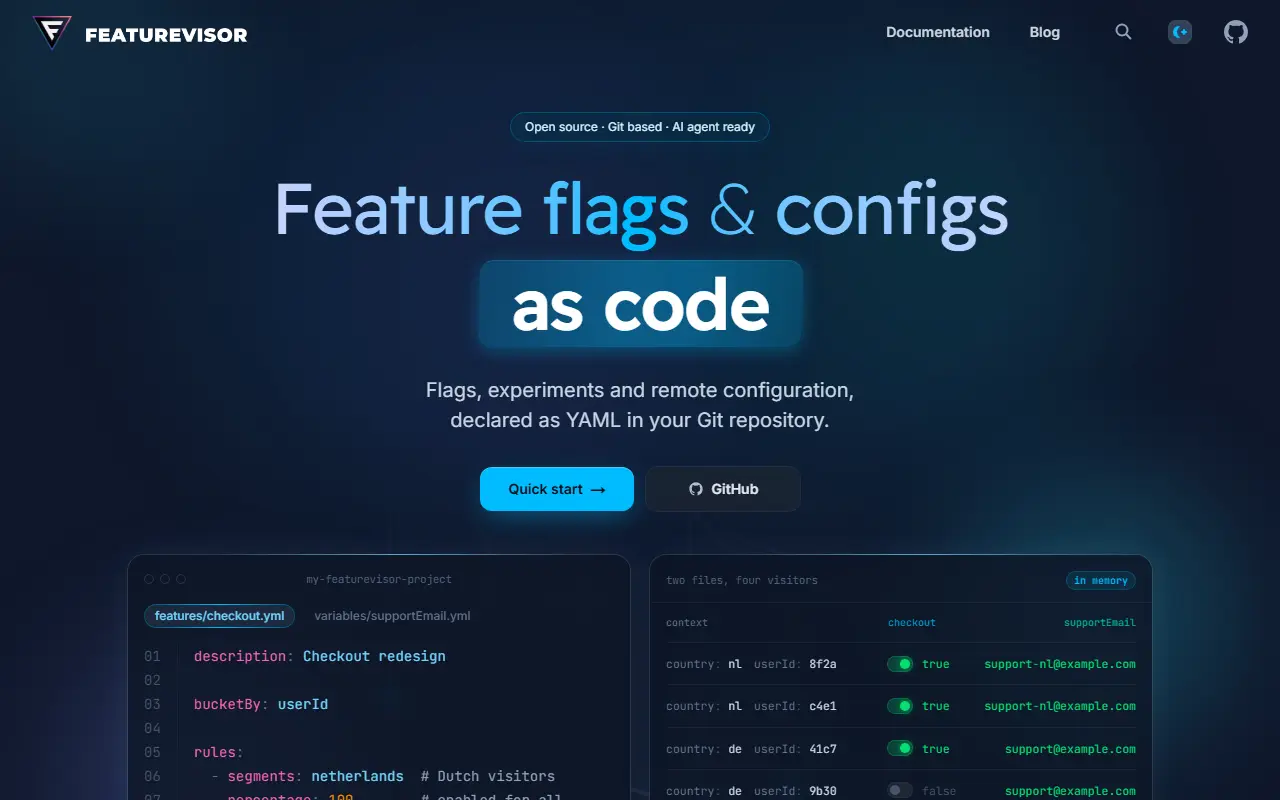
Featurevisor is a feature management tool that treats flags, experiment variations and remote configuration values as code. You define them declaratively in a Git repository, build static JSON datafiles in CI, upload them to a CDN or your own server, and let SDKs in your applications evaluate them.

A project is made of attributes, reusable segments for targeting users, features with flag, variation and variable definitions, and independently evaluated global variables. Evaluation happens in the SDK against the context your app supplies, returning on-off flags, string variations for A/B tests and typed variables. SDKs cover JavaScript, React, React Native, Vue, Next.js, Go, Python, PHP, Ruby, Java, Kotlin, Swift, Rust and Elixir, with OpenFeature providers for many of the same languages.

To use it you bring your own Git repository, a CI/CD pipeline such as GitHub Actions and a place to serve the datafiles. This keeps flag changes reviewable through pull requests and avoids a hosted control plane. Featurevisor is written in TypeScript and released under the MIT license.

Key features

  • Feature flags defined in Git
  • A/B test variations and variables
  • Reusable user segments and attributes
  • Static JSON datafiles for CDN delivery
  • SDKs for many languages
  • OpenFeature provider support

Pricing: Free and open source under the MIT license.

FeatureProbe

Open-source feature management service for feature toggles, gradual rollouts and A/B experiments, aimed at development, SRE and operations teams.

GitHub stars
1.6k
Last commit
4 mo ago
Latest release
2.7.0
Licence
Apache-2.0
Self-hosted
Yes
featureprobe.github.ioFeatureProbe homepage screenshot

FeatureProbe is an open-source feature management service that helps engineering, SRE and operations teams release new features or switch implementations with less risk. It supports feature toggles, gradual (gray) releases and A/B experiments, and lets teams change online parameters within seconds or roll out configuration progressively, without redeploying. The README is bilingual, with a Chinese-language version.

The authors describe several benefits. Feature toggles on the main branch reduce the effort of merging long-lived feature branches. If a feature misbehaves, the SRE team can switch it off or degrade a service from the interface instead of waking developers. New features can also be tested in production with a small share of users, which saves the cost of extra test environments. The team says the product was used internally for years before being open sourced.

FeatureProbe is written mainly in TypeScript and licensed under Apache-2.0. Its topics include feature flags, configuration management, continuous delivery and A/B testing. It is designed to run as a service you operate yourself, with SDKs and documentation on the project site.

Key features

  • Feature toggles managed from a visual interface
  • Gradual release and progressive rollout
  • A/B experiments
  • Online configuration changes within seconds
  • Targeting small user groups in production
  • Works for development and operations teams

AWS AppConfig alternatives: questions

What is the best open-source alternative to AWS AppConfig?
Unleash is the top-ranked open-source alternative to AWS AppConfig on Enlisted: An open-source feature management platform for rolling out features gradually with flags, strategies and variants, with many SDKs and an Enterprise edition. Other strong options are GrowthBook, Flagsmith, Flipt and Flagr.
Are these AWS AppConfig alternatives free?
All 9 are open source, so the code is free to use under its licence, and all of them can be self-hosted on your own server or computer. 3 also offer a paid or managed cloud version if you'd rather not host it yourself.
How is this list of AWS AppConfig alternatives ranked?
By a score built from GitHub stars, star growth over the last 30 days and how recently the code changed. 8 of these projects shipped code in the last 30 days. Data is refreshed daily, and nobody can pay to move up.

People also look for alternatives to…

View all