#1
An agentless IT automation platform for configuration management, application deployment, cloud provisioning and network automation over SSH.
- GitHub stars
- 71k
- Last commit
- 2 days ago
- Latest release
- v2.22.0
- Licence
- GPL-3.0
- Self-hosted
- Yes
ansible.com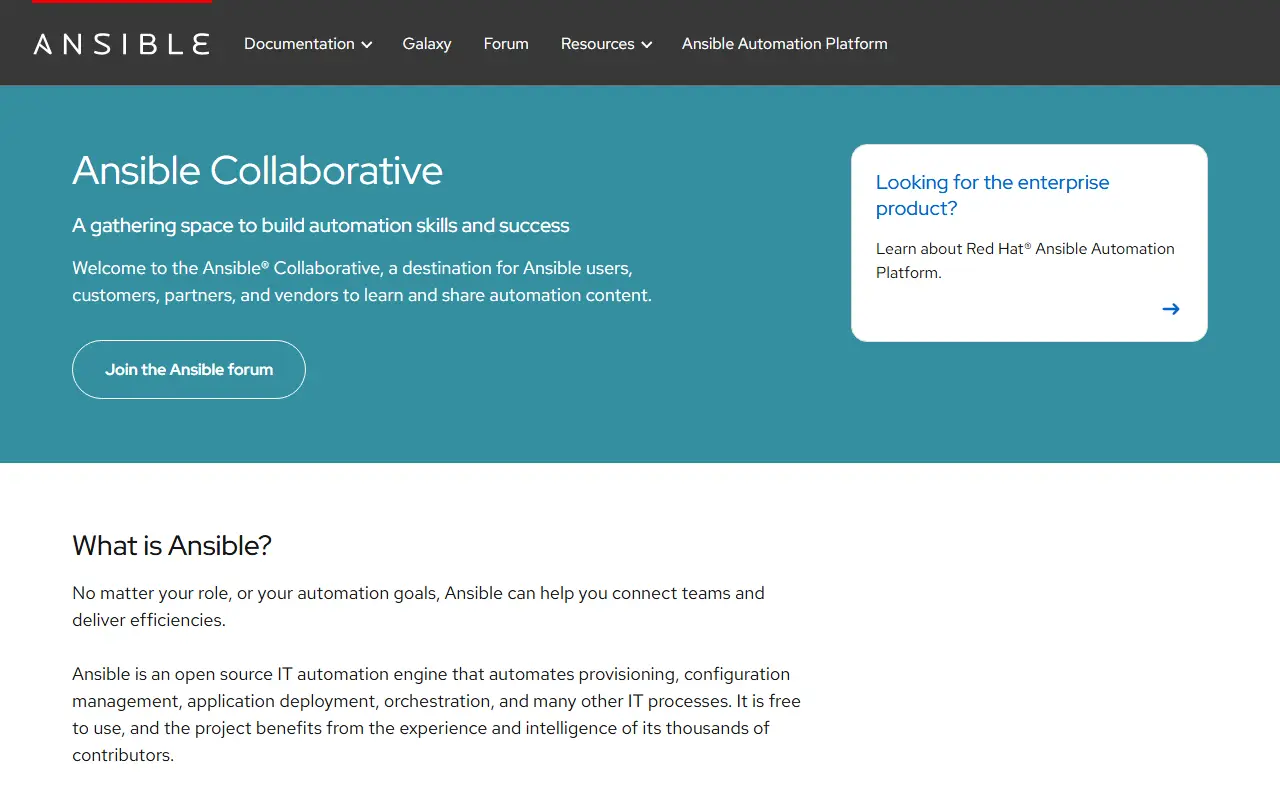
Ansible is an open-source IT automation system written in Python and released under the GPL-3.0 license. It covers configuration management and application deployment, provisioning of cloud resources, one-off ad-hoc commands, network automation and orchestration across many nodes, and it can carry out complex changes such as zero-downtime rolling updates with load balancers.
Its design principles favor a simple setup with a gentle learning curve, managing machines quickly and in parallel, and avoiding custom agents and extra open ports by relying on the existing SSH daemon. Infrastructure is described in a language that is readable by both people and machines, with a focus on security and easy auditing and review. New remote machines can be managed immediately without bootstrapping software, and modules can be written in any dynamic language.
Released versions install with pip or a package manager, while power users can run the development branch for the latest features at the risk of breaking changes. Ansible can be used without root access. It suits system administrators, DevOps and network engineers who want repeatable, version-controlled automation without agents on their servers.
Key features
- Agentless automation over SSH
- Configuration management and application deployment
- Cloud provisioning and network automation
- Parallel management of many machines
- Zero-downtime rolling updates
- Modules in any dynamic language
- Human-readable infrastructure descriptions
Pricing: Free and open source under the GPL-3.0 license.
#2
Pulumi is an infrastructure as code platform that lets teams define cloud infrastructure in Node.js, Python, Go, .NET, Java or YAML.
- GitHub stars
- 26k
- Last commit
- yesterday
- Latest release
- v3.275.0
- Licence
- Apache-2.0
- Self-hosted
- Yes
- Hosted version
- Available
pulumi.com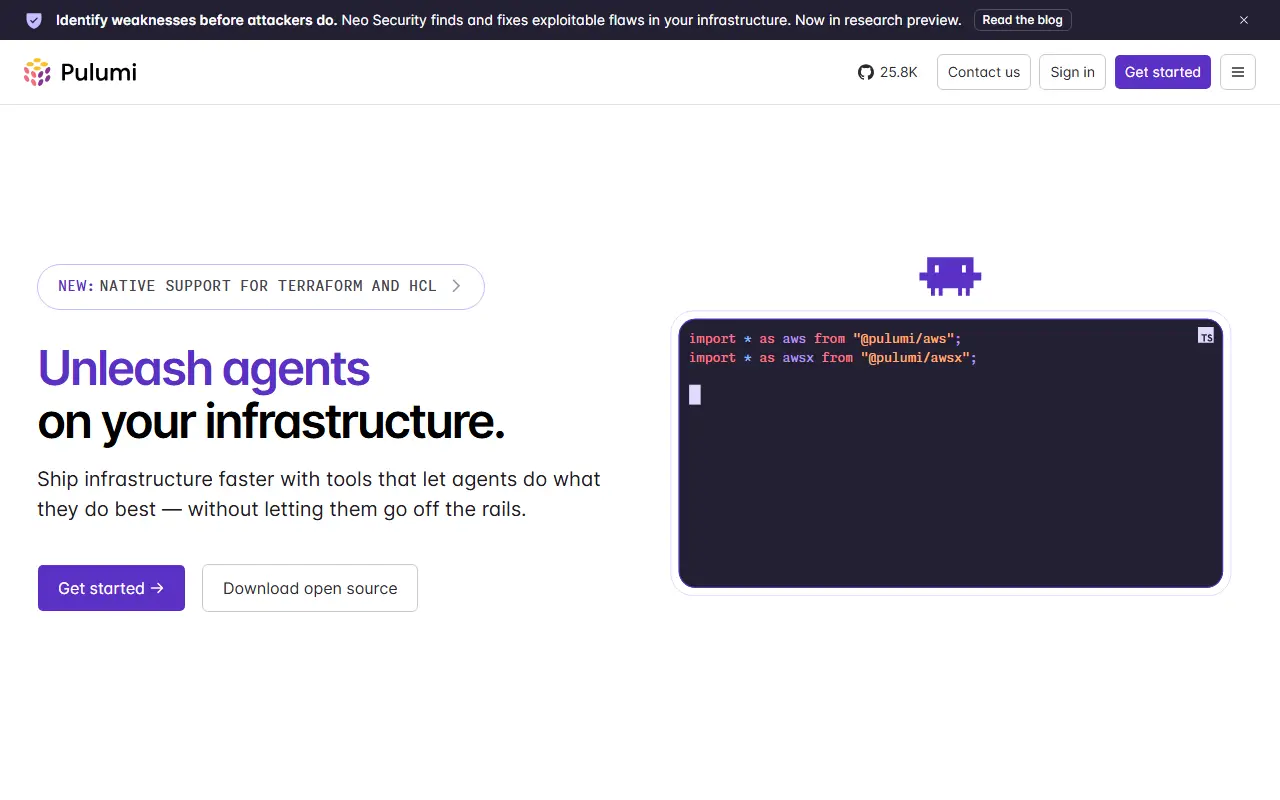
Pulumi is an infrastructure as code platform. Teams describe infrastructure for any cloud in a general-purpose language: Node.js, Python, Go, .NET, Java, or YAML. A registry lists hundreds of cloud providers and packages.
Around the core tool sit services for secrets and configuration, discovery and governance, an internal developer platform, and an AI agent named Neo. The Free plan covers one user with state management and Pulumi Deployments; Essentials, Pro and Enterprise add users, policy, SSO, audit logs and more.
The licence listed for the project is Apache-2.0. The pricing page says Pulumi stays free for open source and individuals, and the Enterprise plan lists self-hosting as available.
Key features
- Infrastructure as code in several languages
- AI infrastructure agent called Neo
- Environments, secrets and configuration management
- Asset management and compliance remediation
- Registry of cloud providers and packages
- Unlimited projects, stacks and environments on Free
- SSO, RBAC and policy enforcement on Pro
Pricing: Free is $0 for 1 user. Essentials is $40/month (up to 500 managed resources), Pro $400/month (up to 2,000), Enterprise $2,000/month (up to 4,750). Credits: 40, 400 and 2,000.
#3
Nix is a purely functional package manager that builds packages in isolation for reproducibility and reliability.
- GitHub stars
- 18k
- Last commit
- yesterday
- Licence
- LGPL-2.1
nixos.org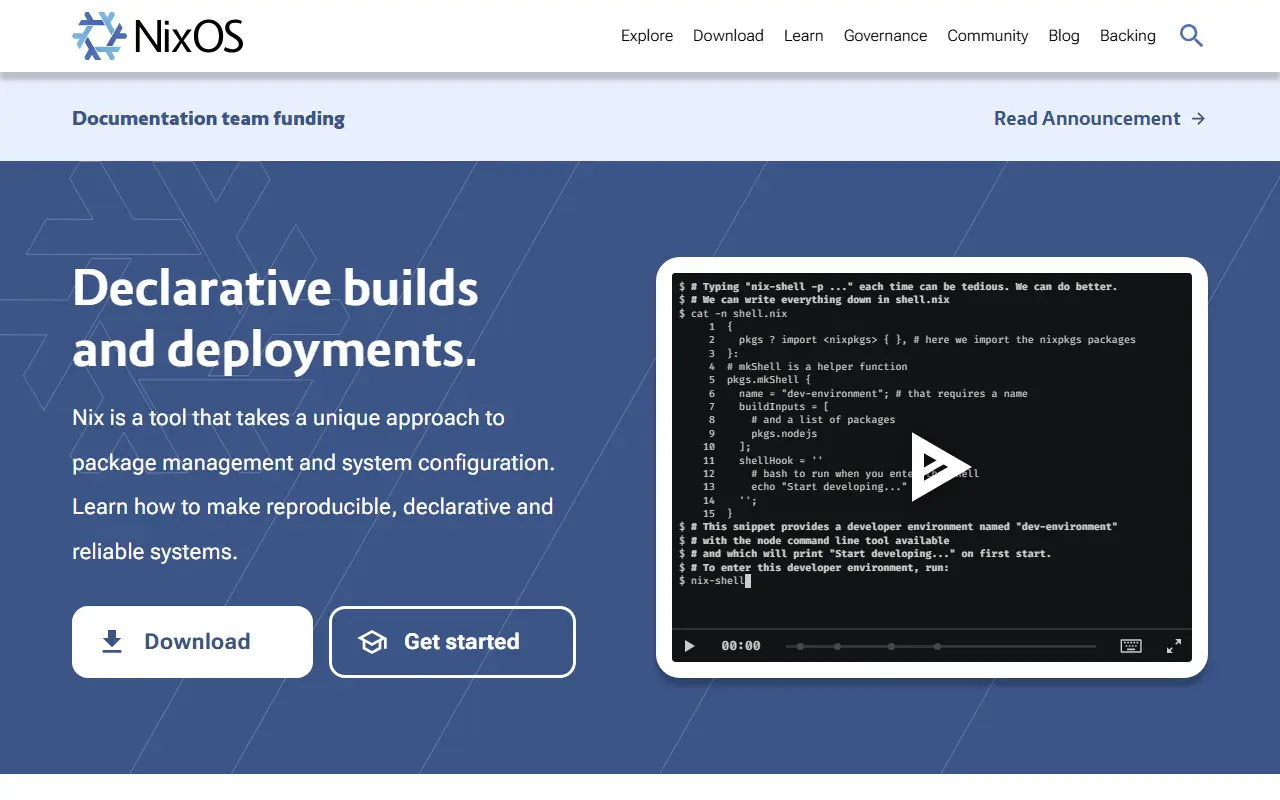
Nix is a purely functional package manager that takes a unique approach to package management and system configuration. It builds packages in isolation from each other, ensuring they are reproducible and don't have undeclared dependencies. This means if a package works on one machine, it will also work on another.
Nix makes it trivial to share development and build environments for projects regardless of programming languages and tools. It ensures that installing or upgrading one package cannot break other packages, allows rollback to previous versions, and ensures no package is in an inconsistent state during an upgrade.
Key features
- Builds packages in isolation from each other
- Ensures reproducibility and no undeclared dependencies
- Makes sharing development and build environments trivial
- Allows rollback to previous versions
- Ensures no package is in an inconsistent state during an upgrade
- Offers over 140,000 packages in the Nix Packages collection (Nixpkgs)

Crossplane is an open source CNCF project built on Kubernetes to orchestrate applications and infrastructure through custom declarative APIs.
- GitHub stars
- 12k
- Last commit
- yesterday
- Latest release
- v2.4.3
- Licence
- Apache-2.0
- Self-hosted
- Yes
crossplane.io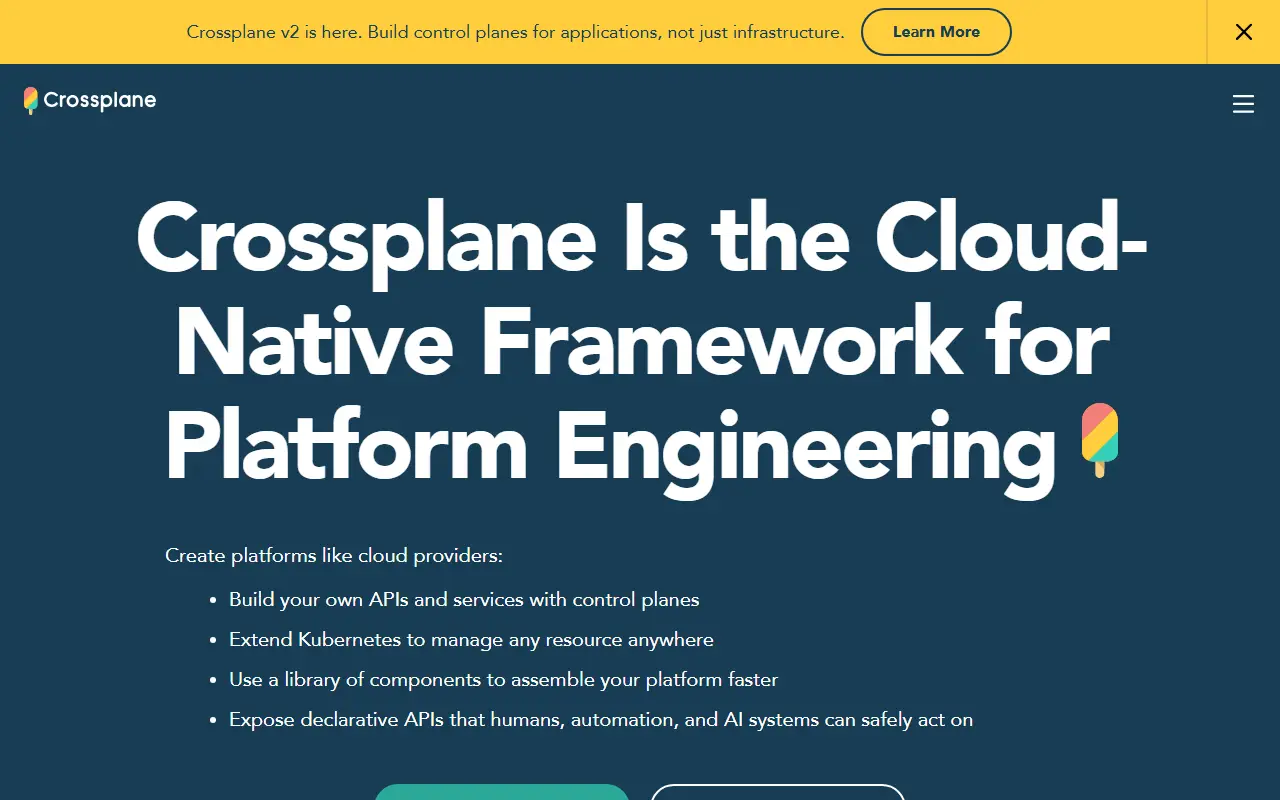
Crossplane is a cloud-native framework for platform engineering that enables organizations to build control planes similar to those used by cloud providers. It extends Kubernetes to manage any resource anywhere and provides a library of components for assembling platforms. The framework allows users to expose declarative APIs that humans, automation, and AI systems can safely act on.
Built on the Kubernetes control plane, Crossplane is designed for extensibility through Providers that orchestrate new kinds of applications and infrastructure, and Configurations that expose new APIs. It puts users in control by allowing them to build platforms around their own opinions using declarative APIs that are explicit, auditable, and machine-readable. The project is maintained by Upbound and is part of the CNCF.
Key features
- Build custom APIs and services with control planes
- Extend Kubernetes to manage any resource anywhere
- Use a library of components to assemble platforms faster
- Expose declarative APIs for humans, automation, and AI systems
- Encapsulate policies, permissions, and guardrails behind a custom API layer
- Extensible through Providers and Configurations

Salt automates infrastructure management and configuration at scale, with remote execution, event-driven automation and cloud provisioning.
- GitHub stars
- 16k
- Last commit
- yesterday
- Latest release
- v3007.17
- Licence
- Apache-2.0
- Self-hosted
- Yes
docs.saltproject.io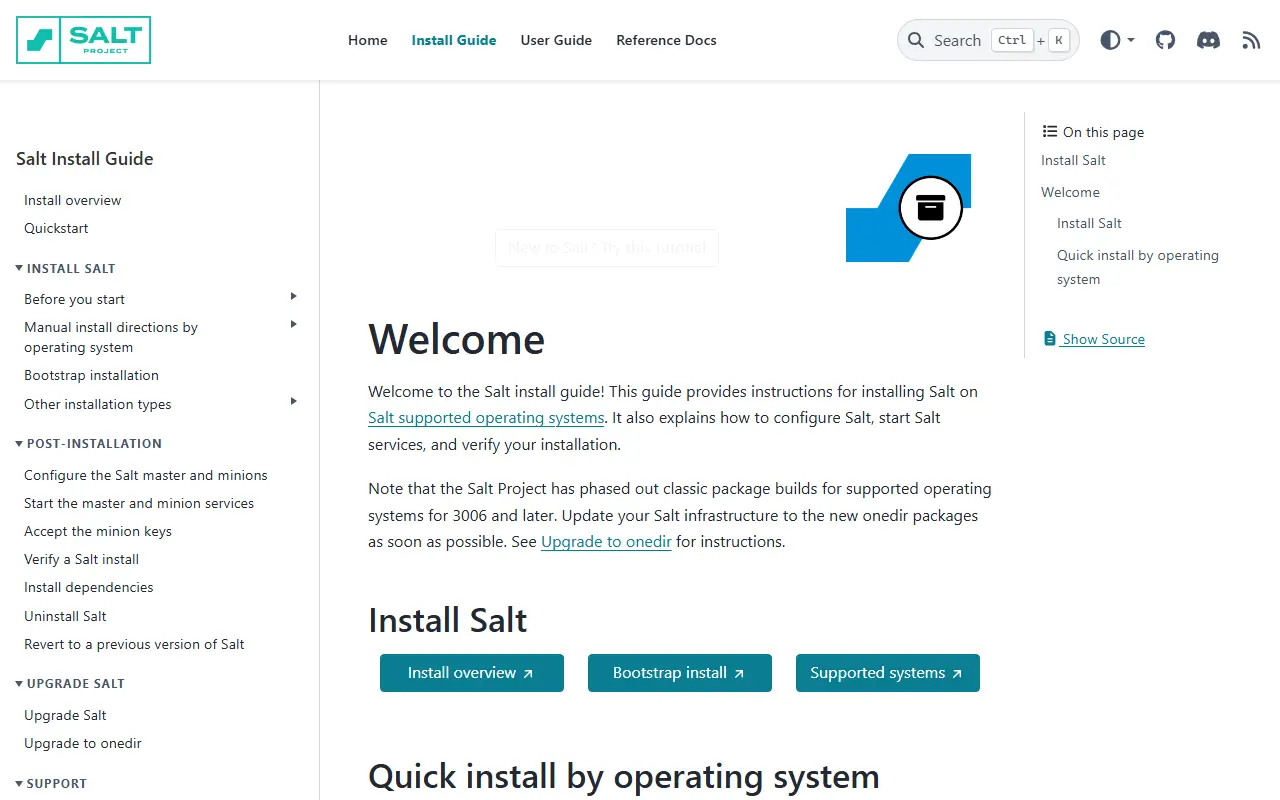
Salt is software for automating the management and configuration of infrastructure and applications at scale. It is written in Python and released under the Apache 2.0 license, and it is used for configuration management, remote execution and infrastructure-as-code across servers, cloud resources and edge or IoT devices.
Salt uses a master and minion model: a Salt master controls agents, called minions, whose keys the administrator accepts. Repository topics point to ZeroMQ messaging, an event stream and event management, along with cloud provider and cloud provisioning support. The install guide covers a quickstart script, bootstrap installation, manual installation by operating system, upgrades and a version support lifecycle.
The install documentation lists supported operating systems and Python versions, and describes a onedir packaging format. Salt is typically self-run on your own infrastructure, with the master and minion services configured and started by the operator, and community support through GitHub and Discord.
Key features
- Configuration management for servers
- Remote execution across many machines
- Event stream and event-driven automation
- Cloud provider provisioning support
- Master and minion architecture
- Quickstart and bootstrap install scripts
Pricing: Free and open source under the Apache 2.0 license.
#6
Chef Infra is a configuration management tool that automates how infrastructure is configured, deployed and managed, using code written in Ruby.
- GitHub stars
- 8.3k
- Last commit
- today
- Latest release
- v15.8.23
- Licence
- Apache-2.0
- Self-hosted
- Yes
chef.io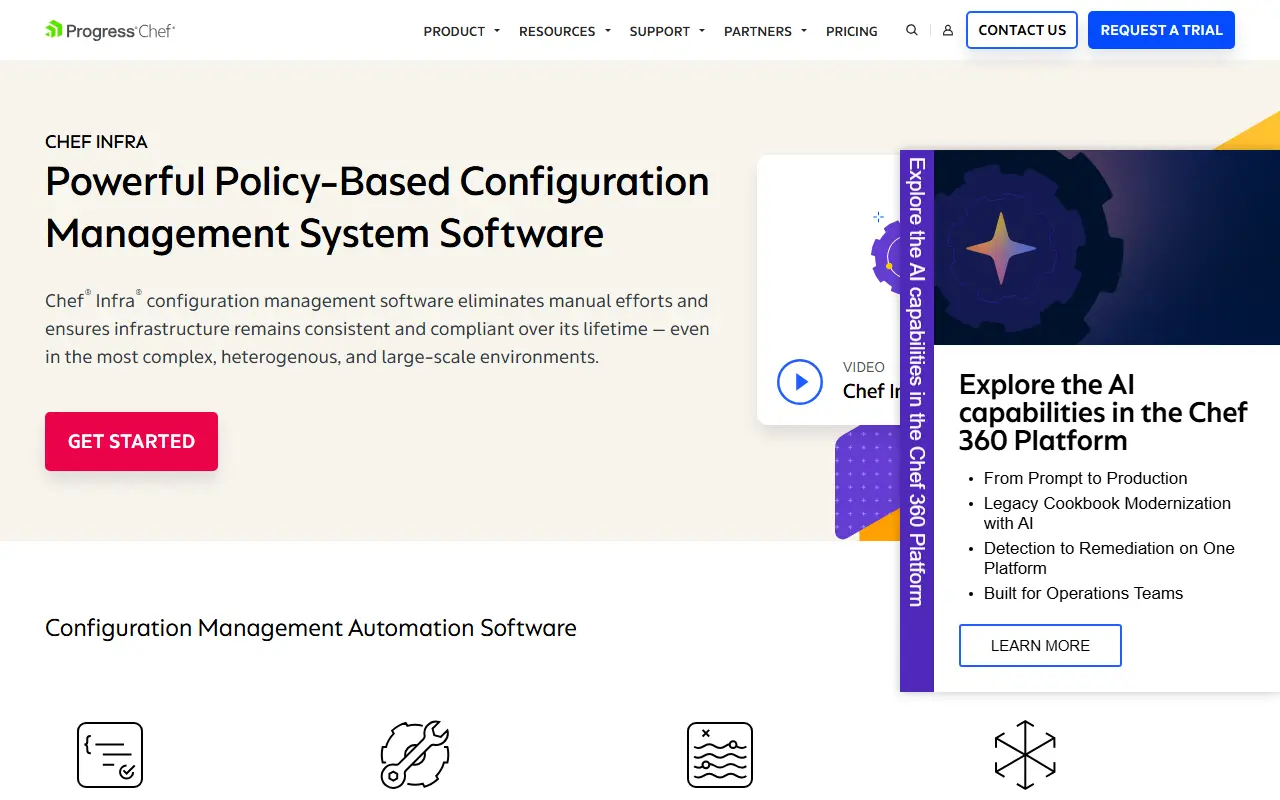
Chef Infra is a configuration management tool that brings automation to an organization's infrastructure by describing it as code. Servers, containers and cloud resources are configured and kept in the desired state through repeatable recipes, across any environment and at any scale.
The Chef ecosystem includes related products such as Chef Automate, Chef Habitat and Chef InSpec, and the project provides Learn Chef, a free self-paced learning platform with module-based training. The repository mainly serves the chef-client itself, so issues for other Chef projects belong in their own repositories. The project publishes monthly feature releases and yearly major releases with a documented support schedule, and states response-time targets for issues and pull requests.
Chef Infra is written in Ruby and licensed under Apache-2.0, with documentation, a community Slack and a mailing list. It is run by operations teams on their own servers, often together with a central Chef server, and suits sysadmins and DevOps engineers managing fleets of machines through infrastructure as code.
Key features
- Infrastructure defined as code in Ruby
- Configuration management for any environment
- Free Learn Chef training platform
- Related Automate, Habitat and InSpec tools
- Monthly feature releases
- Community Slack and forums
Pricing: Priced per node: Business is $59 and Enterprise $189 per node per year; Enterprise Plus is quoted. Available as SaaS or self-managed, and a Business trial can be requested.
#7
StackStorm is an event-driven automation platform for DevOps and SRE teams, covering auto-remediation, incident response, deployments and ChatOps.
- GitHub stars
- 6.6k
- Last commit
- 14 days ago
- Latest release
- v3.9.0
- Licence
- Apache-2.0
- Self-hosted
- Yes
stackstorm.com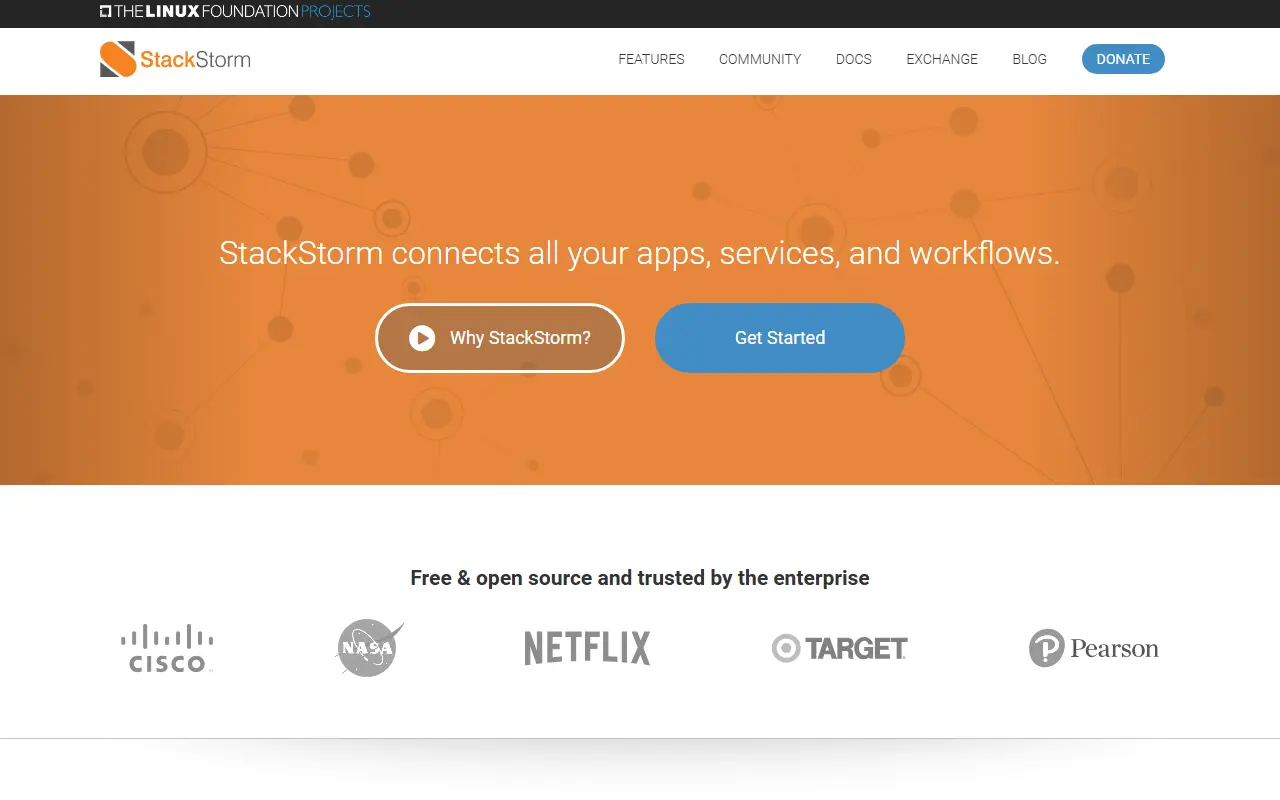
StackStorm is an open-source platform that connects the tools in your infrastructure and runs automated actions when events occur. Nicknamed 'IFTTT for Ops', it targets DevOps and site reliability teams who want to automate remediation, incident response, troubleshooting and deployments instead of handling every alert by hand.
It combines a rules engine that matches incoming events, workflows that chain several actions together, and ChatOps so operators can trigger and follow automation from chat. A catalog of integration packs, about 160 according to the project description, supplies more than 6,000 ready-made actions for common tools, and you can add your own. The project provides an installer script for a clean 64-bit Linux server.
StackStorm is Apache-2.0 licensed software that you run on your own Linux hosts. It suits operations teams building event-driven runbooks who prefer to self-host, and community help is available through a forum and a Slack group.
Key features
- Event-driven rules engine
- Multi-step workflows across tools
- Triggering automation from chat via ChatOps
- Integration packs with thousands of actions
- Auto-remediation and incident response runbooks
- Custom actions written in Python or shell
Pricing: Free and open source under the Apache-2.0 license.
#8
A lifecycle management tool for physical and virtual servers that covers provisioning, configuration management and monitoring.
- GitHub stars
- 3k
- Last commit
- yesterday
- Licence
- GPL-3.0
theforeman.org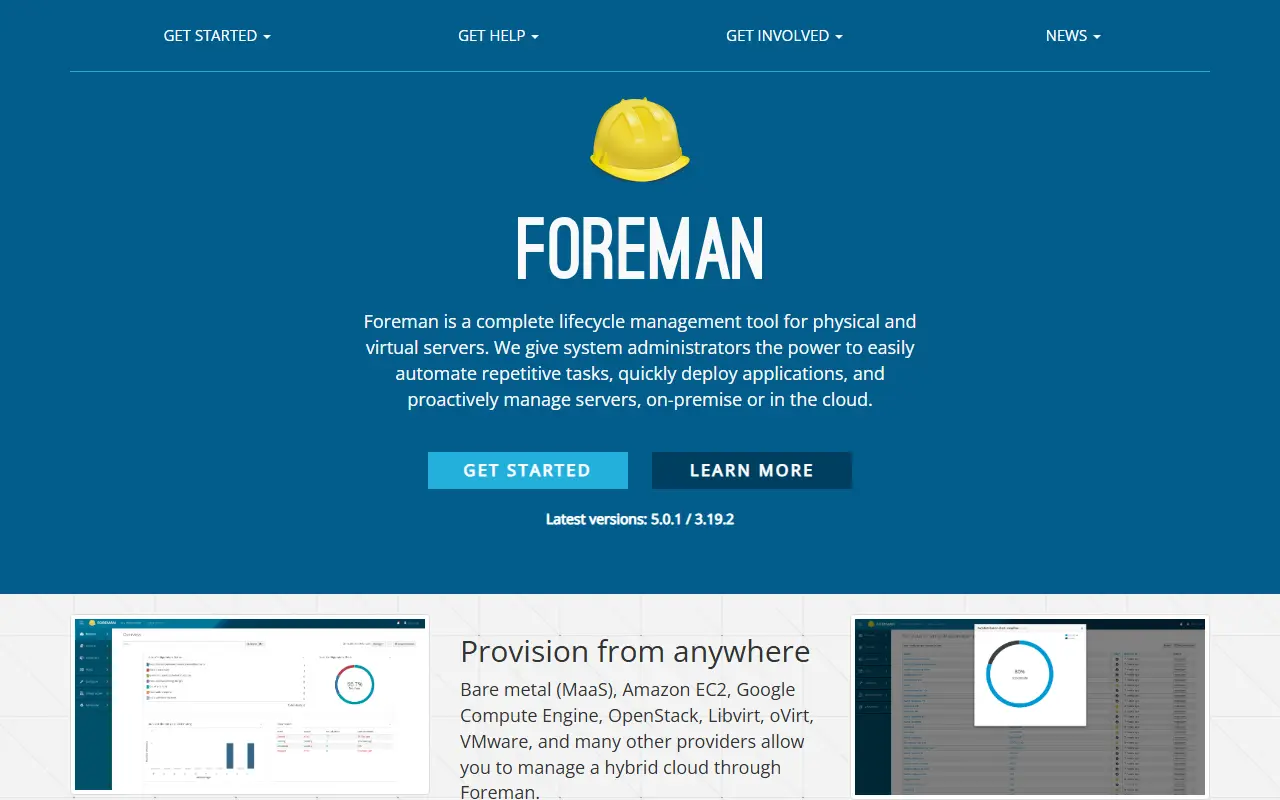
Foreman is a lifecycle management tool for physical and virtual servers, aimed at system administrators who want to automate repetitive tasks, deploy applications and manage servers on-premise or in the cloud. The site lists 5.0.1 and 3.19.2 as the latest versions.
Provisioning covers bare metal (MaaS), Amazon EC2, Google Compute Engine, OpenStack, Libvirt, oVirt, VMware and other providers. For configuration it includes an external node classifier, hiera-like parameters and report monitoring for Puppet and Salt, and it collects Puppet, Salt and Ansible reports and facts to show host status.
Automation is available through a RESTful API and the Hammer CLI. Access control uses role based access control with LDAP or FreeIPA integration, an audit system records how, who and when, host groups let you change configuration for many hosts at once, and a pluggable architecture lets the tool be extended with plugins.
Key features
- Provisioning across bare metal and many clouds
- External node classifier for Puppet and Salt
- Puppet, Salt and Ansible reports and facts
- Hammer CLI for API calls
- RESTful API for automating tasks
- Audit trail of changes
- Host groups for shared configuration

Uyuni is a configuration and infrastructure management tool for managing and updating tens to thousands of machines.
- GitHub stars
- 601
- Last commit
- yesterday
- Licence
- GPL-2.0
- Self-hosted
- Yes
uyuni-project.org
Uyuni is a configuration and infrastructure management tool that automates patch and package management, deployment of hardened OS templates, and compliance auditing. It leverages the Salt configuration management system to manage clients, with the Uyuni Server acting as a full Salt Master node.
The tool is designed for managing any Linux server, from IoT edge devices to Kubernetes environments, across data centers, third-party data centers, or public cloud. It provides graphical visualization of systems, logical grouping via tags, and detailed compliance reporting to track hardware and software changes.
Key features
- Automated patch and package management via software channels and repositories
- Onboarding and management of any Linux server, including IoT edge devices and Kubernetes environments
- Automated deployment of hardened OS templates (bare metal, VM, or container) to tens of thousands of servers and IoT devices
- Detailed compliance auditing and reporting with tracking of hardware and software changes
- Graphical visualization of Linux systems and their relationships, with logical grouping based on tags

Rudder is an open-source platform for automating security configuration, patching and compliance checks across Linux and Windows systems.
- GitHub stars
- 724
- Last commit
- 3 days ago
- Latest release
- 9.1.4
- Licence
- GPL-3.0
rudder.io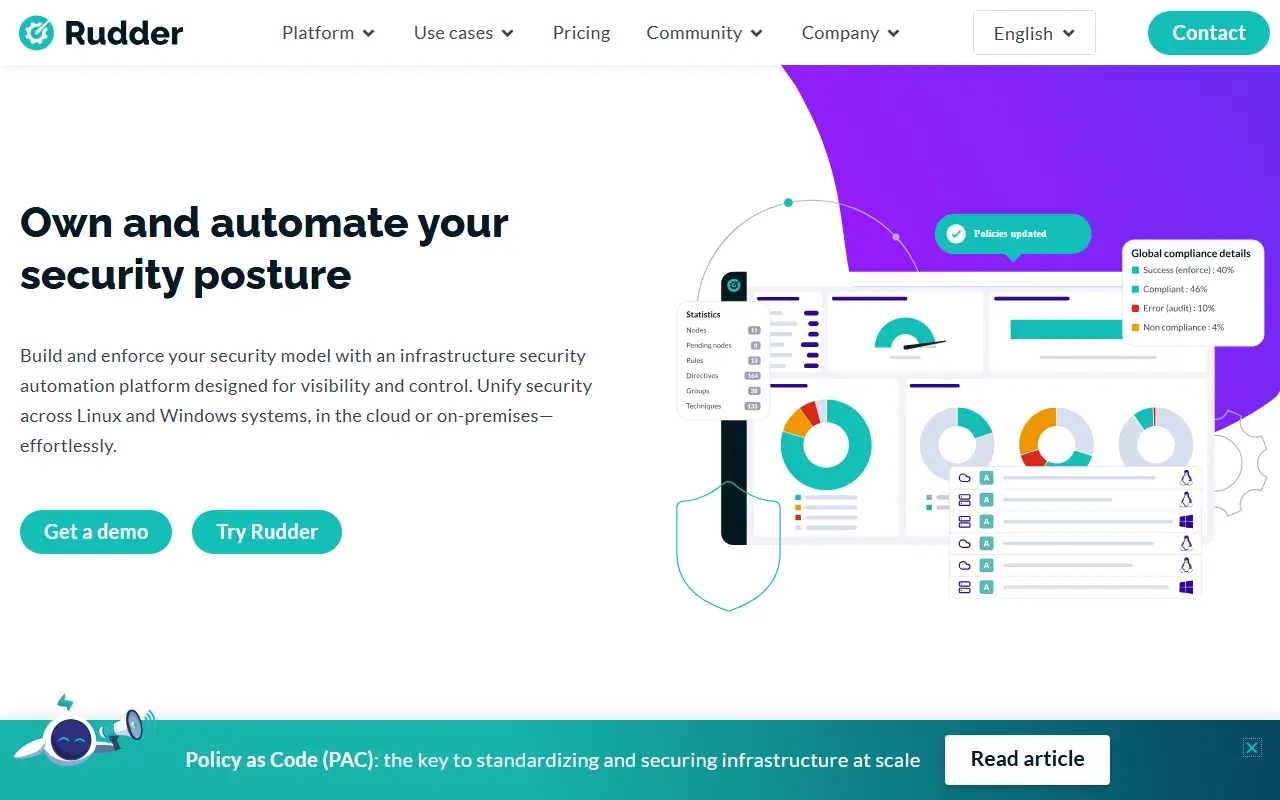
Rudder is a platform for managing the security posture of IT infrastructure. It centralises configuration rules so they are pushed out to machines, then monitored and enforced, which is how one customer quote on the homepage describes using it.
The product is grouped around three areas: security configuration management, patch and vulnerability management, and policy and benchmark compliance. For compliance it names internal policies and industry benchmarks such as CIS, NIST and ISO 27001.
It covers Linux and Windows systems, in the cloud or on premises. The code is published on GitHub under GPL-3.0, and the site also offers a free trial, a Pro edition and an online demo of the enterprise version.
Key features
- Security configuration management across all systems
- Patch and vulnerability management
- Compliance against internal policies and benchmarks
- Covers Linux and Windows, cloud or on-premises
- Centralised rule deployment, monitoring and enforcement
1 more Puppet Enterprise alternative
Puppet Enterprise alternatives: questions
- What is the best open-source alternative to Puppet Enterprise?
- Ansible is the top-ranked open-source alternative to Puppet Enterprise on Enlisted: An agentless IT automation platform for configuration management, application deployment, cloud provisioning and network automation over SSH. Other strong options are Pulumi, Nix, Crossplane and Salt Project.
- What are the best commercial alternatives to Puppet Enterprise?
- Red Hat Ansible Automation Platform, HCP Terraform, AWS AppConfig, Laravel Forge and Mosyle are among the hosted, closed-source alternatives to Puppet Enterprise listed on Enlisted, which lists 20 in total. Compare their pricing and features on each tool page.
- Are these Puppet Enterprise alternatives free?
- All 11 are open source, so the code is free to use under its licence, and all of them can be self-hosted on your own server or computer. 1 also offers a paid or managed cloud version if you'd rather not host it yourself.
- How is this list of Puppet Enterprise alternatives ranked?
- By a score built from GitHub stars, star growth over the last 30 days and how recently the code changed. 11 of these projects shipped code in the last 30 days. Data is refreshed daily, and nobody can pay to move up.
 TrackMedia
 TrackRev