 TrackMedia
 TrackRev
 Qlik
 Starburst
 Matillion
About Microsoft Fabric
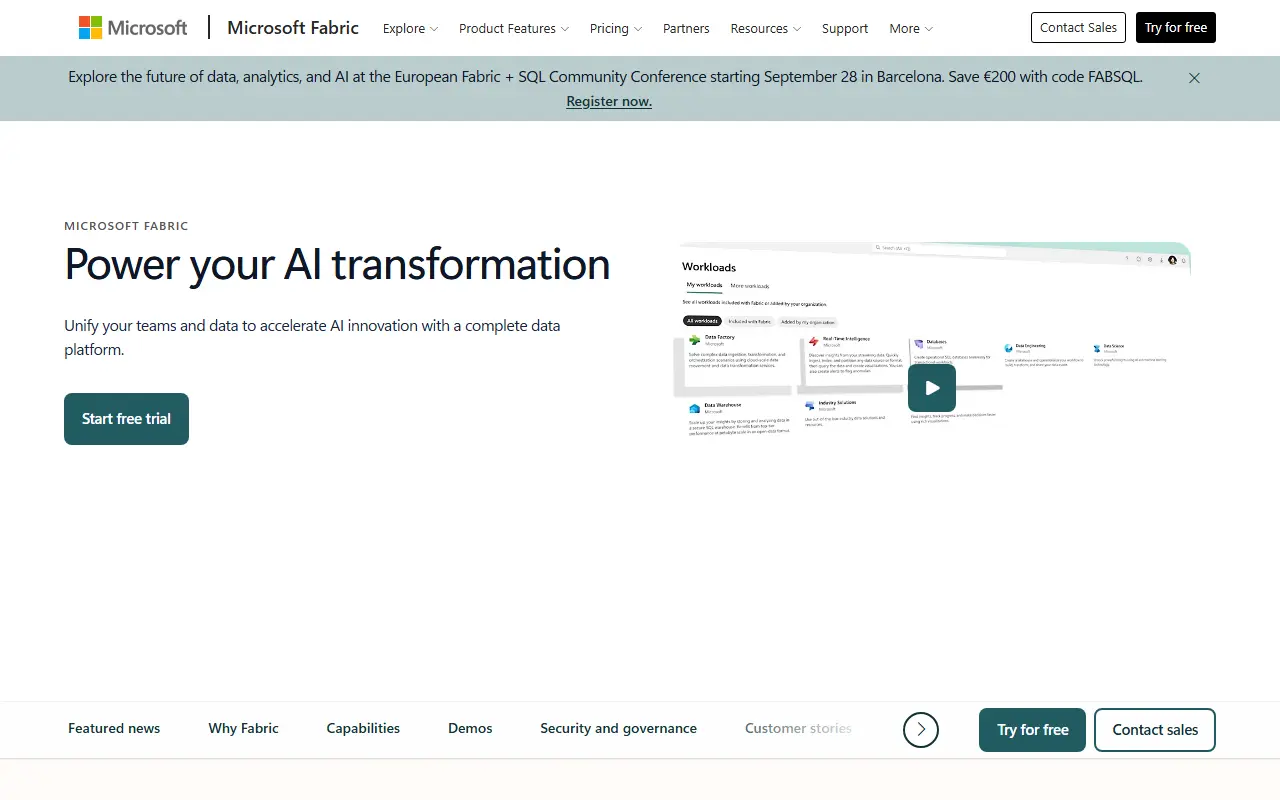
Microsoft Fabric is an analytics platform from Microsoft that brings several data and analytics services into one software-as-a-service product. Microsoft describes it as an AI-powered platform that unites data and services, from data lakes to data science, so teams can work on shared data rather than juggling separate tools.
The platform is organized into workloads: Fabric Data Factory for integration and pipelines, Data Engineering, Data Warehouse, Real-Time Intelligence, Data Science, Databases and Power BI for reporting. Microsoft OneLake provides a common storage layer underneath, and security and governance features apply across the workloads. A newer Fabric IQ offering and a managed application backend are also listed.
Fabric is proprietary and delivered as a managed cloud service from Microsoft, with no self-hosted edition. A free trial is offered, a pricing overview is published on the vendor site, and organizations can contact sales for larger deployments.
Key features
- Data Factory pipelines for data integration
- Data engineering and data warehouse workloads
- Real-Time Intelligence for streaming data
- Power BI reporting and dashboards
- OneLake shared storage layer
- Security and governance across workloads
Good fit for
- Consolidating analytics tools on one platform
- Building a lakehouse with Power BI reporting
- Migrating from separate Azure analytics services
Microsoft Fabric: questions and answers
- What is Microsoft Fabric used for?
- Microsoft Fabric is Microsoft's unified analytics platform combining data engineering, data warehousing, real-time analytics, data science and Power BI in one SaaS service. It is a good fit for consolidating analytics tools on one platform, building a lakehouse with Power BI reporting and migrating from separate Azure analytics services.
- How much does Microsoft Fabric cost?
- Microsoft Fabric is a paid product with no free plan.
- Is Microsoft Fabric open source?
- No. Microsoft Fabric is proprietary (closed-source) software and can't be self-hosted. Open-source alternatives to Microsoft Fabric include Airflow, Apache Spark and Dremio OSS.
- What are some alternatives to Microsoft Fabric?
- Microsoft Fabric competes with Databricks, Snowflake and Google BigQuery. For open-source options, see Enlisted's ranked list of open-source Microsoft Fabric alternatives.
Open-source alternatives to Microsoft Fabric
See all
Airflow
Data Pipelines & ETL
Apache Airflow - A platform to programmatically author, schedule, and monitor workflows
Apache-2.0vs Astronomer★ 47k
Apache Spark
Data Pipelines & ETL
Apache Spark - A unified analytics engine for large-scale data processing
Apache-2.0vs Databricks★ 44k
Dremio OSS
Data Pipelines & ETL
Dremio - the missing link in modern data
Apache-2.0vs Snowflake★ 1.5k
dbt
Data Pipelines & ETL
dbt enables data analysts and engineers to transform their data using the same practices t
Apache-2.0vs Matillion★ 14k
Kafka
Data Pipelines & ETL
Apache Kafka - A distributed event streaming platform
Apache-2.0vs Striim★ 34k
Apache Hive
Databases
Apache Hive
Apache-2.0vs Snowflake★ 6k
SaaS alternatives to Microsoft Fabric
See all
Databricks
Data Pipelines & ETL
Lakehouse platform for data engineering, analytics and machine learning
SaaS
Snowflake
Databases
Cloud data platform for warehousing, data sharing and analytics
SaaS
Google BigQuery
Databases
Serverless data warehouse for SQL analytics on large datasets
SaaS
Amazon Redshift
Databases
Managed cloud data warehouse on AWS for SQL analytics at scale
SaaS
Tableau
BI & Dashboards
Tableau is a business intelligence and data visualization tool for exploring data and building interactive dashboards.
SaaS
Looker
BI & Dashboards
Google Cloud business intelligence platform with a governed semantic modeling layer
SaaS