#1
An open-source column-oriented database management system built for real-time analytical reports, available to self-host or as the managed ClickHouse Cloud service.
- GitHub stars
- 51k
- Last commit
- today
- Latest release
- v26.10.2.103-stable
- Licence
- Apache-2.0
- Self-hosted
- Yes
- Hosted version
- Available
clickhouse.com
ClickHouse is an open-source database management system built to generate analytical reports in real time. Its column-oriented storage makes scans and aggregations over very large tables efficient, which is why it is widely used for event data, logs, metrics and product analytics. It is written in C++ and queried with SQL.
The project's topics describe it as an OLAP, massively parallel and distributed system, and it is used for big data workloads where query latency matters. You can install it on Linux, macOS or FreeBSD, follow a tutorial that sets up a small cluster, or skip installation by trying ClickHouse Cloud, a managed service built by its creators. Releases arrive monthly, with a community call for each one, and there are Slack and Telegram channels for help.
ClickHouse is Apache-2.0 licensed. It is a good fit for analytics engineers and platform teams who need fast aggregations over billions of rows and are comfortable operating a database, or who prefer to hand that operation to the vendor's cloud.
Key features
- Column-oriented storage for analytics
- SQL queries over large datasets
- Distributed, massively parallel processing
- Real-time analytical reporting
- Install on Linux, macOS or FreeBSD
- Managed ClickHouse Cloud option
Pricing: The open-source distribution is free. ClickHouse Cloud is usage-based, with plans from $53 (Basic), $437 (Scale) and $571 (Enterprise) per month and a 30-day trial with $300 in credits.
#2
An Apache workflow orchestration platform where data teams author, schedule and monitor pipelines as Python code, widely used for data engineering and ELT jobs.
- GitHub stars
- 47k
- Last commit
- today
- Latest release
- 3.4.0
- Licence
- Apache-2.0
- Self-hosted
- Yes
airflow.apache.org
Apache Airflow is a workflow platform where you write, schedule and watch over pipelines in code. Workflows are defined as Python code in the form of directed acyclic graphs, or DAGs, where each task and its dependencies are explicit, so pipelines can be versioned, tested and reviewed like any other software.
A scheduler runs tasks on a defined cadence and workers execute them, while a web interface shows the status of each run, lets you inspect logs and retry failures. Airflow is used heavily in data engineering, including data integration, ELT and ETL pipelines, data orchestration and machine learning workflows, and its topics cover data science and automation. It has a large ecosystem of providers and operators for connecting to databases, cloud services and other systems, and the 3.x line is the current series.
Airflow is an Apache Software Foundation project under the Apache-2.0 license and runs on your own infrastructure, from a single machine to Kubernetes. Several vendors offer managed Airflow services, but the project itself is self-hosted software. It suits data engineers who prefer code-first orchestration over drag-and-drop tools.
Key features
- Workflows defined as Python DAGs
- Scheduler for recurring and dependent tasks
- Web UI for monitoring runs and logs
- Retries and task dependency management
- Large provider ecosystem of integrations
- Runs on single machines or Kubernetes
Pricing: Free and open source under the Apache-2.0 license.
#3
An analytics engine for processing large datasets, with APIs in Scala, Java, Python and R and libraries for SQL, machine learning, graphs and streaming.
- GitHub stars
- 44k
- Last commit
- yesterday
- Licence
- Apache-2.0
- Self-hosted
- Yes
spark.apache.org
Apache Spark is an analytics engine that brings batch, SQL, machine learning, graph and streaming workloads together for processing data at scale. It is maintained by the Apache Software Foundation under the Apache-2.0 license. It is written mainly in Scala and offers high-level APIs in Scala, Java and Python, with an R API that is now deprecated, on top of an engine optimized to execute general computation graphs.
A set of higher-level tools is included: Spark SQL for queries and DataFrames, MLlib for machine learning, GraphX for graphs, Structured Streaming for streams, and a pandas-style API for existing pandas workloads. Together they let teams run batch analytics, machine learning and streaming jobs on a single engine and share code between them.
The README points to the project website for full documentation and programming guides, and it contains only basic setup and build instructions. Spark suits data engineers and data scientists who process datasets too large for a single machine, and organizations that want one framework for ETL, analytics and machine learning on clusters.
Key features
- High-level APIs in Scala, Java and Python
- Optimized engine for computation graphs
- Spark SQL and DataFrames
- MLlib for machine learning
- GraphX for graph analytics
- Structured Streaming for stream processing
- Pandas API on Spark
Pricing: Free and open source under the Apache-2.0 license.
#4
Apache Kafka is an open-source platform for distributed event streaming, used in data pipelines, streaming analytics and data integration.
- GitHub stars
- 34k
- Last commit
- yesterday
- Licence
- Apache-2.0
- Self-hosted
- Yes
kafka.apache.org
Apache Kafka is a platform for distributed event streaming. Teams use it to move and process streams of events for data pipelines, streaming analytics, data integration and business-critical applications. The code lives in the Apache Software Foundation repository, is written mainly in Java with Scala for parts of the broker, and is released under the Apache-2.0 license.
Kafka is installed software that you run yourself. The project builds and tests against recent Java versions, supports Scala 2.13 only, and documents how to build a JAR and start a broker through its quickstart. The repository also contains client and streams modules, along with test tooling for unit and integration runs. Because Kafka is operated as infrastructure, adopters typically run clusters on their own servers or on Kubernetes, though managed services from other vendors exist.
Key features
- Distributed event streaming platform
- Durable publish and subscribe topics
- Client libraries and a streams module
- Suited to data pipelines and integration
- Runs on Java with Scala 2.13
- Quickstart for building and running a broker
Pricing: Free and open source under the Apache-2.0 license.
#5
Apache Flink is a framework and distributed processing engine for stateful computations over unbounded and bounded data streams, designed to run in all common cluster environments.
- GitHub stars
- 26k
- Last commit
- yesterday
- Licence
- Apache-2.0
- Self-hosted
- Yes
flink.apache.org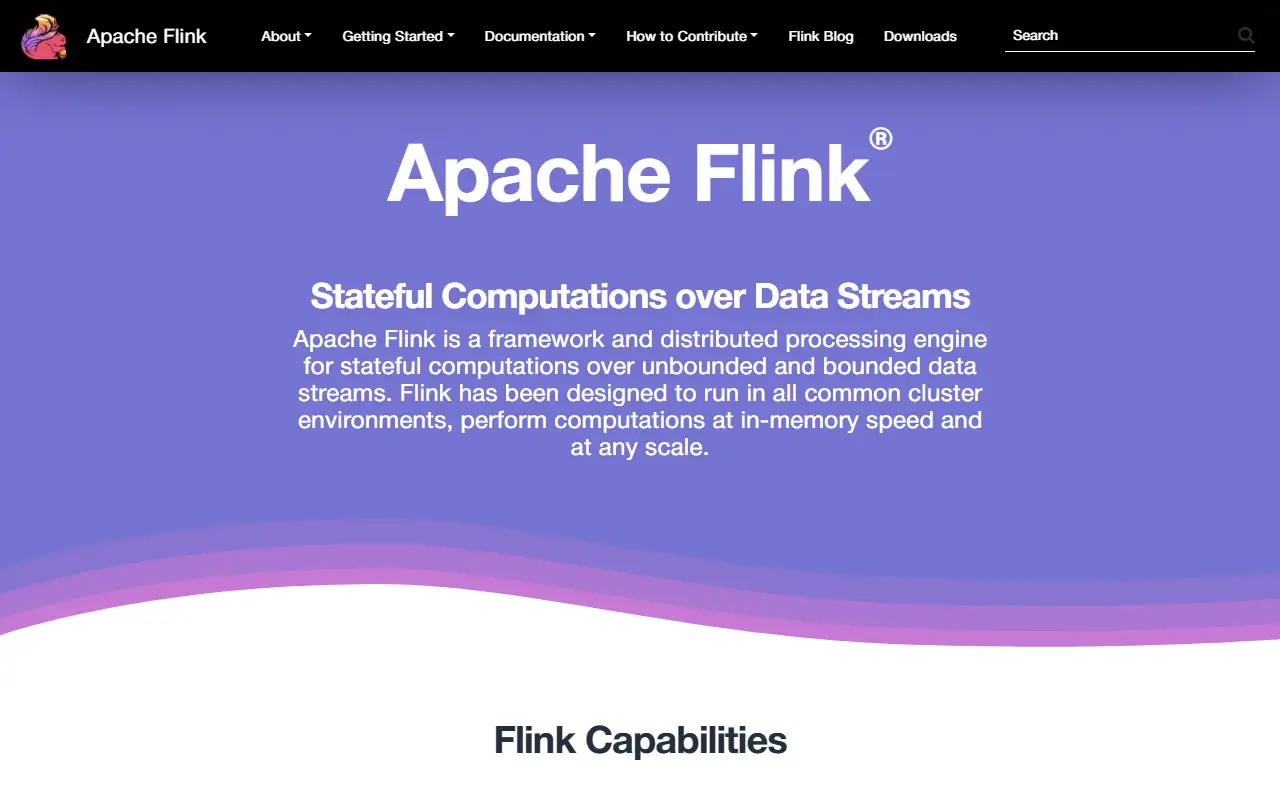
Apache Flink is a framework and distributed processing engine for stateful computations over unbounded and bounded data streams. It has been designed to run in all common cluster environments, perform computations at in-memory speed and at any scale.
Flink provides correctness guarantees including exactly-once state consistency, event-time processing, and sophisticated late data handling. It offers layered APIs such as SQL on stream and batch data, DataStream API, and ProcessFunction for time and state.
Key features
- Exactly-once state consistency
- Event-time processing
- Sophisticated late data handling
- Layered APIs including SQL, DataStream API, and ProcessFunction
- Flexible deployment and high-availability setup
- Scale-out architecture with support for very large state and incremental checkpoints

A distributed SQL query engine for big data analytics that runs fast queries across many data sources, formerly known as PrestoSQL.
- GitHub stars
- 14k
- Last commit
- today
- Latest release
- 484
- Licence
- Apache-2.0
- Self-hosted
- Yes
trino.io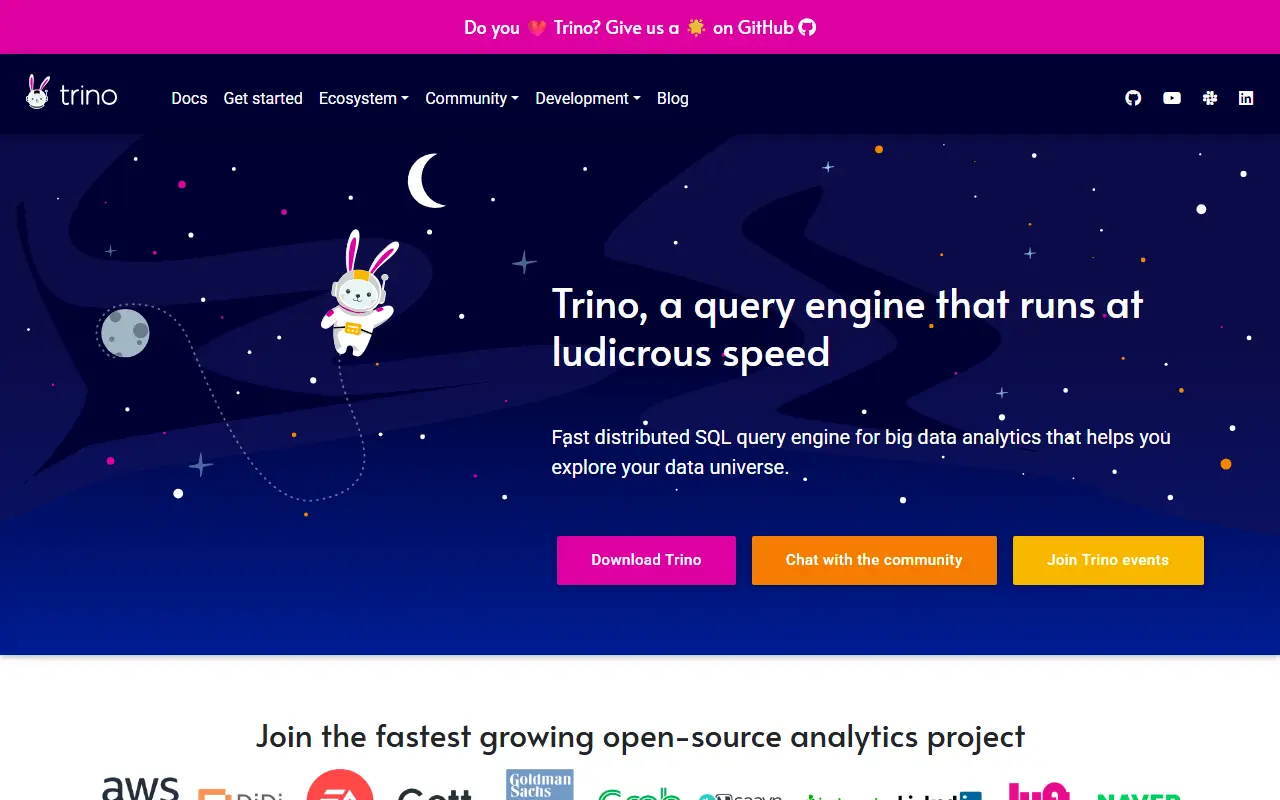
Trino is a distributed SQL query engine built for analytics on large data sets. It was formerly called PrestoSQL, and it lets analysts and engineers run interactive SQL against data wherever it lives rather than first moving it into a single warehouse.
The project's topics point to its role in the data lake ecosystem, with connectors and integrations for systems such as Hive, Hadoop, Iceberg and Delta Lake, and a JDBC driver for applications. Trino is a Maven project written in Java, and its repository covers development guidelines, plugin implementors, a security policy and reproducible builds. It runs as a cluster of servers and has a web UI.
Trino is released under the Apache-2.0 licence and is deployed and operated by the user, with deployment instructions and end-user documentation in the project's user manual. It is a fit for data platform teams that need fast, standards-based SQL over many sources, rather than for individual analysts looking for a point-and-click tool.
Key features
- Distributed SQL query engine
- Fast analytics on big data
- Connectors for data lake formats like Iceberg
- JDBC access for applications
- Plugin architecture for custom connectors
- Reproducible builds since version 449
Pricing: Free and open source under the Apache-2.0 licence.
#7
A data transformation framework that lets analysts and engineers build analytics models with software-engineering practices; v2.0 is a ground-up rewrite in Rust.
- GitHub stars
- 14k
- Last commit
- today
- Latest release
- v1.12.7
- Licence
- Apache-2.0
- Self-hosted
- Yes
- Hosted version
- Available
getdbt.com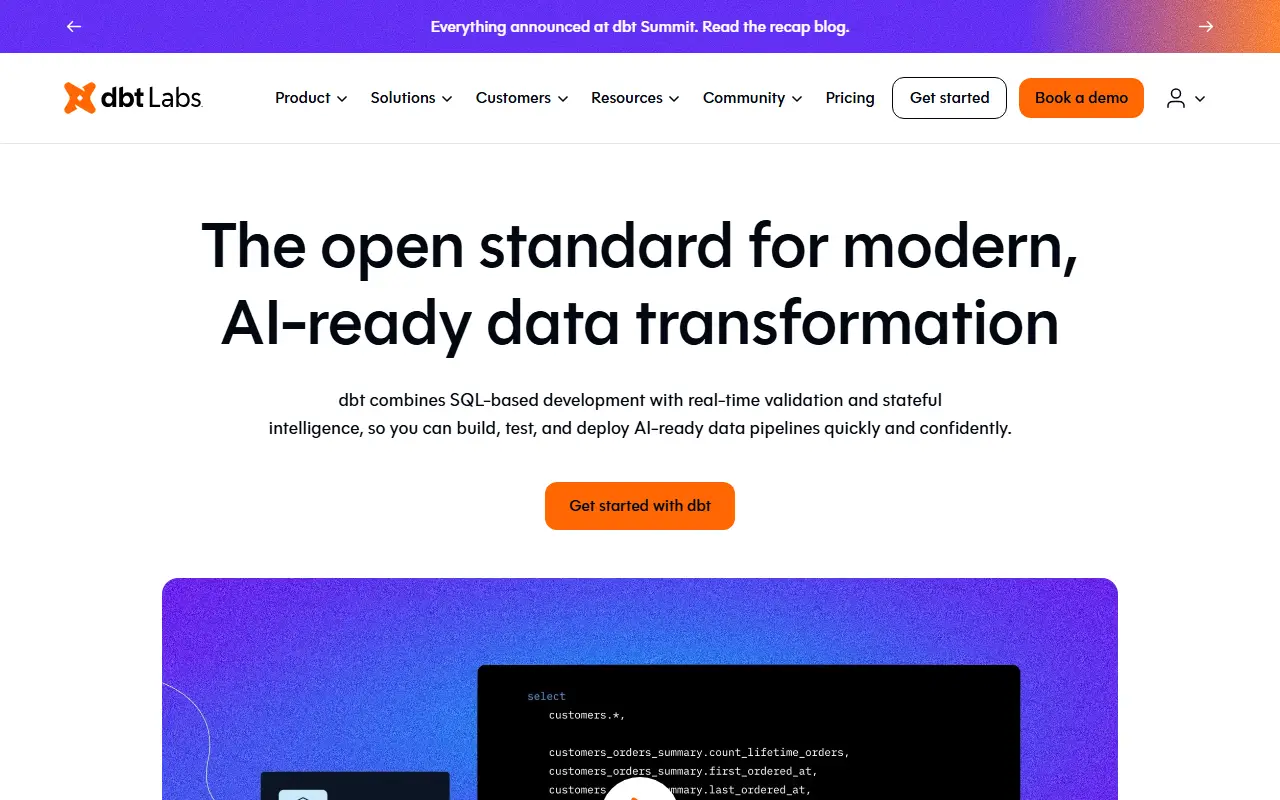
dbt is a framework for transforming data in a warehouse using the same practices that software engineers apply to applications. Analysts and analytics engineers write models, and dbt parses, compiles and runs the project so that transformations are version-controlled and repeatable.
The repository now holds the Apache 2.0 source of dbt v2.0, a ground-up rewrite in Rust. According to its README, v2.0 parses and compiles projects much faster than v1, enforces a stricter language specification at parse time, produces Parquet artifacts alongside the existing JSON ones, and ships as one standalone executable, so no Python installation is needed. The local documentation experience was rebuilt around those artifacts to handle large projects.
The Apache 2.0 code is available to everyone, while the packaged dbt distribution adds dbt-specific customizations under a separate dbt product license. v2.0 supports macOS and Linux on x86-64 and ARM. The v1 Python implementation continues on the 1.latest branch. dbt Labs also offers dbt as a commercial cloud platform.
Key features
- Data transformation using software engineering practices
- Faster parsing and compiling in v2.0
- Strict language specification checks at parse time
- Parquet artifacts for querying project metadata
- Single binary without a Python runtime
- Rebuilt local documentation experience
Pricing: A single-seat Developer plan to start free. Starter costs $100 per user per month; Enterprise and Enterprise+ are custom. A trial is available and add-ons are billed on usage.
#8
Apache Hive is data warehouse software that lets you read, write and manage large datasets in distributed storage using SQL on top of Hadoop.
- GitHub stars
- 6k
- Last commit
- today
- Licence
- Apache-2.0
- Self-hosted
- Yes
hive.apache.org
Apache Hive is data warehouse software built on Apache Hadoop. It makes it possible to read, write and manage very large datasets in distributed storage using SQL, so analysts can run extract-transform-load jobs, reports and data analysis without writing low-level processing code.
Hive provides tools for accessing data through SQL, a way of imposing structure on a variety of data formats, and access to files stored in Apache HDFS or other systems such as Apache HBase. Queries can run on the Apache Tez framework, which is designed for interactive queries and has far lower overhead than MapReduce. It supports much standard SQL functionality, including many analytics features from the 2003 and 2011 SQL standards.
Hive is an Apache Software Foundation project written in Java and licensed under Apache-2.0. You deploy it on your own Hadoop-based clusters, though hosted big data platforms from cloud providers also bundle it. It suits data engineering teams maintaining batch analytics on large distributed data.
Key features
- SQL access to distributed datasets
- Built on Apache Hadoop
- Reads data from HDFS and HBase
- Query execution on Apache Tez
- ETL, reporting and analysis workloads
- Standard SQL analytics functions
Pricing: Free and open source under the Apache-2.0 license.
#9
Dremio OSS is a free, Apache-licensed, open-source data lakehouse platform in Java that provides fast SQL analytics directly on data stored in warehouses and lakes.
- GitHub stars
- 1.5k
- Last commit
- 1 yr ago
- Licence
- Apache-2.0
- Self-hosted
- Yes
dremio.com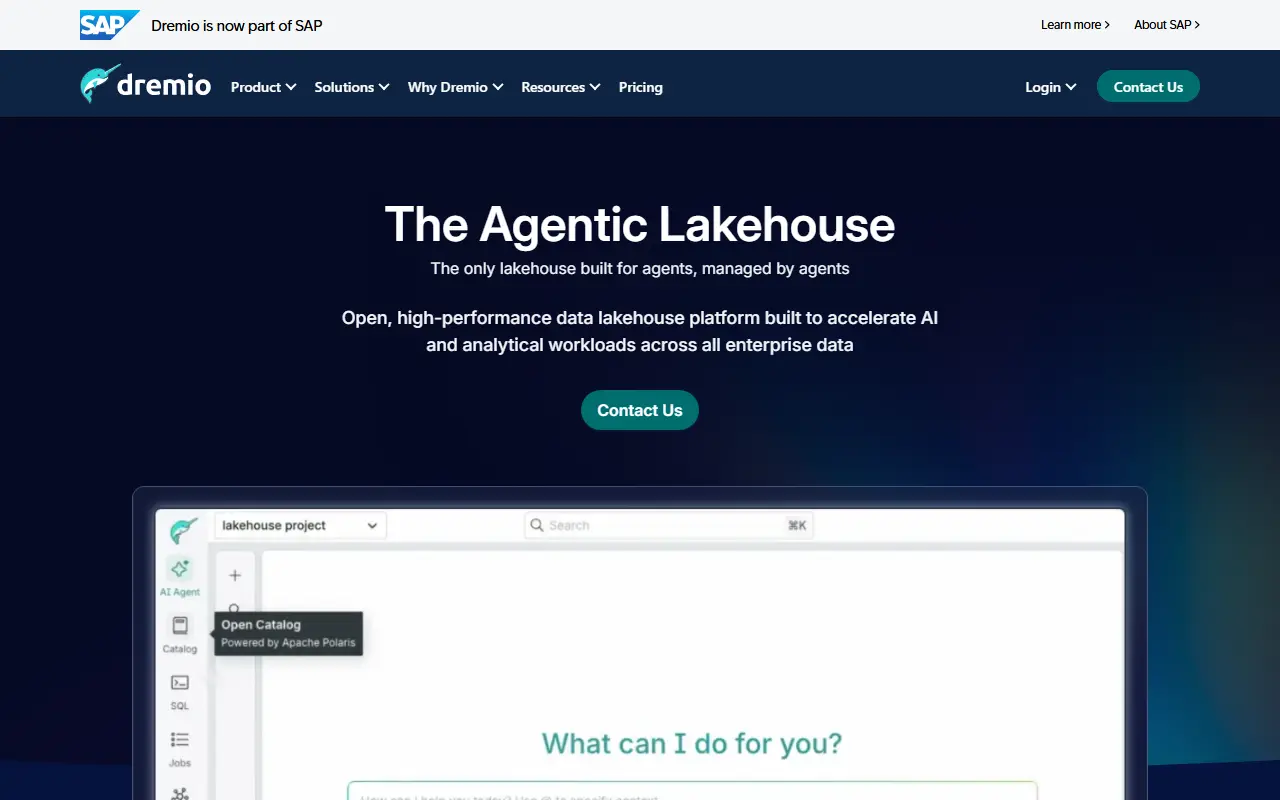
Dremio is a data analytics platform aimed at organizations that want to query and analyze large volumes of data without first moving or copying it into a separate, dedicated analytics database. It positions itself as filling a gap between raw data storage and the tools people need to get value out of that data.
The open-source edition can be built and run locally, exposing a web UI at localhost:9047 once started, or installed as a production tarball for server deployment, with an embedded mode also available. Building it requires a specific combination of JDK versions (21 as default, with 17 and 11 configured in the Maven toolchain for certain tests) plus Maven, reflecting a substantial, enterprise-grade Java codebase.
The README notes that to provide the best possible experience, the build includes some dependencies distributed under non-open-source licenses, so the fully open-source experience may differ slightly depending on build configuration. Dremio is written in Java and the open-source edition is released under the Apache-2.0 license, with full documentation hosted separately.
Key features
- SQL analytics directly on lake and warehouse data
- Web-based query interface
- Local and production deployment modes
- Built on a Java codebase with Maven tooling
- No data duplication required for analytics
Pricing: Dremio Cloud is pay-as-you-go at $0.20 per compute unit, with a 30-day trial that includes $400 in credit. Dremio Enterprise, which can be self-hosted, is priced through sales.
Microsoft Fabric alternatives: questions
- What is the best open-source alternative to Microsoft Fabric?
- ClickHouse is the top-ranked open-source alternative to Microsoft Fabric on Enlisted: An open-source column-oriented database management system built for real-time analytical reports, available to self-host or as the managed ClickHouse Cloud service. Other strong options are Airflow, Apache Spark, Kafka and Flink.
- What are the best commercial alternatives to Microsoft Fabric?
- Cloudera, Azure Synapse Analytics, Vertica, Amazon Redshift and Snowflake are among the hosted, closed-source alternatives to Microsoft Fabric listed on Enlisted, which lists 97 in total. Compare their pricing and features on each tool page.
- Are these Microsoft Fabric alternatives free?
- All 9 are open source, so the code is free to use under its licence, and all of them can be self-hosted on your own server or computer. 2 also offer a paid or managed cloud version if you'd rather not host it yourself.
- How is this list of Microsoft Fabric alternatives ranked?
- By a score built from GitHub stars, star growth over the last 30 days and how recently the code changed. 8 of these projects shipped code in the last 30 days. Data is refreshed daily, and nobody can pay to move up.
 TrackMedia
 TrackRev