#1
An open-source feature flag and remote config platform with segments, A/B testing and SDKs, deployable self-hosted, in a private cloud or as a managed cloud service.
- GitHub stars
- 7.2k
- Last commit
- today
- Latest release
- v2.290.0
- Licence
- BSD-3-Clause
- Self-hosted
- Yes
- Hosted version
- Available
flagsmith.com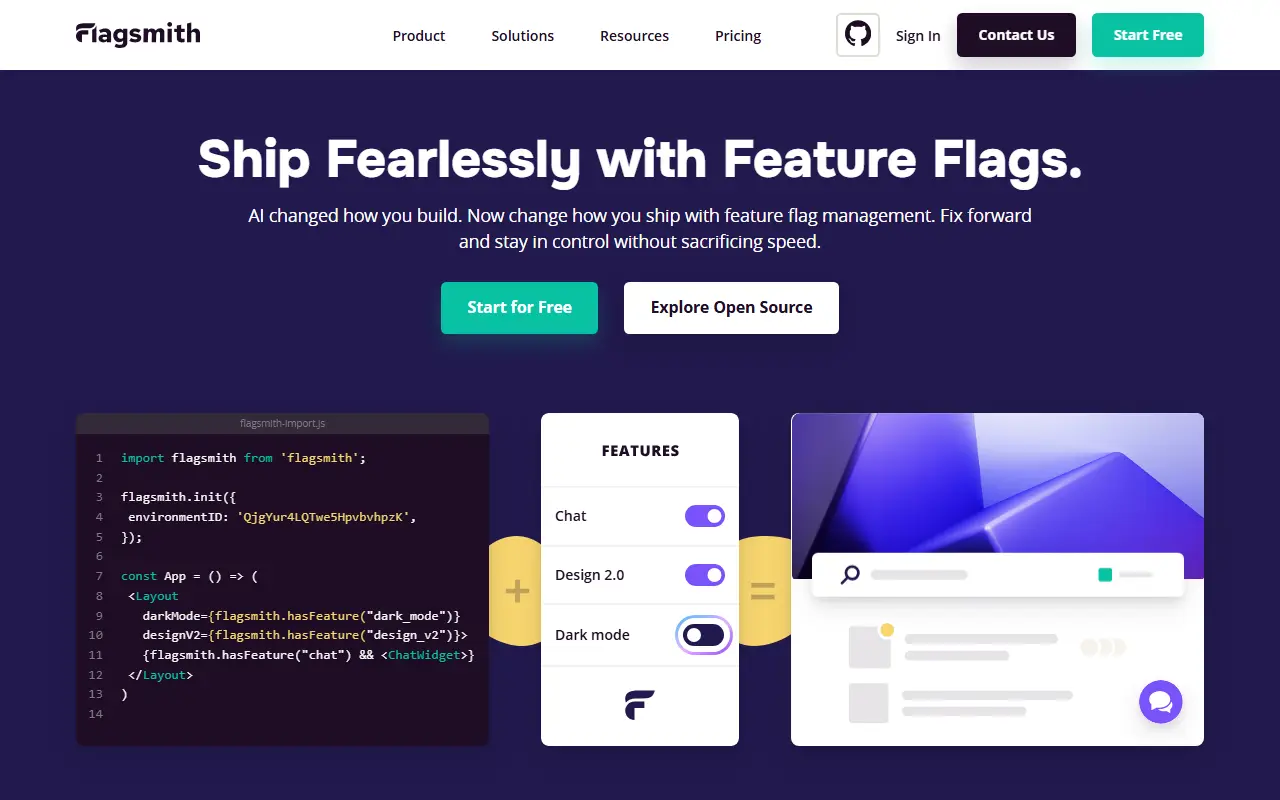
Flagsmith is a feature management platform, released as open source, offering feature flags, remote configuration and experimentation. It provides three deployment options: self-hosted, available as a free open-source build or as a fully supported Enterprise edition, a private cloud and a standard cloud service. Its partnership with OpenFeature is intended to avoid vendor lock-in.
Teams wrap sections of code in flags and toggle features on or off remotely for different environments, users or segments without deploying new code. Segments let you release to beta testers and gather feedback, and A/B and multivariate tests run on top of segments. Organisation management covers orgs, projects and roles for team members, and SDKs cover more than 15 languages with support for frameworks such as React and Next.js, plus integrations and an MCP server.
Flagsmith is written in Python and React, ships as Docker images and is released under the BSD 3-Clause licence for the open-source build. It suits product and engineering teams that want controlled rollouts and remote configuration across web, mobile and server-side applications.
Key features
- Feature flags with remote toggling
- Remote configuration values
- Segments for targeted releases
- A/B and multivariate testing
- Organisations, projects and roles
- SDKs for 15+ languages
- Integrations and MCP server
Pricing: Free plan with 50,000 requests a month. Start-Up costs $45 and Scale-Up $300 per month ($40 and $250 billed yearly), each with a 14-day trial; Enterprise is quoted.
#2
An open-source system for deploying, scaling and managing containerized applications across clusters of hosts, hosted by the CNCF.
- GitHub stars
- 129k
- Last commit
- yesterday
- Latest release
- v1.37.2
- Licence
- Apache-2.0
- Self-hosted
- Yes
- Hosted version
- Available
kubernetes.io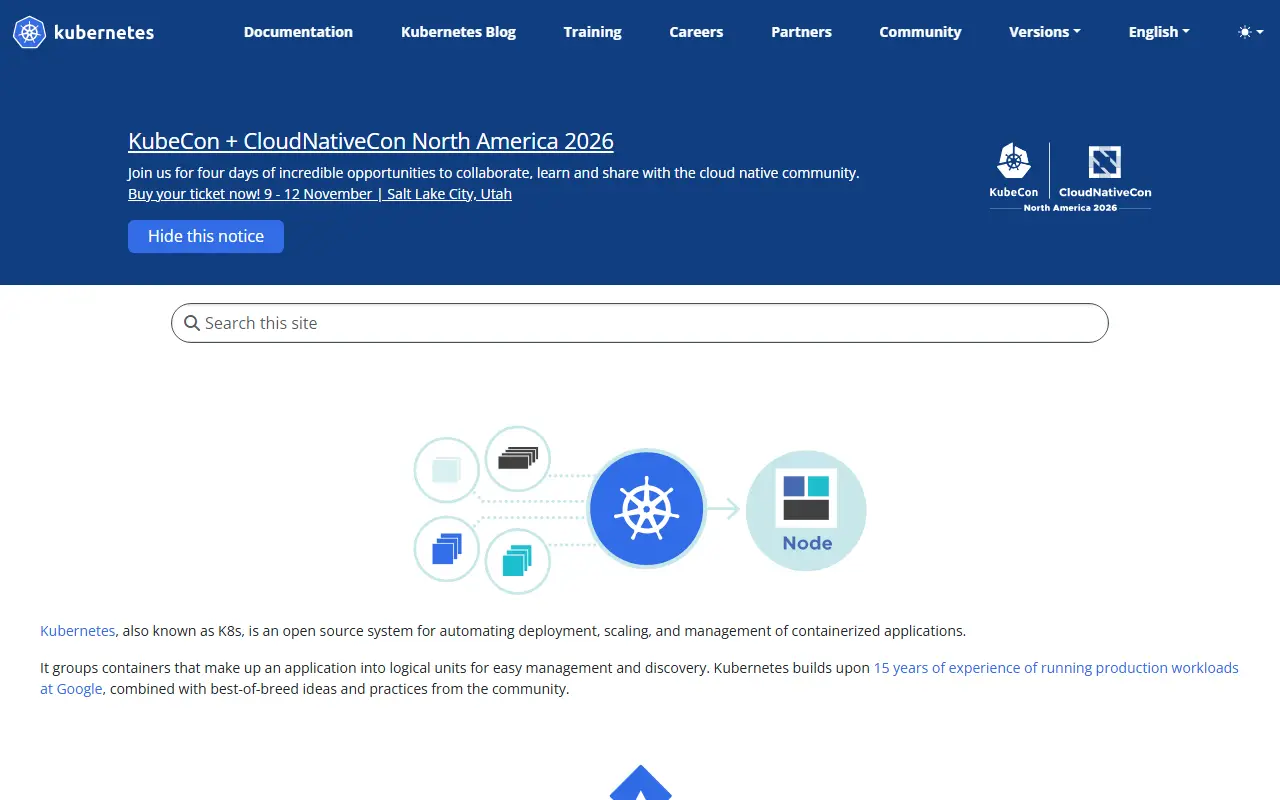
Kubernetes, also written K8s, is an open-source system that manages containerized applications across multiple hosts. It provides the basic mechanisms for deploying, maintaining and scaling applications, so teams can run containers reliably without scheduling each one by hand. It is written in Go and released under the Apache-2.0 license.
The project builds on years of experience running production workloads at Google with an internal system called Borg, combined with practices from the wider community. The Cloud Native Computing Foundation hosts the project. Users interact with it through declarative configuration and the documentation on kubernetes.io, which includes tutorials and a free course on scalable microservices.
Kubernetes can be run on your own infrastructure, and major cloud providers also offer managed Kubernetes services. The README adds that the k8s.io/kubernetes module is not supported for use as a library. It suits platform and DevOps teams running microservices that need scheduling, scaling and automatic recovery.
Key features
- Container scheduling across multiple hosts
- Automated application deployment and rollouts
- Scaling of containerized workloads
- Maintenance and self-healing of applications
- Declarative configuration of desired state
- CNCF-hosted with extensive documentation
Pricing: Free and open source under the Apache-2.0 license; cloud providers sell managed services built on it.
#3
An agentless IT automation platform for configuration management, application deployment, cloud provisioning and network automation over SSH.
- GitHub stars
- 71k
- Last commit
- 2 days ago
- Latest release
- v2.22.0
- Licence
- GPL-3.0
- Self-hosted
- Yes
ansible.com
Ansible is an open-source IT automation system written in Python and released under the GPL-3.0 license. It covers configuration management and application deployment, provisioning of cloud resources, one-off ad-hoc commands, network automation and orchestration across many nodes, and it can carry out complex changes such as zero-downtime rolling updates with load balancers.
Its design principles favor a simple setup with a gentle learning curve, managing machines quickly and in parallel, and avoiding custom agents and extra open ports by relying on the existing SSH daemon. Infrastructure is described in a language that is readable by both people and machines, with a focus on security and easy auditing and review. New remote machines can be managed immediately without bootstrapping software, and modules can be written in any dynamic language.
Released versions install with pip or a package manager, while power users can run the development branch for the latest features at the risk of breaking changes. Ansible can be used without root access. It suits system administrators, DevOps and network engineers who want repeatable, version-controlled automation without agents on their servers.
Key features
- Agentless automation over SSH
- Configuration management and application deployment
- Cloud provisioning and network automation
- Parallel management of many machines
- Zero-downtime rolling updates
- Modules in any dynamic language
- Human-readable infrastructure descriptions
Pricing: Free and open source under the GPL-3.0 license.
#4
A highly available key-value store that keeps a distributed system's essential data consistent across nodes using Raft consensus and a gRPC API.
- GitHub stars
- 53k
- Last commit
- yesterday
- Latest release
- v3.7.3
- Licence
- Apache-2.0
- Self-hosted
- Yes
etcd.io
etcd is a distributed key-value store built to hold the data a distributed system cannot afford to lose. Written in Go, it relies on the Raft algorithm to maintain a highly available replicated log, so a cluster keeps agreeing on its data even when individual members fail. It is a Cloud Native Computing Foundation project and is closely associated with Kubernetes, which relies on it to store cluster state.
The project lists four design goals. The API is simple and well defined, exposed through gRPC. Security is built in, with automatic TLS and optional client certificate authentication. Performance is benchmarked at around ten thousand writes per second according to the maintainers, and reliability comes from the Raft design and rigorous robustness testing. A command line client called etcdctl handles day-to-day operations.
etcd is Apache-2.0 licensed and used in production by many organizations. The README notes that the main branch may be unstable during development, so deployments should use tagged releases. It is infrastructure software that you run yourself, typically as a three- or five-member cluster.
Key features
- Distributed key-value storage
- Raft consensus for a replicated log
- Simple, well-defined gRPC API
- Automatic TLS with optional client certificates
- etcdctl command line client
- Kubernetes-friendly configuration store
Pricing: Free and open source under the Apache-2.0 license.
#5
An open-source feature management platform for rolling out features gradually with flags, strategies and variants, with many SDKs and an Enterprise edition.
- GitHub stars
- 14k
- Last commit
- yesterday
- Latest release
- v8.3.1
- Licence
- AGPL-3.0
- Self-hosted
- Yes
- Hosted version
- Available
getunleash.io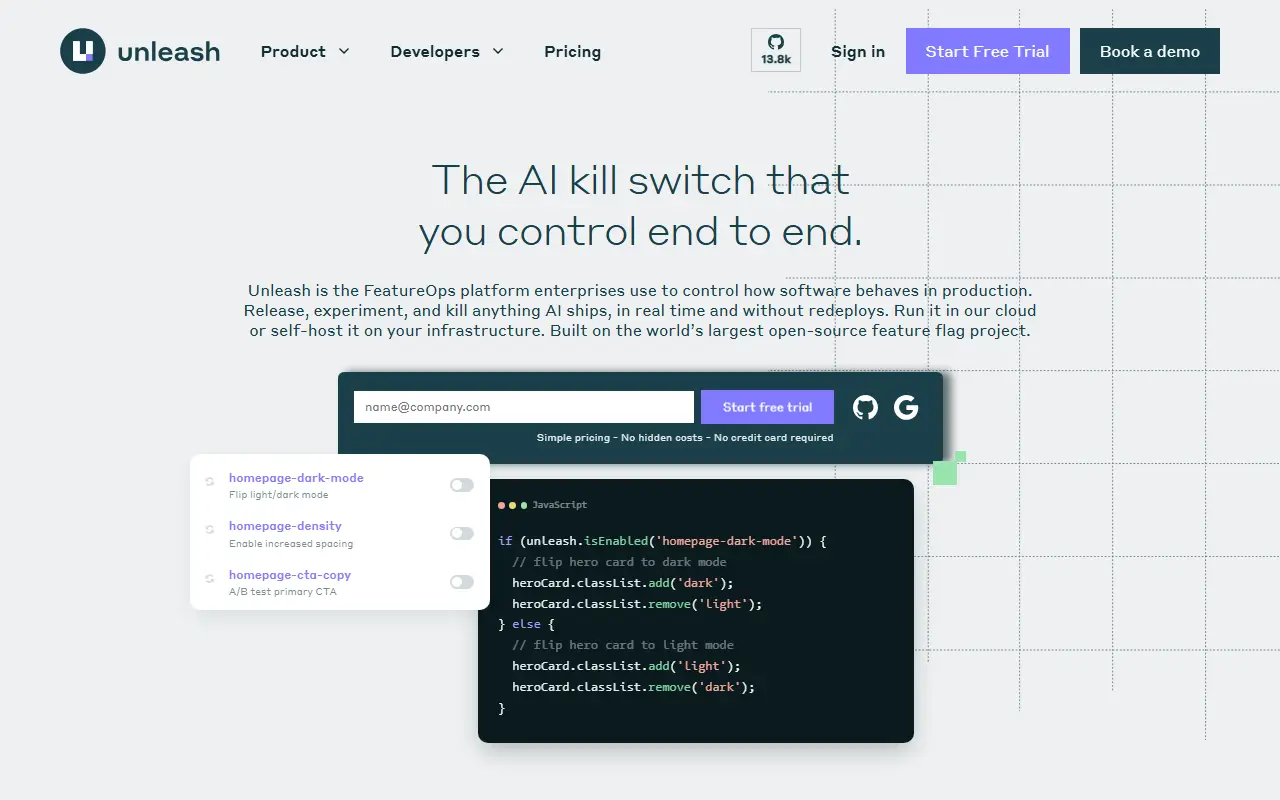
Unleash is an open-source feature management platform. Teams wrap new functionality in feature flags, deploy code to production in smaller releases, and then decide when and for whom each feature is switched on. This lowers the risk of releases and lets several features be developed at once without long-lived feature branches.
Flags can be tested against real production data and controlled using activation strategies and variants, and the project topics also point to experiments and toggles. Unleash provides 15 official client and server SDKs plus community SDKs and works with any language or framework. The Enterprise edition adds single sign-on, SCIM user provisioning, change requests and fine-grained roles, with unlimited projects and environments in a hosted instance.
The open-source edition is licensed under AGPL-3.0 and can be run locally with git and Docker, serving its interface on port 4242, or directly from source with Node.js. A live demo is available, and a free trial gives access to a hosted Enterprise instance.
Key features
- Feature flags with gradual rollouts
- Activation strategies and variants
- 15 official client and server SDKs
- Role-based access control in Enterprise
- Change requests for flag updates
- SSO and SCIM provisioning in Enterprise
- Multiple projects and environments
- Run locally with Docker
Pricing: The open-source edition is free to self-host. Pay-as-you-go costs $75 per seat per month with a 14-day trial; annual Enterprise contracts are quoted.
#6
A cloud-native, plugin-extensible API gateway that also handles LLM and MCP traffic, runs natively on Kubernetes and can be self-hosted or used as a cloud service.
- GitHub stars
- 44k
- Last commit
- 25 days ago
- Latest release
- 3.9.4
- Licence
- Apache-2.0
- Self-hosted
- Yes
- Hosted version
- Available
konghq.com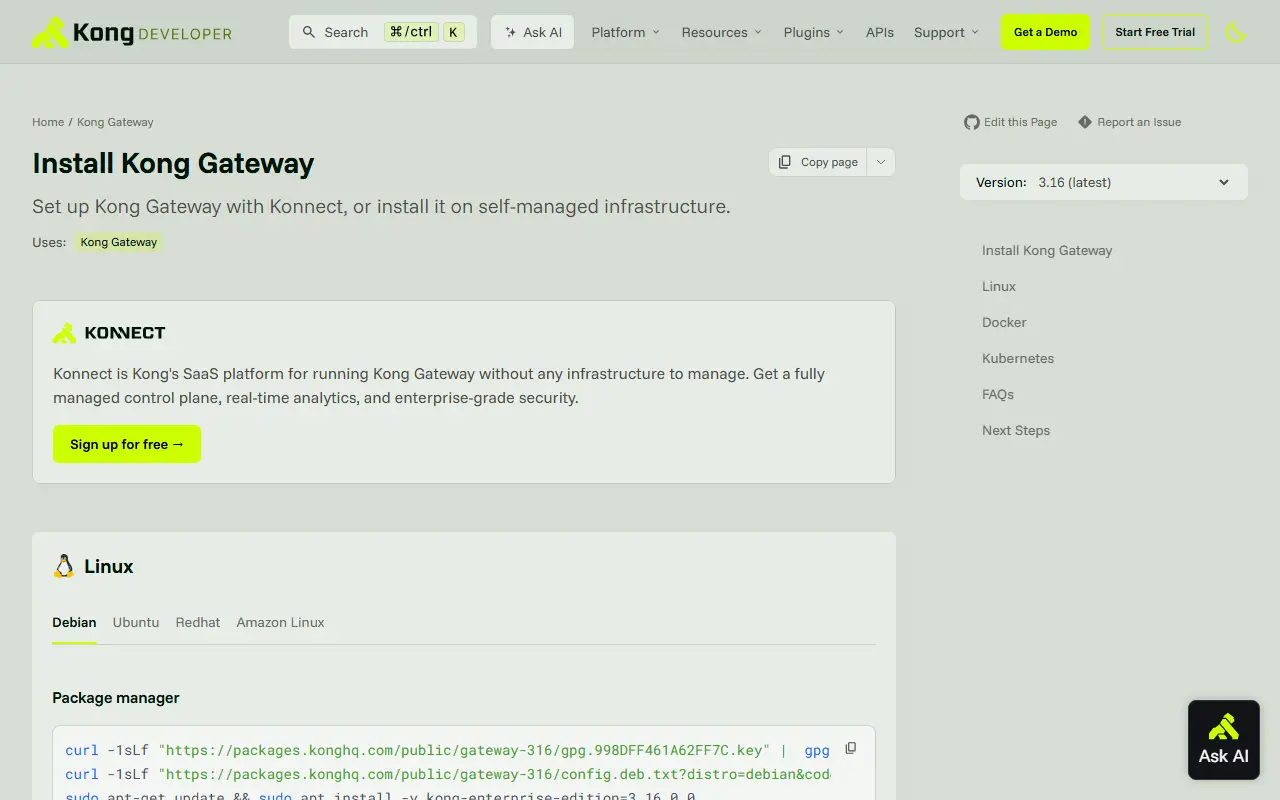
Kong, also called Kong Gateway, is a cloud-native and platform-agnostic API gateway that has expanded to cover LLM and MCP traffic. It is written in Lua, released under the Apache-2.0 license, and extended through plugins. It proxies, routes, load balances and health checks traffic and handles authentication, sitting as a central layer in front of microservices or conventional APIs.
For AI workloads it adds multi-LLM support, semantic security, and security and analytics for MCP traffic. Kong runs natively on Kubernetes through its official Ingress Controller. The quickstart uses docker-compose, adds authentication to an API in a few minutes, and a Docker procedure covers a DB-less mode, with other distributions listed on the official installation page.
You can run Kong on your own infrastructure, in the cloud, on bare metal or in containers, or sign up for a free trial of the cloud-hosted Kong Konnect. It suits platform and API teams managing many services who need a gateway with a plugin ecosystem and an upgrade path to AI traffic management.
Key features
- API gateway with routing and load balancing
- Extensible through a plugin system
- Authentication and health checking
- Multi-LLM and MCP gateway capabilities
- Kubernetes Ingress Controller
- Docker, DB-less and cloud-hosted deployment
Pricing: Kong Konnect's AI Management Plus plan starts at $25 per month plus usage, with a 30-day free trial. Enterprise is custom and billed annually; API and event management rates are not shown.
#7
Envoy is an open source edge and service proxy designed for cloud-native and AI-native applications, providing traffic management, observability, and extensibility.
- GitHub stars
- 29k
- Last commit
- yesterday
- Latest release
- v1.40.2
- Licence
- Apache-2.0
- Self-hosted
- Yes
envoyproxy.io
Envoy is an open source edge and service proxy designed for cloud-native and AI-native applications. It handles traffic for microservices, edge, and AI workloads, including streaming LLM responses and agentic workloads.
It offers deep L7 observability, runtime programmability via xDS APIs, and security features like TLS and mTLS. Envoy is extensible through Wasm, Lua, Go, or Rust modules and external processing.
Key features
- AI-native traffic handling: streaming LLM responses, agentic workloads, long-lived connections, load balancing for inference backends
- Extensible data path: Wasm, Lua, Go, Rust dynamic modules, out-of-process external processing
- Observability: consistent stats, access logs, distributed tracing
- Runtime programmable: dynamic xDS configuration APIs for routing, clusters, policy
- Security: TLS termination/origination, mTLS, SNI, JWT auth, RBAC, external authorization

Nacos is a dynamic service discovery, configuration and service management platform for building AI cloud native applications, supporting Kubernetes, Spring Cloud, Spring AI, and Dify.
- GitHub stars
- 34k
- Last commit
- yesterday
- Latest release
- 3.3.0
- Licence
- Apache-2.0
- Self-hosted
- Yes
nacos.io
Nacos is a platform that provides dynamic service discovery, configuration management, and service management. It is designed for building AI cloud native applications and supports integration with Kubernetes, Spring Cloud, Spring AI, and Dify.
The platform offers a lightweight management console and supports multi-tenant and multi-environment setups. It is production-grade, having been used in Alibaba's internal production for over 10 years, and supports large-scale scenarios with millions of services.
Key features
- Dynamic configuration service for centralized, externalized, and dynamic management of configurations across environments
- Service discovery supporting DNS-based and RPC-based (Dubbo, gRPC) modes
- Real-time health checks to prevent requests to unhealthy hosts or service instances
- Support for AI Registry scenarios including Prompt, MCP, and A2A
- MCP service management center compatible with MCP official protocol
- Traffic scheduling and service governance with rate limiting, promotion plans, and multi-site active-active

Consul is HashiCorp's service networking tool, providing service discovery, service mesh and secure service-to-service connectivity.
- GitHub stars
- 30k
- Last commit
- yesterday
- Latest release
- v2.1.0
consul.io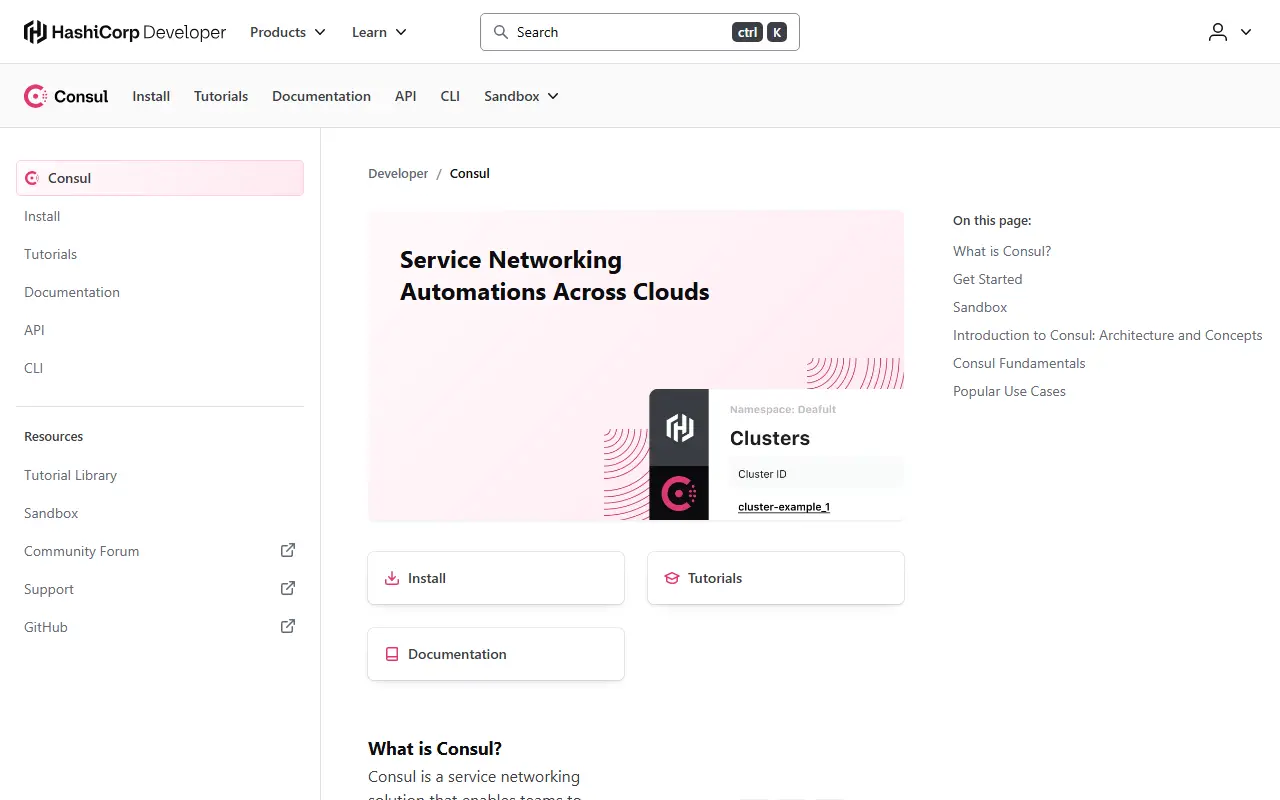
Consul is a service networking solution from HashiCorp for secure connectivity between services across on-premises, hybrid cloud and multi-cloud environments. It offers service discovery, service mesh, identity-based authorization, L7 traffic management and service-to-service encryption.
Its architecture has a control plane to register, access and secure services, and a data plane where gateways and sidecar proxies can handle traffic. A catalog API tracks registered services, and the Raft protocol keeps cluster state consistent. The site provides getting-started guides for VMs and Kubernetes and a sandbox with preinstalled tools.
The documentation covers concepts in separate pages: the catalog, cluster consensus and gossip communication, which agents use to manage membership in datacenters. Tutorials, an API reference and CLI documentation sit in the same developer portal. Consul appears next to Terraform, Vault, Nomad and Boundary in HashiCorp's product list, where it is described as the product for securing network services.
Key features
- Service discovery and service mesh
- Control plane for registering and securing services
- Catalog API for registered services
- Raft-based consistent cluster state
- Hands-on sandbox

Nomad is HashiCorp's workload scheduler and orchestrator for containers, binaries and batch jobs, in the cloud or on-prem.
- GitHub stars
- 17k
- Last commit
- 8 days ago
- Latest release
- v2.1.1
- Self-hosted
- Yes
nomadproject.io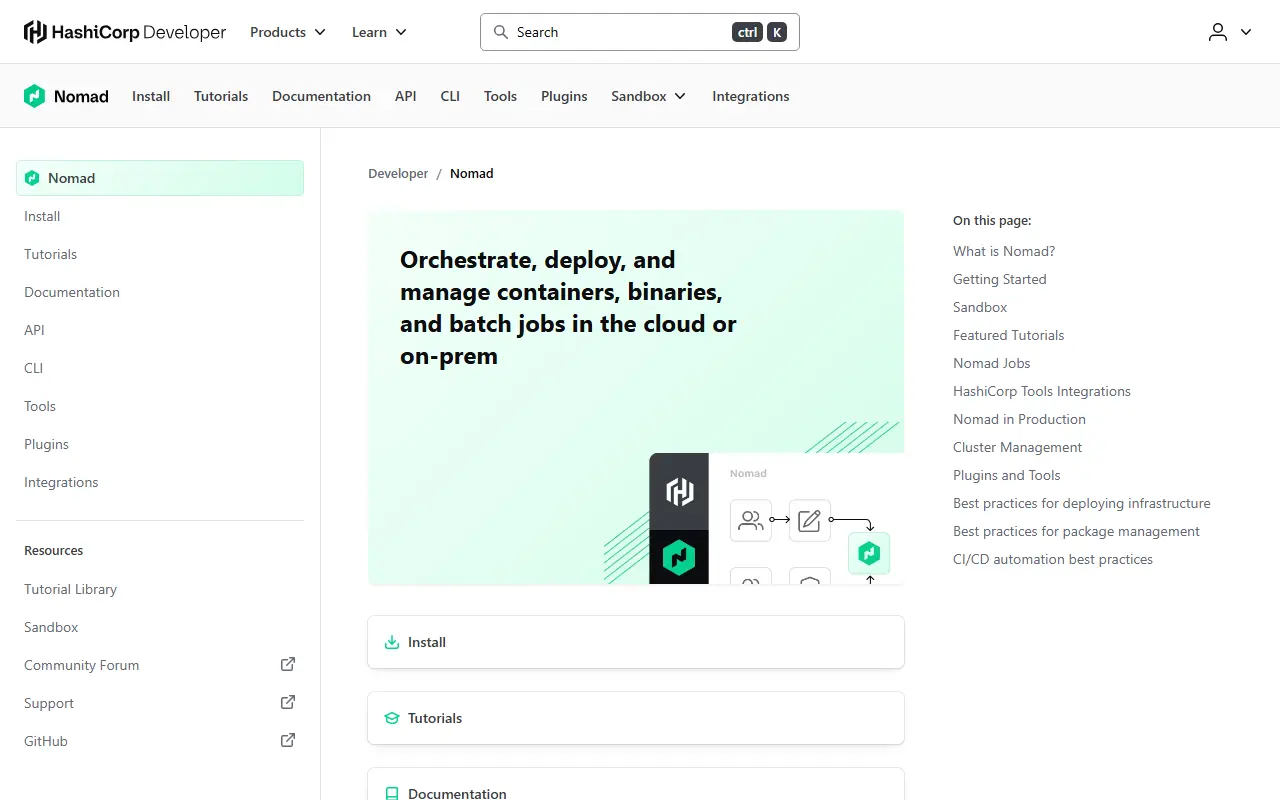
Nomad is a scheduler and orchestrator from HashiCorp. It deploys and manages containers and non-containerized applications, including binaries and batch jobs, across on-prem environments and clouds.
Workloads are described as Nomad jobs. Parameterized jobs allow dynamic runtime behavior from a single job specification, and Nomad Pack provides reusable job templates. The tutorials show it working alongside Consul for service discovery and health checking, Vault for secrets and Terraform for creating clusters.
HashiCorp offers a sandbox with preinstalled tools for experimenting, and the site documents a separate Nomad Enterprise edition. The listed licence is Other, so check the project's terms before using it.
Key features
- Containers, binaries and batch jobs
- Containerized and non-containerized apps at scale
- Parameterized jobs
- Reusable job templates with Nomad Pack
- Consul integration for service discovery and mesh
- Vault integration for workload secrets
10 more Azure App Configuration alternatives
Commercial Azure App Configuration alternatives
Hosted, closed-source products that compete with Azure App Configuration.
Azure App Configuration alternatives: questions
- What is the best open-source alternative to Azure App Configuration?
- Flagsmith is the top-ranked open-source alternative to Azure App Configuration on Enlisted: An open-source feature flag and remote config platform with segments, A/B testing and SDKs, deployable self-hosted, in a private cloud or as a managed cloud service. Other strong options are Kubernetes, Ansible, etcd and Unleash.
- What are the best commercial alternatives to Azure App Configuration?
- AWS AppConfig, ConfigCat, DevCycle, Firebase Remote Config and LaunchDarkly are among the hosted, closed-source alternatives to Azure App Configuration listed on Enlisted, which lists 9 in total. Compare their pricing and features on each tool page.
- Are these Azure App Configuration alternatives free?
- All 20 are open source, so the code is free to use under its licence, and all of them can be self-hosted on your own server or computer. 5 also offer a paid or managed cloud version if you'd rather not host it yourself.
- How is this list of Azure App Configuration alternatives ranked?
- By a score built from GitHub stars, star growth over the last 30 days and how recently the code changed. 19 of these projects shipped code in the last 30 days. Data is refreshed daily, and nobody can pay to move up.
 TrackMedia
 TrackRev