#1
A self-hostable platform for deploying apps, databases and one-click services to your own servers over SSH, an open-source alternative to Heroku, Vercel and Netlify.
- GitHub stars
- 66k
- Last commit
- today
- Latest release
- v4.7.5
- Licence
- Apache-2.0
- Self-hosted
- Yes
- Hosted version
- Available
coolify.io
Coolify is an open-source, self-hostable alternative to Heroku, Vercel and Netlify. It manages servers, applications and databases on hardware you control, and the only requirement is SSH access, so a VPS, a bare-metal machine or even a Raspberry Pi can serve as a target. Your configuration stays on your own servers, and if you stop using Coolify the resources it deployed keep running.
Applications can be built from GitHub, GitLab, Bitbucket or Gitea using Nixpacks, Railpack, a Dockerfile, Docker Compose or a prebuilt image. Hundreds of one-click services and managed-style databases come with persistent storage and generated credentials. Deployments can run on every push, create pull-request previews, call webhooks and roll back to retained images. Custom domains, automatic HTTPS, reverse proxies and health checks cover networking, while logs, container terminals and resource monitoring help with operations.
Backups, scheduled tasks, secrets, environment variables and notifications are built in, and resources can be managed through the dashboard, an API, a CLI or MCP, with team-based access controls. Coolify is Apache-2.0 licensed and built mainly with PHP; a hosted Coolify Cloud option exists for people who prefer not to run the control plane themselves.
Key features
- Deploy from Git with Nixpacks, Dockerfile or Compose
- Hundreds of one-click services and databases
- Pull-request previews and rollbacks
- Automatic HTTPS and custom domains
- Database and storage backups
- Multi-server management with team access controls
- Dashboard, API, CLI and MCP management
Pricing: Self-hosting is free with no feature limits. Coolify Cloud is $5 per month including two connected servers, plus $3 per month for each additional server.
#2
An open-source system for deploying, scaling and managing containerized applications across clusters of hosts, hosted by the CNCF.
- GitHub stars
- 129k
- Last commit
- yesterday
- Latest release
- v1.37.2
- Licence
- Apache-2.0
- Self-hosted
- Yes
- Hosted version
- Available
kubernetes.io
Kubernetes, also written K8s, is an open-source system that manages containerized applications across multiple hosts. It provides the basic mechanisms for deploying, maintaining and scaling applications, so teams can run containers reliably without scheduling each one by hand. It is written in Go and released under the Apache-2.0 license.
The project builds on years of experience running production workloads at Google with an internal system called Borg, combined with practices from the wider community. The Cloud Native Computing Foundation hosts the project. Users interact with it through declarative configuration and the documentation on kubernetes.io, which includes tutorials and a free course on scalable microservices.
Kubernetes can be run on your own infrastructure, and major cloud providers also offer managed Kubernetes services. The README adds that the k8s.io/kubernetes module is not supported for use as a library. It suits platform and DevOps teams running microservices that need scheduling, scaling and automatic recovery.
Key features
- Container scheduling across multiple hosts
- Automated application deployment and rollouts
- Scaling of containerized workloads
- Maintenance and self-healing of applications
- Declarative configuration of desired state
- CNCF-hosted with extensive documentation
Pricing: Free and open source under the Apache-2.0 license; cloud providers sell managed services built on it.
#3
An extensible web server written in Go that speaks HTTP/1.1, 2 and 3 and obtains and renews TLS certificates automatically.
- GitHub stars
- 79k
- Last commit
- yesterday
- Latest release
- v2.11.9
- Licence
- Apache-2.0
- Self-hosted
- Yes
caddyserver.com
Caddy is a server platform built to be extended, with TLS enabled by default. It is a web server and reverse proxy written in Go, released under the Apache-2.0 license, and it obtains HTTPS certificates through ZeroSSL and Let's Encrypt, so sites are served over HTTPS without manual certificate work. It runs on macOS, Linux and Windows.
Configuration is flexible: an easy Caddyfile for common cases, a native JSON config for fine control, a JSON API for dynamic changes, and config adapters for other formats. Caddy can manage a local certificate authority for internal names and IP addresses, coordinate with other instances in a cluster, fall back between multiple certificate issuers, and it supports Encrypted ClientHello. All three HTTP versions, 1.1, 2 and 3, work by default.
A modular architecture allows features to be added as plugins, and the binary has no external dependencies, not even libc. Installation can be as simple as downloading the executable from GitHub Releases and placing it on your PATH. It suits developers, small teams and operators who want a reverse proxy or static file server with sensible HTTPS defaults.
Key features
- Automatic HTTPS with Let's Encrypt and ZeroSSL
- Caddyfile and native JSON configuration
- Dynamic configuration through a JSON API
- Local certificate authority for internal names
- Supports HTTP versions 1.1, 2 and 3
- Modular architecture with plugins
- Single binary with no external dependencies
Pricing: Free and open source under the Apache-2.0 license.
#4
An agentless IT automation platform for configuration management, application deployment, cloud provisioning and network automation over SSH.
- GitHub stars
- 71k
- Last commit
- 2 days ago
- Latest release
- v2.22.0
- Licence
- GPL-3.0
- Self-hosted
- Yes
ansible.com
Ansible is an open-source IT automation system written in Python and released under the GPL-3.0 license. It covers configuration management and application deployment, provisioning of cloud resources, one-off ad-hoc commands, network automation and orchestration across many nodes, and it can carry out complex changes such as zero-downtime rolling updates with load balancers.
Its design principles favor a simple setup with a gentle learning curve, managing machines quickly and in parallel, and avoiding custom agents and extra open ports by relying on the existing SSH daemon. Infrastructure is described in a language that is readable by both people and machines, with a focus on security and easy auditing and review. New remote machines can be managed immediately without bootstrapping software, and modules can be written in any dynamic language.
Released versions install with pip or a package manager, while power users can run the development branch for the latest features at the risk of breaking changes. Ansible can be used without root access. It suits system administrators, DevOps and network engineers who want repeatable, version-controlled automation without agents on their servers.
Key features
- Agentless automation over SSH
- Configuration management and application deployment
- Cloud provisioning and network automation
- Parallel management of many machines
- Zero-downtime rolling updates
- Modules in any dynamic language
- Human-readable infrastructure descriptions
Pricing: Free and open source under the GPL-3.0 license.
#5
A free, self-hostable platform as a service for deploying apps, databases and Docker Compose stacks on your own servers, an alternative to Vercel, Netlify and Heroku.
- GitHub stars
- 38k
- Last commit
- today
- Latest release
- v0.31.1
- Self-hosted
- Yes
- Hosted version
- Available
dokploy.com
Dokploy is an open-source, self-hostable platform as a service that simplifies deploying and managing applications and databases. It is positioned as an alternative to Heroku, Vercel and Netlify, and it runs on a VPS you control, installed with a single command.
It can deploy apps in languages such as Node.js, PHP, Python, Go and Ruby, create and manage MySQL, PostgreSQL, MongoDB, MariaDB, libsql and Redis databases, and schedule database backups to external storage. Docker Compose is supported natively, and multiple nodes can be clustered with Docker Swarm or managed as remote servers. One-click templates cover open-source apps such as Plausible, PocketBase and Cal.com, Traefik handles routing and load balancing, and live monitoring shows CPU, memory, storage and network usage per resource.
A CLI and API allow automation, and notifications about deploy success or failure can go to Slack, Discord, Telegram or email. The license is listed as 'Other', so check the repository terms before redistribution. For people who want to skip installation there is a hosted Dokploy Cloud.
Key features
- Deploy apps in many languages
- Managed databases with automated backups
- Native Docker Compose support
- Multi-node scaling with Docker Swarm
- One-click open-source templates
- Traefik routing and load balancing
- Real-time resource monitoring
Pricing: Hobby costs $4.50 per server per month and Startup starts at $15 per month for up to 3 servers. Enterprise (cloud or self-hosted) and Agency plans are quoted by sales; there is a 7-day free trial.
#6
A cloud-native reverse proxy and load balancer that configures itself automatically from orchestrators such as Docker and Kubernetes.
- GitHub stars
- 66k
- Last commit
- yesterday
- Latest release
- v3.7.18
- Licence
- MIT
- Self-hosted
- Yes
traefik.io
Traefik (pronounced like traffic) is an HTTP reverse proxy and load balancer designed to simplify deploying microservices. It is written in Go, released under the MIT license, and designed to integrate with your existing infrastructure and configure itself automatically and dynamically.
Instead of requiring a hand-written route for every service, Traefik listens to a service registry or orchestrator API and generates routes as services are added, removed, upgraded or scaled, without restarts. It connects to Docker, Docker Swarm, Kubernetes, Consul, Etcd, Rancher v2 and Amazon ECS, and routes can still be configured manually if you prefer. A web UI is available, and its topics reference Let's Encrypt.
It is typically deployed on container platforms where services change many times a day, and the project provides a migration guide for major upgrades. It suits platform and DevOps teams running microservices who want routing to follow their orchestrator automatically.
Key features
- Reverse proxy and load balancer for HTTP
- Automatic route discovery from orchestrators
- Configuration updates without restarts
- Integrations with Docker, Kubernetes and Consul
- Let's Encrypt certificate support
- Web UI for inspecting routes
Pricing: Traefik Proxy is free and open source. Traefik Hub API Gateway and API Management are paid products with no published prices; pricing is requested from the vendor.
#7
1Panel is an open-source Linux server management panel with a web interface for apps, websites, databases and containers, plus AI management.
- GitHub stars
- 37k
- Last commit
- yesterday
- Latest release
- v2.5.1
- Licence
- GPL-3.0
- Self-hosted
- Yes
1panel.pro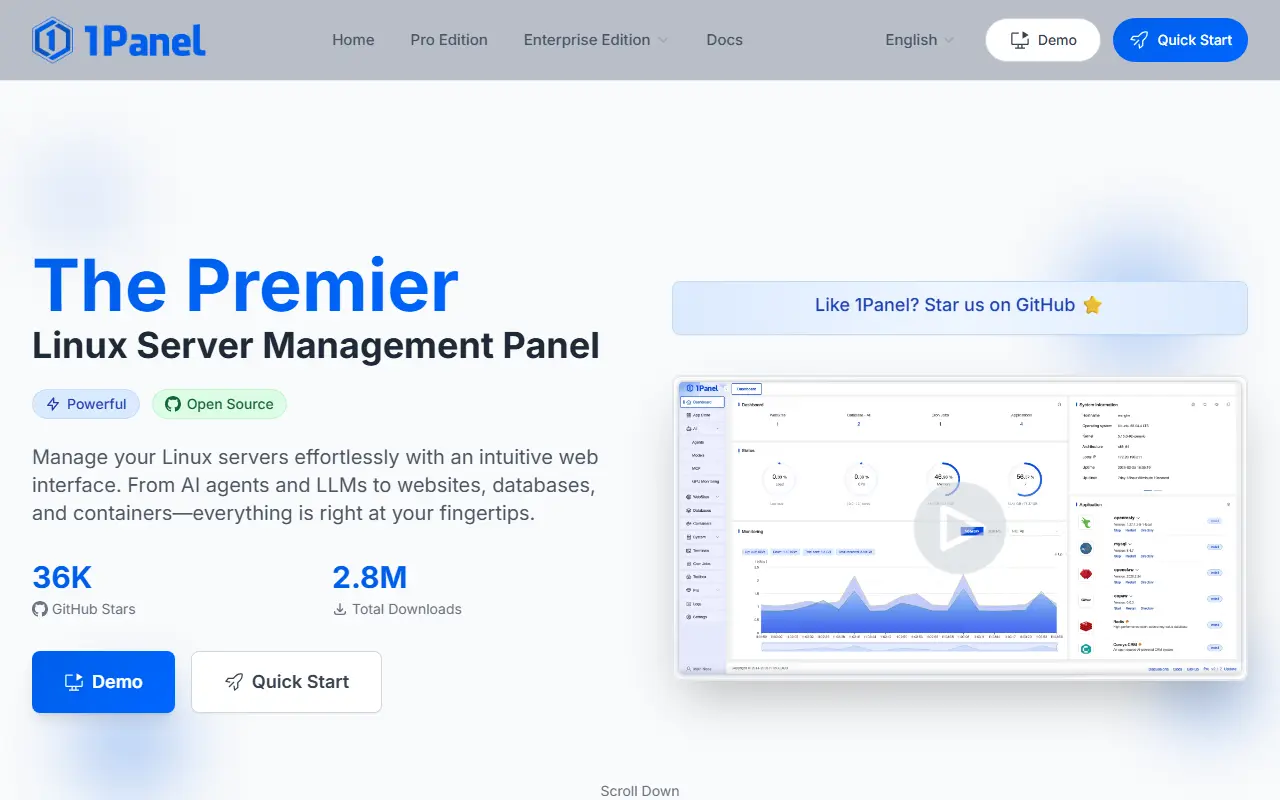
1Panel is an open-source Linux server management panel that also positions itself as a lightweight AI management platform. Through a web interface it covers monitoring of the host, files, databases and containers, so common server chores can be done without working only in a terminal. It is written in Go, uses Docker for app deployment and is released under the GPL-3.0 license.
A built-in app store offers one-click installation and upgrades of open-source applications, and website tooling integrates with builders such as WordPress and Halo, including domain binding and SSL certificate setup. Security features include a web application firewall and log auditing, and applications are deployed in containers to limit exposure. Backups and restores can be triggered in one click and sent to various cloud storage services. The project compares itself with panels such as cPanel, Plesk, aaPanel and Webmin.
Key features
- Web GUI for Linux server management
- One-click app store with installs and upgrades
- Website deployment with domain and SSL setup
- Docker container and database management
- Backup and restore to cloud storage
- AI gateway and agent management tools
Pricing: The open-source edition is free forever. The Pro Edition costs $80 per year as a subscription or $200 as a one-time perpetual license.
#8
Nginx Proxy Manager is a Docker image with a web admin interface for managing reverse proxy hosts, redirections and free SSL certificates.
- GitHub stars
- 35k
- Last commit
- 3 days ago
- Latest release
- v2.16.0
- Licence
- MIT
- Self-hosted
- Yes
nginxproxymanager.com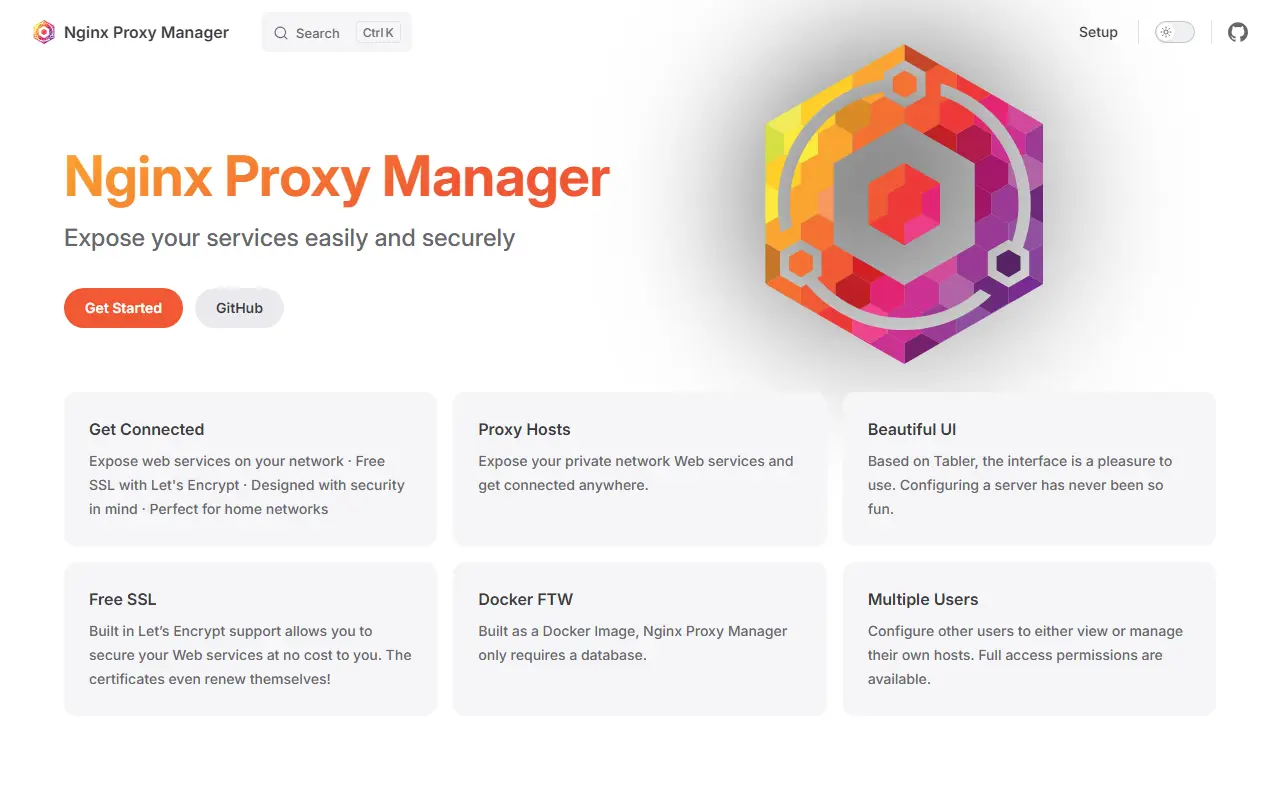
Nginx Proxy Manager is a pre-built Docker image that makes it easy to forward traffic to websites and services running at home or elsewhere, including free SSL, without needing deep knowledge of Nginx or Let's Encrypt. The project grew out of a personal need for simple reverse proxying with SSL termination, and that simplicity remains its stated goal. It is MIT licensed and written in TypeScript.
The web admin interface, based on the Tabler UI kit, lets you create proxy hosts, redirections, streams and 404 hosts. Certificates can come from Let's Encrypt or be uploaded as custom certificates. Access lists and basic HTTP authentication protect individual hosts, and advanced users can add raw Nginx configuration. User management, permissions and an audit log are included. Note that armv7 is no longer supported from version 2.14 onward, and the README lists the older 2.13.7 tag for those devices.
Key features
- Web UI for Nginx reverse proxy hosts
- Free SSL through Let's Encrypt or custom certificates
- Redirections, streams and 404 hosts
- Access lists and basic HTTP authentication
- Advanced Nginx configuration for power users
- User management, permissions and audit log
Pricing: Free and open source under the MIT license.
#9
A lightweight container management web UI for Docker, Swarm, Podman and Kubernetes, with a free Community Edition and a commercial Business Edition.
- GitHub stars
- 39k
- Last commit
- 2 days ago
- Latest release
- 2.45.3
- Licence
- Zlib
- Self-hosted
- Yes
portainer.io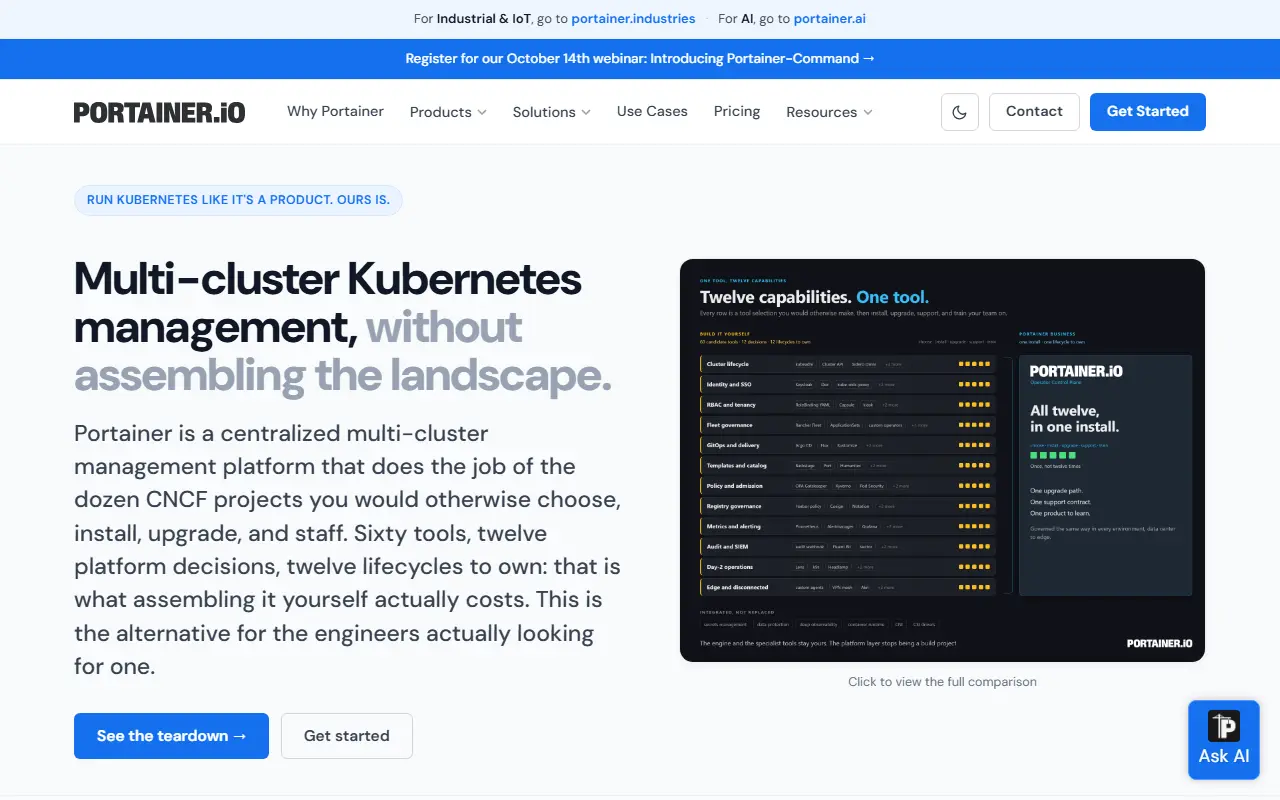
Portainer is a container management interface for Docker, Swarm, Podman, Kubernetes and Azure Container Instances environments. The Community Edition is free and lightweight and is provided as-is, aimed at homelab users, hobbyists, students and others trying out containers on their own machines. It is written in TypeScript and released under the Zlib license.
The README is clear about intended use: The project positions Community Edition for homelabs, learning setups, personal projects and similar non-production use. It comes without support, warranty, SLA or roadmap commitment, and updates arrive without guaranteed cadence. For production or business-critical use, the project points to Portainer Business Edition.
Business Edition is based on the same open-source code and adds hardening, commercial support and features such as RBAC, GitOps, edge management, auditing and SSO. A Take3 offer gives three free Business nodes. Getting started documentation covers deploying Portainer. It suits individuals and small teams who want a visual way to manage containers, with a commercial path available as needs grow.
Key features
- Web UI for Docker, Swarm and Podman
- Kubernetes and Azure Container Instances support
- Lightweight Community Edition
- Business Edition with RBAC, GitOps and SSO
- Edge management and auditing in Business Edition
- Getting-started deployment documentation
Pricing: Portainer is priced by node, not seat. Free for up to 3 nodes; Starter is $1,045 and Scale $2,095 per year billed annually; Enterprise is custom, with a 45-day trial.
#10
Pulumi is an infrastructure as code platform that lets teams define cloud infrastructure in Node.js, Python, Go, .NET, Java or YAML.
- GitHub stars
- 26k
- Last commit
- yesterday
- Latest release
- v3.275.0
- Licence
- Apache-2.0
- Self-hosted
- Yes
- Hosted version
- Available
pulumi.com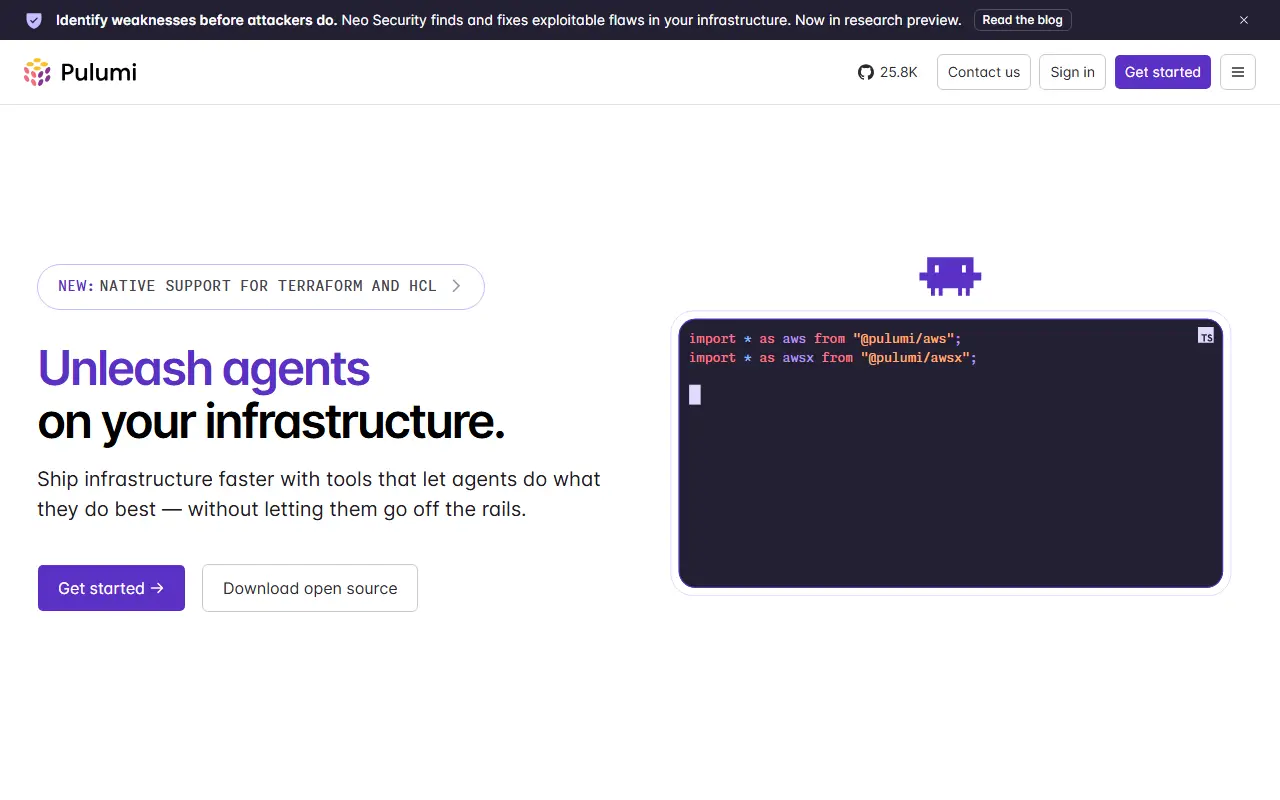
Pulumi is an infrastructure as code platform. Teams describe infrastructure for any cloud in a general-purpose language: Node.js, Python, Go, .NET, Java, or YAML. A registry lists hundreds of cloud providers and packages.
Around the core tool sit services for secrets and configuration, discovery and governance, an internal developer platform, and an AI agent named Neo. The Free plan covers one user with state management and Pulumi Deployments; Essentials, Pro and Enterprise add users, policy, SSO, audit logs and more.
The licence listed for the project is Apache-2.0. The pricing page says Pulumi stays free for open source and individuals, and the Enterprise plan lists self-hosting as available.
Key features
- Infrastructure as code in several languages
- AI infrastructure agent called Neo
- Environments, secrets and configuration management
- Asset management and compliance remediation
- Registry of cloud providers and packages
- Unlimited projects, stacks and environments on Free
- SSO, RBAC and policy enforcement on Pro
Pricing: Free is $0 for 1 user. Essentials is $40/month (up to 500 managed resources), Pro $400/month (up to 2,000), Enterprise $2,000/month (up to 4,750). Credits: 40, 400 and 2,000.
4 more Elestio alternatives
Commercial Elestio alternatives
Hosted, closed-source products that compete with Elestio. Showing 12 of 19.
- View tool

DigitalOcean
Hosting & PaaS
Cloud provider with virtual servers, managed databases and the App Platform PaaS
SaaS
- View tool
Managed hosting for web services, static sites, databases and cron jobs
SaaS
- View tool
Cloud virtual machines, storage and Kubernetes, now operated as Akamai Cloud
SaaS
- View tool
Netlify is a web hosting and deployment platform for building and shipping sites and apps, with deploy previews, serverless functions and an edge network.
SaaS
- View tool
Vercel is a cloud platform for deploying web applications and AI agents, from the company behind Next.js, with a CDN, serverless compute and AI tooling.
SaaS
- View tool
Cloud platform for deploying Git or Docker apps with managed databases and S3-compatible storage
SaaS
- View tool
Heroku is a cloud platform as a service where developers deploy, run and scale applications on managed containers, with managed data services and AI add-ons.
SaaS
- View tool
Runs containers as micro VMs close to users across regional data centers
SaaS
- View tool

Hetzner Cloud
Hosting & PaaS
Low-cost European cloud servers with volumes, networks and load balancers
SaaS
- View tool
Deploys apps and databases from a repo or image with usage-based billing
SaaS
- View tool
Cloud servers, bare metal and managed Kubernetes across many locations
SaaS
- View tool
Managed cloud hosting layered on top of DigitalOcean, AWS and Google Cloud
SaaS
See every Elestio alternative on its tool page
Elestio alternatives: questions
- What is the best open-source alternative to Elestio?
- Coolify is the top-ranked open-source alternative to Elestio on Enlisted: A self-hostable platform for deploying apps, databases and one-click services to your own servers over SSH, an open-source alternative to Heroku, Vercel and Netlify. Other strong options are Kubernetes, Caddy, Ansible and Dokploy.
- What are the best commercial alternatives to Elestio?
- DigitalOcean, Render, Linode, Netlify and Vercel are among the hosted, closed-source alternatives to Elestio listed on Enlisted, which lists 19 in total. Compare their pricing and features on each tool page.
- Are these Elestio alternatives free?
- All 14 are open source, so the code is free to use under its licence, and all of them can be self-hosted on your own server or computer. 4 also offer a paid or managed cloud version if you'd rather not host it yourself.
- How is this list of Elestio alternatives ranked?
- By a score built from GitHub stars, star growth over the last 30 days and how recently the code changed. 14 of these projects shipped code in the last 30 days. Data is refreshed daily, and nobody can pay to move up.
 TrackMedia
 TrackRev