
About Caddy
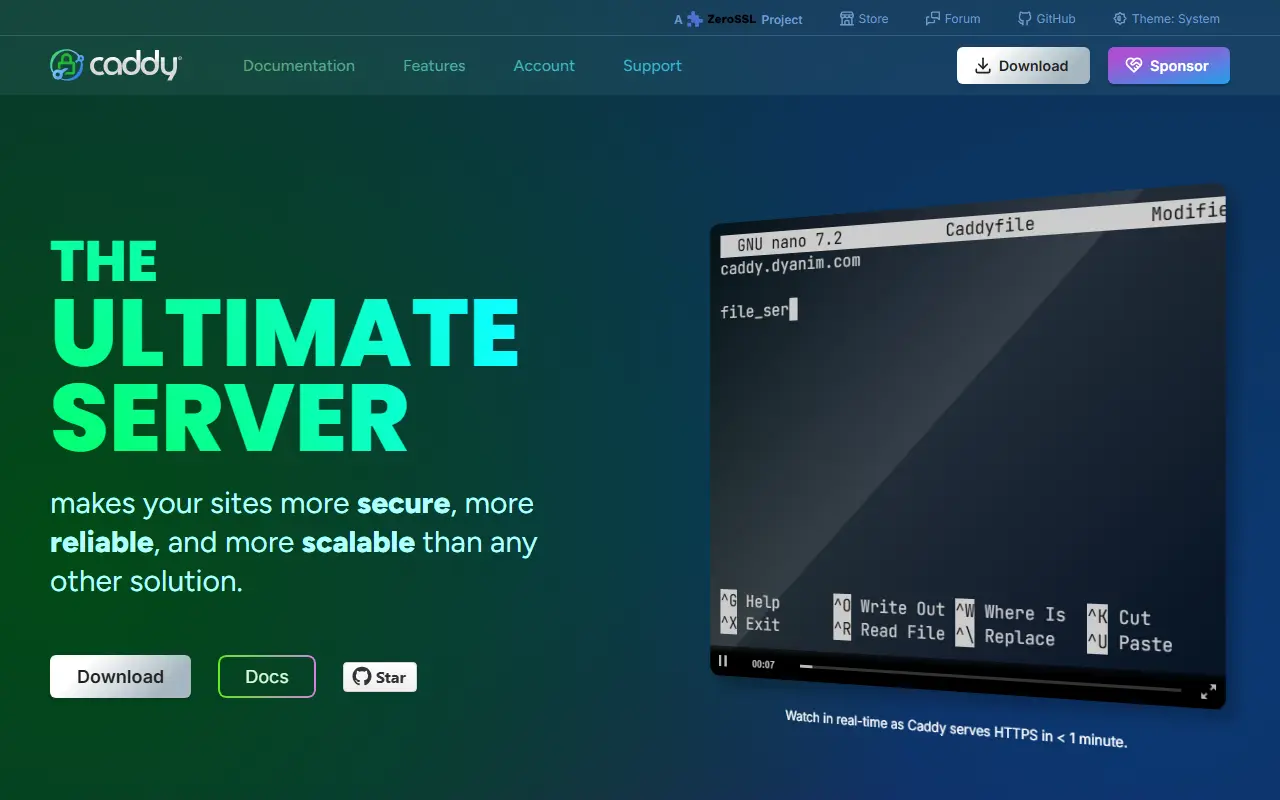
Caddy is a server platform built to be extended, with TLS enabled by default. It is a web server and reverse proxy written in Go, released under the Apache-2.0 license, and it obtains HTTPS certificates through ZeroSSL and Let's Encrypt, so sites are served over HTTPS without manual certificate work. It runs on macOS, Linux and Windows.
Configuration is flexible: an easy Caddyfile for common cases, a native JSON config for fine control, a JSON API for dynamic changes, and config adapters for other formats. Caddy can manage a local certificate authority for internal names and IP addresses, coordinate with other instances in a cluster, fall back between multiple certificate issuers, and it supports Encrypted ClientHello. All three HTTP versions, 1.1, 2 and 3, work by default.
A modular architecture allows features to be added as plugins, and the binary has no external dependencies, not even libc. Installation can be as simple as downloading the executable from GitHub Releases and placing it on your PATH. It suits developers, small teams and operators who want a reverse proxy or static file server with sensible HTTPS defaults.
Key features
- Automatic HTTPS with Let's Encrypt and ZeroSSL
- Caddyfile and native JSON configuration
- Dynamic configuration through a JSON API
- Local certificate authority for internal names
- Supports HTTP versions 1.1, 2 and 3
- Modular architecture with plugins
- Single binary with no external dependencies
Good fit for
- →Reverse proxy with automatic TLS
- →Static site and app hosting
- →Internal HTTPS for homelab services
- Built with
- Go
- Tags
- web-server
- reverse-proxy
- https
- tls
- golang
- http3
- self-hosted
- acme
Caddy: questions and answers
- What is Caddy used for?
- Caddy is an extensible web server written in Go that speaks HTTP/1.1, 2 and 3 and obtains and renews TLS certificates automatically. It is a good fit for reverse proxy with automatic TLS, static site and app hosting, and internal HTTPS for homelab services.
- Is Caddy open source?
- Yes. Caddy is open source under the Apache-2.0 licence. Its source code is on GitHub at caddyserver/caddy and is written mainly in Go.
- Is Caddy free?
- Yes. Caddy is open source, so the software itself is free to use.
- Can I self-host Caddy?
- Yes. Caddy can be self-hosted on your own server or infrastructure; there is no official hosted version.
- What are some alternatives to Caddy?
- Similar open-source tools in the Networking & VPN category include frp, NGINX and Zoraxy. SaaS products in the same category include Akamai, Amazon CloudFront and Amazon Route 53.
- Is Caddy actively maintained?
- Yes. The most recent commit to Caddy was on 2 October 2026, and the latest release is v2.11.6, published on 1 October 2026. The project has 76k stars on GitHub.
Open-source alternatives to Caddy
See allfrp
Networking & VPN
A fast reverse proxy to help you expose a local server behind a NAT or firewall to the int
Apache-2.0vs ngrok★ 110k
NGINX
Networking & VPN
The official NGINX Open Source repository.
BSD-2-Clausevs Cloudflare★ 32k
Zoraxy
Networking & VPN
A general purpose HTTP reverse proxy and forwarding tool. Now written in Go!
AGPL-3.0★ 5.5k
Zrok
Networking & VPN
Secure internet sharing made simple.
Apache-2.0vs ngrok★ 4.7k
OpenResty Manager
Networking & VPN
Modern, secure, and elegant server control panel, alternative to OpenResty Edge and Nginx
AGPL-3.0★ 1.5k
Traefik
Networking & VPN
The Cloud Native Application Proxy
MIT★ 65k
SaaS alternatives to Caddy
See all
Akamai
Networking & VPN
CDN, security and edge compute platform for enterprise web delivery
SaaS
Amazon CloudFront
Networking & VPN
AWS content delivery network for caching and accelerating web content and APIs
SaaS
Amazon Route 53
Networking & VPN
Scalable DNS, domain registration and health-check routing service on AWS
SaaS
AnyDesk
Networking & VPN
Remote desktop software for support, administration and file transfer
SaaS
Aruba Central
Networking & VPN
Cloud-based network management platform from HPE Aruba
SaaS
Azure Front Door
Networking & VPN
Global CDN and application delivery network on Azure
SaaS