
 CDN77
CDN77 Google Cloud CDN
 Azure Front Door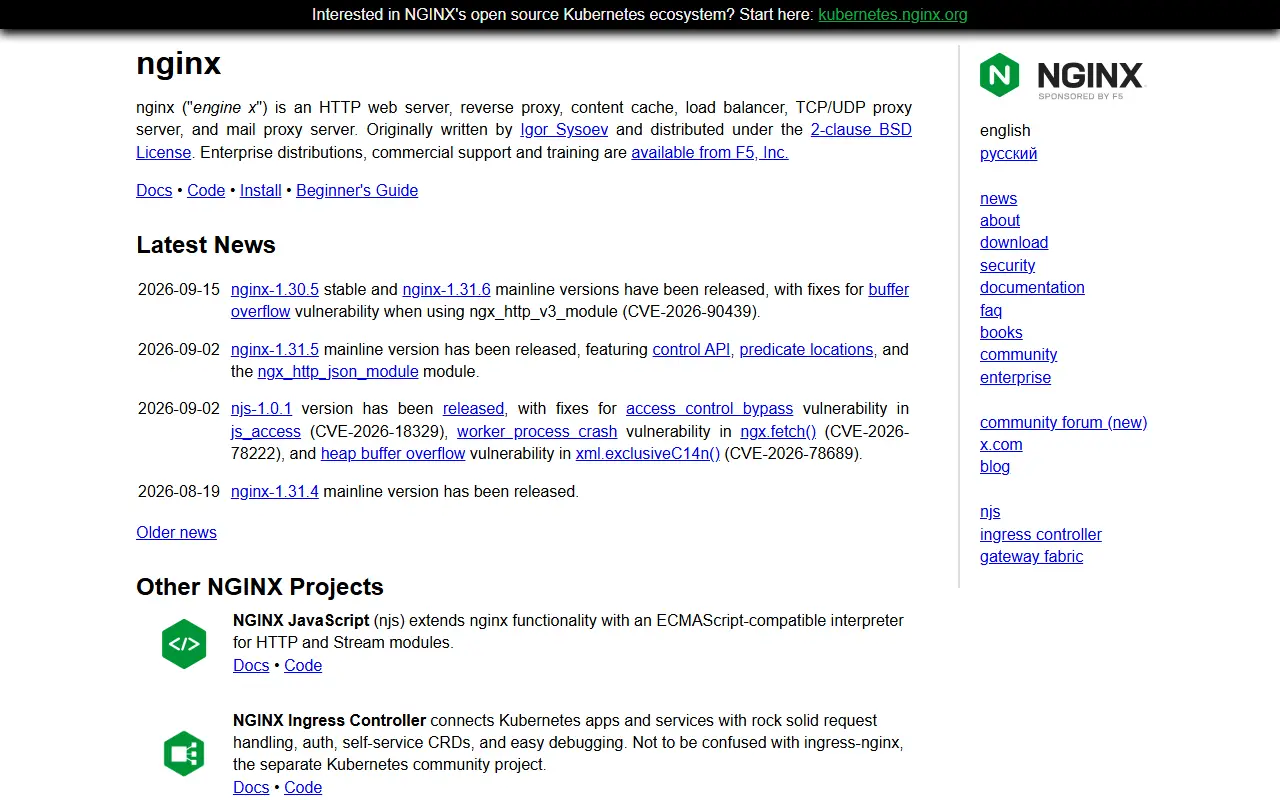
About NGINX
NGINX, pronounced engine x, is a web server that also serves as a reverse proxy, load balancer, API gateway and content cache. The official open source repository is written in C and distributed under a simplified two-clause BSD license. Enterprise distributions, commercial support and training are sold separately by F5, Inc.
NGINX is installed software with binary packages for the major operating systems and Linux distributions, in stable and mainline versions, plus Windows executables and dynamic modules. Typical tasks covered by the project's introduction include installing SSL certificates and enabling TLS, load balancing, rate limiting and content caching. Topics on the repository list TCP, UDP and mail proxying, HTTP/2, HTTP/3 and QUIC. You can also build from source, and the full documentation includes a beginners guide, development guide and directive reference.
Key features
- Web server and reverse proxy
- Load balancing across upstream servers
- TLS termination, HTTP/2 and HTTP/3
- Rate limiting and content caching
- TCP, UDP and mail proxying
- Stable and mainline release channels
Good fit for
- →Serving static sites and web applications
- →Reverse proxy in front of application servers
- →Load balancing and caching for busy sites
- Built with
- C
- Tags
- web-server
- reverse-proxy
- load-balancer
- http
- tls
- api-gateway
- caching
- nginx
NGINX: questions and answers
- What is NGINX used for?
- NGINX is a web server, reverse proxy, load balancer, API gateway and content cache, free under a BSD-style license. It is a good fit for serving static sites and web applications, reverse proxy in front of application servers, and load balancing and caching for busy sites.
- Is NGINX open source?
- Yes. NGINX is open source under the BSD-2-Clause licence. Its source code is on GitHub at nginx/nginx and is written mainly in C.
- Is NGINX free?
- Yes. NGINX is open source, so the software itself is free to use.
- Can I self-host NGINX?
- Yes. NGINX can be self-hosted on your own server or infrastructure.
- What is NGINX an alternative to?
- NGINX is an open-source alternative to Cloudflare, Fastly, Amazon CloudFront and Akamai. Other open-source alternatives to Cloudflare include BunkerWeb, SafeLine and ModSecurity.
- Is NGINX actively maintained?
- Yes. The most recent commit to NGINX was on 30 September 2026. The project has 32k stars on GitHub.
Open-source alternatives to NGINX
See all
BunkerWeb
Security
🛡️ Open-source and cloud-native Web Application Firewall (WAF)
AGPL-3.0vs Cloudflare★ 11k
SafeLine
Security
CyberServal open-source WAF is a self-hosted WAF with 20.9K GitHub stars. Block SQL inject
GPL-3.0vs Cloudflare★ 23k
ModSecurity
Security
ModSecurity is an open source, cross platform web application firewall (WAF) engine for Ap
Apache-2.0vs Cloudflare★ 9.8k
CrowdSec
Security
Open-source IDS/IPS, WAF and bot detection for Linux, Windows, Docker and Kubernetes, with
MITvs Cloudflare★ 15k
Technitium DNS Server
Networking & VPN
Technitium DNS Server
GPL-3.0vs Cloudflare★ 10k
PowerDNS
Networking & VPN
PowerDNS Authoritative, PowerDNS Recursor, dnsdist
GPL-2.0vs Cloudflare★ 4.5k
SaaS alternatives to NGINX
See all
Cloudflare
Networking & VPN
CDN, DNS, DDoS protection and edge computing platform
SaaS
Fastly
Networking & VPN
Edge cloud platform for CDN, security and serverless compute
SaaS
Amazon CloudFront
Networking & VPN
AWS content delivery network for caching and accelerating web content and APIs
SaaS
Akamai
Networking & VPN
CDN, security and edge compute platform for enterprise web delivery
SaaS
Gcore
Networking & VPN
CDN, edge cloud, DNS and DDoS protection provider
SaaS
KeyCDN
Networking & VPN
Pay-as-you-go content delivery network
SaaS