
About Cloudflare
Cloudflare is a network platform that sits in front of websites and applications to speed them up and protect them. Its core services are a content delivery network, DNS, unmetered DDoS protection, universal SSL certificates and a web application firewall, all managed from a single dashboard.
Beyond web performance and security, Cloudflare sells a SASE and Zero Trust suite and a compute and storage platform for building applications at the edge, with AI services priced on usage as well. Higher website plans add features such as lossless image optimization, PCI DSS 4.0 compliance and an uptime SLA.
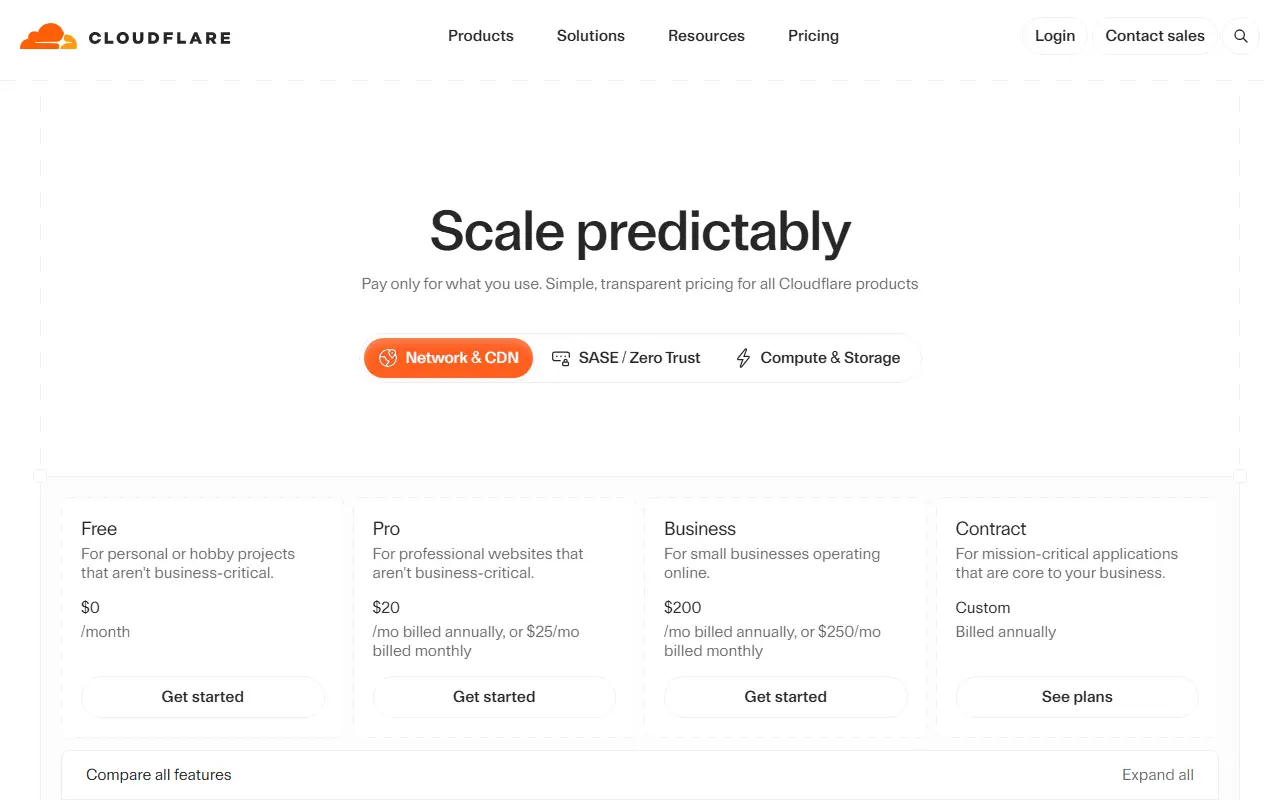
Cloudflare is a hosted, proprietary service with no self-hosted version. Website plans range from Free through Pro and Business to a custom Contract tier, so it suits everything from hobby sites to businesses running mission-critical applications.
Key features
- Global CDN for caching web content
- DNS hosting for domains
- Unmetered DDoS protection
- Web application firewall with managed rulesets
- Free universal SSL certificates
- Compute and storage platform for edge apps
- Zero Trust and SASE services
Good fit for
- →Speeding up and protecting a website
- →Mitigating DDoS attacks
- →Building applications on edge compute
- Tags
- cdn
- dns
- ddos-protection
- waf
- edge-computing
- security
- networking
- zero-trust
Cloudflare: questions and answers
- What is Cloudflare used for?
- Cloudflare is a global edge platform offering CDN, DNS, DDoS protection, a web application firewall and edge computing, with free and paid plans. It is a good fit for speeding up and protecting a website, mitigating DDoS attacks, and building applications on edge compute.
- Is Cloudflare free?
- Yes. Cloudflare has a free plan. Free plan at $0; Pro from $20/month billed annually; Business from $200/month billed annually; custom Contract plans. Compute, storage and AI are usage-based.
- Is Cloudflare open source?
- No. Cloudflare is proprietary (closed-source) software and can't be self-hosted. Open-source alternatives to Cloudflare include Zrok, PowerDNS and Pangolin.
- What are some alternatives to Cloudflare?
- Cloudflare competes with Fastly, Amazon CloudFront and Akamai. For open-source options, see Enlisted's ranked list of open-source Cloudflare alternatives.
Open-source alternatives to Cloudflare
See all
Zrok
Networking & VPN
Secure internet sharing made simple.
Apache-2.0vs ngrok★ 4.7k
PowerDNS
Networking & VPN
PowerDNS Authoritative, PowerDNS Recursor, dnsdist
GPL-2.0vs Cloudflare★ 4.5k
Pangolin
Networking & VPN
Open-source SASE platform providing secure access and connectivity to apps, infrastructure
OSSvs Cloudflare Tunnel★ 23k
Technitium DNS Server
Networking & VPN
Technitium DNS Server
GPL-3.0vs Cloudflare★ 10k
Octelium
Networking & VPN
A next-gen FOSS self-hosted unified zero trust secure access platform that can operate as
AGPL-3.0vs Tailscale★ 4.1k
NGINX
Networking & VPN
The official NGINX Open Source repository.
BSD-2-Clausevs Cloudflare★ 32k
SaaS alternatives to Cloudflare
See all
Fastly
Networking & VPN
Edge cloud platform for CDN, security and serverless compute
SaaS
Amazon CloudFront
Networking & VPN
AWS content delivery network for caching and accelerating web content and APIs
SaaS
Akamai
Networking & VPN
CDN, security and edge compute platform for enterprise web delivery
SaaS
Bunny.net
Hosting & PaaS
CDN, edge storage and DNS service with pay-as-you-go pricing
SaaS
Gcore
Networking & VPN
CDN, edge cloud, DNS and DDoS protection provider
SaaS
CDN77
Networking & VPN
Content delivery network for video, downloads and websites
SaaS