
 NextDNS
 Control D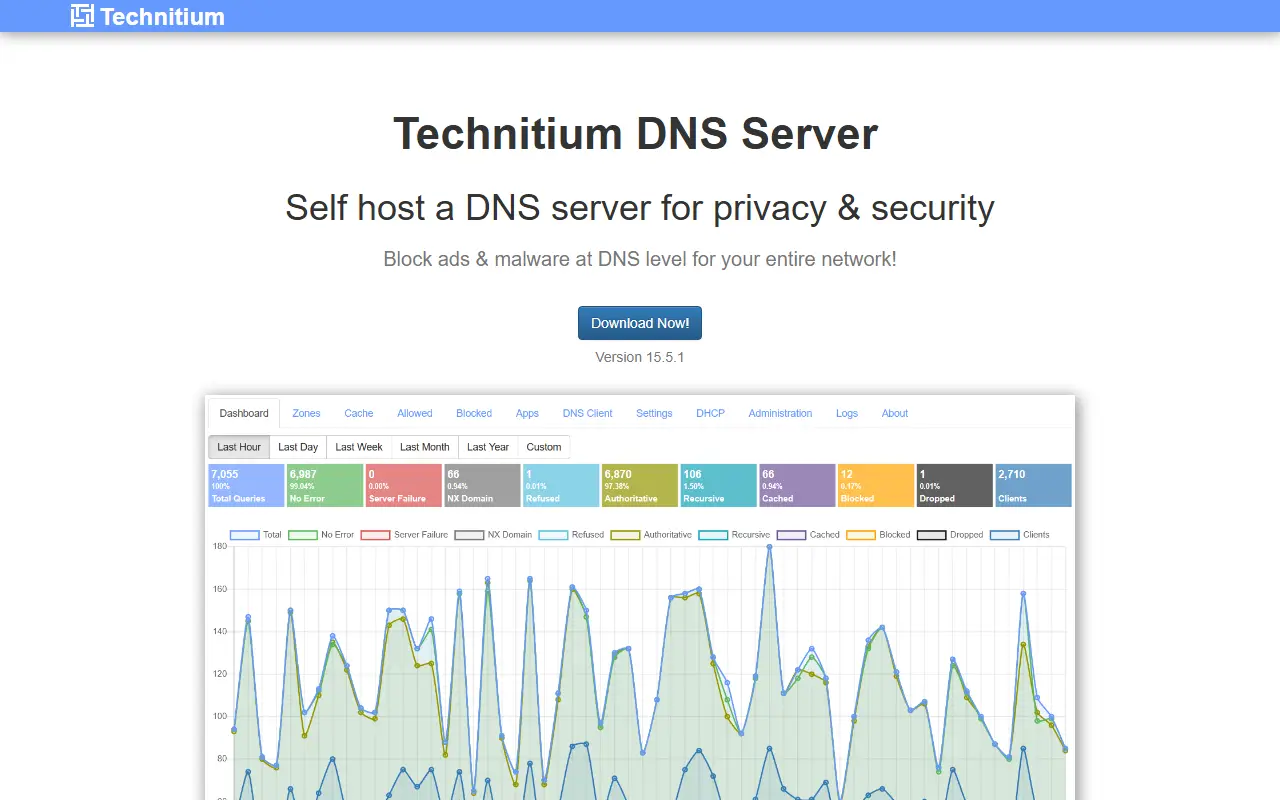
About Technitium DNS Server
Technitium DNS Server is an open-source DNS server that can act as both an authoritative and a recursive resolver. People host it themselves for privacy and security, and it works out of the box with little or no configuration. A friendly web console is reachable from any modern browser.
It can block ads and malware at the DNS level for an entire network. By forwarding queries over DNS-over-TLS, DNS-over-HTTPS or DNS-over-QUIC, it limits what an internet provider can see or tamper with. A local DNS server also gives logs and statistics for understanding network activity, serves many queries from cache, and allows network-wide domain blocking. Repository topics also mention DHCP server functions and DNS-over-Tor.
The server is written in C# on .NET and runs on Windows, Linux, macOS and Raspberry Pi, with Docker support. It is released under the GPL-3.0 license, and the project site at technitium.com provides downloads and documentation. It is suited to home networks and organizations that want more control over name resolution.
Key features
- Authoritative and recursive DNS server
- Network-wide ad and malware blocking
- DNS-over-TLS, HTTPS and QUIC forwarders
- Browser-based web console
- DNS logs and statistics
- Windows, Linux, macOS and Raspberry Pi support
Good fit for
- →Blocking ads across a home network
- →Running private DNS for an office
- Tags
- dns
- dns-server
- privacy
- ad-blocking
- dhcp
- self-hosted
- dotnet
- network
Technitium DNS Server: questions and answers
- What is Technitium DNS Server used for?
- Technitium DNS Server, a self-hosted authoritative and recursive DNS server with ad blocking, encrypted DNS and a web console. It is a good fit for blocking ads across a home network and running private DNS for an office.
- Is Technitium DNS Server open source?
- Yes. Technitium DNS Server is open source under the GPL-3.0 licence. Its source code is on GitHub at TechnitiumSoftware/DnsServer and is written mainly in C#.
- Is Technitium DNS Server free?
- Yes. Technitium DNS Server is open source, so the software itself is free to use.
- Can I self-host Technitium DNS Server?
- Yes. Technitium DNS Server can be self-hosted on your own server or infrastructure; there is no official hosted version.
- What is Technitium DNS Server an alternative to?
- Technitium DNS Server is an open-source alternative to Cloudflare, Cisco Umbrella, Gcore and Amazon Route 53. Other open-source alternatives to Cloudflare include PowerDNS.
- Is Technitium DNS Server actively maintained?
- Yes. The most recent commit to Technitium DNS Server was on 26 September 2026, and the latest release is v15.5.1, published on 26 September 2026. The project has 10k stars on GitHub.
Open-source alternatives to Technitium DNS Server
See all
PowerDNS
Networking & VPN
PowerDNS Authoritative, PowerDNS Recursor, dnsdist
GPL-2.0vs Cloudflare★ 4.5k
Pi-hole
Networking & VPN
A black hole for Internet advertisements
OSSvs Cisco Umbrella★ 61k
AdGuard Home
Networking & VPN
Network-wide ads & trackers blocking DNS server
GPL-3.0vs Cisco Umbrella★ 37kBlocky
Networking & VPN
Fast and lightweight DNS proxy as ad-blocker for local network with many features
Apache-2.0vs Cisco Umbrella★ 7k
CoreDNS
Networking & VPN
CoreDNS is a DNS server that chains plugins
Apache-2.0vs Amazon Route 53★ 14k
PowerDNS-Admin
Networking & VPN
A PowerDNS web interface with advanced features
MITvs Amazon Route 53★ 2.8k
SaaS alternatives to Technitium DNS Server
See all
Cloudflare
Networking & VPN
CDN, DNS, DDoS protection and edge computing platform
SaaS
Cisco Umbrella
Security
Cloud security service providing DNS-layer protection and secure web gateway
SaaS
Gcore
Networking & VPN
CDN, edge cloud, DNS and DDoS protection provider
SaaS
Amazon Route 53
Networking & VPN
Scalable DNS, domain registration and health-check routing service on AWS
SaaS
NS1
Networking & VPN
Managed DNS and traffic management platform from IBM
SaaS
DNSimple
Networking & VPN
DNS hosting and domain registration service with an API
SaaS