
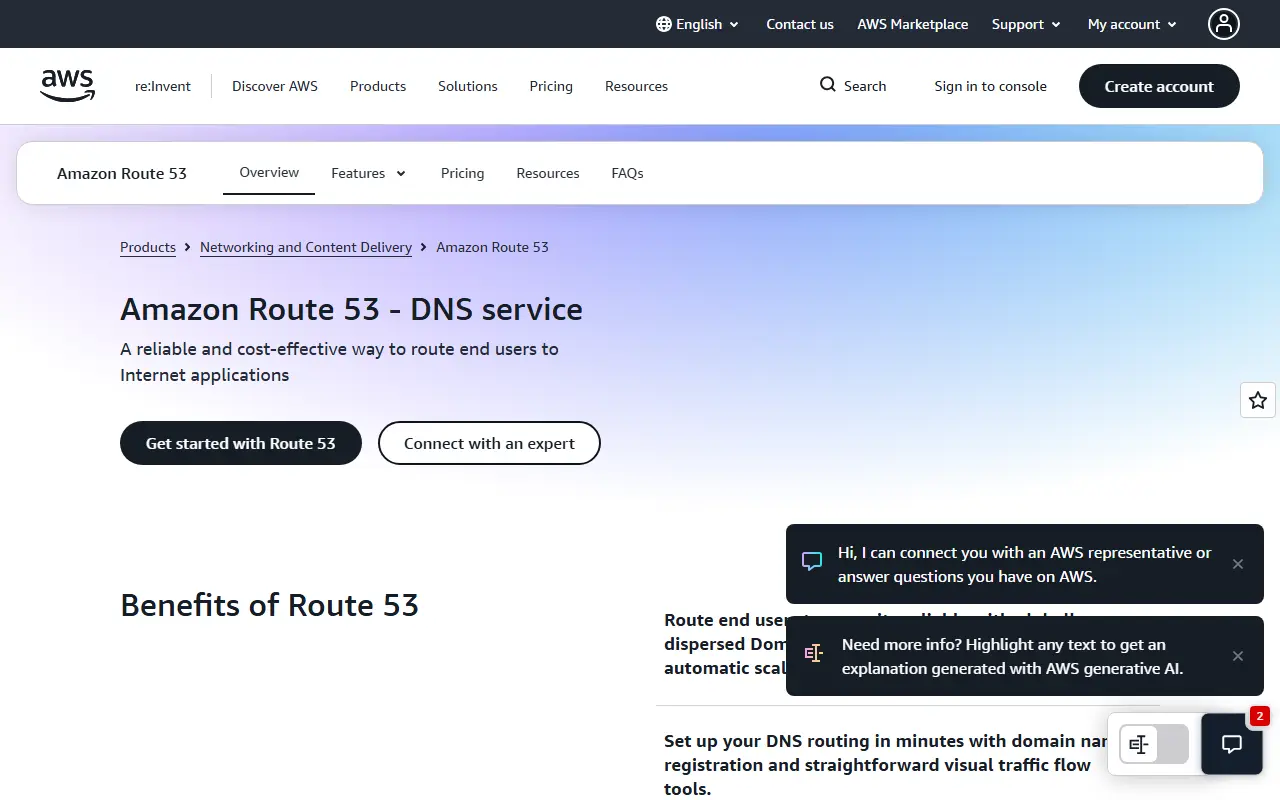
About Amazon Route 53
Amazon Route 53 is the domain name system service from Amazon Web Services. It translates domain names into IP addresses and is built to be highly available and scalable, so it is commonly used as the authoritative DNS for websites and applications running on AWS or elsewhere.
Besides hosting DNS zones, Route 53 can register domain names and monitor the health of endpoints. Its routing policies let teams steer traffic by factors such as latency, geographic location, weighting or failover, which helps reduce latency and keep applications reachable when a resource fails.
Route 53 is a commercial AWS service charged by usage, aimed at developers and operations teams of any size, and it integrates closely with other AWS services. Pricing is documented on the AWS Route 53 pricing page.
Key features
- Authoritative DNS hosting for domains
- Domain name registration
- Health checks for endpoint monitoring
- Latency, geolocation and weighted routing
- DNS failover between resources
- Integration with other AWS services
Good fit for
- →Hosting DNS for AWS-based applications
- →Failing over traffic between regions
- →Routing users to the lowest-latency endpoint
- Tags
- dns
- aws
- domain-registration
- traffic-routing
- health-checks
- cloud
Amazon Route 53: questions and answers
- What is Amazon Route 53 used for?
- Amazon Route 53 is AWS's scalable DNS service, also providing domain registration and health-check based traffic routing. It is a good fit for hosting DNS for AWS-based applications, failing over traffic between regions and routing users to the lowest-latency endpoint.
- How much does Amazon Route 53 cost?
- Amazon Route 53 is a paid product with no free plan. Pay as you go with no upfront fees: $0.50 per hosted zone per month for the first 25 zones and $0.40 per million standard DNS queries. Traffic Flow policy records cost $50 per month.
- Is Amazon Route 53 open source?
- No. Amazon Route 53 is proprietary (closed-source) software and can't be self-hosted. Open-source alternatives to Amazon Route 53 include CoreDNS, Technitium DNS Server and PowerDNS.
- What are some alternatives to Amazon Route 53?
- Amazon Route 53 competes with Cloudflare, NS1 and DNSimple. For open-source options, see Enlisted's ranked list of open-source Amazon Route 53 alternatives.
Open-source alternatives to Amazon Route 53
See all
CoreDNS
Networking & VPN
CoreDNS is a DNS server that chains plugins
Apache-2.0vs Amazon Route 53★ 14k
Technitium DNS Server
Networking & VPN
Technitium DNS Server
GPL-3.0vs Cloudflare★ 10k
PowerDNS
Networking & VPN
PowerDNS Authoritative, PowerDNS Recursor, dnsdist
GPL-2.0vs Cloudflare★ 4.5k
PowerDNS-Admin
Networking & VPN
A PowerDNS web interface with advanced features
MITvs Amazon Route 53★ 2.8k
Pi-hole
Networking & VPN
A black hole for Internet advertisements
OSSvs Cisco Umbrella★ 61k
sing-box
Networking & VPN
The universal proxy platform
OSS★ 39k
SaaS alternatives to Amazon Route 53
See all
Cloudflare
Networking & VPN
CDN, DNS, DDoS protection and edge computing platform
SaaS
NS1
Networking & VPN
Managed DNS and traffic management platform from IBM
SaaS
DNSimple
Networking & VPN
DNS hosting and domain registration service with an API
SaaS
Akamai
Networking & VPN
CDN, security and edge compute platform for enterprise web delivery
SaaS
Gandi
Hosting & PaaS
Domain registrar and web hosting provider
SaaS
Amazon CloudFront
Networking & VPN
AWS content delivery network for caching and accelerating web content and APIs
SaaS