
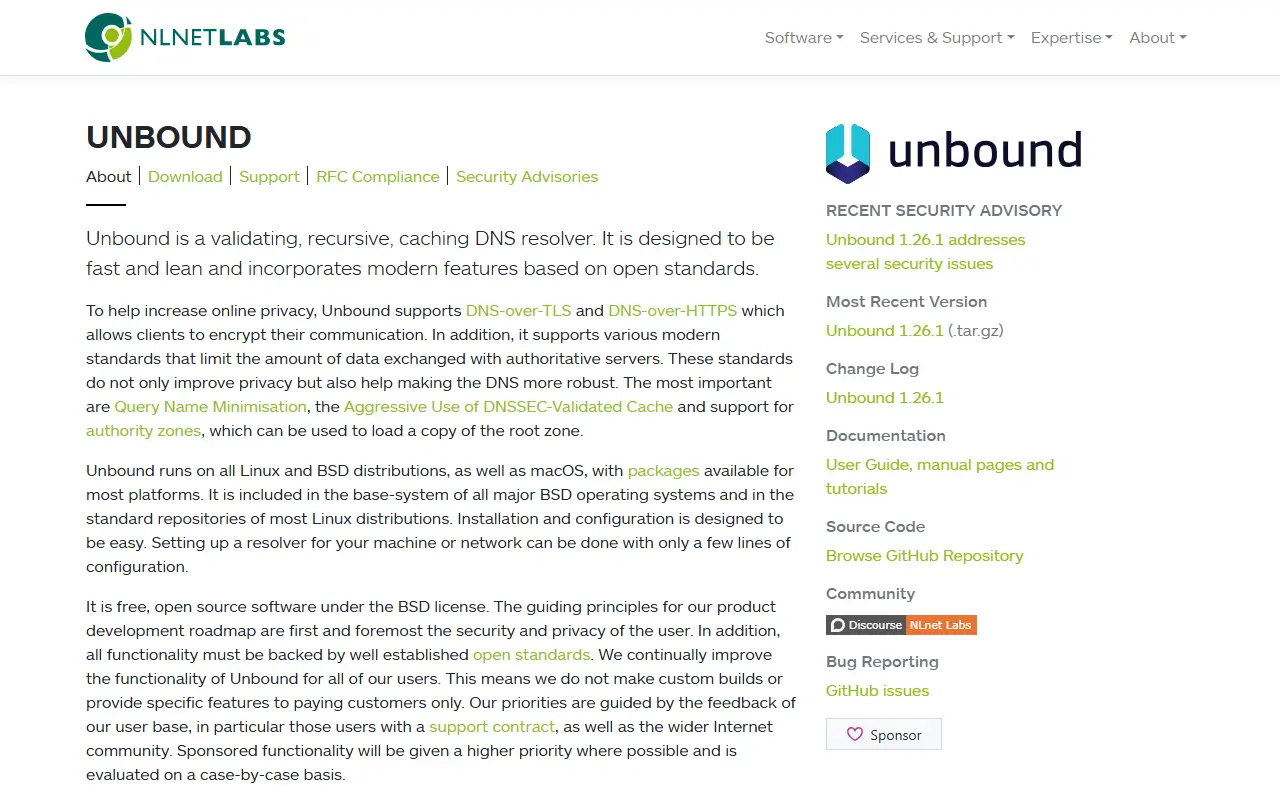
About Unbound
Unbound is a validating, recursive, and caching DNS resolver designed to be fast and lean, incorporating modern features based on open standards. It supports DNS-over-TLS and DNS-over-HTTPS to encrypt client communication, and includes standards like Query Name Minimisation and Aggressive Use of DNSSEC-Validated Cache.
It runs on all Linux and BSD distributions, as well as macOS, with packages available for most platforms. It is included in the base system of major BSD operating systems and standard repositories of most Linux distributions, with easy installation and configuration.
Key features
- Validating, recursive, and caching DNS resolution
- DNS-over-TLS and DNS-over-HTTPS support for encrypted communication
- Query Name Minimisation to limit data exchanged with authoritative servers
- Aggressive Use of DNSSEC-Validated Cache
- Support for authority zones, including loading a copy of the root zone
- Free and open source under the BSD license
Good fit for
- Setting up a local or network DNS resolver
- Enhancing online privacy through encrypted DNS queries
- Improving DNS robustness with DNSSEC validation and caching
Unbound: questions and answers
- What is Unbound used for?
- Unbound is a validating, recursive, and caching DNS resolver that supports DNS-over-TLS and DNS-over-HTTPS for encrypted client communication. It is a good fit for setting up a local or network DNS resolver, enhancing online privacy through encrypted DNS queries, and improving DNS robustness with DNSSEC validation and caching.
- Is Unbound open source?
- Yes. Unbound is open source under the BSD-3-Clause licence. Its source code is on GitHub at NLnetLabs/unbound and is written mainly in C.
- Is Unbound free?
- Yes. Unbound is open source, so the software itself is free to use.
- Can I self-host Unbound?
- Yes. Unbound can be self-hosted on your own server or infrastructure; there is no official hosted version.
- What is Unbound an alternative to?
- Unbound is an open-source alternative to Gcore, NextDNS, NS1 and Amazon Route 53. Other open-source alternatives to Gcore include Technitium DNS Server, PowerDNS and bind9.
- Is Unbound actively maintained?
- Yes. The most recent commit to Unbound was on 13 October 2026. The project has 5k stars on GitHub.
Open-source alternatives to Unbound
See all
Technitium DNS Server
Networking & VPN
Technitium DNS Server
GPL-3.0vs Cloudflare★ 10k
PowerDNS
Networking & VPN
PowerDNS Authoritative, PowerDNS Recursor, dnsdist
GPL-2.0vs Cloudflare★ 4.5k
bind9
Networking & VPN
Archived mirror of https://gitlab.isc.org/isc-projects/bind9, please submit issues and PR/
MPL-2.0vs Gcore★ 781
CoreDNS
Networking & VPN
CoreDNS is a DNS server that chains plugins
Apache-2.0vs Amazon Route 53★ 14k
Pi-hole
Networking & VPN
A black hole for Internet advertisements
OSSvs Cisco Umbrella★ 61k
AdGuard Home
Networking & VPN
Network-wide ads & trackers blocking DNS server
GPL-3.0vs Cisco Umbrella★ 37k
SaaS alternatives to Unbound
See all
Gcore
Networking & VPN
CDN, edge cloud, DNS and DDoS protection provider
SaaS
NextDNS
Networking & VPN
Cloud DNS resolver with ad, tracker and malware blocking
SaaS
NS1
Networking & VPN
Managed DNS and traffic management platform from IBM
SaaS
Amazon Route 53
Networking & VPN
Scalable DNS, domain registration and health-check routing service on AWS
SaaS
Control D
Networking & VPN
Customizable DNS filtering and traffic routing service
SaaS
DNSimple
Networking & VPN
DNS hosting and domain registration service with an API
SaaS