6,598 open-source and SaaS tools, with GitHub stats refreshed every day.

3 alternatives ranked by real activity

Open-source Gcore alternatives

A curated, ranked list of the 3 best open-source alternatives to Gcore.

The best open-source alternative to Gcore is NGINX. If that doesn't suit you, other good options are Technitium DNS Server and PowerDNS.

Gcore alternatives are mainly Networking & VPN tools. 3 of them shipped code in the last 30 days, 3 can be self-hosted, and 1 uses a permissive licence.

Last updated October 3, 2026 · ranked by GitHub stars, growth and recent commits

NGINX

NGINX is a web server, reverse proxy, load balancer, API gateway and content cache, free under a BSD-style license.

GitHub stars
32k
Last commit
2 days ago
Latest release
release-1.31.6
Licence
BSD-2-Clause
Self-hosted
Yes
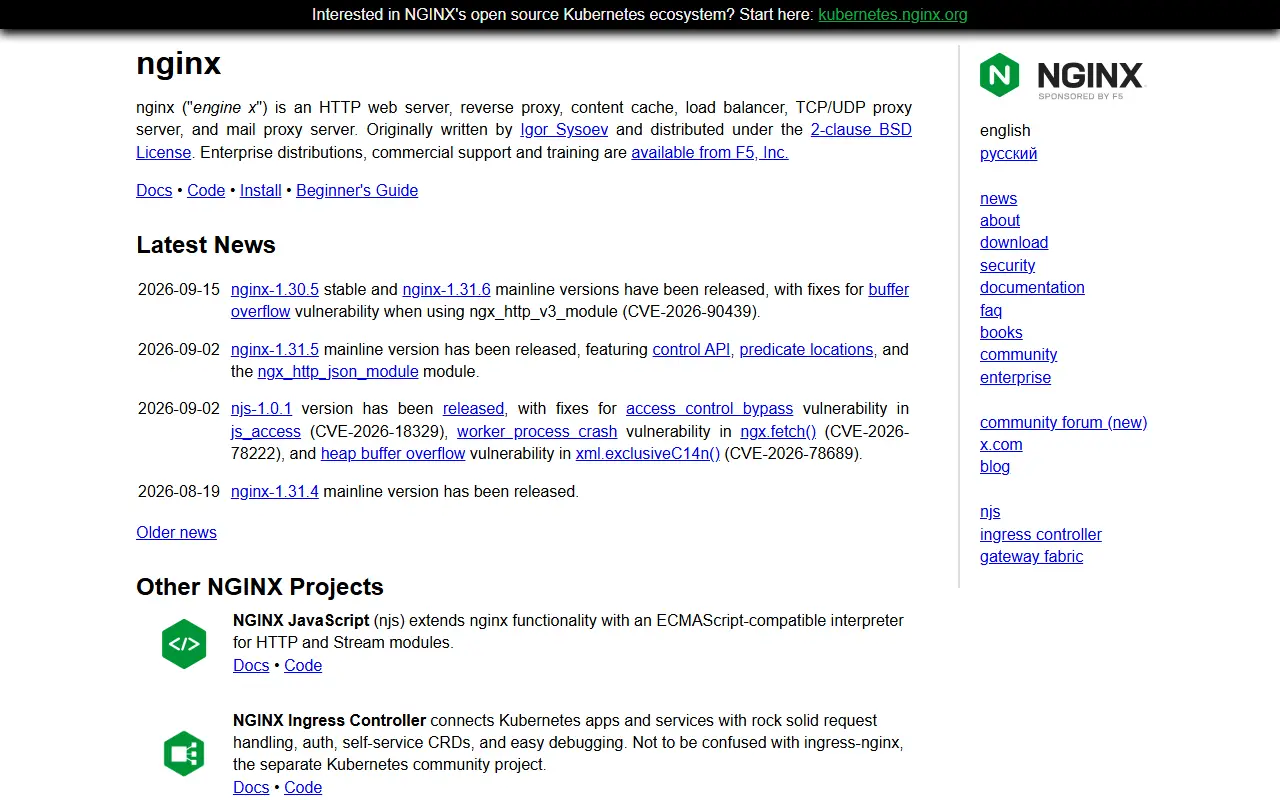
nginx.orgNGINX homepage screenshot

NGINX, pronounced engine x, is a web server that also serves as a reverse proxy, load balancer, API gateway and content cache. The official open source repository is written in C and distributed under a simplified two-clause BSD license. Enterprise distributions, commercial support and training are sold separately by F5, Inc.

NGINX is installed software with binary packages for the major operating systems and Linux distributions, in stable and mainline versions, plus Windows executables and dynamic modules. Typical tasks covered by the project's introduction include installing SSL certificates and enabling TLS, load balancing, rate limiting and content caching. Topics on the repository list TCP, UDP and mail proxying, HTTP/2, HTTP/3 and QUIC. You can also build from source, and the full documentation includes a beginners guide, development guide and directive reference.

Key features

  • Web server and reverse proxy
  • Load balancing across upstream servers
  • TLS termination, HTTP/2 and HTTP/3
  • Rate limiting and content caching
  • TCP, UDP and mail proxying
  • Stable and mainline release channels

Pricing: Free and open source under a two-clause BSD license; enterprise distributions and support are sold by F5, Inc.

Technitium DNS Server

Technitium DNS Server, a self-hosted authoritative and recursive DNS server with ad blocking, encrypted DNS and a web console.

GitHub stars
10k
Last commit
6 days ago
Latest release
v15.5.1
Licence
GPL-3.0
Self-hosted
Yes
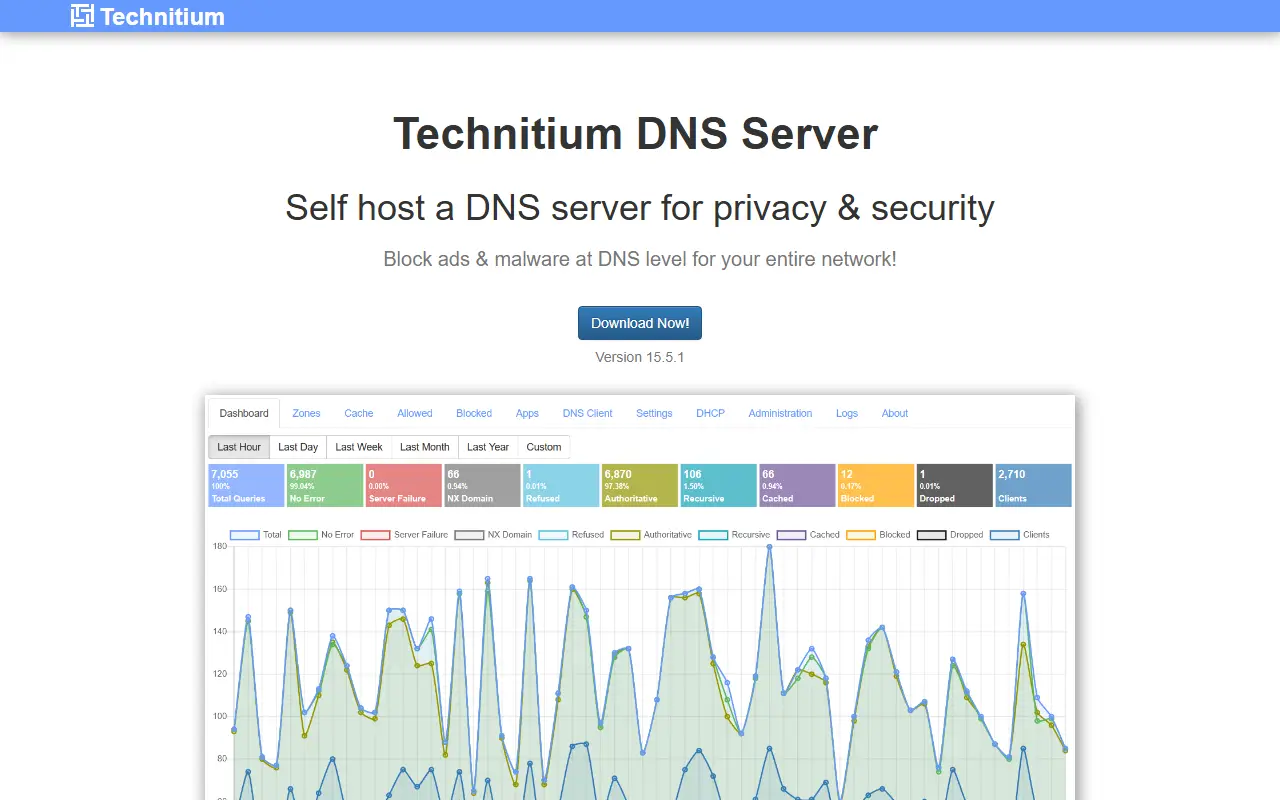
technitium.comTechnitium DNS Server homepage screenshot

Technitium DNS Server is an open-source DNS server that can act as both an authoritative and a recursive resolver. People host it themselves for privacy and security, and it works out of the box with little or no configuration. A friendly web console is reachable from any modern browser.

It can block ads and malware at the DNS level for an entire network. By forwarding queries over DNS-over-TLS, DNS-over-HTTPS or DNS-over-QUIC, it limits what an internet provider can see or tamper with. A local DNS server also gives logs and statistics for understanding network activity, serves many queries from cache, and allows network-wide domain blocking. Repository topics also mention DHCP server functions and DNS-over-Tor.

The server is written in C# on .NET and runs on Windows, Linux, macOS and Raspberry Pi, with Docker support. It is released under the GPL-3.0 license, and the project site at technitium.com provides downloads and documentation. It is suited to home networks and organizations that want more control over name resolution.

Key features

  • Authoritative and recursive DNS server
  • Network-wide ad and malware blocking
  • DNS-over-TLS, HTTPS and QUIC forwarders
  • Browser-based web console
  • DNS logs and statistics
  • Windows, Linux, macOS and Raspberry Pi support

Pricing: Free and open source under the GPL-3.0 license.

PowerDNS

The PowerDNS source repository containing the Authoritative Server, the Recursor and dnsdist, a DNS load balancer, for running DNS infrastructure.

GitHub stars
4.5k
Last commit
today
Licence
GPL-2.0
Self-hosted
Yes
powerdns.comPowerDNS homepage screenshot

This repository contains the sources for PowerDNS, a set of DNS server software. It includes the PowerDNS Authoritative Server, the PowerDNS Recursor and dnsdist, a DNS load balancer. All three can be built from the same repository, although they are also released separately as tarball, deb and rpm packages.

The authoritative server depends on Boost, OpenSSL and Lua and needs a compiler with C++17 support, and the project provides pdns-builder, a Docker-based build process for producing the different releases. Docker images are available, with the README mirrored to Docker Hub, and full documentation lives at doc.powerdns.com.

PowerDNS is copyright PowerDNS.COM BV and many contributors and is distributed under the GNU GPLv2, with the NOTICE file describing the exact license and exception. Bugs are reported on the GitHub issue tracker, and the changelog on the documentation site is the place to check for recent updates.

Key features

  • Authoritative DNS server
  • Recursive DNS resolver
  • dnsdist DNS load balancer
  • Releases as tarball, deb and rpm
  • Docker images and Docker-based builder
  • Documentation and changelog online

Pricing: Free and open source under the GPL-2.0 licence.

Gcore alternatives: questions

What is the best open-source alternative to Gcore?
NGINX is the top-ranked open-source alternative to Gcore on Enlisted: NGINX is a web server, reverse proxy, load balancer, API gateway and content cache, free under a BSD-style license. Other strong options are Technitium DNS Server and PowerDNS.
Are these Gcore alternatives free?
All 3 are open source, so the code is free to use under its licence, and 3 of them can be self-hosted on your own server.
How is this list of Gcore alternatives ranked?
By a score built from GitHub stars, star growth over the last 30 days and how recently the code changed. 3 of these projects shipped code in the last 30 days. Data is refreshed daily, and nobody can pay to move up.

People also look for alternatives to…

View all