
About CoreDNS
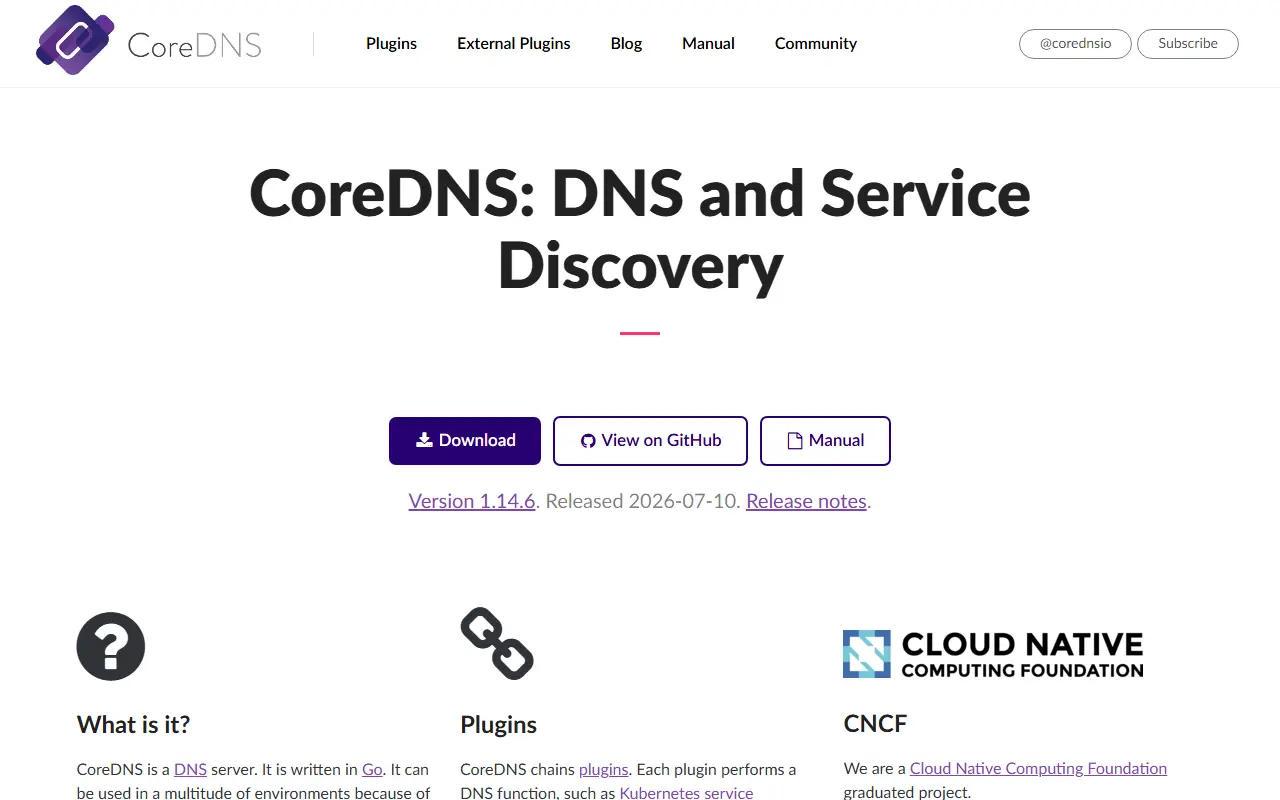
CoreDNS is a DNS server and forwarder, written in Go, that chains plugins together, with each plugin performing a DNS function. It is a Cloud Native Computing Foundation graduated project and is released under the Apache 2.0 license. If a function is not available out of the box, it can be added by writing a plugin.
It can listen for DNS requests over UDP and TCP, TLS (DoT), DNS over HTTP/2 (DoH), DNS over HTTP/3, DNS over QUIC (DoQ) and gRPC. Its plugins cover serving zone data from files with DNSSEC and DNS support, acting as a primary or secondary server, signing zone data on the fly, load balancing responses, caching, and forwarding queries to other nameservers.
Backends include etcd and Kubernetes, which is why topics mention service discovery, and there are plugins for Prometheus metrics, query and error logging, Route 53 integration, query rewriting, DNS64 IPv6 translation, profiling and more. Each plugin is documented individually. It is run by operators on their own infrastructure.
Key features
- Plugin chain architecture
- DNS over TLS, HTTPS, HTTP/3 and QUIC
- Zone file serving with DNSSEC signing
- Caching and query forwarding
- Kubernetes and etcd backends
- Prometheus metrics and logging
Good fit for
- →Cluster DNS and service discovery
- →Custom DNS forwarding and caching
- Built with
- Go
- Tags
- dns
- dns-server
- plugins
- kubernetes
- service-discovery
- cncf
- golang
- dnssec
CoreDNS: questions and answers
- What is CoreDNS used for?
- CoreDNS is a flexible DNS server and forwarder written in Go whose functionality comes from chained plugins. It is a good fit for cluster DNS and service discovery, and custom DNS forwarding and caching.
- Is CoreDNS open source?
- Yes. CoreDNS is open source under the Apache-2.0 licence. Its source code is on GitHub at coredns/coredns and is written mainly in Go.
- Is CoreDNS free?
- Yes. CoreDNS is open source, so the software itself is free to use.
- Can I self-host CoreDNS?
- Yes. CoreDNS can be self-hosted on your own server or infrastructure; there is no official hosted version.
- What is CoreDNS an alternative to?
- CoreDNS is an open-source alternative to Amazon Route 53, NS1 and DNSimple. Other open-source alternatives to Amazon Route 53 include Technitium DNS Server, PowerDNS and PowerDNS-Admin.
- Is CoreDNS actively maintained?
- Yes. The most recent commit to CoreDNS was on 30 September 2026, and the latest release is v1.14.7, published on 19 August 2026. The project has 14k stars on GitHub.
Open-source alternatives to CoreDNS
See all
Technitium DNS Server
Networking & VPN
Technitium DNS Server
GPL-3.0vs Cloudflare★ 10k
PowerDNS
Networking & VPN
PowerDNS Authoritative, PowerDNS Recursor, dnsdist
GPL-2.0vs Cloudflare★ 4.5k
PowerDNS-Admin
Networking & VPN
A PowerDNS web interface with advanced features
MITvs Amazon Route 53★ 2.8k
Traefik
Networking & VPN
The Cloud Native Application Proxy
MIT★ 65k
sing-box
Networking & VPN
The universal proxy platform
OSS★ 39k
AdGuard Home
Networking & VPN
Network-wide ads & trackers blocking DNS server
GPL-3.0vs Cisco Umbrella★ 37k
SaaS alternatives to CoreDNS
See all
Amazon Route 53
Networking & VPN
Scalable DNS, domain registration and health-check routing service on AWS
SaaS
NS1
Networking & VPN
Managed DNS and traffic management platform from IBM
SaaS
DNSimple
Networking & VPN
DNS hosting and domain registration service with an API
SaaS
Cloudflare
Networking & VPN
CDN, DNS, DDoS protection and edge computing platform
SaaS
Control D
Networking & VPN
Customizable DNS filtering and traffic routing service
SaaS
Gcore
Networking & VPN
CDN, edge cloud, DNS and DDoS protection provider
SaaS