 TrackMedia
 TrackRev

About Zrok
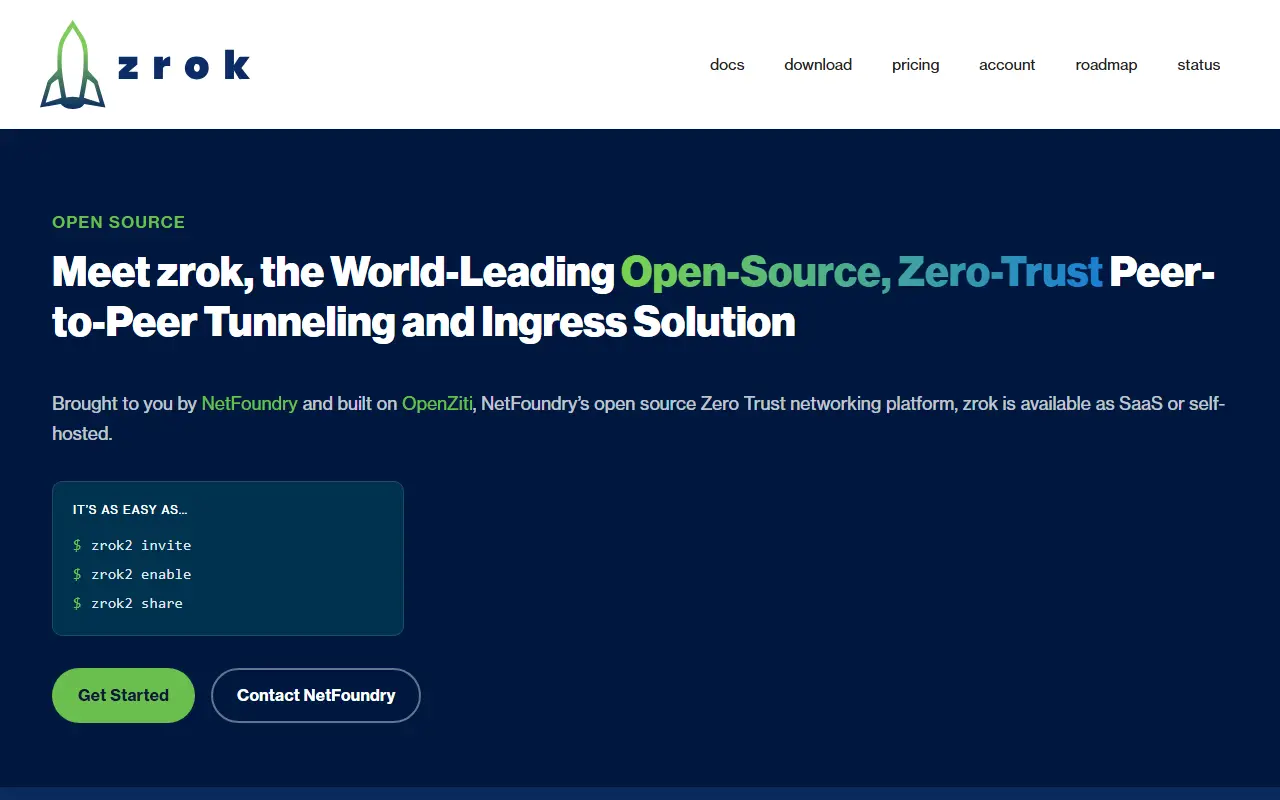
zrok lets you share web services, files and network resources with other people, whether they are across the internet or on a private network. It is built on zero-trust networking, so it works through firewalls and NAT without port forwarding or other network changes, and it behaves like a secure reverse proxy and peer-to-peer sharing tool.
Getting started takes a few steps: install zrok, create an account with the invite command, using the free zrok.io service, and enable sharing on your machine. After that you can publish a local web app, share a folder or expose a private resource to selected users. The project is part of the OpenZiti ecosystem and written in Go.
zrok is licensed under Apache-2.0. You can use the hosted zrok.io service or run your own zrok instance, which suits developers who need to expose a local service temporarily, teams sharing files securely and homelab owners who want remote access without opening ports.
Key features
- Share web services without port forwarding
- File sharing over zero-trust networking
- Works through firewalls and NAT
- Public and private share modes
- Free hosted zrok.io service
- Self-hostable zrok server
Good fit for
- Exposing a local dev server to testers
- Sharing files securely with colleagues
- Remote access to home lab services
Zrok: questions and answers
- What is Zrok used for?
- zrok is an open-source tool for sharing web services, files and network resources securely over the internet without firewall or port-forwarding changes. It is a good fit for exposing a local dev server to testers, sharing files securely with colleagues and remote access to home lab services.
- Is Zrok open source?
- Yes. Zrok is open source under the Apache-2.0 licence. Its source code is on GitHub at openziti/zrok and is written mainly in Go.
- Is Zrok free?
- Yes. Zrok is open source, so the software itself is free to use. A managed cloud version is also available.
- Can I self-host Zrok?
- Yes. Zrok can be self-hosted on your own server or infrastructure.
- What is Zrok an alternative to?
- Zrok is an open-source alternative to ngrok, Cloudflare Tunnel, Tailscale and Cloudflare. Other open-source alternatives to ngrok include Pangolin, Octelium and frp.
- Is Zrok actively maintained?
- Yes. The most recent commit to Zrok was on 12 November 2026, and the latest release is v2.0.9, published on 31 October 2026. The project has 4.8k stars on GitHub, with 39 added in the last 30 days.
Open-source alternatives to Zrok
See all
Pangolin
Networking & VPN
Open-source SASE platform providing secure access and connectivity to apps, infrastructure
OSSvs Cloudflare Tunnel★ 24k
Octelium
Networking & VPN
A next-gen FOSS self-hosted unified zero trust secure access platform that can operate as
AGPL-3.0vs Tailscale★ 4.2kfrp
Networking & VPN
A fast reverse proxy to help you expose a local server behind a NAT or firewall to the int
Apache-2.0vs ngrok★ 111k
NetBird
Networking & VPN
Connect your devices, users, and agents into a secure WireGuard®-based overlay network wit
OSSvs Tailscale★ 31k
OpenZiti
Networking & VPN
The parent project for OpenZiti. Here you will find the executables for a fully zero-trust
Apache-2.0vs Twingate★ 4.5kHeadscale
Networking & VPN
An open source, self-hosted implementation of the Tailscale control server
BSD-3-Clausevs Tailscale★ 46k
SaaS alternatives to Zrok
See all
ngrok
Networking & VPN
ngrok is developer infrastructure that exposes local apps and APIs to the internet and routes and secures traffic to services wherever they run.
SaaS
Cloudflare Tunnel
Networking & VPN
Cloudflare Tunnel securely connects web services and private networks to Cloudflare without opening inbound ports on the origin server.
SaaS
Tailscale
Networking & VPN
Mesh VPN and zero trust network that connects devices without manual configuration
SaaS
Cloudflare
Networking & VPN
CDN, DNS, DDoS protection and edge computing platform
SaaS
Localdock
Developer Tools
Gives each local project its own address on your Mac, your Wi-Fi network or anywhere online
SaaS
Fastly
Networking & VPN
Edge cloud platform for CDN, security and serverless compute
SaaS