frp is an Apache-2.0 reverse proxy written in Go that exposes servers behind a NAT or firewall to the internet over TCP, UDP, HTTP and HTTPS.
- GitHub stars
- 111k
- Last commit
- 3 days ago
- Latest release
- v0.72.0
- Licence
- Apache-2.0
- Self-hosted
- Yes
frp is a reverse proxy for reaching a local server that sits behind a NAT or firewall from the public internet. It supports TCP and UDP as well as HTTP and HTTPS, so requests can be forwarded to internal services by domain name. It also has a P2P connect mode.
The README's table of contents shows how wide the feature set is. It covers a server dashboard and a client admin UI, Prometheus monitoring, token and OIDC authentication, encryption and compression, TLS, bandwidth limits per proxy, TCP stream multiplexing, KCP and QUIC protocol support, load balancing and health checks.
Examples in the README include reaching a machine over SSH inside a LAN, sharing one port between several SSH services, serving internal web apps on custom domains, forwarding DNS queries and Unix domain sockets, and exposing a simple HTTP file server. Version 1 is in maintenance mode while the author works on an incompatible version 2.
Key features
- Exposes local servers behind NAT or firewalls
- Supports TCP, UDP, HTTP and HTTPS
- Peer-to-peer connect mode
- Token and OIDC authentication for clients
- KCP and QUIC protocol support
- Server dashboard, client admin UI and Prometheus monitoring
- Per-proxy bandwidth limits and port range mapping
- SSH tunnel gateway and virtual network features

NetBird builds a secure WireGuard-based overlay network for devices and users, with SSO, MFA and granular access controls.
- GitHub stars
- 31k
- Last commit
- yesterday
- Latest release
- v0.82.1
- Self-hosted
- Yes
- Hosted version
- Available
netbird.io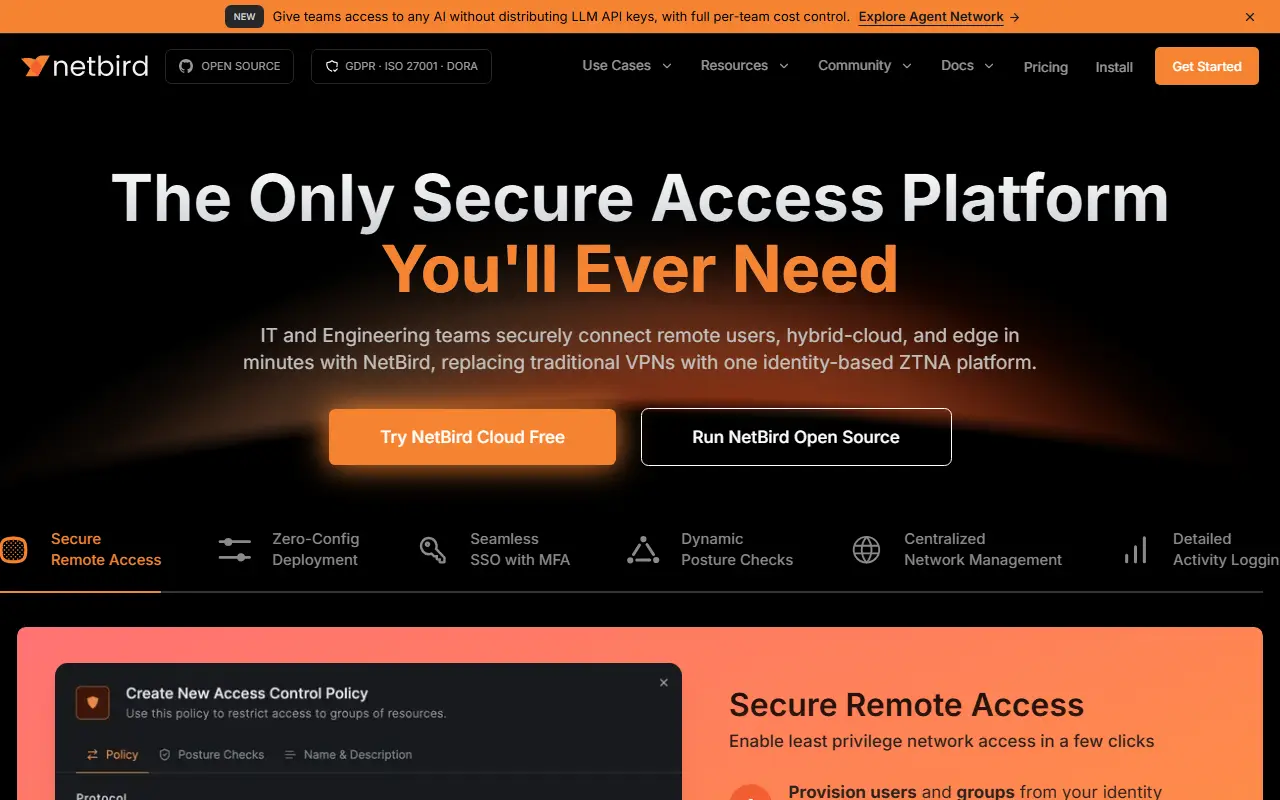
NetBird joins a configuration-free peer-to-peer private network with a central access control system on one platform. It creates a WireGuard-based overlay that connects machines over encrypted tunnels automatically, which avoids opening ports, writing complex firewall rules or running VPN gateways. It is written in Go and can be used for an organization or a home network. The repository metadata lists the license as Other.
Connectivity features include kernel WireGuard, peer-to-peer connections with relay fallback, routes to external networks, exit nodes, and private DNS with custom zones. For management and security there is an admin web UI, automatic peer discovery, SSO and MFA, identity provider integrations, groups and rules for access control, activity logging, traffic events and device posture checks. A public API, setup keys, a Terraform provider and a self-hosting quickstart script support automation. Clients cover Linux, macOS, Windows, Android and Android TV, and an agent network beta targets AI agents.
Key features
- WireGuard-based peer-to-peer overlay network
- Relay fallback when direct connections fail
- SSO, MFA and identity provider integrations
- Access control through groups and rules
- Private DNS, exit nodes and network routes
- Public API and Terraform provider
Pricing: The cloud Free plan covers up to 5 users. Team costs €6 and Business €12 per user per month, with a free trial; Enterprise is custom, and NetBird can also be self-hosted.
Headscale is a BSD-3-Clause, self-hosted implementation of the Tailscale control server, written in Go for homelabs and small organisations.
- GitHub stars
- 46k
- Last commit
- yesterday
- Latest release
- v0.29.7
- Licence
- BSD-3-Clause
- Self-hosted
- Yes
Headscale is an open source, self-hosted implementation of the Tailscale control server. Tailscale is a VPN built on WireGuard that links machines into an overlay network using NAT traversal. The control server exchanges WireGuard public keys, assigns client IP addresses, sets boundaries between users, and exposes the routes your nodes advertise.
The design goal is a self-hosted alternative for self-hosters and hobbyists to use in projects and labs. The scope is deliberately narrow: a single Tailscale network (tailnet), suitable for personal use or a small open-source organisation. Features and client operating system support are documented on the project's documentation site.
It is not associated with Tailscale Inc, although one active maintainer works there. The README advises matching the GitHub tag to the release you run so example configuration fits, and it provides a NixOS module plus development builds as container images and binaries. It also says reverse proxies and containers are not supported or encouraged.
Key features
- Self-hosted Tailscale control server
- Exchanges WireGuard public keys between nodes
- Assigns client IP addresses and user boundaries
- Exposes advertised routes of nodes
- NixOS module available
- Development builds as images and binaries

An open-source SASE platform on WireGuard combining zero-trust VPN and proxy access, privileged access control and an AI gateway that understands identity.
- GitHub stars
- 24k
- Last commit
- today
- Latest release
- 1.26.0
- Self-hosted
- Yes
- Hosted version
- Available
pangolin.net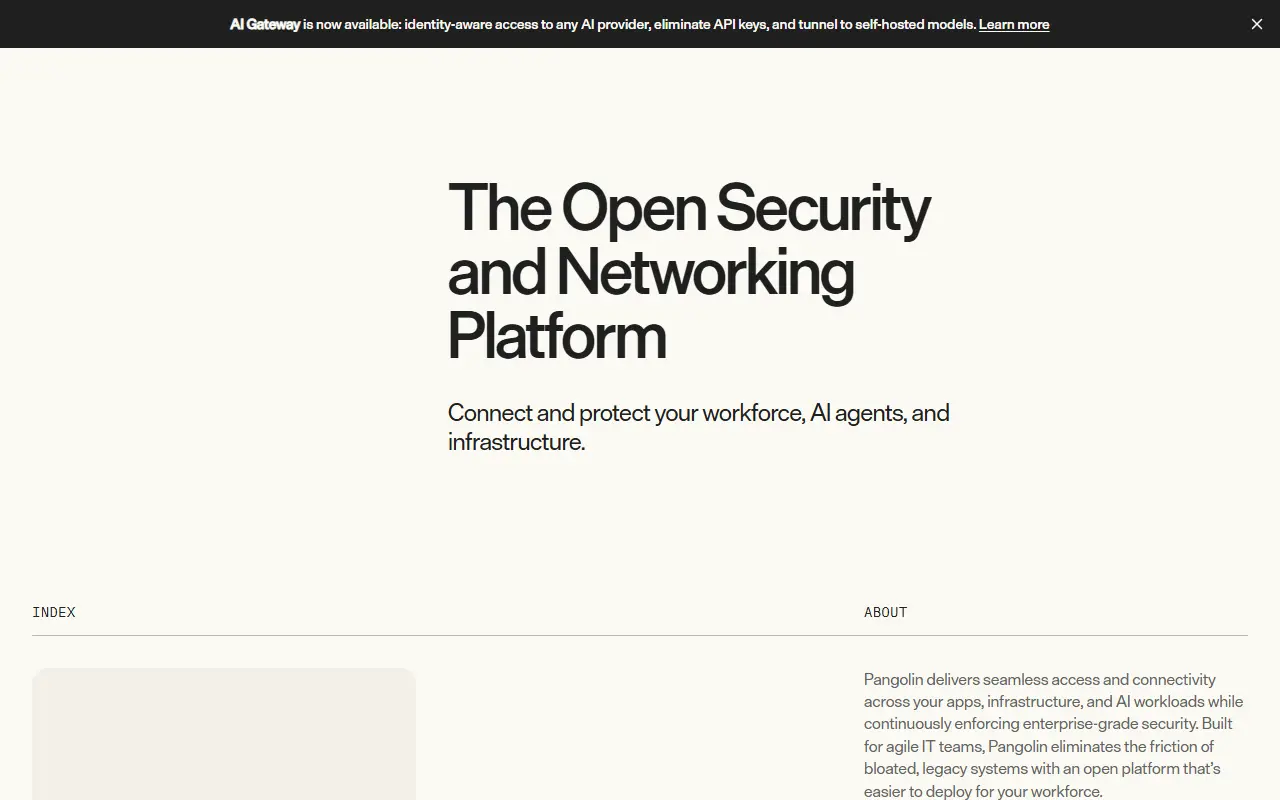
Pangolin is an open-source secure access service edge platform built on WireGuard. It aims to connect and protect users wherever they are by combining networking and security in one system: a zero-trust VPN, a zero-trust reverse proxy, privileged access control and a gateway for AI workloads that is aware of user identity, with one identity and policy model underneath.
The project compares its idea to commercial platforms such as Cloudflare One, Zscaler and Prisma, but argues that it is open, self-hostable and light enough to be easy to deploy. Legacy SASE products, it says, are heavy, closed and cloud-locked. Topics include reverse proxy, single sign-on, OIDC, SSH, tunneling, NAT traversal and remote access. Because the source is open to inspection, you can verify how traffic and access decisions are handled.
You can use Pangolin Cloud at app.pangolin.net or run it yourself. The repository's license is listed as 'Other' on GitHub, because it mixes open-source and enterprise components, so check the terms. It suits homelab users, small companies and IT teams that want zero-trust remote access without a large vendor contract.
Key features
- Zero-trust VPN built on WireGuard
- Zero-trust reverse proxy
- Privileged access management
- Identity-aware AI gateway
- Single identity and policy model
- Cloud or self-hosted deployment
Pricing: Basic is free for up to 5 users. Team costs $4 and Business $9 per user per month with a 10-day free trial; Enterprise is custom. Pangolin can run in the cloud or self-hosted.
#5
OpenVPN is an open-source VPN daemon, developed in C, for creating secure virtual private network connections.
- GitHub stars
- 15k
- Last commit
- yesterday
- Latest release
- v2.7.9
- Self-hosted
- Yes
community.openvpn.net
This entry is the OpenVPN source repository. OpenVPN is an open-source VPN daemon, a program that creates secure virtual private network connections between machines. The code is written in C, and the repository is tagged for security and VPN.
No readme or homepage details were available for this entry, so specifics about features, deployment and licensing are not listed here. The repository lists its license as 'Other', and the project community site is community.openvpn.net, which is the place to look for downloads, documentation and support.
Key features
- Open-source VPN daemon
- Secure virtual private network connections
- Written in C
- Community-supported project
Pricing: Self-hosted Access Server is free for up to 2 connections. Growth is $7 per connection per month on yearly billing with a 14-day trial; Enterprise is custom.
#6
Octelium is a self-hosted zero trust access platform that can act as a VPN, ZTNA system, API and AI gateway, tunnel service or PaaS on Kubernetes.
- GitHub stars
- 4.2k
- Last commit
- today
- Latest release
- v0.50.0
- Licence
- AGPL-3.0
- Self-hosted
- Yes
octelium.com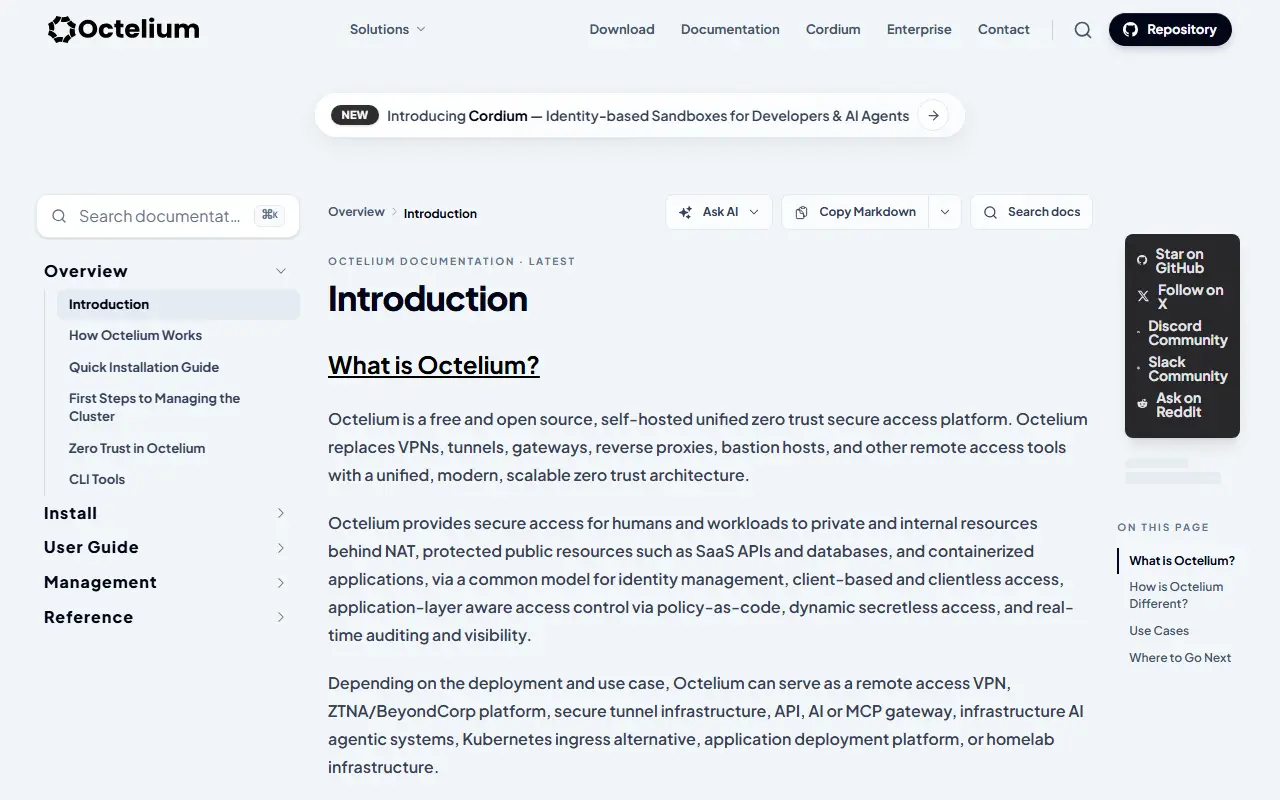
Octelium is a self-hosted, open-source platform that unifies zero trust secure access under one system. It is flexible enough to act as a zero-config remote access VPN, a Zero Trust Network Access and BeyondCorp-style platform, an alternative to ngrok and Cloudflare Tunnel, an API gateway, an AI and LLM gateway, and an infrastructure for building MCP gateways and AI agent access.
Repository topics list attribute-based access control, policy as code, WireGuard, QUIC, SSO, multi-factor authentication, OpenTelemetry and SSH access. The README includes use cases, a feature overview, a guide to try it in a Codespace, CLI installation and instructions to install your first cluster. It is written in Go and runs on Kubernetes. It is compared to ngrok, Cloudflare Tunnel and Apigee for different roles.
Octelium is licensed under AGPL-3.0 and you operate the cluster yourself. It suits platform and security teams, homelab users and developers who want to replace several access, tunnel and gateway tools with one self-hosted system.
Key features
- Zero-config remote access VPN
- ZTNA and BeyondCorp-style access
- API, AI and MCP gateway capabilities
- Tunnel service as ngrok alternative
- Attribute-based policy as code
- Runs on Kubernetes clusters
Pricing: Free and open source under AGPL-3.0.
#7
ZeroTier is a peer-to-peer virtual network that lets devices, VMs and containers communicate as if they were on the same local network.
- GitHub stars
- 17k
- Last commit
- 2 mo ago
- Latest release
- 1.16.2
- Self-hosted
- Yes
- Hosted version
- Available
zerotier.com
ZeroTier describes itself as a programmable Ethernet switch for the planet. It lets networked devices, virtual machines, containers and applications communicate as if they were located in the same data center or cloud region, no matter where they actually are. The client is written in C++.
It combines an encrypted peer-to-peer network layer, called VL1, with an Ethernet emulation layer, called VL2, that works somewhat like VXLAN. The virtualization layer includes enterprise SDN features such as fine-grained access control rules for micro-segmentation and security monitoring. Traffic is encrypted end to end with keys the user controls, and most of it flows directly between peers, with free but slow relaying for cases where a direct connection cannot be made.
Android and iOS apps are available free of charge from the app stores. Most of the code sits under a Mozilla Public License file, while parts of the repository are marked as non-free, source-available code, which is why the repository lists the license as 'Other'. The vendor also offers a network controller, a service API and commercial support.
Key features
- Peer-to-peer virtual Ethernet networking
- End-to-end encrypted traffic
- Access control rules for micro-segmentation
- Relay fallback when direct links fail
- Apps for Android and iOS
- Network controller and service API
Pricing: Free Personal plan for 10 devices. Essential is $18 a month and Scale $179 a month, each with extra devices billed per device; Enterprise is custom.
#8
zrok is an open-source tool for sharing web services, files and network resources securely over the internet without firewall or port-forwarding changes.
- GitHub stars
- 4.8k
- Last commit
- today
- Latest release
- v2.0.9
- Licence
- Apache-2.0
- Self-hosted
- Yes
- Hosted version
- Available
zrok.io
zrok lets you share web services, files and network resources with other people, whether they are across the internet or on a private network. It is built on zero-trust networking, so it works through firewalls and NAT without port forwarding or other network changes, and it behaves like a secure reverse proxy and peer-to-peer sharing tool.
Getting started takes a few steps: install zrok, create an account with the invite command, using the free zrok.io service, and enable sharing on your machine. After that you can publish a local web app, share a folder or expose a private resource to selected users. The project is part of the OpenZiti ecosystem and written in Go.
zrok is licensed under Apache-2.0. You can use the hosted zrok.io service or run your own zrok instance, which suits developers who need to expose a local service temporarily, teams sharing files securely and homelab owners who want remote access without opening ports.
Key features
- Share web services without port forwarding
- File sharing over zero-trust networking
- Works through firewalls and NAT
- Public and private share modes
- Free hosted zrok.io service
- Self-hostable zrok server
Pricing: The hosted service is free with a 5 GB daily allowance and no card required, and Zrok can be self-hosted at no cost. Commercial options with SLAs are quoted by NetFoundry.
#9
An open source SSH server that tunnels HTTP(S), WebSocket and TCP traffic to localhost, usable self-hosted or through a managed service.
- GitHub stars
- 4.8k
- Last commit
- 6 days ago
- Latest release
- v4.0.0
- Licence
- MIT
- Self-hosted
- Yes
- Hosted version
- Available
ssi.sh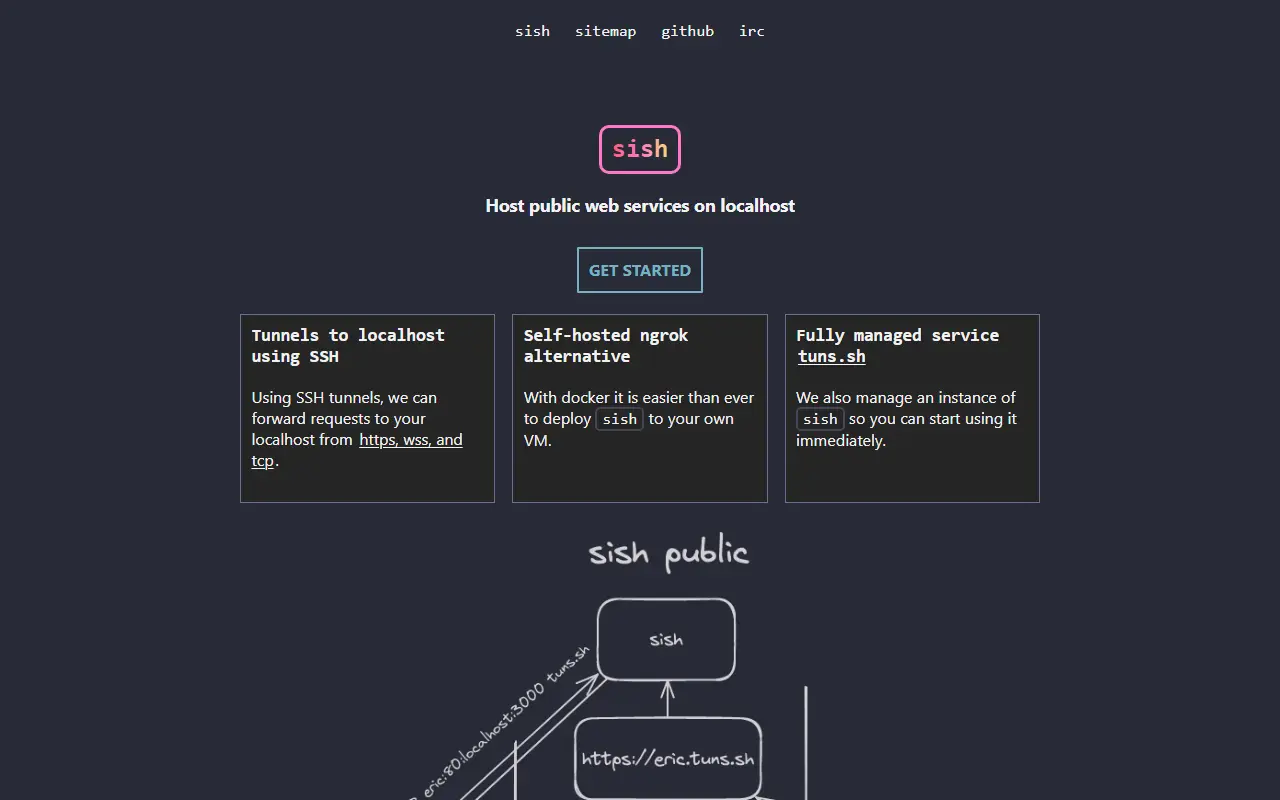
sish runs an SSH server that only handles forwarding and multiplexing. Users connect with the plain ssh command and a remote port forward, and sish creates a public URL for the local service, so no custom client is needed. The README compares the model to serveo and ngrok but with plain SSH on infrastructure the user controls.
It forwards HTTP(S), WS(S) and TCP traffic. TCP aliases make private connections that can only be reached through authenticated SSH, with allowed users set by public key fingerprint. It also supports SNI proxying, which routes TLS traffic to different backends without terminating TLS, and optional load balancing for HTTP, TCP and SNI aliases.
To self-host, the README gives a Docker setup with directories for SSL certificates, host keys and authorised public keys, and binary releases are also provided. The project also runs a managed instance at tuns.sh, which can be tried with a single ssh command. Authentication is by key or password, and keys reload dynamically. It is written in Go and MIT licensed.
Key features
- Forwards HTTP(S), WS(S) and TCP traffic
- Private TCP aliases reachable only through SSH
- SNI proxy routes TLS traffic without terminating it
- Optional load balancing for HTTP, TCP and SNI aliases
- Service console to inspect forwarded requests
- Key and password authentication with dynamic key reloading
- Binding policies for multi-tenant setups

A small command line tool, written in Rust, that tunnels a local TCP port to a remote server so it can be reached from the public internet.
- GitHub stars
- 12k
- Last commit
- 9 mo ago
- Latest release
- v0.6.0
- Licence
- MIT
- Self-hosted
- Yes
- Hosted version
- Available
Bore is a TCP tunnel written in Rust. Running bore local with a port number and a remote address exposes that local port on the remote server, which lets services behind a NAT firewall be reached from outside. The port on the remote end is assigned randomly unless you ask for a specific one.
The README compares it to localtunnel and ngrok but says bore is deliberately plain: an efficient, unopinionated way to forward TCP traffic that is simple to install and easy to self-host. The same binary runs as the client and, with bore server, as the server. A public instance runs at bore.pub, and an optional shared secret can protect your own server.
Bore is released under the MIT licence. It installs with Homebrew on macOS, from the AUR on Arch Linux, from the gentoo-zh overlay, with cargo, or from prebuilt binaries for macOS, Windows and Linux. Versioned Docker images are also published for each release.
Key features
- Exposes local ports through NAT firewalls
- Can request a specific remote port
- Optional shared secret for authentication
- Runs its own server with a single command
- Separate addresses for control server and tunnels
- Prebuilt binaries for macOS, Windows and Linux
- Versioned Docker images for every release
1 more Cloudflare Tunnel alternative
Commercial Cloudflare Tunnel alternatives
Hosted, closed-source products that compete with Cloudflare Tunnel.
Cloudflare Tunnel alternatives: questions
- What is the best open-source alternative to Cloudflare Tunnel?
- frp is the top-ranked open-source alternative to Cloudflare Tunnel on Enlisted: frp is an Apache-2.0 reverse proxy written in Go that exposes servers behind a NAT or firewall to the internet over TCP, UDP, HTTP and HTTPS. Other strong options are NetBird, Headscale, Pangolin and OpenVPN.
- What are the best commercial alternatives to Cloudflare Tunnel?
- ngrok, Tailscale, Cloudflare Zero Trust, Localdock and Teleport are among the hosted, closed-source alternatives to Cloudflare Tunnel listed on Enlisted, which lists 10 in total. Compare their pricing and features on each tool page.
- Are these Cloudflare Tunnel alternatives free?
- All 11 are open source, so the code is free to use under its licence, and all of them can be self-hosted on your own server or computer. 6 also offer a paid or managed cloud version if you'd rather not host it yourself.
- How is this list of Cloudflare Tunnel alternatives ranked?
- By a score built from GitHub stars, star growth over the last 30 days and how recently the code changed. 8 of these projects shipped code in the last 30 days. Data is refreshed daily, and nobody can pay to move up.
 TrackMedia
 TrackRev