
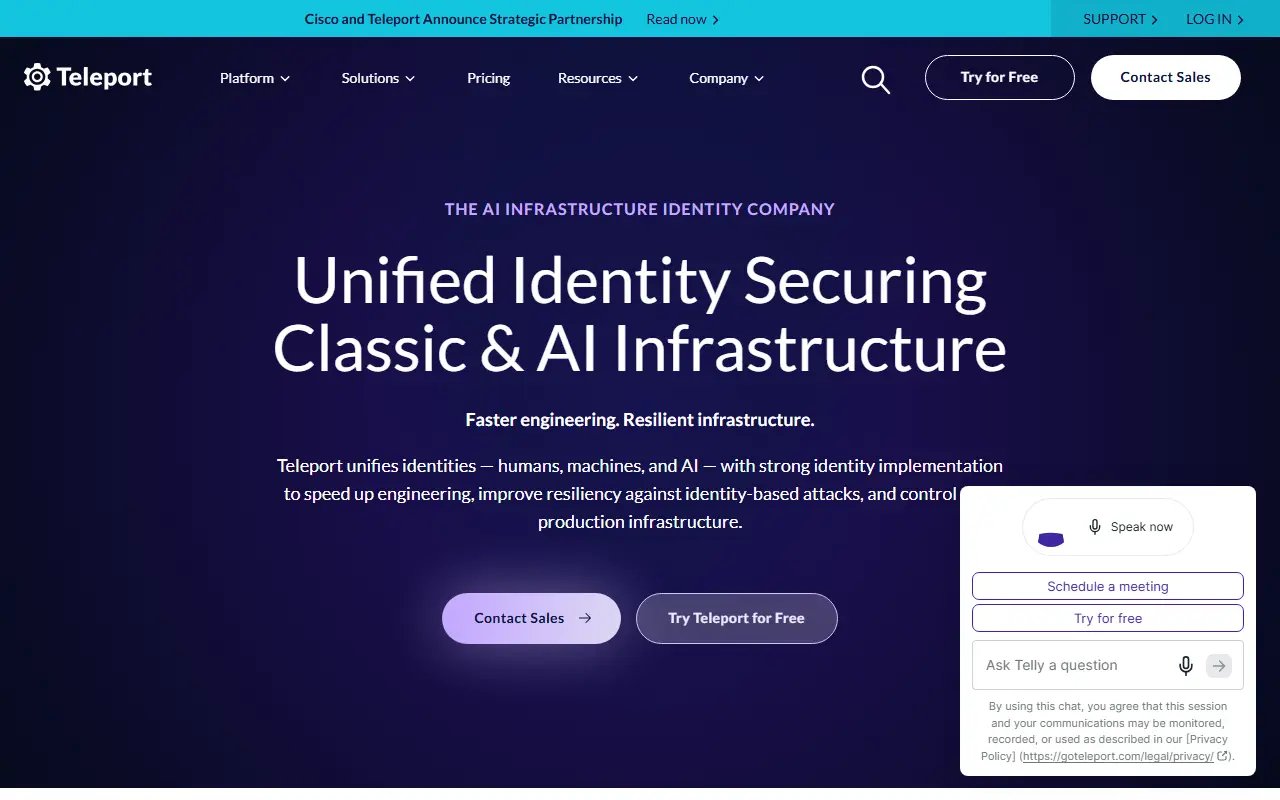
About Teleport
Teleport is an infrastructure access and identity platform that gives engineers, machines and AI agents short-lived, identity-based access to servers, databases, Kubernetes clusters and other internal resources. Its stated aim is to remove shared secrets and standing privileges, replacing them with cryptographic identities and ephemeral access.
The vendor describes a unified identity layer that covers humans, machine workloads and AI agents, backed by hardware roots of trust such as HSMs, TPMs and biometrics. It emphasizes a single audit trail and a smaller set of access paths, addressing credential sprawl, lateral movement risk and blind spots around AI identities in production infrastructure.
Teleport can be run by an organization in its own environment or used as a managed cloud service, and the website offers both a free trial and a contact-sales route. The product has its roots in an open-source project, but the supplied listing treats it as a commercial product, so licensing terms should be checked with the vendor.
Key features
- Short-lived credentials with no standing privilege
- Access to servers, databases and Kubernetes clusters
- Unified identity for humans, machines and AI agents
- Hardware-backed cryptographic identity
- Unified audit trail of infrastructure access
- Access governance controls
Good fit for
- →Replacing SSH keys and shared database credentials
- →Auditing engineer access to production
- →Controlling AI agent access to infrastructure
- Tags
- infrastructure-access
- zero-trust
- identity
- ssh
- kubernetes
- audit
- privileged-access
Teleport: questions and answers
- What is Teleport used for?
- Teleport is an infrastructure access platform that secures access to servers, databases, clusters and AI workloads with cryptographic identity. It is a good fit for replacing SSH keys and shared database credentials, auditing engineer access to production, and controlling AI agent access to infrastructure.
- Is Teleport free?
- Yes. Teleport has a free plan.
- Is Teleport open source?
- No. Teleport is proprietary (closed-source) software. Open-source alternatives to Teleport include Pomerium, Octelium and OpenZiti.
- Can I self-host Teleport?
- Yes. Although Teleport is closed source, it can be self-hosted on your own servers, and the vendor also offers a hosted version.
- What are some alternatives to Teleport?
- Teleport competes with StrongDM, BeyondTrust and CyberArk. For open-source options, see Enlisted's ranked list of open-source Teleport alternatives.
Open-source alternatives to Teleport
See all
Pomerium
Security
Pomerium is an identity and context-aware access proxy.
Apache-2.0vs Cloudflare Zero Trust★ 5k
Octelium
Networking & VPN
A next-gen FOSS self-hosted unified zero trust secure access platform that can operate as
AGPL-3.0vs Tailscale★ 4.1k
OpenZiti
Networking & VPN
The parent project for OpenZiti. Here you will find the executables for a fully zero-trust
Apache-2.0vs Twingate★ 4.4kfwknop
Security
Single Packet Authorization > Port Knocking
GPL-2.0★ 1.5k
Infisical
Security
Infisical is the open-source platform for secrets, certificates, and privileged access man
OSSvs Doppler★ 30k
fail2ban
Security
Daemon to ban hosts that cause multiple authentication errors
OSS★ 19k
SaaS alternatives to Teleport
See all
StrongDM
Security
Access management proxy for databases, servers and Kubernetes with audit logging
SaaS
BeyondTrust
Security
Privileged access management and remote support for enterprises
SaaSCyberArk
Security
Identity security and privileged access management for people, machines and AI agents
SaaS
Cloudflare Zero Trust
Security
Zero trust network access, secure web gateway and browser isolation from Cloudflare
SaaS
Twingate
Networking & VPN
Zero trust remote access service positioned as a replacement for business VPNs
SaaS
Silverfort
Security
Identity security platform that extends MFA and threat protection across hybrid environments
SaaS