 TrackMedia
 TrackRev

 Microsoft Entra ID
 Permit.io
 heylogin
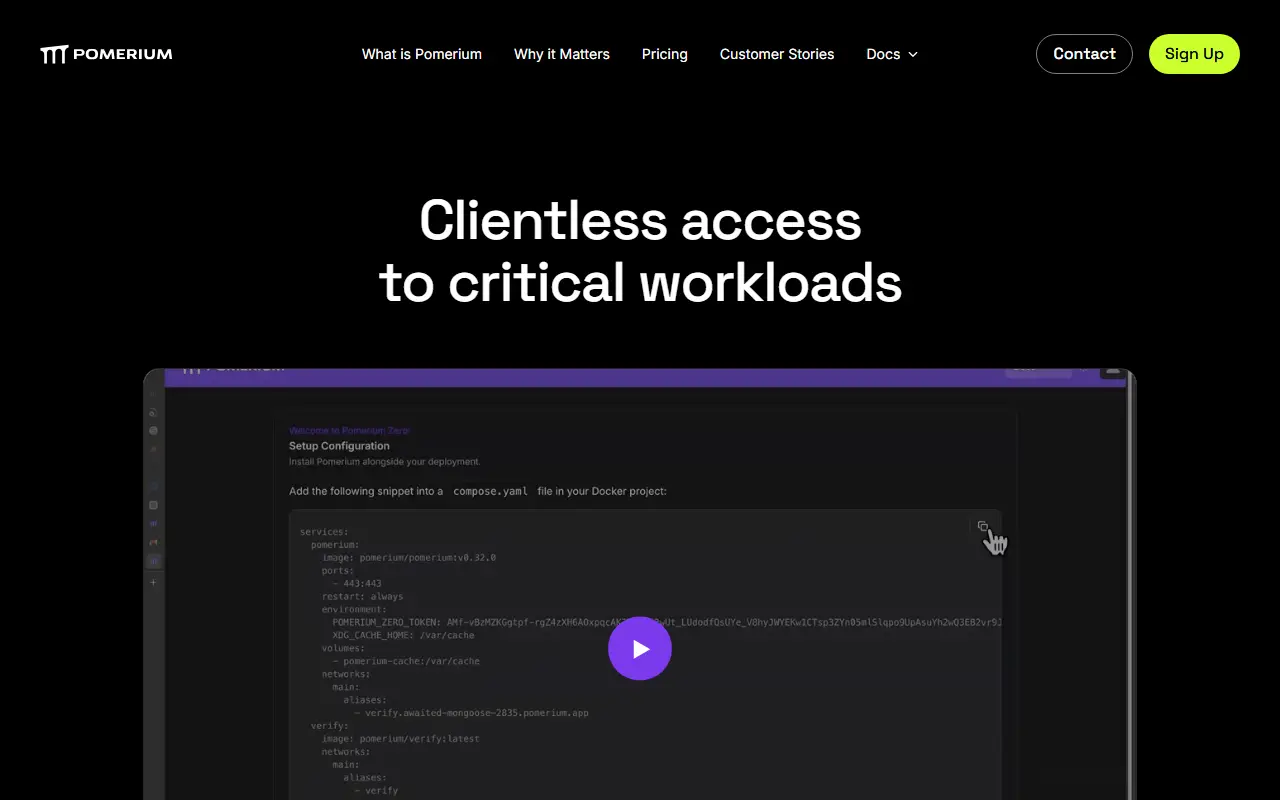
About Pomerium
Pomerium is an identity and context-aware reverse proxy that makes secure, clientless connections to internal web apps and other services. The goal is to protect internal resources without asking users to connect through a corporate VPN.
According to the project, clientless access makes it easier to adopt, running tunnel-free and close to your apps and services makes it faster, and verifying each action before it executes makes it safer. Context-aware policies can draw on data from several sources, so access decisions can reflect your organization's own needs. Repository topics point to zero-trust, BeyondCorp-style, identity-aware proxy and IAM use cases.
Pomerium is written in Go and licensed under Apache-2.0. Teams that want a hosted control plane and a management GUI can look at Pomerium Zero, while the open-source proxy can be run on your own infrastructure. Documentation and tutorials are available on pomerium.com.
Key features
- Identity-aware reverse proxy
- Clientless access to internal apps
- Per-request verification of every action
- Context-aware access policies
- Tunnel-free deployment near your services
- Hosted control plane via Pomerium Zero
Good fit for
- Zero-trust access to internal web apps
- Reducing reliance on a corporate VPN
- Protecting internal tools with identity-based access
Pomerium: questions and answers
- What is Pomerium used for?
- Pomerium is an identity and context-aware access proxy written in Go that secures internal apps and services without a corporate VPN. It is a good fit for zero-trust access to internal web apps, reducing reliance on a corporate VPN and protecting internal tools with identity-based access.
- Is Pomerium open source?
- Yes. Pomerium is open source under the Apache-2.0 licence. Its source code is on GitHub at pomerium/pomerium and is written mainly in Go.
- Is Pomerium free?
- Yes. Pomerium is open source, so the software itself is free to use. A managed cloud version is also available, with paid plans from $7 per seat per month.
- Can I self-host Pomerium?
- Yes. Pomerium can be self-hosted on your own server or infrastructure.
- What is Pomerium an alternative to?
- Pomerium is an open-source alternative to Cloudflare Zero Trust, Twingate, Zscaler and StrongDM. Other open-source alternatives to Cloudflare Zero Trust include Octelium, OpenZiti and Tailscale.
- Is Pomerium actively maintained?
- Yes. The most recent commit to Pomerium was on 12 November 2026, and the latest release is v0.34.1, published on 11 November 2026. The project has 5.1k stars on GitHub, with 63 added in the last 30 days.
Open-source alternatives to Pomerium
See all
Octelium
Networking & VPN
A next-gen FOSS self-hosted unified zero trust secure access platform that can operate as
AGPL-3.0vs Tailscale★ 4.2k
OpenZiti
Networking & VPN
The parent project for OpenZiti. Here you will find the executables for a fully zero-trust
Apache-2.0vs Twingate★ 4.5k
Firezone
Networking & VPN
Blazing-fast remote access
Apache-2.0vs Tailscale★ 9.2k
Keycloak
Auth & Identity
Open Source Identity and Access Management For Modern Applications and Services
Apache-2.0vs Auth0★ 38k
Netmaker
Networking & VPN
Securely connect your devices, clouds, and sites with Netmaker's Zero Trust platform.
OSSvs Tailscale★ 12k
Tailscale
Networking & VPN
The easiest, most secure way to use WireGuard and 2FA.
BSD-3-Clausevs Twingate★ 39k
SaaS alternatives to Pomerium
See all
Cloudflare Zero Trust
Security
Zero trust network access, secure web gateway and browser isolation from Cloudflare
SaaS
Twingate
Networking & VPN
Zero trust remote access service positioned as a replacement for business VPNs
SaaS
Zscaler
Security
Cloud security platform for zero trust internet and private application access
SaaS
StrongDM
Security
Access management proxy for databases, servers and Kubernetes with audit logging
SaaS
Netskope
Security
Security service edge platform covering CASB, secure web gateway and data protection
SaaS
Teleport
Security
Infrastructure access platform for secure access to servers, databases and clusters
SaaS