 TrackMedia
 TrackRev

 Windscribe
 PureVPN
 TunnelBear
 Cato Networks
 Prisma Access
 Illumio
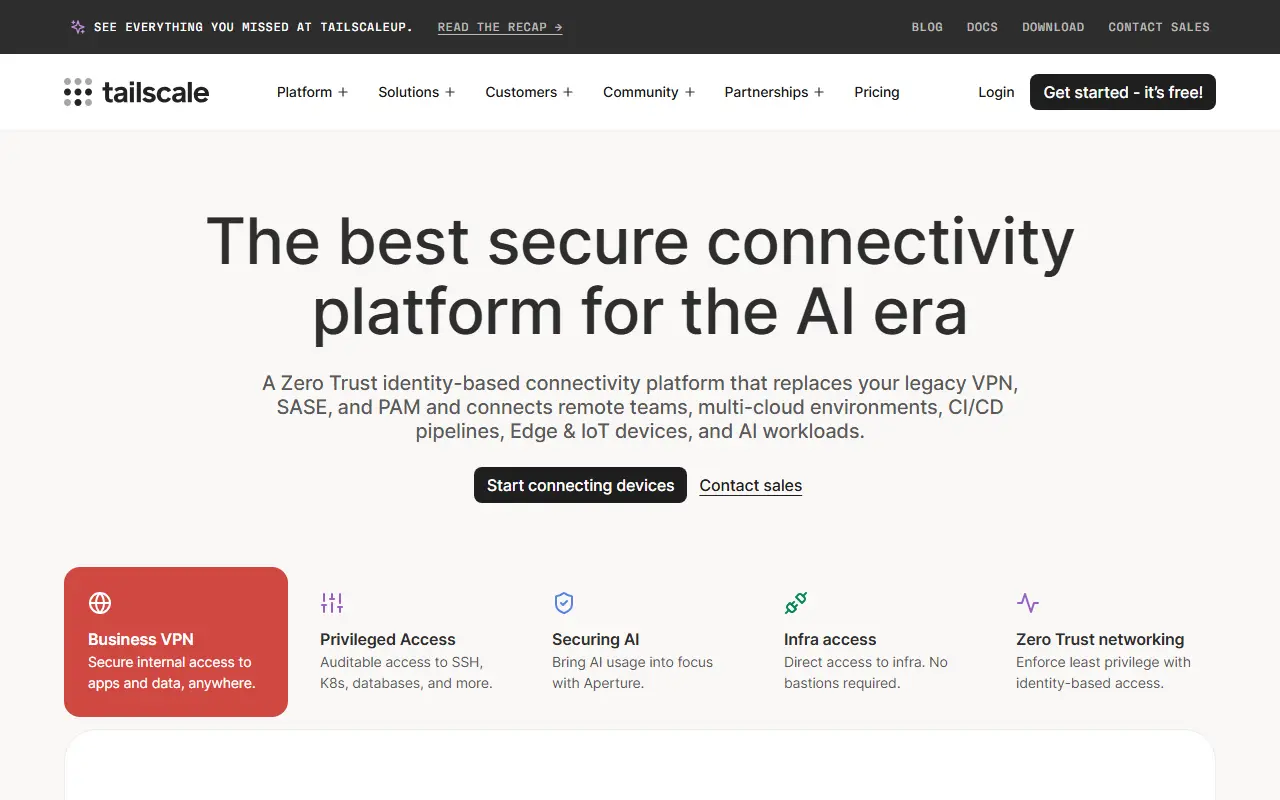
About Tailscale
Tailscale makes private networks between devices using the WireGuard protocol, with sign-in handled by existing identity providers and two-factor authentication. The GitHub repository contains most of the company's open-source code, notably the tailscaled daemon and the tailscale command-line tool. It is published under the BSD-3-Clause license and written in Go.
The daemon runs on Linux, Windows and macOS, with partial support on FreeBSD and OpenBSD. The iOS and Android apps reuse this code, while the graphical wrappers for some non-open platforms are not open source, so the full product is a mix of open and proprietary parts. Packages for many distributions are served from the project's package site, and the code can be built from source with the latest Go release. The service itself is hosted by Tailscale.
Key features
- WireGuard-based private device networking
- tailscaled daemon and tailscale CLI
- Sign-in through SSO and two-factor authentication
- Clients for Linux, Windows, macOS, iOS and Android
- Packages for Synology, QNAP and Debian-style distros
- Client source code under BSD-3-Clause
Good fit for
- Reaching home or office machines remotely
- Connecting servers across clouds without public ports
- Replacing a traditional VPN for small teams
Tailscale: questions and answers
- What is Tailscale used for?
- Tailscale builds private WireGuard-based networks between your devices; this repository holds the open-source client daemon and CLI. It is a good fit for reaching home or office machines remotely, connecting servers across clouds without public ports and replacing a traditional VPN for small teams.
- Is Tailscale open source?
- Yes. Tailscale is open source under the BSD-3-Clause licence. Its source code is on GitHub at tailscale/tailscale and is written mainly in Go.
- Is Tailscale free?
- Yes. Tailscale is open source, so the software itself is free to use. A managed cloud version is also available, with paid plans from $8 per seat per month.
- Can I self-host Tailscale?
- Yes. Tailscale can be self-hosted on your own server or infrastructure.
- What is Tailscale an alternative to?
- Tailscale is an open-source alternative to Twingate, NordLayer, ExpressVPN and Cloudflare Zero Trust. Other open-source alternatives to Twingate include OpenVPN, ZeroTier and Octelium.
- Is Tailscale actively maintained?
- Yes. The most recent commit to Tailscale was on 13 November 2026, and the latest release is v1.104.7, published on 12 November 2026. The project has 39k stars on GitHub, with 1.6k added in the last 30 days.
Open-source alternatives to Tailscale
See all
OpenVPN
Networking & VPN
OpenVPN is an open source VPN daemon
OSSvs NordLayer★ 15k
ZeroTier
Networking & VPN
A Smart Ethernet Switch for Earth
OSSvs Tailscale★ 17k
wg-easy
Networking & VPN
The easiest way to run WireGuard VPN + Web-based Admin UI.
AGPL-3.0vs NordVPN★ 27kHeadscale
Networking & VPN
An open source, self-hosted implementation of the Tailscale control server
BSD-3-Clausevs Tailscale★ 46k
Octelium
Networking & VPN
A next-gen FOSS self-hosted unified zero trust secure access platform that can operate as
AGPL-3.0vs Tailscale★ 4.2k
OpenZiti
Networking & VPN
The parent project for OpenZiti. Here you will find the executables for a fully zero-trust
Apache-2.0vs Twingate★ 4.5k
SaaS alternatives to Tailscale
See all
Twingate
Networking & VPN
Zero trust remote access service positioned as a replacement for business VPNs
SaaS
NordLayer
Networking & VPN
Business VPN and network access security for remote and hybrid teams
SaaS
ExpressVPN
Networking & VPN
Consumer VPN service with apps for desktop, mobile, routers and browsers
SaaS
Cloudflare Zero Trust
Security
Zero trust network access, secure web gateway and browser isolation from Cloudflare
SaaS
Netskope
Security
Security service edge platform covering CASB, secure web gateway and data protection
SaaS
Mullvad VPN
Networking & VPN
Privacy-focused VPN service with anonymous account numbers
SaaS