8 open-source alternatives ranked by real activity

Open-source Windscribe alternatives

A curated, ranked list of the 8 best open-source alternatives to Windscribe.

The best open-source alternative to Windscribe is Tailscale. If that doesn't suit you, other good options are Headscale, AdGuard Home, Pi-hole and wg-easy.

Commercial alternatives to Windscribe include hide.me, Mullvad VPN, TunnelBear and IPVanish. See all 16.

Windscribe alternatives are mainly networking & VPN tools. 7 of them shipped code in the last 30 days, 8 can be self-hosted, and 2 use a permissive licence.

Last updated November 12, 2026 · ranked by GitHub stars, growth and recent commits

Tailscale

Tailscale builds private WireGuard-based networks between your devices; this repository holds the open-source client daemon and CLI.

GitHub stars
39k
Last commit
2 days ago
Latest release
v1.104.6
Licence
BSD-3-Clause
Hosted version
Available
tailscale.comTailscale homepage screenshot

Tailscale makes private networks between devices using the WireGuard protocol, with sign-in handled by existing identity providers and two-factor authentication. The GitHub repository contains most of the company's open-source code, notably the tailscaled daemon and the tailscale command-line tool. It is published under the BSD-3-Clause license and written in Go.

The daemon runs on Linux, Windows and macOS, with partial support on FreeBSD and OpenBSD. The iOS and Android apps reuse this code, while the graphical wrappers for some non-open platforms are not open source, so the full product is a mix of open and proprietary parts. Packages for many distributions are served from the project's package site, and the code can be built from source with the latest Go release. The service itself is hosted by Tailscale.

Key features

  • WireGuard-based private device networking
  • tailscaled daemon and tailscale CLI
  • Sign-in through SSO and two-factor authentication
  • Clients for Linux, Windows, macOS, iOS and Android
  • Packages for Synology, QNAP and Debian-style distros
  • Client source code under BSD-3-Clause

Pricing: Personal is free forever for up to 6 users. Standard costs $8 and Premium $18 per user per month; Enterprise is custom and quoted through sales.

Headscale

Headscale is a BSD-3-Clause, self-hosted implementation of the Tailscale control server, written in Go for homelabs and small organisations.

GitHub stars
46k
Last commit
yesterday
Latest release
v0.29.7
Licence
BSD-3-Clause
Self-hosted
Yes

Headscale is an open source, self-hosted implementation of the Tailscale control server. Tailscale is a VPN built on WireGuard that links machines into an overlay network using NAT traversal. The control server exchanges WireGuard public keys, assigns client IP addresses, sets boundaries between users, and exposes the routes your nodes advertise.

The design goal is a self-hosted alternative for self-hosters and hobbyists to use in projects and labs. The scope is deliberately narrow: a single Tailscale network (tailnet), suitable for personal use or a small open-source organisation. Features and client operating system support are documented on the project's documentation site.

It is not associated with Tailscale Inc, although one active maintainer works there. The README advises matching the GitHub tag to the release you run so example configuration fits, and it provides a NixOS module plus development builds as container images and binaries. It also says reverse proxies and containers are not supported or encouraged.

Key features

  • Self-hosted Tailscale control server
  • Exchanges WireGuard public keys between nodes
  • Assigns client IP addresses and user boundaries
  • Exposes advertised routes of nodes
  • NixOS module available
  • Development builds as images and binaries
Read more about HeadscaleGitHub#2 Windscribe alternative

AdGuard Home

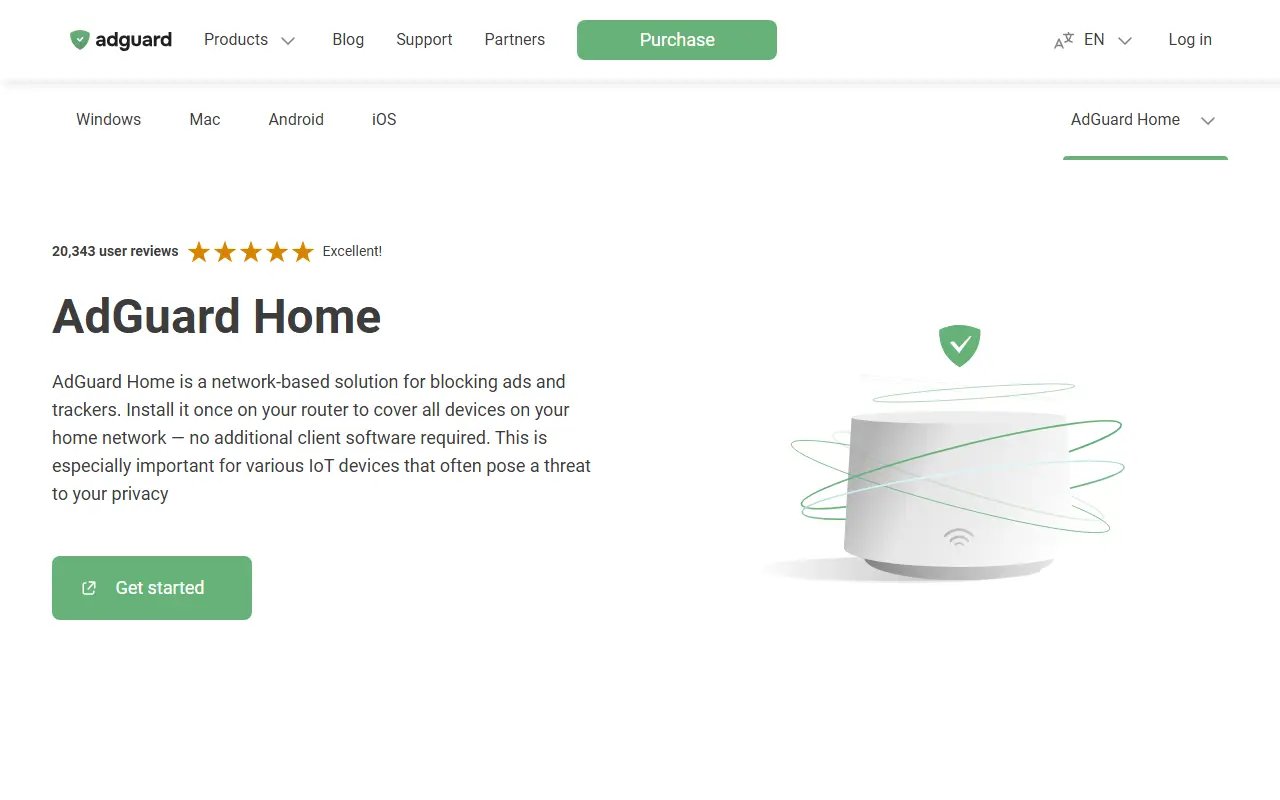
AdGuard Home is a self-hosted DNS server that blocks ads and trackers for every device on your network without client software.

GitHub stars
38k
Last commit
yesterday
Latest release
v0.107.80
Licence
GPL-3.0
Self-hosted
Yes
adguard.comAdGuard Home homepage screenshot

AdGuard Home is network-wide software for blocking ads and tracking. Once it is set up, it covers all devices on your home network without any client-side software. It works as a DNS server that redirects tracking and advertising domains to a black hole, so devices never connect to those servers. It is free and open source under the GPL-3.0 license.

The server is written mainly in Go with a TypeScript web interface, and it shares a lot of code with the public AdGuard DNS service. Encrypted DNS protocols are supported, including DNS-over-HTTPS, DNS-over-TLS, DNS-over-QUIC and DNSCrypt. Installation is done with an automated script for Linux, Unix, macOS, FreeBSD and OpenBSD, or manually following the wiki, and there is an HTTP API. The project documents how it differs from Pi-hole and from browser-based ad blockers.

Key features

  • Network-wide ad and tracker blocking via DNS
  • No software needed on client devices
  • DNS-over-HTTPS, TLS, QUIC and DNSCrypt support
  • Web interface and HTTP API
  • Automated install script for Unix-like systems
  • Wiki guides and build-from-source instructions

Pricing: Free and open source under the GPL-3.0 license.

Pi-hole

A network-wide ad blocker that works as a DNS sinkhole on your own Linux hardware, with a web dashboard and no client software needed.

GitHub stars
62k
Last commit
yesterday
Latest release
v6.6
Self-hosted
Yes
pi-hole.netPi-hole homepage screenshot

Pi-hole is a DNS sinkhole that blocks unwanted content, mainly ads, for every device on your network without installing client-side software. You run it on your own Linux hardware, such as a Raspberry Pi, and point your network's DNS at it. The project is written mostly in shell script, and GitHub lists its license as 'Other'.

Because blocking happens at the DNS level, it also covers non-browser locations such as ad-heavy mobile apps and smart TVs, and it speeds up everyday browsing by caching DNS queries. It includes a command-line interface and a responsive web dashboard for viewing and controlling the instance, can optionally act as a DHCP server so all devices are protected automatically, and blocks over both IPv4 and IPv6.

An automated installer walks through setup in under ten minutes, and alternative methods allow reviewing the code first: cloning the repository, downloading the installer manually, or using the official Docker images. Pi-hole runs on modest hardware and, on server-grade machines, can handle very large query volumes. It suits home networks and small offices that want central ad and tracker blocking.

Key features

  • Network-wide ad blocking via DNS
  • No client-side software required
  • Web dashboard for monitoring and control
  • Optional built-in DHCP server
  • DNS query caching
  • IPv4 and IPv6 blocking
  • Official Docker images

Pricing: Free and open source software that runs on your own hardware.

Read more about Pi-holeWebsiteGitHub#4 Windscribe alternative

wg-easy

WireGuard Easy is a Docker-friendly tool that bundles a WireGuard VPN server with a web UI for managing clients on a Linux host.

GitHub stars
27k
Last commit
4 days ago
Latest release
v15.5.0
Licence
AGPL-3.0
Self-hosted
Yes
wg-easy.github.iowg-easy homepage screenshot

WireGuard Easy (wg-easy) combines a WireGuard VPN server and a web-based admin interface into a single package for Linux hosts. The web UI lets you list, create, edit, delete, enable and disable VPN clients, show a client's QR code, and download its configuration file. It is written in TypeScript and released under the AGPL-3.0 license.

Monitoring and security options include connection statistics, transmit and receive charts for each client, Prometheus metrics, client expiration, one-time links, two-factor authentication, OIDC sign-in with providers such as Google, GitHub, Authelia and Authentik, and per-client firewall filtering that requires iptables. The interface supports light and dark modes, multiple languages, IPv6 and CIDR. Installation uses Docker Compose, docker run or Podman, and the documentation covers reverse proxy setups with Caddy and Traefik as well as a migration guide from older versions.

Key features

  • WireGuard server with a web admin UI
  • Client QR codes and config downloads
  • Per-client traffic charts and connection status
  • Client expiration and one-time links
  • Two-factor and OIDC sign-in support
  • Prometheus metrics and IPv6 support

Pricing: Free and open source under the AGPL-3.0 license.

Read more about wg-easyWebsiteGitHub#5 Windscribe alternative

OpenVPN

OpenVPN is an open-source VPN daemon, developed in C, for creating secure virtual private network connections.

GitHub stars
15k
Last commit
yesterday
Latest release
v2.7.9
Self-hosted
Yes
community.openvpn.netOpenVPN homepage screenshot

This entry is the OpenVPN source repository. OpenVPN is an open-source VPN daemon, a program that creates secure virtual private network connections between machines. The code is written in C, and the repository is tagged for security and VPN.

No readme or homepage details were available for this entry, so specifics about features, deployment and licensing are not listed here. The repository lists its license as 'Other', and the project community site is community.openvpn.net, which is the place to look for downloads, documentation and support.

Key features

  • Open-source VPN daemon
  • Secure virtual private network connections
  • Written in C
  • Community-supported project

Pricing: Self-hosted Access Server is free for up to 2 connections. Growth is $7 per connection per month on yearly billing with a 14-day trial; Enterprise is custom.

Read more about OpenVPNWebsiteGitHub#6 Windscribe alternative

ZeroTier

ZeroTier is a peer-to-peer virtual network that lets devices, VMs and containers communicate as if they were on the same local network.

GitHub stars
17k
Last commit
2 mo ago
Latest release
1.16.2
Self-hosted
Yes
Hosted version
Available
zerotier.comZeroTier homepage screenshot

ZeroTier describes itself as a programmable Ethernet switch for the planet. It lets networked devices, virtual machines, containers and applications communicate as if they were located in the same data center or cloud region, no matter where they actually are. The client is written in C++.

It combines an encrypted peer-to-peer network layer, called VL1, with an Ethernet emulation layer, called VL2, that works somewhat like VXLAN. The virtualization layer includes enterprise SDN features such as fine-grained access control rules for micro-segmentation and security monitoring. Traffic is encrypted end to end with keys the user controls, and most of it flows directly between peers, with free but slow relaying for cases where a direct connection cannot be made.

Android and iOS apps are available free of charge from the app stores. Most of the code sits under a Mozilla Public License file, while parts of the repository are marked as non-free, source-available code, which is why the repository lists the license as 'Other'. The vendor also offers a network controller, a service API and commercial support.

Key features

  • Peer-to-peer virtual Ethernet networking
  • End-to-end encrypted traffic
  • Access control rules for micro-segmentation
  • Relay fallback when direct links fail
  • Apps for Android and iOS
  • Network controller and service API

Pricing: Free Personal plan for 10 devices. Essential is $18 a month and Scale $179 a month, each with extra devices billed per device; Enterprise is custom.

Read more about ZeroTierWebsiteGitHub#7 Windscribe alternative

IPsec VPN Server

A Docker image that runs an IPsec VPN server supporting IPsec/L2TP, Cisco IPsec and IKEv2, with auto-generated credentials and client setup profiles.

GitHub stars
7.2k
Last commit
5 days ago
Self-hosted
Yes
hub.docker.comIPsec VPN Server homepage screenshot

This project provides a Docker image for running your own IPsec VPN server. It supports IPsec/L2TP, Cisco IPsec and IKEv2 modes, is built on Alpine or Debian, and uses Libreswan as the IPsec software and xl2tpd as the L2TP daemon. A VPN like this encrypts traffic between a device and the server, which helps on untrusted networks such as cafes, airports and hotels.

On first start it automatically generates VPN credentials and the IKEv2 configuration. It supports IKEv2 with modern ciphers such as AES-GCM, creates profiles that configure iOS, macOS and Android devices, and works with Windows, macOS, iOS, Android, Chrome OS and Linux clients. A helper script manages IKEv2 users and certificates, data persists in a Docker volume, and images are built for amd64, arm64 and arm/v7 through GitHub Actions.

Setup is a single docker run command, or the IPsec VPN can be installed without Docker. The author also publishes related projects for WireGuard, OpenVPN and Headscale. The repository lists the license as Other, so check the licence file. It suits individuals and small teams running a personal or private VPN on a VPS, home server or Raspberry Pi.

Key features

  • IPsec/L2TP, Cisco IPsec and IKEv2 modes
  • Auto-generated credentials on first start
  • Client profiles for iOS, macOS and Android
  • Helper script for IKEv2 users and certificates
  • Persistent data in a Docker volume
  • Images for amd64, arm64 and arm/v7

Pricing: Free to use; the repository lists the license as Other.

Commercial Windscribe alternatives

Hosted, closed-source products that compete with Windscribe. Showing 12 of 16.

See every Windscribe alternative on its tool page

Windscribe alternatives: questions

What is the best open-source alternative to Windscribe?
Tailscale is the top-ranked open-source alternative to Windscribe on Enlisted: Tailscale builds private WireGuard-based networks between your devices; this repository holds the open-source client daemon and CLI. Other strong options are Headscale, AdGuard Home, Pi-hole and wg-easy.
What are the best commercial alternatives to Windscribe?
hide.me, Mullvad VPN, TunnelBear, IPVanish and Private Internet Access are among the hosted, closed-source alternatives to Windscribe listed on Enlisted, which lists 16 in total. Compare their pricing and features on each tool page.
Are these Windscribe alternatives free?
All 8 are open source, so the code is free to use under its licence, and all of them can be self-hosted on your own server or computer. 2 also offer a paid or managed cloud version if you'd rather not host it yourself.
How is this list of Windscribe alternatives ranked?
By a score built from GitHub stars, star growth over the last 30 days and how recently the code changed. 7 of these projects shipped code in the last 30 days. Data is refreshed daily, and nobody can pay to move up.

People also look for alternatives to…

View all