
 Cloudflare
 NordLayer
 Zscaler
 StrongDM
 Netskope
 Cato Networks
 Prisma Access
 Teleport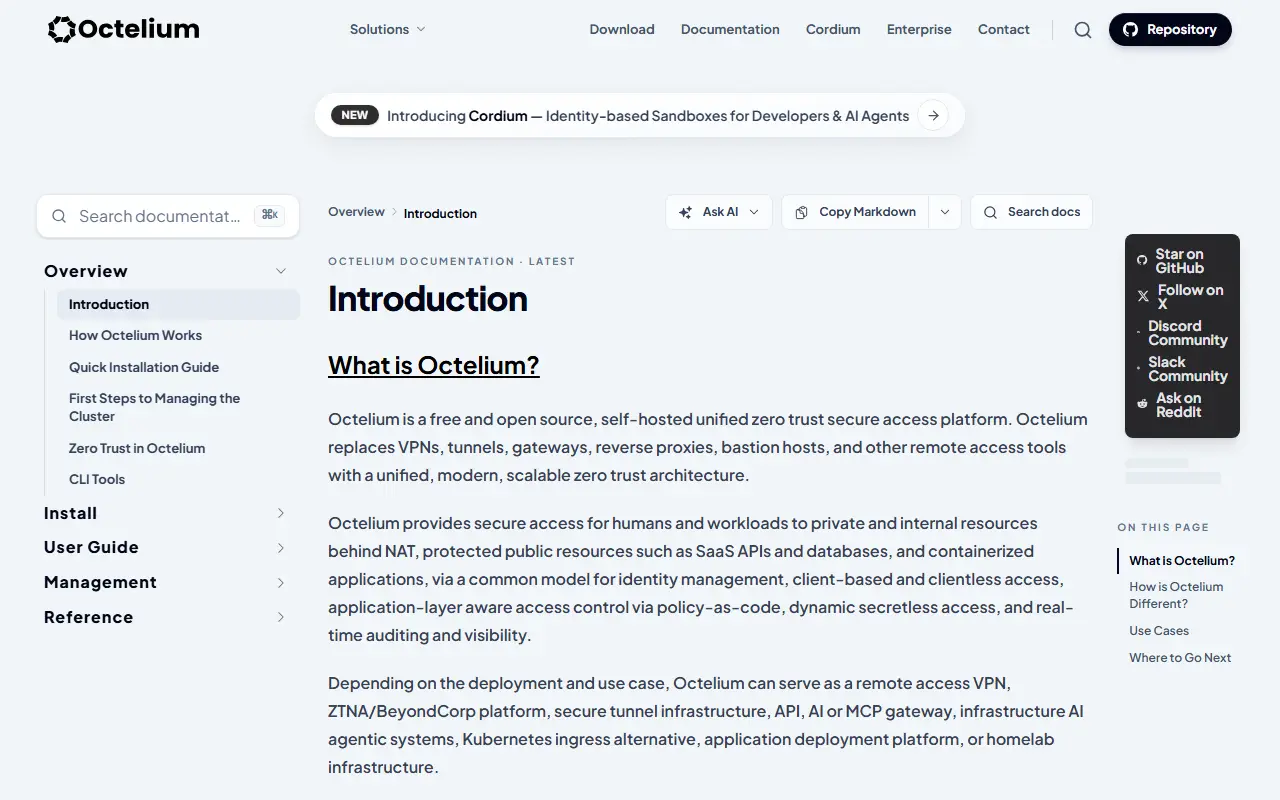
About Octelium
Octelium is a self-hosted, open-source platform that unifies zero trust secure access under one system. It is flexible enough to act as a zero-config remote access VPN, a Zero Trust Network Access and BeyondCorp-style platform, an alternative to ngrok and Cloudflare Tunnel, an API gateway, an AI and LLM gateway, and an infrastructure for building MCP gateways and AI agent access.
Repository topics list attribute-based access control, policy as code, WireGuard, QUIC, SSO, multi-factor authentication, OpenTelemetry and SSH access. The README includes use cases, a feature overview, a guide to try it in a Codespace, CLI installation and instructions to install your first cluster. It is written in Go and runs on Kubernetes. It is compared to ngrok, Cloudflare Tunnel and Apigee for different roles.
Octelium is licensed under AGPL-3.0 and you operate the cluster yourself. It suits platform and security teams, homelab users and developers who want to replace several access, tunnel and gateway tools with one self-hosted system.
Key features
- Zero-config remote access VPN
- ZTNA and BeyondCorp-style access
- API, AI and MCP gateway capabilities
- Tunnel service as ngrok alternative
- Attribute-based policy as code
- Runs on Kubernetes clusters
Good fit for
- →Replacing a VPN with zero trust access
- →Secure access to homelab services
- →Gateway for AI agents and MCP servers
- Tags
- zero-trust
- ztna
- vpn
- api-gateway
- mcp-gateway
- kubernetes
- self-hosted
- wireguard
Octelium: questions and answers
- What is Octelium used for?
- Octelium is a self-hosted zero trust access platform that can act as a VPN, ZTNA system, API and AI gateway, tunnel service or PaaS on Kubernetes. It is a good fit for replacing a VPN with zero trust access, secure access to homelab services, and gateway for AI agents and MCP servers.
- Is Octelium open source?
- Yes. Octelium is open source under the AGPL-3.0 licence. Its source code is on GitHub at octelium/octelium and is written mainly in Go.
- Is Octelium free?
- Yes. Octelium is open source, so the software itself is free to use.
- Can I self-host Octelium?
- Yes. Octelium can be self-hosted on your own server or infrastructure; there is no official hosted version.
- What is Octelium an alternative to?
- Octelium is an open-source alternative to Tailscale, Twingate, Cloudflare Zero Trust and ngrok. Other open-source alternatives to Tailscale include OpenZiti, Pangolin and Firezone.
- Is Octelium actively maintained?
- Yes. The most recent commit to Octelium was on 2 October 2026, and the latest release is v0.43.0, published on 21 September 2026. The project has 4.1k stars on GitHub.
Open-source alternatives to Octelium
See all
OpenZiti
Networking & VPN
The parent project for OpenZiti. Here you will find the executables for a fully zero-trust
Apache-2.0vs Twingate★ 4.4k
Pangolin
Networking & VPN
Open-source SASE platform providing secure access and connectivity to apps, infrastructure
OSSvs Cloudflare Tunnel★ 23k
Firezone
Networking & VPN
Blazing-fast remote access
Apache-2.0vs Tailscale★ 9.1k
NetBird
Networking & VPN
Connect your devices, users, and agents into a secure WireGuard®-based overlay network wit
OSSvs Tailscale★ 30k
Pomerium
Security
Pomerium is an identity and context-aware access proxy.
Apache-2.0vs Cloudflare Zero Trust★ 5k
Defguard
Networking & VPN
Zero-Trust access management with true WireGuard® 2FA/MFA
OSSvs Tailscale★ 2.9k
SaaS alternatives to Octelium
See all
Tailscale
Networking & VPN
Mesh VPN and zero trust network that connects devices without manual configuration
SaaS
Twingate
Networking & VPN
Zero trust remote access service positioned as a replacement for business VPNs
SaaS
Cloudflare Zero Trust
Security
Zero trust network access, secure web gateway and browser isolation from Cloudflare
SaaS
ngrok
Networking & VPN
ngrok is developer infrastructure that exposes local apps and APIs to the internet and routes and secures traffic to services wherever they run.
SaaS
Cloudflare Tunnel
Networking & VPN
Cloudflare Tunnel securely connects web services and private networks to Cloudflare without opening inbound ports on the origin server.
SaaS
Apigee
API Tools
Google Cloud API management platform with gateway, analytics and monetization
SaaS