8 open-source alternatives ranked by real activity

Open-source Illumio alternatives

A curated, ranked list of the 8 best open-source alternatives to Illumio.

The best open-source alternative to Illumio is Tailscale. If that doesn't suit you, other good options are Kubernetes, Istio, Cilium and Consul.

Commercial alternatives to Illumio include Palo Alto Networks, Check Point, Fortinet and Akamai. See all 14.

Illumio alternatives are mainly networking & VPN tools, but some are also infrastructure & container tools and password managers. 7 of them shipped code in the last 30 days, 8 can be self-hosted, and 6 use a permissive licence.

Last updated November 12, 2026 · ranked by GitHub stars, growth and recent commits

Tailscale

Tailscale builds private WireGuard-based networks between your devices; this repository holds the open-source client daemon and CLI.

GitHub stars
39k
Last commit
2 days ago
Latest release
v1.104.6
Licence
BSD-3-Clause
Hosted version
Available
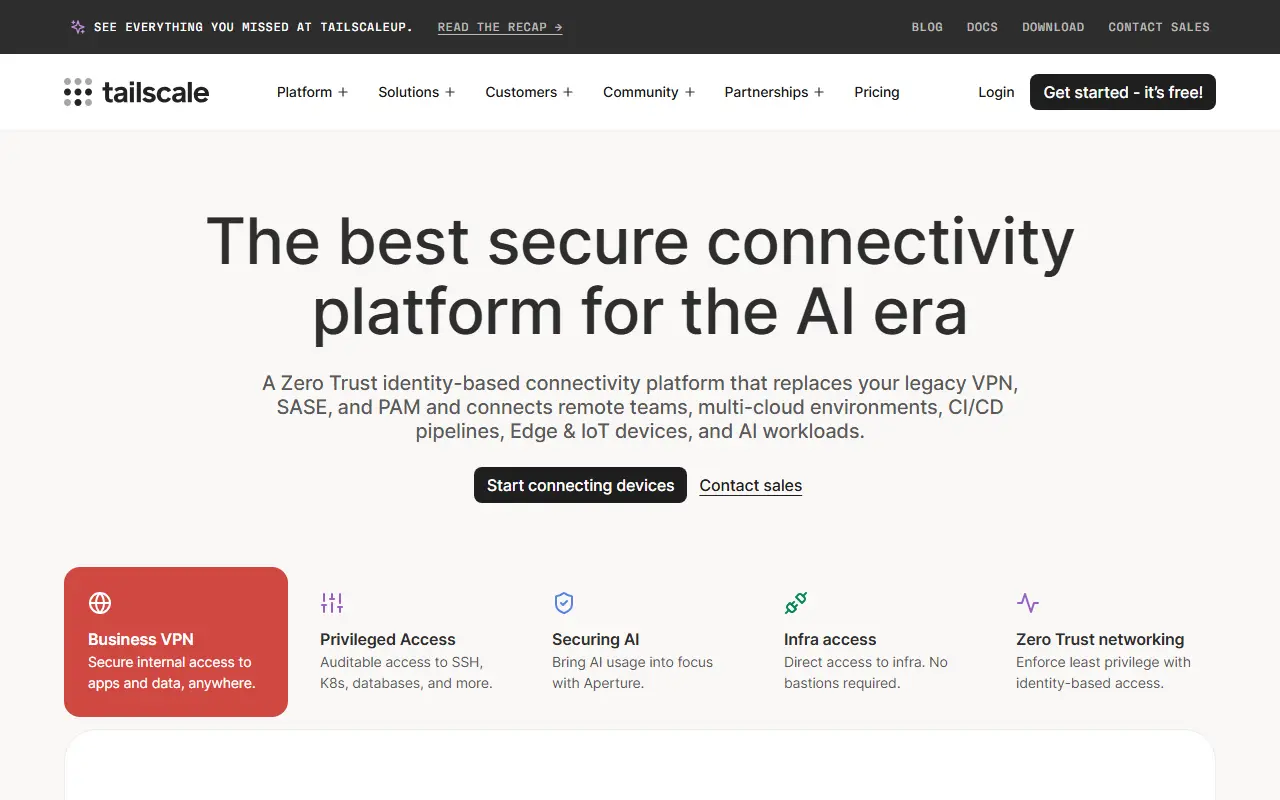
tailscale.comTailscale homepage screenshot

Tailscale makes private networks between devices using the WireGuard protocol, with sign-in handled by existing identity providers and two-factor authentication. The GitHub repository contains most of the company's open-source code, notably the tailscaled daemon and the tailscale command-line tool. It is published under the BSD-3-Clause license and written in Go.

The daemon runs on Linux, Windows and macOS, with partial support on FreeBSD and OpenBSD. The iOS and Android apps reuse this code, while the graphical wrappers for some non-open platforms are not open source, so the full product is a mix of open and proprietary parts. Packages for many distributions are served from the project's package site, and the code can be built from source with the latest Go release. The service itself is hosted by Tailscale.

Key features

  • WireGuard-based private device networking
  • tailscaled daemon and tailscale CLI
  • Sign-in through SSO and two-factor authentication
  • Clients for Linux, Windows, macOS, iOS and Android
  • Packages for Synology, QNAP and Debian-style distros
  • Client source code under BSD-3-Clause

Pricing: Personal is free forever for up to 6 users. Standard costs $8 and Premium $18 per user per month; Enterprise is custom and quoted through sales.

Kubernetes

An open-source system for deploying, scaling and managing containerized applications across clusters of hosts, hosted by the CNCF.

GitHub stars
129k
Last commit
yesterday
Latest release
v1.37.2
Licence
Apache-2.0
Self-hosted
Yes
Hosted version
Available
kubernetes.ioKubernetes homepage screenshot

Kubernetes, also written K8s, is an open-source system that manages containerized applications across multiple hosts. It provides the basic mechanisms for deploying, maintaining and scaling applications, so teams can run containers reliably without scheduling each one by hand. It is written in Go and released under the Apache-2.0 license.

The project builds on years of experience running production workloads at Google with an internal system called Borg, combined with practices from the wider community. The Cloud Native Computing Foundation hosts the project. Users interact with it through declarative configuration and the documentation on kubernetes.io, which includes tutorials and a free course on scalable microservices.

Kubernetes can be run on your own infrastructure, and major cloud providers also offer managed Kubernetes services. The README adds that the k8s.io/kubernetes module is not supported for use as a library. It suits platform and DevOps teams running microservices that need scheduling, scaling and automatic recovery.

Key features

  • Container scheduling across multiple hosts
  • Automated application deployment and rollouts
  • Scaling of containerized workloads
  • Maintenance and self-healing of applications
  • Declarative configuration of desired state
  • CNCF-hosted with extensive documentation

Pricing: Free and open source under the Apache-2.0 license; cloud providers sell managed services built on it.

Istio

Istio extends Kubernetes to establish a programmable, application-aware network, providing traffic management, telemetry, and security for complex deployments.

GitHub stars
39k
Last commit
yesterday
Latest release
1.32.0
Licence
Apache-2.0
Hosted version
Available
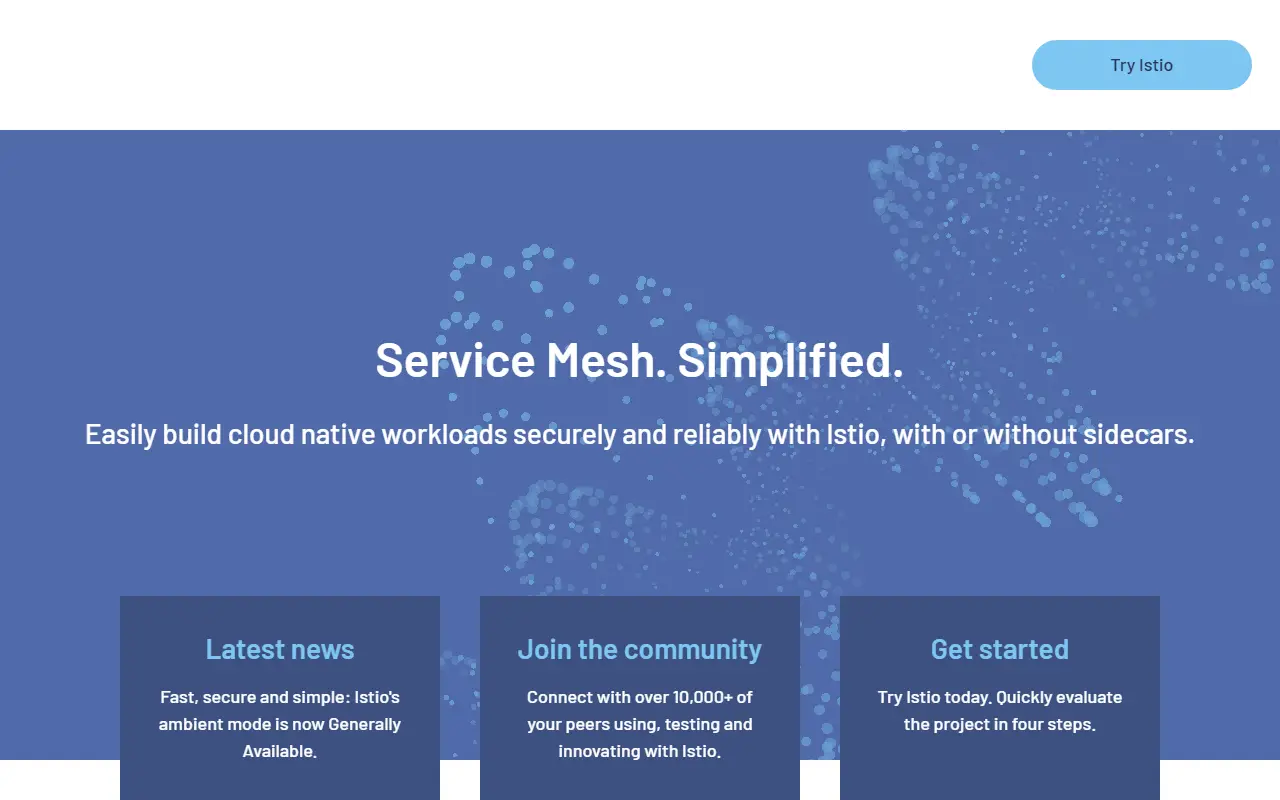
istio.ioIstio homepage screenshot

Istio is a service mesh that extends Kubernetes to create a programmable, application-aware network. It works with both Kubernetes and traditional workloads, bringing standard, universal traffic management, telemetry, and security to complex deployments.

The platform allows users to select features and deploys proxy infrastructure as needed, using a zero-trust tunnel for Layer 4 performance and security, or the Envoy service proxy for Layer 7 features. It is a Cloud Native Computing Foundation graduated project.

Key features

  • Service-to-service security including mTLS authentication, authorization, and encryption
  • Deep visibility into applications for observability and performance improvement
  • Consistent networking management for services without additional developer overhead
  • Support for ambient mode, now Generally Available
  • Deployable with or without sidecars
  • Installable by users, via Kubernetes or cloud provider one-click install, or through fully managed providers

Cilium

An eBPF-based networking, security and observability layer for cloud native and Kubernetes environments, covering container networking, policies and load balancing.

GitHub stars
26k
Last commit
today
Latest release
v1.20.4
Licence
Apache-2.0
Self-hosted
Yes
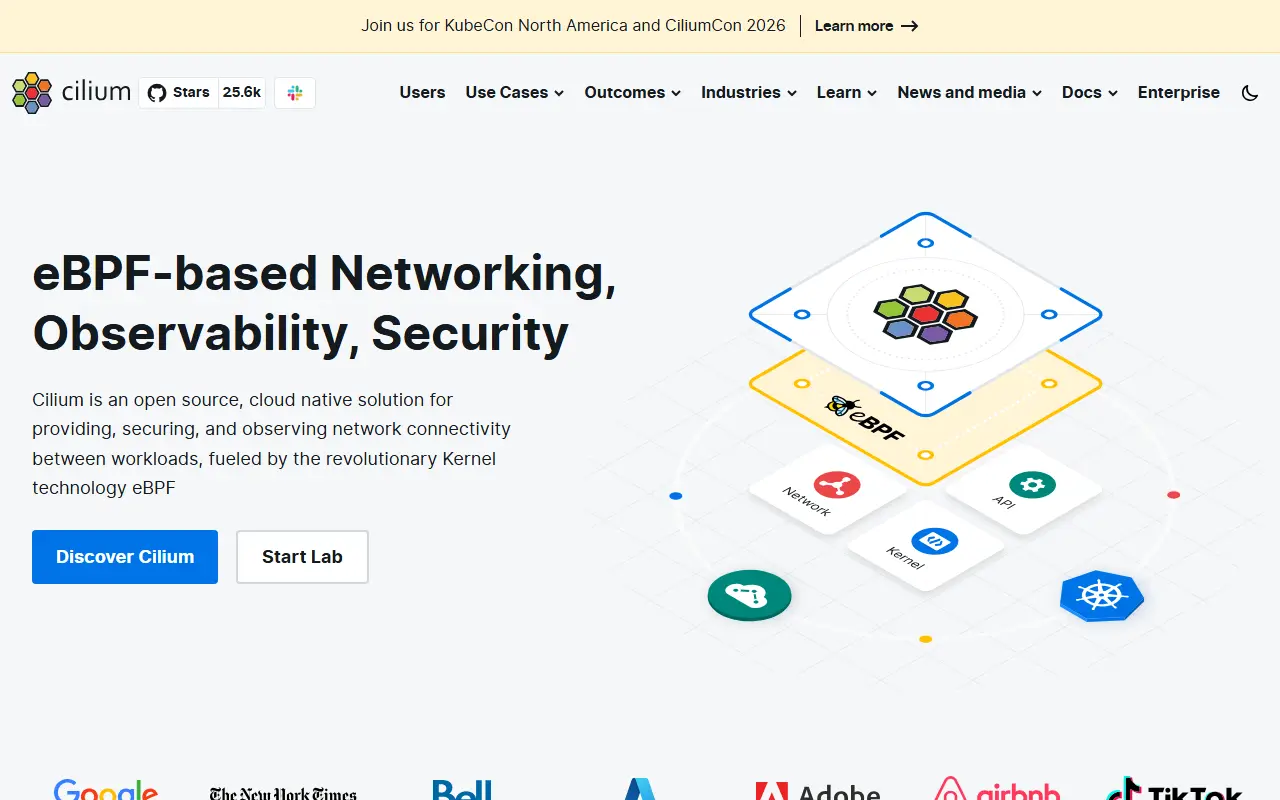
cilium.ioCilium homepage screenshot

Cilium is a cloud native project that uses eBPF, a technology that runs sandboxed programs inside the Linux kernel, to provide networking, security and observability for containerized workloads. It is most often deployed in Kubernetes clusters as the container network interface, replacing traditional iptables-based approaches.

Its topics show the breadth of the project: Kubernetes networking and CNI, load balancing, XDP, security, kernel-level monitoring and troubleshooting. Because policies and visibility are implemented in the kernel, it can enforce network rules and observe traffic between services with relatively low overhead. The project website describes it simply as cloud native, eBPF-based networking, observability and security.

Cilium is written in Go and Apache-2.0 licensed, and it runs on your own clusters rather than as a hosted service, though several cloud providers integrate it into managed Kubernetes. It suits platform and security teams that operate Kubernetes at scale and need fine-grained network policy plus insight into service-to-service traffic.

Key features

  • eBPF-powered Kubernetes networking
  • Network security policies
  • Kernel-level load balancing
  • Traffic observability and troubleshooting
  • XDP acceleration support
  • Container network interface plugin

Pricing: Free and open source under the Apache-2.0 license.

Consul

Consul is HashiCorp's service networking tool, providing service discovery, service mesh and secure service-to-service connectivity.

GitHub stars
30k
Last commit
yesterday
Latest release
v2.1.0
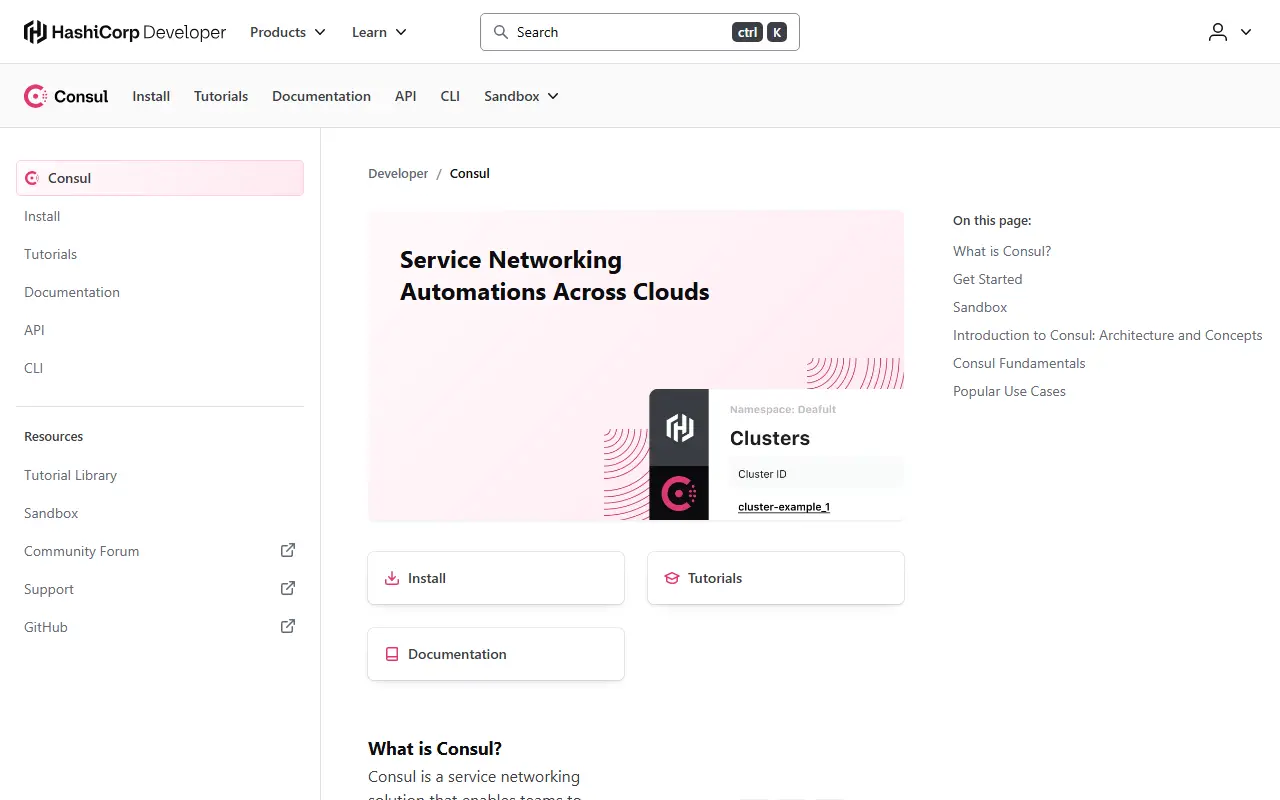
consul.ioConsul homepage screenshot

Consul is a service networking solution from HashiCorp for secure connectivity between services across on-premises, hybrid cloud and multi-cloud environments. It offers service discovery, service mesh, identity-based authorization, L7 traffic management and service-to-service encryption.

Its architecture has a control plane to register, access and secure services, and a data plane where gateways and sidecar proxies can handle traffic. A catalog API tracks registered services, and the Raft protocol keeps cluster state consistent. The site provides getting-started guides for VMs and Kubernetes and a sandbox with preinstalled tools.

The documentation covers concepts in separate pages: the catalog, cluster consensus and gossip communication, which agents use to manage membership in datacenters. Tutorials, an API reference and CLI documentation sit in the same developer portal. Consul appears next to Terraform, Vault, Nomad and Boundary in HashiCorp's product list, where it is described as the product for securing network services.

Key features

  • Service discovery and service mesh
  • Control plane for registering and securing services
  • Catalog API for registered services
  • Raft-based consistent cluster state
  • Hands-on sandbox

Calico

Kubernetes networking, network security and observability platform from Tigera, with an open-source edition alongside enterprise and cloud editions.

GitHub stars
7.4k
Last commit
yesterday
Latest release
v3.33.0
Licence
Apache-2.0
Hosted version
Available
docs.tigera.ioCalico homepage screenshot

Calico is described by its documentation as a single platform for networking, network security and observability on any Kubernetes distribution, whether that runs in the cloud, on-premises or at the edge. The pitch is one set of controls that stays the same across distributions, so workloads can move between them.

The product comes in three editions: Calico Open Source, Calico Enterprise (self-managed) and Calico Cloud (a fully managed SaaS). The documentation says everything is built on Calico Open Source. Several features in the overview are marked as Cloud only, among them cluster mesh, DNS policies, a web application firewall, a dynamic service graph, packet capture and analytics.

In the open-source edition the documented pieces include network policies, policy tiers and staged policies, WireGuard encryption for data in transit, an egress gateway and an ingress gateway built on the Kubernetes Gateway API, and a flow-log console called Calico Whisker. The networking guide compares overlay and non-overlay modes, BGP routing, CNI choices and IPAM modes.

Key features

  • Network policies for network and application traffic
  • WireGuard encryption for data in transit
  • Egress gateway with fixed, routable IPs
  • Flow logs in the Calico Whisker web console
  • Choice of overlay, BGP, CNI and IPAM options

Pricing: Calico Cloud has a Free Tier limited to observability and policy management for a single cluster. Calico Open Source, Enterprise and Cloud are the three editions; no prices are given in the sources.

ZeroTier

ZeroTier is a peer-to-peer virtual network that lets devices, VMs and containers communicate as if they were on the same local network.

GitHub stars
17k
Last commit
2 mo ago
Latest release
1.16.2
Self-hosted
Yes
Hosted version
Available
zerotier.comZeroTier homepage screenshot

ZeroTier describes itself as a programmable Ethernet switch for the planet. It lets networked devices, virtual machines, containers and applications communicate as if they were located in the same data center or cloud region, no matter where they actually are. The client is written in C++.

It combines an encrypted peer-to-peer network layer, called VL1, with an Ethernet emulation layer, called VL2, that works somewhat like VXLAN. The virtualization layer includes enterprise SDN features such as fine-grained access control rules for micro-segmentation and security monitoring. Traffic is encrypted end to end with keys the user controls, and most of it flows directly between peers, with free but slow relaying for cases where a direct connection cannot be made.

Android and iOS apps are available free of charge from the app stores. Most of the code sits under a Mozilla Public License file, while parts of the repository are marked as non-free, source-available code, which is why the repository lists the license as 'Other'. The vendor also offers a network controller, a service API and commercial support.

Key features

  • Peer-to-peer virtual Ethernet networking
  • End-to-end encrypted traffic
  • Access control rules for micro-segmentation
  • Relay fallback when direct links fail
  • Apps for Android and iOS
  • Network controller and service API

Pricing: Free Personal plan for 10 devices. Essential is $18 a month and Scale $179 a month, each with extra devices billed per device; Enterprise is custom.

Neutron

Neutron is the networking component of the OpenStack cloud platform.

GitHub stars
1.5k
Last commit
yesterday
Licence
Apache-2.0
Self-hosted
Yes
opendev.orgNeutron homepage screenshot

Neutron provides networking services for OpenStack clouds. It manages networks, subnets, and ports for virtual machines and other OpenStack resources.

Key features

  • Manages networks, subnets, and ports
  • Supports L3 routing and HA state file permissions
  • Includes BGP spine and leaf ansible roles
  • Integrates with OVN metadata
  • Provides OpenTelemetry tracing middleware

Commercial Illumio alternatives

Hosted, closed-source products that compete with Illumio. Showing 12 of 14.

See every Illumio alternative on its tool page

Illumio alternatives: questions

What is the best open-source alternative to Illumio?
Tailscale is the top-ranked open-source alternative to Illumio on Enlisted: Tailscale builds private WireGuard-based networks between your devices; this repository holds the open-source client daemon and CLI. Other strong options are Kubernetes, Istio, Cilium and Consul.
What are the best commercial alternatives to Illumio?
Palo Alto Networks, Check Point, Fortinet, Akamai and Google Memorystore are among the hosted, closed-source alternatives to Illumio listed on Enlisted, which lists 14 in total. Compare their pricing and features on each tool page.
Are these Illumio alternatives free?
All 8 are open source, so the code is free to use under its licence, and all of them can be self-hosted on your own server or computer. 5 also offer a paid or managed cloud version if you'd rather not host it yourself.
How is this list of Illumio alternatives ranked?
By a score built from GitHub stars, star growth over the last 30 days and how recently the code changed. 7 of these projects shipped code in the last 30 days. Data is refreshed daily, and nobody can pay to move up.

People also look for alternatives to…

View all